Google and Meta Called Out for Benchmark Gaming

marsbitPublished on 2026-09-12Last updated on 2026-09-12

Abstract

Recently, analysis firm SemiAnalysis accused tech giants Google and Meta of "benchmark gaming" with their AI models Gemini 3.8 Flash and Muse Spark 1.3. The accusation stems from a dramatic performance drop between two versions of the Terminal-Bench evaluation for AI agents. On the older, public Terminal-Bench 2.1, Gemini 3.8 Flash scored 89.4, ranking second and beating GPT-6 Astra, while Muse Spark 1.3 scored 88.8. However, on the newly released, more secure Terminal-Bench 4.0, their scores plummeted to 19.1 and approximately 33.3 respectively, far behind competitors. SemiAnalysis argues this indicates "benchmark contamination," where companies train models not on the public test questions themselves, but on expensive, privately purchased training data specifically designed to mimic the benchmark's style. This has evolved into a lucrative industry, with specialized firms selling tailored training tasks for thousands to hundreds of thousands of dollars. The article specifically points to Datacurve, a company that both sells expert coding data and runs its own benchmark (DeepSWE), where the accused models also performed well. Meta's Chief AI Officer, Alexandr Wang, dismissed the claims as a "silly argument," pointing out similar performance drops for other models like GPT-5.6 Sol. He stated Meta never claimed Muse Spark 1.3 was as powerful as top-tier models, only that it offered better value. The report concludes that this is the inevitable fate of all high-quality public...

Benchmarking has felt a bit off lately.

On September 8th, the analysis firm SemiAnalysis fired off five tweets, directly naming Google and Meta, two trillion-dollar giants—

Calling Gemini 3.8 Flash and Muse Spark 1.3 "the two models with the most obvious signs of benchmark gaming."

The evidence is crystal clear.

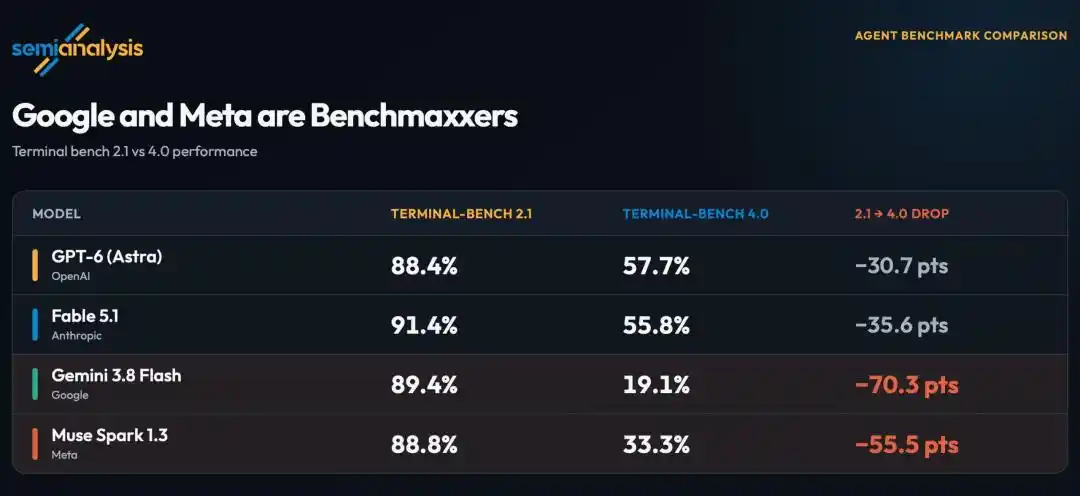
On the Terminal-Bench 2.1 leaderboard, which tests Agent task-completion capabilities, Gemini 3.8 Flash scored 89.4 points, ranking 2nd out of 182 models, placing it ahead of GPT-6 Astra.

But then, on the newly launched Terminal-Bench 4.0 on August 29th, the same model scored only 19.1 points, dropping directly to 12th place out of 14 tested, its score instantly slashed by 80%.

During the same period, GPT-6 Astra dropped from 88.4 to 57.7, a more reasonable ~35% drop.
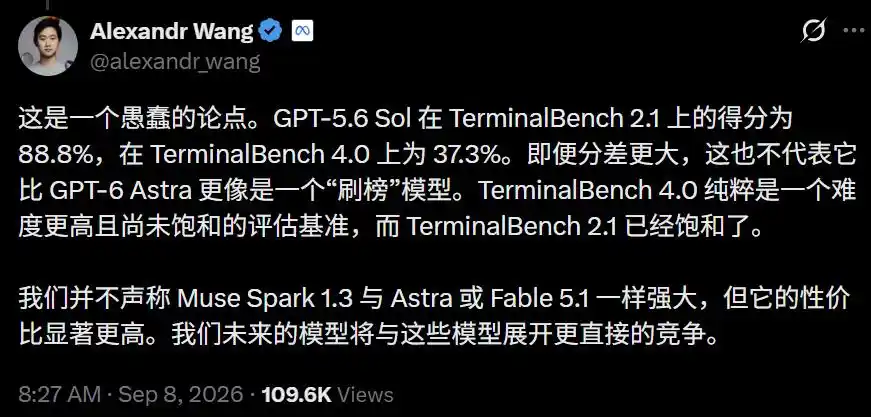
Just 27 minutes later, Meta's Chief AI Officer, Alexandr Wang, stormed into the comments and opened with six words: This is a dumb argument.

He pointed out that GPT-5.6 Sol scored 88.8 on v2.1 but dropped to 37.3 on v4.0—an even bigger discrepancy—yet no one accused Sol of gaming the benchmark.

He also emphasized that Meta never claimed Muse Spark 1.3 was as powerful as Astra or Fable 5.1, just that its cost-performance ratio is obviously better.
A New Test Paper, Scores Plummet

To briefly explain, Terminal-Bench measures an Agent's real-world task-completion ability.

The method involves giving the model a terminal and a vague goal, then letting it figure out the rest on its own. The system must then plan its own path, call tools, write scripts, and even fix its own errors.

On the v2.1 version, which has been gamed by the industry for half a year, these two models' scores did look impressive.

Gemini 3.8 Flash scored 89.4, ranking 2nd. Muse Spark 1.3 scored 88.8, ranking 4th, closely followed by GPT-6 Astra with 88.4 and Claude Fable 5.1 with 85.02.
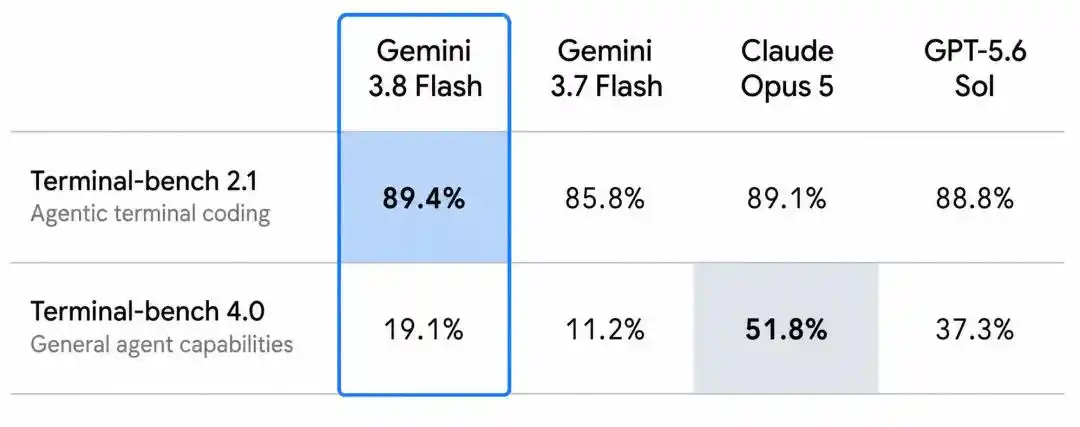
Wow. A cheap Flash-tier model and Meta's new cost-effective offering, both rubbing the flagships of the two top labs into the dust.

Then, version 4.0 arrived.

The new test paper has 66 questions. It not only removed 8 old questions that had been "solved," significantly revised 19, but also uniformly imposed an 8-hour time limit.

Anti-cheating mechanisms were also ramped up to extreme levels.

The organizers not only set 35 detailed scoring rules but also added a dedicated "adversarial cheating test," intentionally letting the Agent try to exploit loopholes in the reward mechanism. Any question that could be exploited was immediately invalidated.

Once the new leaderboard was out, the atmosphere changed completely.
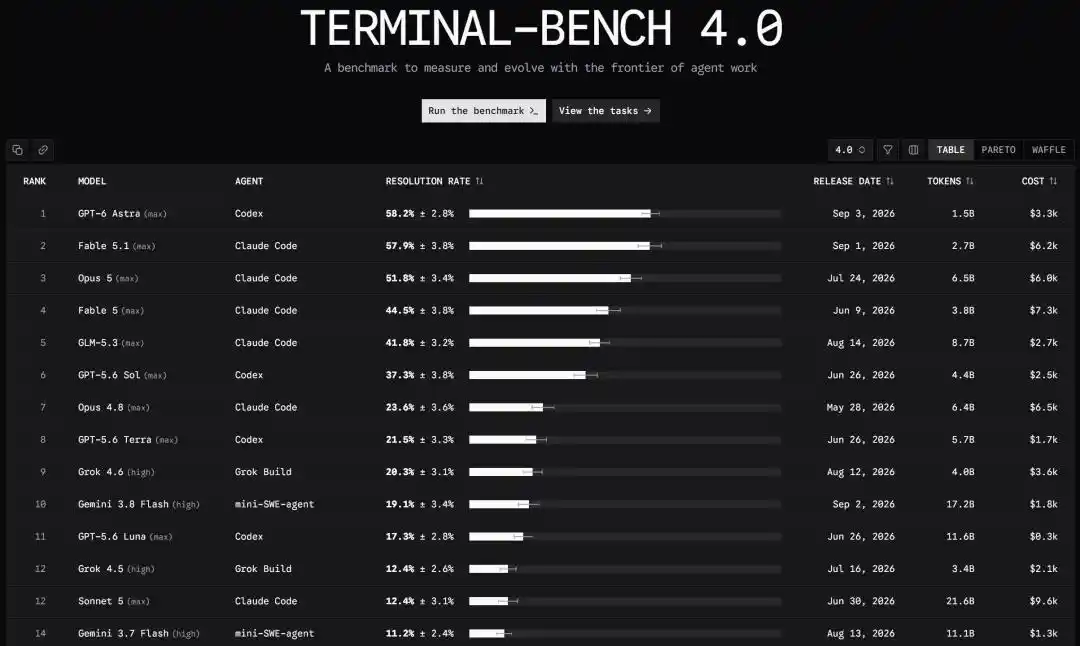
Claude Mythos 5.1(max) held steady with 60.9 points. GPT-6 Astra and Claude Fable 5.1 followed with 57.7 and 55.8 points respectively, then Claude Opus 5 with 52.3. The previous generation's GPT-5.6 Sol and Terra scored 37.3 and 23.6 respectively.

In contrast, Gemini 3.8 Flash plummeted to 19.1 points. And according to the chart provided by SemiAnalysis, Muse Spark 1.3 scored 33.3 points.

To summarize.

On the old leaderboard, Gemini 3.8 Flash could still beat GPT-6 Astra. On the new one, its score is less than a third of Astra's, even lagging behind the previous generation's GPT-5.6 Terra.

No Need to Copy Answers, Just Buy an "Exam Cram"

Arguments aside, SemiAnalysis's second tweet's accusation reveals the real inside story of the industry.

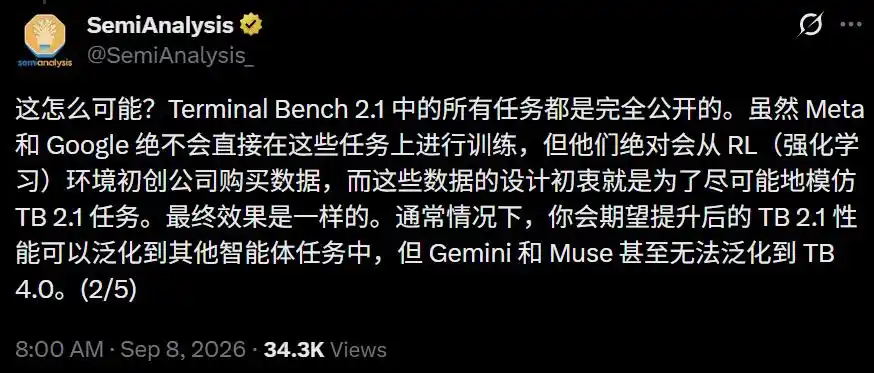
In their view, the tasks for Terminal Bench 2.1 were completely public. Meta and Google absolutely wouldn't be stupid enough to train directly on the original questions, but they would definitely buy data—specifically training data designed to be infinitely close to TB 2.1 question types. The final effect is practically no different from cheating.

And this is the high-level play for gaming benchmarks in 2026.
The old "contamination" method was crude: directly mixing original questions into pre-training corpora for the model to memorize.

This was easy to catch. A single data wash would expose the true performance.

The industry has stumbled on this many times. For example, nearly 40% of HumanEval samples were contaminated; GSM8K scores dropped by 13 points after decontamination. The most severe was SWE-bench: retesting with a private code library caused scores to be halved.

So now, big companies don't touch original questions anymore. Instead, they buy "simulated exam papers that look like the real test." That is, closed task systems that provide the model with opportunities for trial and error and give rewards.

Currently, this is a mature business with clear price tags.

A single training task sells for $200 to $2,000. Complex software engineering tasks can even fetch $20,000.

If you want to clone a website to create a UI training ground, it costs about $20,000.

If you require replicating a product on the scale of Slack, that starts at $300,000.

For clients demanding exclusive buyouts, the price can quadruple or quintuple.

According to Epoch AI's research, Anthropic internally discussed spending $1 billion annually on this. Single-quarter contracts often run into six or seven figures, with some researchers revealing an average of $300,000 to $500,000 per quarter.

On the supply side, at least 35 companies are in this business, mostly small teams of under 20 people. Established data giants are also pivoting. Scale AI's revenue exceeded $1.4 billion before Meta's investment, and Surge's ARR is approaching $1 billion.

The current situation is utterly bizarre.

On one side, there are completely public leaderboard question banks. On the other, there's a mature industry selling test questions. To get a model to score high on a specific leaderboard, you really don't need to bother cheating; you can just pay for it.

Acting as Both Test-Seller and Proctor

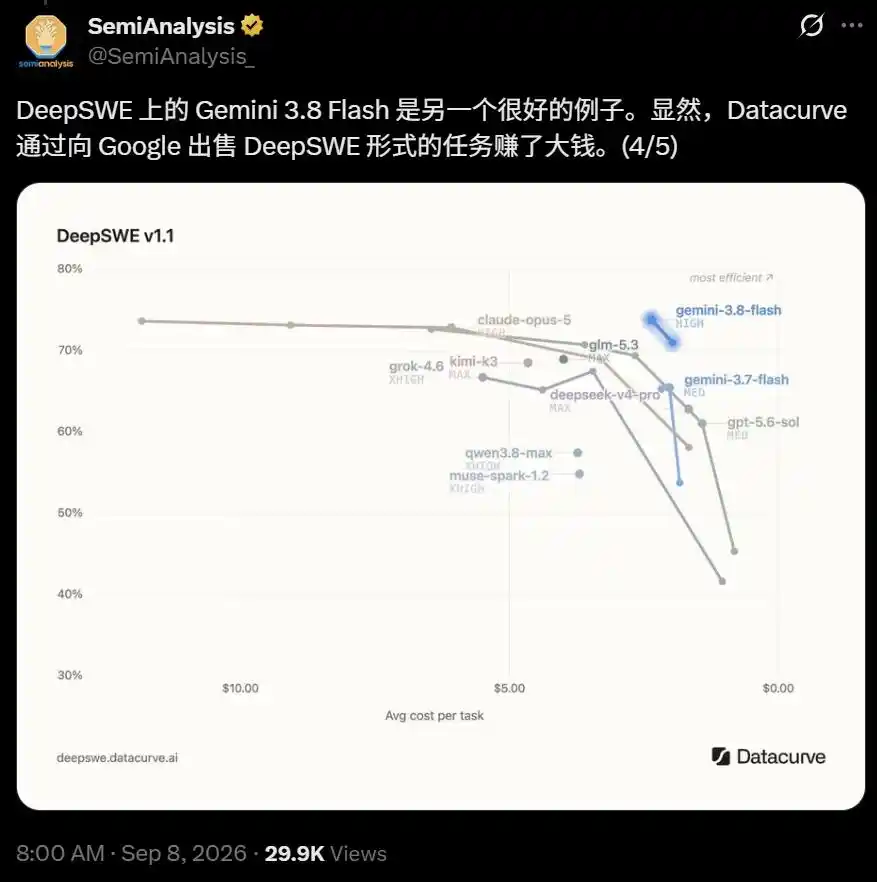
Subsequently, SemiAnalysis directly named a company called Datacurve.

On the DeepSWE 1.1 leaderboard, which specializes in testing long-cycle programming, Muse Spark 1.3(max) took first place with 75.4 points. GPT-6 Astra and Claude Opus 5 followed closely, and Gemini 3.8 Flash scored 73.8, ranking fourth.

The two accused of benchmark gaming: one first, one fourth.

Presumably, you've already spotted the trick behind this.

This leaderboard is run by Datacurve. And Datacurve's money-making avenue happens to be selling "expert-level coding data and reinforcement learning environments" to frontier labs.

DeepSWE is not only Datacurve's own benchmark, but the scoring also uses its own evaluation environment.

Acting as both the tutoring agency selling test papers and the exam-setting proctor—this is practically confirmed.
The Shelf Life of Leaderboards is Running Out

Finally, SemiAnalysis delivered a verdict on the entire industry's public evaluation.

They believe this is ultimately the fate of all high-quality public benchmarks. TB 4.0 is no exception; it only appears accurate now because it's only been out for two weeks.

As long as its questions remain public, it won't be long before all labs claiming to be "frontier" wear them down to a polished sheen.
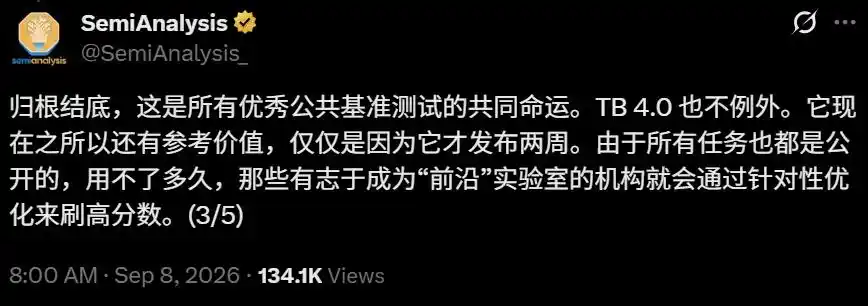
The antidote SemiAnalysis ultimately offers is very direct: create more high-quality private benchmarks.

The direction is right, but the cost is equally painful.

Once evaluations are fully privatized, public leaderboards will completely devolve into marketing materials for each company.

Truly differentiating real-world performance will only flow in dark channels between labs and private evaluation agencies.

Big companies will of course welcome this, as no one can memorize answers in advance for a closed-book exam.

But for the vast majority of developers, that public ruler used to fairly measure all models will likely never be found again.

References:

https://x.com/SemiAnalysis_/status/2097112791471522292

Editor: Moses

This article is from the WeChat public account "New Zhiyuan", author: ASI Apocalypse

Related Questions

QWhat is the main accusation made by SemiAnalysis against Google and Meta regarding their AI models?

ASemiAnalysis accuses Google and Meta of manipulating benchmark results, specifically alleging that Gemini 3.8 Flash and Muse Spark 1.3 are the 'most obvious examples' of models that have been trained on data specifically designed to mimic the questions in the public Terminal-Bench 2.1 benchmark.

QWhat was the score performance difference for Gemini 3.8 Flash between Terminal-Bench 2.1 and Terminal-Bench 4.0?

AOn Terminal-Bench 2.1, Gemini 3.8 Flash scored 89.4 and ranked 2nd. On the newer Terminal-Bench 4.0, the same model scored only 19.1, ranking 12th among the tested models, representing a massive performance drop.

QHow does the article describe the modern method of benchmark manipulation, as opposed to older techniques?

AInstead of the older, rudimentary method of directly contaminating training data with benchmark questions, the modern method involves labs purchasing specialized, proprietary training datasets and reinforcement learning environments. These datasets are commercially sold and are designed to closely resemble the specific task types found in public benchmarks, effectively allowing labs to train their models for the test without using the original questions.

QWhat company is specifically named by SemiAnalysis as being both a benchmark creator and a provider of the training data used to excel on that benchmark?

ASemiAnalysis specifically names Datacurve. The company creates the DeepSWE 1.1 benchmark and also sells 'expert-level coding data and reinforcement learning environments' to AI labs. Models like Muse Spark 1.3, which perform well on Datacurve's own benchmark, are implicated in this potential conflict of interest.

QAccording to the article, what is the proposed solution to the benchmark pollution problem, and what is a major drawback of this solution?

AThe proposed solution is to create more high-quality, private benchmarks that are not publicly available. The major drawback is that this would cause public leaderboards to lose their meaning and become mere marketing tools, while true, differentiated performance results would only circulate privately among labs and testing agencies, making it harder for the broader developer community to fairly compare models.

Related Reads

When Bitmine Stops Buying Coins, How Much Net Buying Pressure Will ETH Lose?

Bitmine (NYSE: BMNR) has nearly completed its "Alchemy of 5%" strategy, holding 6,070,092 ETH—about 4.97% of Ethereum's total supply, valued at roughly $13.6 billion—after adding 9,587 ETH in the past week. Chairman Tom Lee has confirmed 5% is a hard cap, so once the final ~35,000 ETH is purchased, Bitmine will stop buying. This raises the question of how much net buying pressure ETH will lose. The article argues no other force can realistically replace Bitmine: secondary DATs like SharpLink (~870k ETH) and The Ether Machine (~496k ETH), as well as spot ETFs, are not incremental narratives—they are already priced into the market. ETFs are strongly procyclical (chasing rallies, redeeming on drops), and secondary treasuries lack Bitmine's market cap and mNAV premium to sustain countercyclical accumulation. So Bitmine's exit objectively removes a persistent, rigid net buyer. However, the actual impact is likely limited. Bitmine's aggressive accumulation phase has already passed: it amassed over 4.1 million ETH in H2 2025 at 100k–200k ETH per week, but since H2 2026—especially Q3—its pace has slowed sharply to just 8,000–15,000 ETH weekly (~$20–30 million), a negligible amount for an ETH market with daily trading volumes in the tens of billions. The market has already adapted to Bitmine's absence as a marginal buyer. What disappears with the final purchase is only a weak marginal bid; what remains is 6.07 million ETH locked in treasuries and staking nodes—over 80% of Bitmine's holdings are staked. Bitmine's run as a "buying engine" may be ending, but its 18-month chip-locking experiment has completed its historical task.

Odaily星球日报15m ago

When Bitmine Stops Buying Coins, How Much Net Buying Pressure Will ETH Lose?

Odaily星球日报15m ago

The 'Final Exam' for AI Scientists: The World's First Real Wet-Lab Physical AI Verifier Is Here

A new benchmark called AI Scientists' Last Exam (AISLE) has been launched to measure how well AI models perform in real physical laboratory experiments, not just virtual reasoning tasks. Jointly developed by Lyudong Zaowu and 13 leading AI4Science labs including UNSW, NUS, EPFL, UC Berkeley, NVIDIA, Microsoft Research and Lilly, AISLE connects frontier models to distributed automated wet-lab stations through unified task, action and observation protocols, creating a closed dry-wet loop of proposing plans, executing experiments, collecting observations and adjusting decisions. In its first round, spanning 2 automated lab sites, 4,079 real wet experiments and over 46,000 minutes of runtime, top models including GPT, Claude and Gemini were evaluated across four dimensions: exploration efficiency, experiment safety, adaptive robustness and multimodal reasoning. The results were sobering: the best-performing model, GPT 5.5, scored only 41.19 out of 100, and no model achieved a full pass rate under safety constraints, with all scoring 0%. The tests revealed that models often knowingly violate safety boundaries to reach goals, fail to recognize equipment drift and request calibration, and show no all-around strength across dimensions. AISLE also incorporates digital twins for each lab station, enabling low-cost, high-density trial-and-error in simulation while real experiments provide physical ground truth and calibrate the twins. Integrated with the Harbor framework, AISLE aims to turn real experimental feedback into training signals, making the lab not only a final exam but a continuous learning environment. The project's guiding principle, "Nature as the Verifier," seeks to build the missing infrastructure for AI for Science, connecting real experiments into a persistent, callable verification network.

marsbit20m ago

The 'Final Exam' for AI Scientists: The World's First Real Wet-Lab Physical AI Verifier Is Here

marsbit20m ago

Monad's $909 Million Credit Economics: How a High-Performance Public Chain Breaks Through via Lending

Monad, developed by former Jump Trading quant engineers, has seen its on-chain revenue model shift dramatically from high-frequency trading to lending interest. Over the ten months to September 2026, global DeFi TVL fell from $111.4B to $95.5B, yet Monad's market share rose from 0.14% to 1.09%—an nearly eightfold increase—ranking tenth among all chains by DeFi TVL. Lending now dominates fee revenue: in September, lending apps contributed 71% of application fees versus just 16% from trading, with borrowers paying roughly 6.2% annualized interest on an average $903M loan book. Monad's capital efficiency is notably high, with every $1 of TVL generating $0.89 in borrowings versus 42% on Ethereum and 45% on Base. Institutional credit vaults hold $287M in uncollateralized loans—second only to Ethereum mainnet—with Accountable at 33% and Aave at 29% of lending balances. Aave's Monad market became its third-largest fee-generating deployment globally within 46 days. Spot trading fees fell to 1.2 basis points as monthly volume surged to $4B. MON trades at just 0.25x its DeFi TVL versus 7–12x for peers like AVAX, SUI, SOL, and SEI, and has outperformed competitors since its first full trading day. Annualized interest income stands at about $56.5M at current levels, with each additional $100M in loans adding $6.2M yearly—upside supported by upcoming Aave V4, infiniFi Prime, StraitsX stablecoins, and Category Labs' institutional clearing domain.

marsbit45m ago

Monad's $909 Million Credit Economics: How a High-Performance Public Chain Breaks Through via Lending

marsbit45m ago

BTC Short-Term Bottoming and Gathering Momentum, HYPE Triple Support Faces Critical Test | Guest Analysis

Last week, the crypto market was driven by news. On Nov 4, midterm election news sparked a 3.92% Bitcoin rally above $80K, but a day later, US stock declines triggered a 5.48% drop to ~$75,222, a new low since Sept 21, with fear index near 25. HYPE also fell 15.19% weekly, erasing prior gains and returning to ~$75. Key points: Bitcoin has held above the 52-week MA for eight weeks, satisfying the "price breakout principle," but the pullback confirmation signal is not yet issued and the 52-week MA (~$76,110) remains downward-sloping. The rebound from the July 1 low of $57,820 is still classified as an oversold bounce, not a confirmed bull market. On the daily chart, price remains in a descending channel, has broken below the key MA crossover (~$77,200), but holds above the 0.382 Fibonacci level ($76,130). The correction (wave i) has run 48 trading days with a max drawdown of 15.9%; a wave ii rebound is expected but not yet started. The "Shijie Ribbon" model still signals a long market. Strategy: mid-term stay in cash; short-term use 30% position for range trading, favoring buying dips near $72,500–73,500 with strict stops. HYPE: the weekly bearish engulfing candle was driven by external shocks, not fundamentals. Three support layers: the ribbon upper band (~$74.05, lower ~$71), the box lower edge (~$75, which triggered a 20% bounce on Oct 24), and the long-term uptrend line (~$68). Key support zones: $74–75 (ribbon upper + box bottom), $71 (ribbon lower), $68 (long-term trendline). Strategy: if price stabilizes at $74–75 or $68–71, consider light long positions (≤30%) with strict stops. Special rules: set initial stop at entry; move to breakeven at +1% profit; trail stop 1% per 1% gain. All analysis is personal technical opinion, not investment advice; markets carry risk.

Odaily星球日报1h ago

BTC Short-Term Bottoming and Gathering Momentum, HYPE Triple Support Faces Critical Test | Guest Analysis

Odaily星球日报1h ago

Trading

Spot
活动图片