From the 'Babson Break' to AI and Meme Coins: A Global Bubble Driven by FOMO Is Taking Shape

marsbitPublié le 2025-12-18Dernière mise à jour le 2025-12-18

Résumé

The article draws a parallel between the 1929 "Babson Break" and current warnings about an AI bubble, suggesting a global FOMO-driven speculative mania is forming across multiple asset classes. It highlights concerns over unsustainable valuations in AI tech companies, where massive data center investments (projected near $1.6 trillion annually by 2030) are fueled by hype around unproven AGI capabilities. Beyond AI, bubbles are identified in gold, government bonds, private credit (dubbed "crap loans"), and particularly meme coins like TRUMP and MELANIA, which saw values plummet over 88%. The author argues speculative frenzy is amplified by social media, creating a global "attention economy" where collective obsession—from AI to pop culture trends—drives synchronized global market movements. While tech giants may withstand the AI investment rush, risky leverage by newer players and opaque financing structures (like SPVs buying Nvidia chips) raise systemic concerns. Experts warn that a collapse in AI or crypto could trigger a global crisis, emphasizing that productive eras historically follow only after speculative excesses are disciplined by regulation.

Two months before the stock market crash of "Black Monday" that triggered the Great Depression, an economist from Massachusetts named Roger Babson was deeply concerned about the frenzy of retail investors borrowing money to speculate in stocks. In a speech, he declared, "Sooner or later, a crash is coming, and it may be terrific." The market immediately fell by 3%, a drop that became known as the "Babson Break." But as Andrew Ross Sorkin writes in his captivating new book, "1929: The Inside Story of Wall Street's Worst Crash and How It Destroyed a Nation," in the following weeks, "the market shook off Babson's ominous prediction," partly due to optimistic expectations for new mass consumer goods like radios and cars. "Imaginative' investors once again gained the upper hand."

Today, there are many such "prophets of doom" like Babson warning of risks in the artificial intelligence (AI) sector, particularly regarding the valuations of public and private tech companies and their blind pursuit of the elusive goal of Artificial General Intelligence (AGI) — systems that can perform almost all human tasks, even surpassing human capabilities. Data from analytics firm Omdia shows that by 2030, tech companies will be spending nearly $1.6 trillion annually on data centers. The hype surrounding AI is immense, but its prospects as a profit-generating tool remain entirely hypothetical, leaving many clear-headed investors perplexed. Yet, just like a century ago, a "fear of missing out on the next big thing" mindset is driving many companies to ignore these "doomsday prophecies." Advait Arun, an analyst for climate finance and energy infrastructure at the Center for Public Enterprise, stated: "These companies are playing a game of 'Mad Libs,' believing these bold technologies can solve all existing problems." He recently published a report in the vein of Babson's views titled "It's a Bubble or It's Nothing," questioning the financing schemes behind data center projects and noting, "We are undoubtedly still in a phase of irrational exuberance."

Tech stocks have been soaring:
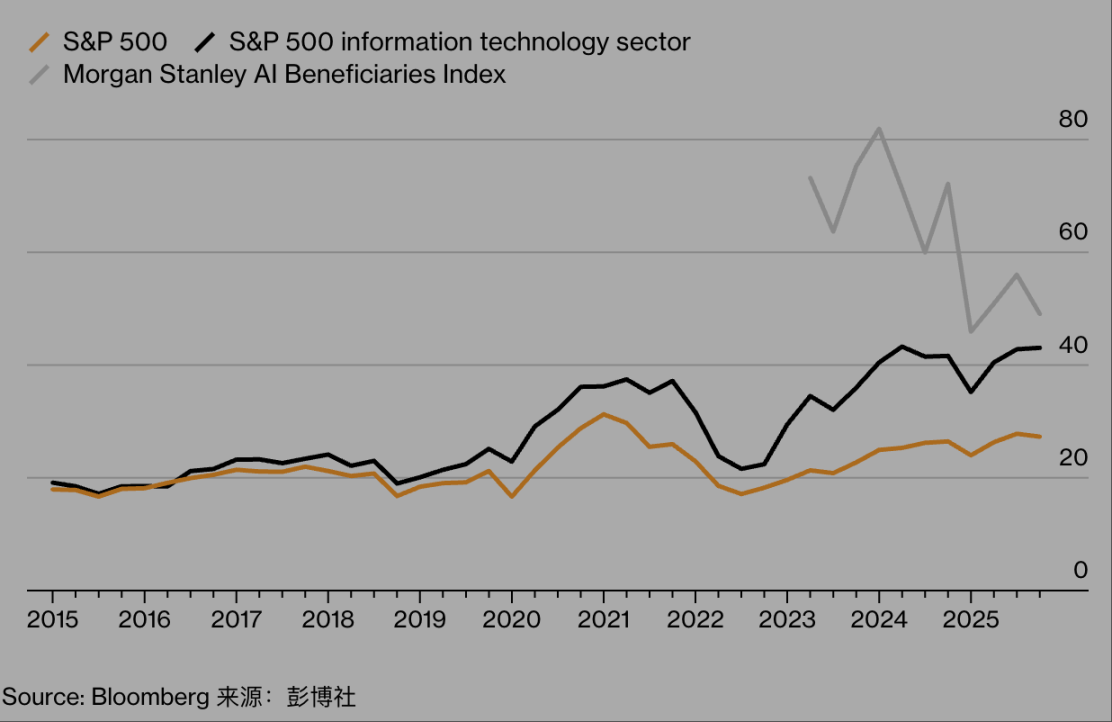
Source: Bloomberg

(This chart uses three index lines (S&P 500, S&P 500 Information Technology Sector, Morgan Stanley AI Beneficiaries Index) to show the process in US stocks from 2015 to 2025 where AI-related concept stocks first surged significantly on hype, then fell back as the bubble receded, diverging from the trends of the broader market and traditional tech sectors, reflecting the speculative frenzy and retreat risks in the AI field.)

Journalists should generally avoid arguing whether a particular resource or technology is overvalued. I don't have a strong stance on whether we are in an "AI bubble," but I suspect the question itself might be too narrow. If we define a "speculative bubble" as "an unsustainable rise in the value of an asset detached from its determinable fundamentals," then looking around, bubbles seem to be almost everywhere, and they appear to be inflating and contracting in sync.

World Economic Forum CEO Børge Brende pointed out that bubbles may exist in gold and government bonds. He recently stated that overall national debt levels haven't been this severe since World War II; and as of December 12th, gold prices had surged nearly 64% in a year. Many financial practitioners believe a bubble also exists in the private credit sector. This market, worth $3 trillion, involves large investment institutions providing loans (many for building AI data centers) and operates outside the constraints of the strictly regulated commercial banking system. Jeffrey Gundlach, founder and CEO of asset management firm DoubleLine Capital, recently called this opaque, unregulated, chaotic lending phenomenon "junk loans" on Bloomberg's "Odd Lots" podcast; JPMorgan Chase CEO Jamie Dimon referred to it as a "fuse for a financial crisis."

The most absurd phenomena occur in areas where "intrinsic value is difficult to judge." For example, from the beginning of the year to October 6th, the total market capitalization of BTC increased by $636 billion, but by December 12th, not only had all those gains been erased, but it had fallen even further. According to data from cryptocurrency media company Blockworks, the trading volume of "Meme coins," virtual currencies commemorating internet trends, peaked at $170 billion in January but plummeted to $19 billion by September. Leading the decline were TRUMP and MELANIA — coins launched by the US First Family two days before the presidential inauguration, which have fallen 88% and 99% in value since January 19th, respectively.

Many investors evaluating these cryptocurrencies do not focus on their potential to create intrinsic value for shareholders and society (as one would when assessing a traditional company's stock that reports profits), but rather solely attracted by the opportunity to "quickly make a lot of money." Their attitude towards cryptocurrencies is purely speculative, like joining a craps table during a trip to Las Vegas.

There might be demographic reasons behind investors (especially those attracted to cryptocurrencies, sports betting, and online prediction markets) trying to "manipulate" financial markets like a casino. A recent survey by Harris Poll showed that 60% of Americans today desire to amass huge wealth; among Gen Z and Millennial respondents, 70% said they want to be billionaires, compared to only 51% among Gen X and Baby Boomers. A study last year by financial firm Empower found that Gen Z believes "financial success" requires an annual salary of nearly $600,000 and a net worth of $10 million.

Thanks to TikTok videos, group chats, Reddit, and the "instant and unavoidable" nature of the internet, people around the world can now learn about money-making opportunities simultaneously. In principle, this seems fine, but in practice, it triggers imitation frenzies, fierce competition, and "groupthink" — a phenomenon that makes the new Apple TV+ series "Pluribus" particularly timely. The traditional economy, with its complex and diverse dimensions, has been replaced by the "attention economy": what is collectively obsessed over by everyone globally at any given moment.

In the business world, the focus of this "collective obsession" is AI; in pop culture, following "Pedro Pascal fever," there's "Sydney Sweeney fever," and "6-7 fever" (if you don't have teenagers at home, try Googling it). Over the past year, thanks to celebrities like BLACKPINK member Lisa, the "cute but practically worthless animal-shaped plush toys" launched by Chinese toymaker Pop Mart International Group have become a global craze, which we might call "Labubble" (referring to Labubu fever).

There's also a clear "protein bubble" in the food sector: from popcorn makers to breakfast cereal producers, everyone is promoting the "protein content" of their products to attract health-conscious consumers and GLP-1 (a blood sugar-lowering drug often used for weight loss) users. In the media sector, there might be bubbles in Substack newsletters, podcasts hosted by celebrities (like Amy Poehler's "Say More" and Meghan Markle's "Archetypes"), and the almost weekly release of "authorized celebrity documentary biopics" (Netflix's latest include: "Being Eddie" about Eddie Murphy and a biopic about Victoria Beckham). W. David Marx, author of "Status and Culture: How Our Desire for Social Rank Creates Taste, Identity, Art, Fashion, and Constant Change," said: "Today, everyone's 'reference group' is global, far beyond their immediate surroundings and surpassing their actual class and status. In these markets, 'globally synchronized movements' that were absolutely impossible in the past can occur."

Of course, the risks in the AI field are far higher than those related to "Labubu fever" products. No company wants to fall behind, so all industry giants are pushing forward, building computing infrastructure through "complex financing arrangements." In some cases, this involves "special purpose vehicles" (remember those from the 2008 financial crisis?) — entities that take on debt to purchase graphics processing units (AI chips) from Nvidia, which some observers believe could depreciate faster than expected.

Tech giants have the capacity to withstand any consequences of this "FOMO-induced frenzy": they primarily rely on strong balance sheets to pay for data centers, and can handle it even if white-collar workers widely believe "the current version of ChatGPT is sufficient for writing annual self-evaluations." But other companies are taking riskier moves. Oracle — a conservative database provider unlikely to be a challenger in the AI boom — is raising $38 billion in debt to build data centers in Texas and Wisconsin.

Other so-called "new cloud providers" (like relatively young companies such as CoreWeave and Fluidstack) are building specialized data centers for AI, Bitcoin mining, and other uses, and they are also borrowing heavily. At this point, the "cumulative impact" of the AI bubble begins to look increasingly severe. Gil Luria, Managing Director at investment firm D.A. Davidson & Co., echoing Roger Babson from a century ago, said: "When some institutions borrow money to build multi-billion dollar data centers without even having real customers, I start to worry. Lending for speculative investments has never been wise."

Carlota Perez, a British-Venezuelan researcher who has studied economic boom and bust cycles for decades, is also concerned. She points out that technological innovation is being transformed into high-risk speculation within a "over-leveraged, fragile, casino-like economy where bubbles burst once doubts spread." She wrote in an email: "If the AI and cryptocurrency sectors crash, it could trigger a global crisis of unimaginable scale. Historically, truly productive golden ages only arrive when the financial sector pays for its own actions (rather than being consistently bailed out) and society constrains it through proper regulation." Until then, hold tight to your Labubu plush toy.


Questions liées

QWhat historical event and figure does the article use as a parallel to the current AI investment frenzy, and what was the initial market reaction?

AThe article uses the 1929 stock market crash and the economist Roger Babson as a parallel. Babson warned of an impending crash, which initially caused a 3% market drop, an event known as the 'Babson Break.' However, the market soon recovered as optimistic investors took over.

QAccording to the article, what is the primary driver causing companies to ignore warnings about an AI bubble?

AThe primary driver is the 'Fear Of Missing Out' (FOMO) on the next big opportunity. This mindset, similar to a century ago, pushes companies to invest heavily despite the risks and unproven profitability of AI as a tool.

QBeyond AI, what other areas does the article identify as potential speculative bubbles?

AThe article identifies several other potential bubbles, including gold and government bonds (due to high global debt), the $3 trillion private credit market (called 'crap loans'), and the extreme volatility in cryptocurrencies and meme coins like TRUMP and MELANIA.

QWhat demographic trend does the article suggest is fueling the desire to treat financial markets like a casino?

AThe article cites a demographic trend where a significant majority of younger generations (70% of Gen Z and Millennials) aspire to become billionaires, compared to 51% of Gen X and Baby Boomers. This desire for immense wealth fuels speculative behavior in crypto, sports betting, and online prediction markets.

QWhat is the 'cumulative impact' of the AI bubble that the article suggests is becoming increasingly severe?

AThe 'cumulative impact' is the massive, and often risky, debt being taken on by companies to build AI infrastructure. This includes established giants and new 'cloud providers' borrowing billions, sometimes without confirmed customers, creating a fragile, over-leveraged system that could lead to a severe crisis if the bubble bursts.

Lectures associées

Trading

Spot
Futures

Articles tendance

Qu'est ce que MEME 2.0

Memecoin 2.0 : L'Ascension de $MEME 2.0 dans le Monde de la Cryptomonnaie Introduction Dans le paysage en constante évolution de la cryptomonnaie, un nouveau concurrent a émergé. Memecoin 2.0, symbolisé par $MEME 2.0, porte le concept des meme coins à un niveau excitant. En tant que produit dérivé du Memecoin original, ce projet a captivé l'attention de la communauté crypto en déplaçant l'accent des incitations financières typiques vers une expérience engageante et divertissante. Fonctionnant sur la blockchain Ethereum, Memecoin 2.0 redéfinit audacieusement l'engagement communautaire dans la sphère crypto. Qu'est-ce que Memecoin 2.0, $MEME 2.0 ? Au cœur de Memecoin 2.0 se trouve un projet de cryptomonnaie qui privilégie l'esprit communautaire et le plaisir associé à la culture des memes. Contrairement aux cryptomonnaies conventionnelles, qui se concentrent sur des cas d'utilisation pratiques et des avantages tangibles, Memecoin 2.0 se distingue en adoptant le côté léger de la monnaie numérique. Le projet existe sans promesses d'utilité, de feuille de route structurée ou de rendements financiers, se concentrant plutôt sur le développement d'une communauté dynamique centrée sur les memes et le plaisir partagé. Ce faisant, il s'inscrit dans la tendance croissante de la culture meme dans l'espace en ligne, en faisant un acteur unique dans le monde des actifs numériques. Créateur de Memecoin 2.0, $MEME 2.0 Malgré des recherches approfondies sur les origines de Memecoin 2.0, l'identité explicite de son créateur demeure inconnue. Cette anonymat n'est pas rare dans la communauté crypto, où de nombreux projets sont dirigés par des individus ou des groupes qui préfèrent rester dans l'ombre. Le manque d'informations accessibles au public sur le créateur pourrait être perçu comme un mouvement stratégique, mettant l'accent sur l'engagement communautaire plutôt que sur la notoriété individuelle dans l'espace. Investisseurs de Memecoin 2.0, $MEME 2.0 Les informations concernant les investisseurs ou le soutien financier de Memecoin 2.0 sont rares. Cette absence de détails peut suggérer que le projet est soit autofinancé, soit que son accent sur la communauté plutôt que sur les structures d'investissement traditionnelles a attiré un type de soutien différent. Étant donné que le monde des meme coins implique généralement un engagement plus de base plutôt que des investissements institutionnels, cette approche s'aligne sur l'éthique des projets dirigés par la communauté. Comment fonctionne Memecoin 2.0, $MEME 2.0 ? Memecoin 2.0 fonctionne entièrement sur la blockchain Ethereum, capitalisant sur ses caractéristiques de sécurité robustes et sa scalabilité. En tirant parti des forces d'Ethereum, Memecoin 2.0 peut offrir un environnement sécurisé pour les interactions des utilisateurs tout en garantissant que les transactions sont à la fois efficaces et rentables. Un des attributs uniques de Memecoin 2.0 réside dans sa structure axée sur la communauté. La valeur et la popularité du jeton $MEME 2.0 découlent de la participation active de ses utilisateurs, plutôt que d'une utilité inhérente. Ce design renforce l'accent mis par le projet sur l'aspect divertissant de la cryptomonnaie, impliquant que le rire et l'engagement communautaire sont les véritables devises qui guident son succès. De plus, le projet s'inscrit dans l'écosystème plus large des meme coins, où la valeur de chaque meme coin oscille en fonction de la culture, des tendances et de l'implication de la communauté plutôt que sur des principes économiques traditionnels. Chronologie de Memecoin 2.0, $MEME 2.0 Pour mieux comprendre l'évolution et les étapes marquantes de Memecoin 2.0, voici une chronologie mettant en évidence des événements significatifs de son histoire : 2024 : La création de Memecoin 2.0 est reconnue comme un découlement du Memecoin original, s'établissant dans le contexte florissant des meme coins tout en opérant sur la blockchain Ethereum. 13 Juillet 2024 : Memecoin 2.0 se positionne officiellement comme un meme coin centré sur la communauté sur le réseau Ethereum, soulignant son approche axée sur le divertissement qui invite les utilisateurs à s'engager et à participer à sa croissance. Points Clés sur Memecoin 2.0, $MEME 2.0 Plusieurs caractéristiques critiques définissent Memecoin 2.0 : Approche Axée sur la Communauté : La mission principale de Memecoin 2.0 est de créer une expérience communautaire amusante et engageante, capitalisant sur le plaisir collectif dérivé de la culture mémétique. Bâti sur Ethereum : Opérer sur la blockchain Ethereum procure au projet une infrastructure essentielle qui assure sécurité et scalabilité. Absence d'Utilité ou de Feuille de Route : Dans un départ frappant par rapport aux cryptomonnaies traditionnelles, Memecoin 2.0 ne promet aucune caractéristique utilitaire ou rendement financier, réaffirmant son engagement envers l'implication communautaire et l'engagement social. Accent sur la Culture Mémétique : En embrassant les aspects humoristiques et culturels du phénomène meme, Memecoin 2.0 fournit une plateforme permettant aux utilisateurs de s'engager avec la crypto hors ligne et en ligne. Contexte Supplémentaire : La Signification des Meme Coins Les meme coins ont émergé comme une classe distincte de cryptomonnaie, souvent motivée par l'humour et une approche légère du trading. Ces coins manquent généralement d'une utilité significative ou de feuilles de route de développement, attirant les utilisateurs avec la promesse de fun, d'interaction communautaire et de pertinence culturelle. Dans le paysage de l'écosystème crypto plus large, les meme coins ravivent l'importance de l'engagement communautaire, faisant barrage à des approches uniquement motivées par le profit. Des projets comme Memecoin 2.0 annoncent une ère où le divertissement peut s'harmoniser avec les aspirations financières, transformant la blockchain en un terrain de jeu créatif et d'interaction sociale. Conclusion Memecoin 2.0, ou $MEME 2.0, incarne une nouvelle vague de cryptomonnaie qui privilégie l'engagement communautaire au détriment de structures financières rigides. Avec un accent sur l'humour et l'interaction sociale, il capitalise sur la fascination entourant la culture meme. En opérant sur la blockchain Ethereum, Memecoin 2.0 exploite les capacités de la technologie tout en restant ferme dans son engagement envers la valeur de divertissement de la monnaie numérique. Alors que l'espace autour des cryptomonnaies continue d'évoluer, Memecoin 2.0 témoigne de l'idée que l'avenir des actifs numériques pourrait très bien dépendre d'expériences partagées, de rires et de liens communautaires solides. Dans le monde imprévisible des cryptos, peut-être que la joie peut être tout aussi précieuse que le gain financier traditionnel.

111 vues totalesPublié le 2024.04.04Mis à jour le 2024.12.03

Qu'est ce que MEME 2.0

Comment acheter MEME

Bienvenue sur HTX.com ! Nous vous permettons d'acheter Memeland (MEME) de manière simple et pratique. Suivez notre guide étape par étape pour commencer votre parcours crypto.Étape 1 : Création de votre compte HTXUtilisez votre adresse e-mail ou votre numéro de téléphone pour ouvrir un compte sur HTX gratuitement. L'inscription se fait en toute simplicité et débloque toutes les fonctionnalités.Créer mon compteÉtape 2 : Choix du mode de paiement (rubrique Acheter des cryptosCarte de crédit/débit : utilisez votre carte Visa ou Mastercard pour acheter instantanément Memeland (MEME).Solde :utilisez les fonds du solde de votre compte HTX pour trader en toute simplicité.Prestataire tiers :pour accroître la commodité d'utilisation, nous avons ajouté des modes de paiement populaires tels que Google Pay et Apple Pay.P2P :tradez directement avec d'autres utilisateurs sur HTX.OTC (de gré à gré) : nous offrons des services personnalisés et des taux de change compétitifs aux traders.Étape 3 : stockage de vos Memeland (MEME)Après avoir acheté vos Memeland (MEME), stockez-les sur votre compte HTX. Vous pouvez également les envoyer ailleurs via un transfert sur la blockchain ou les utiliser pour trader d'autres cryptos.Étape 4 : tradez des Memeland (MEME)Tradez facilement Memeland (MEME) sur le marché Spot de HTX. Il vous suffit d'accéder à votre compte, de sélectionner la paire de trading, d'exécuter vos trades et de les suivre en temps réel. Nous offrons une expérience conviviale aux débutants comme aux traders chevronnés.

301 vues totalesPublié le 2024.12.12Mis à jour le 2025.03.21

Comment acheter MEME

Discussions

Bienvenue dans la Communauté HTX. Ici, vous pouvez vous tenir informé(e) des derniers développements de la plateforme et accéder à des analyses de marché professionnelles. Les opinions des utilisateurs sur le prix de MEME (MEME) sont présentées ci-dessous.

活动图片













