French Hill highlights CLARITY Act, with 15% probability of passage in 2026

cryptonews.ruPublished on 2026-09-03Last updated on 2026-09-03

Abstract

The CLARITY Act (H.R. 3633), a U.S. bill to establish federal crypto market rules, faces low odds of becoming law in 2026, according to prediction markets. While the House has passed it, the bill's progress in the Senate is uncertain. Prediction markets on Polymarket gave it just a 15% chance of full enactment by year-end, despite public support from lawmakers like Rep. French Hill. A key procedural vote (cloture) is scheduled for September 15th, requiring 60 Senate votes to advance; failure would likely doom its 2026 prospects. Traders see a higher probability (30-50%) of similar legislation passing by 2027 or 2028. The revised bill addresses SEC/CFTC jurisdiction, consumer protection, and oversight of crypto intermediaries.

Washington's efforts to establish national rules for cryptocurrency trading, custody, and market oversight are currently focused on the CLARITY Act. The bill, which passed the House of Representatives, allocates federal authority between the Securities and Exchange Commission (SEC) and the Commodity Futures Trading Commission (CFTC), and establishes requirements for exchanges, brokers, dealers, disclosure, and customer asset protection.

Traders on prediction markets remain skeptical that the Crypto Asset Market Structure Act will complete the legislative process this year. A Polymarket contract on the law taking effect in 2026 showed on September 2 that the probability of the CLARITY Act (H.R. 3633) being passed by both chambers and signed by the president by December 31 is 15%. Trading volume reached approximately $11.62 million.
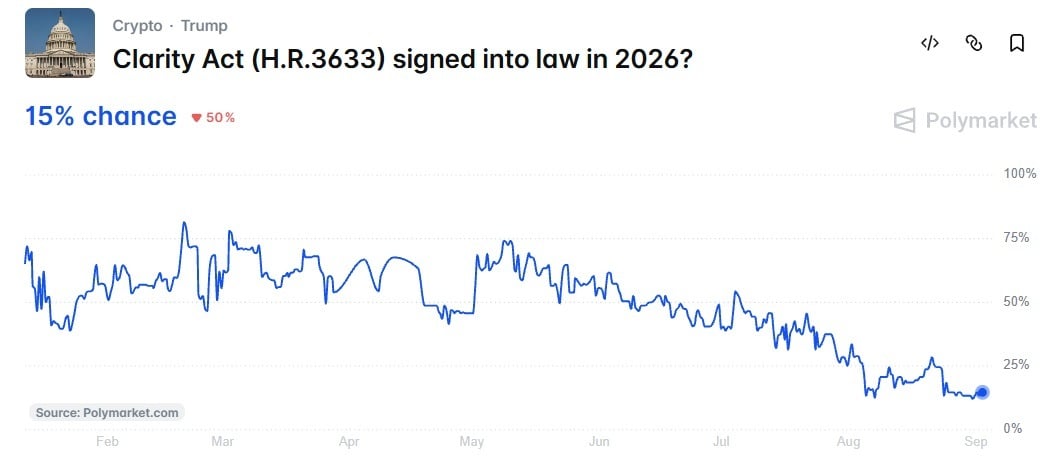
Polymarket traders estimated the probability of the CLARITY Act becoming law by December 31 at 15%. Source: Polymarket, September 2, 2026.

This low probability contrasted with House Financial Services Committee Chairman French Hill's renewed mention of the bill during September 2 hearings on growth, affordability, innovation, and capital access. In his prepared remarks, the Arkansas Republican listed the CLARITY Act's House passage among the committee's accomplishments and called for permanent, predictable financial rules.

Long-term Kalshi contracts showed higher probabilities, although they assess a broader range of possible outcomes and cannot be directly compared to the 2026 Polymarket contract. Kalshi estimated the probability that the CLARITY Act or another relevant crypto market structure bill becomes law by July 1, 2027 at 30%, and by January 1, 2028 at 50%. Trading volume was approximately $6.85 million.
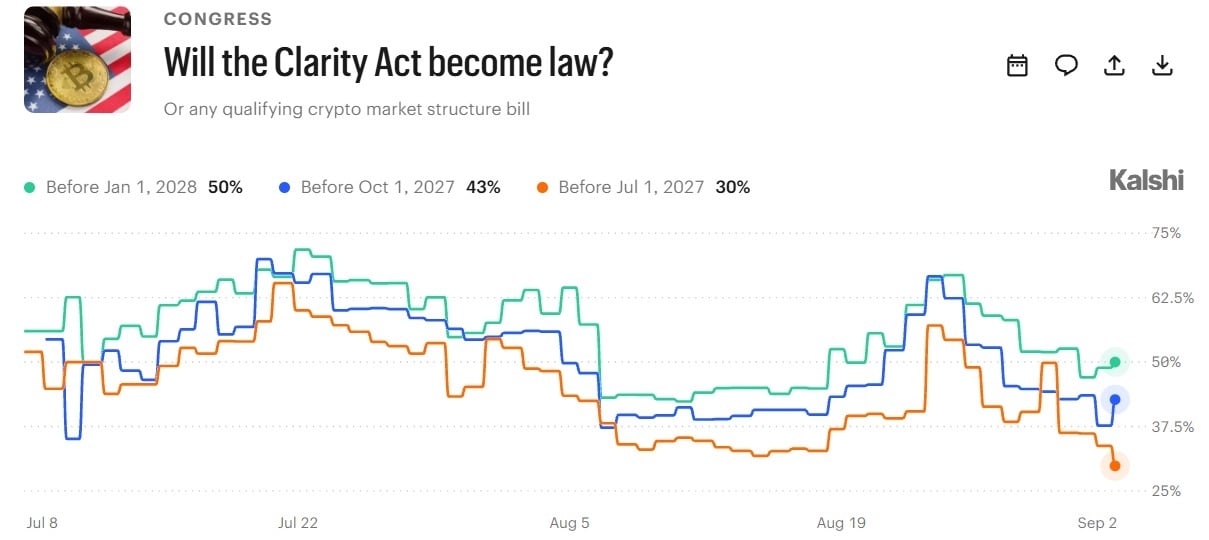
Kalshi traders estimated the probability of a relevant crypto market structure bill passing as 30% by July 1, 2027 and 50% by January 1, 2028. Source: Kalshi, September 2, 2026.

The latest data shows traders are distinguishing between an upcoming Senate vote and final enactment. By August 31, the market had already separated procedural progress from final passage: traders assessed the probability of a Senate vote as high, but the probability of the bill becoming law during 2026 as much lower. The latest Polymarket figure of 15% rose from 13%, but still largely signalled against passage.

September 15 cloture motion will be the next test

The next significant step will be a procedural vote on the bill, which senators could hold as early as September 15. According to the official Senate schedule, a motion to invoke cloture on H.R. 3633 will be voted on at 2:15 PM. Passing a cloture motion typically requires 60 votes, so the bill's future depends on its ability to maintain bipartisan support.

In earlier stages, the bill already received bipartisan support. On May 14, the Senate Banking Committee approved H.R. 3633 by a vote of 15 to 9, sending it to the full floor. Democratic Senators Ruben Gallego and Angela Alsobrooks joined Republicans in supporting the bill's advancement, though the committee's approval did not guarantee sufficient support for cloture or final passage.

Subsequently, Senate negotiators unveiled a revised bill merging the work of the Banking and Agriculture Committees. The updated CLARITY Act framework addresses SEC and CFTC jurisdiction, consumer protection, illicit financing, decentralized finance (DeFi), intermediary oversight, disclosure requirements, and certain network tokens.

The revised language creates another factor affecting the timeline, reflected in the low odds for 2026 passage. Senate approval of provisions differing from the House-passed bill may require additional action before the bill reaches the president's desk. The Polymarket contract will pay out only if H.R. 3633 clears all remaining steps by the end of 2026.

Hill's regulatory initiative faces legislative calendar constraints

Hill included the CLARITY Act within a broader economic agenda covering capital markets, housing, community financial institutions, and regulatory modernization. He stated, "Republicans on the committee are working diligently to codify these reforms into law to make them permanent and predictable." Prediction market probabilities indicate traders view the remaining congressional schedule as a significant obstacle to this goal.

In his September 2 statement, the lawmaker did not provide extensive arguments for digital assets, but had previously explained why he considers CLARITY critical. During July field hearings marking the one-year anniversary of the bill's House passage, Hill compared passing stablecoin legislation without a crypto market framework to an unfinished communication system, with the CLARITY bill remaining stalled in the Senate.

Hill stated:

"We need to get CLARITY done because of one key point I always emphasize: if you have the GENIUS Act and a dollar-backed stablecoin that President Trump signed in July of last year, but you don't have a market structure bill, it's like getting permission to own a cell phone but not having a cellular network."

The bill could impact centralized exchanges, decentralized platforms, brokers, dealers, token issuers, and customers. Centralized and decentralized crypto exchange structures raise different issues related to asset custody, regulatory compliance, and consumer protection, which the proposed framework aims to address.

If senators agree to take up the cloture motion on September 15, the vote will become the next direct test for market skepticism. Overcoming this procedural hurdle could improve forecasts for Senate consideration, while failure would reinforce the current 85% probability assessed for H.R. 3633 not becoming law during 2026.

end-content

Related Questions

QWhat is the CLARITY Act (H.R. 3633) and what are its main provisions according to the article?

AThe CLARITY Act (H.R. 3633) is legislation focused on establishing national rules for cryptocurrency trading, custody, and market oversight in the US. Its main provisions, as passed by the House of Representatives, include allocating federal authority between the Securities and Exchange Commission (SEC) and the Commodity Futures Trading Commission (CFTC), and setting requirements for exchanges, brokers, dealers, disclosure, and client asset protection.

QAccording to the Polymarket prediction contract, what is the perceived probability of the CLARITY Act becoming law by the end of 2026?

AAccording to the Polymarket prediction contract as of September 2, 2026, the perceived probability of the CLARITY Act passing both congressional chambers and being signed by the president before December 31, 2026, is 15%.

QWhat is the significance of the cloture motion scheduled for September 15 for the future of the CLARITY Act?

AThe cloture motion scheduled for a vote on September 15 is a key procedural step for the CLARITY Act. Passing cloture typically requires 60 votes in the Senate. Success would allow the bill to proceed to a final vote, while failure would represent a major setback, confirming market skepticism about its passage in 2026.

QHow do the market prediction probabilities from Kalshi for the CLARITY Act differ from those on Polymarket, and why are they not directly comparable?

AKalshi's long-term contracts show higher probabilities: 30% for a relevant crypto market structure bill (like CLARITY) becoming law by July 1, 2027, and 50% by January 1, 2028. They are not directly comparable to Polymarket's 2026 contract because they assess a broader range of possible outcomes over different, longer timeframes.

QWhat analogy did French Hill use to argue for the necessity of passing the CLARITY Act alongside stablecoin legislation?

AFrench Hill used an analogy comparing stablecoin legislation without a crypto market structure framework to 'having permission to own a mobile phone but not having a cellular network.' He argued that the CLARITY Act is needed to complete the regulatory framework, just as a network is needed for a phone to function.

Related Reads

The Lighter Attack: How a Single API Key Drained Tens of Millions of Dollars?

On November 16, a security incident hit Lighter, a decentralized perpetual contract trading platform. Roughly $15.48 million in USDC was drained from two large market-maker accounts (#714710 and #714723), though Lighter officially confirmed only that a single trader's API key was compromised—not the protocol or smart contracts. The attacker reportedly exploited a leaked API key that lacked direct withdrawal permissions by chaining legitimate product features: closing the victim's trading positions to free margin, creating a 0% fee public pool funded with about $10,000 from an attacker-controlled account to secure ~99.99% of pool shares, then using the victim account's internal transfer permissions to move USDC into the pool in ~$1 million batches. Because internal transfers between accounts linked to the same L1 address may not require additional signatures, and such transfers may not have minted new shares for the victim, the attacker's dominant share position appreciated and could be redeemed for the victim's funds. On-chain records show about 10.39 million USDC withdrawn via withdrawPendingBalance, then swapped through CoW Protocol into ~5,764 ETH/WETH, with some funds later moved to Hyperliquid and converted to XMR. Lighter's LIT token fell over 12% in 24 hours. Lighter attributed the root cause to the affected account using unofficial SDK signing code that reused nonces, allowing private key recovery from public signature data; the official SDK was unaffected. The Guardian mechanism paused withdrawals, the security committee returned about $5 million USDC, and deposits/withdrawals have resumed. Lighter now requires wallet signatures for transfers to public pools, makes API key signatures non-public, and plans IP whitelists, API key permissions and limits, plus monitoring for nonce reuse.

marsbit37m ago

The Lighter Attack: How a Single API Key Drained Tens of Millions of Dollars?

marsbit37m ago

Trading

Spot
活动图片