Dissecting Circle's Q1 Earnings Report: After the Interest Rate Dividend Ebbs, USDC Prepares for a Big Chess Game

marsbitPublié le 2026-05-11Dernière mise à jour le 2026-05-11

Résumé

Title: Circle Q1 2026 Earnings: Shifting Strategy as Interest Rate Windfall Subsides Circle reported its Q1 2026 financial results. While total revenue and reserve income of $694M slightly missed expectations, adjusted EBITDA grew 24% to $151M. A key trend is the decline in reserve income due to lower Federal Reserve interest rates, which Circle is countering by diversifying its revenue streams. Notably, non-interest "Other Revenue" hit a record $42M. USDC's circulation reached 77 billion, up 28% year-over-year, but its on-chain transaction volume surged 263% to $21.5 trillion, indicating significantly higher utilization in payments and DeFi. Financially, the core RLDC Margin improved to 41%, showing better cost control. However, operating expenses nearly doubled, partly due to post-IPO stock compensation costs. Looking ahead, Circle is expanding beyond being a simple stablecoin issuer. It highlighted the $222M presale for its Arc Network (valued at $3B) and launched new services like Managed Payments and the "Agent Stack" for AI-driven commerce. The company's strategy is evolving to position USDC as the foundational dollar network for the internet, targeting broader payment, enterprise, and AI agent economies.

Original | Odaily Planet Daily(@OdailyChina)

Author | Azuma(@azuma_eth)
Before the US stock market opened on May 11th, stablecoin issuer Circle officially announced its Q1 2026 earnings report.

The financial report data shows, Circle's total revenue and reserve income for Q1 was $694 million, slightly below market expectations of $715 million; EPS was $0.21, higher than market expectations of $0.18; adjusted EBITDA was $151 million, a year-on-year increase of 24%; net profit was $55 million, a year-on-year decrease of 15%.

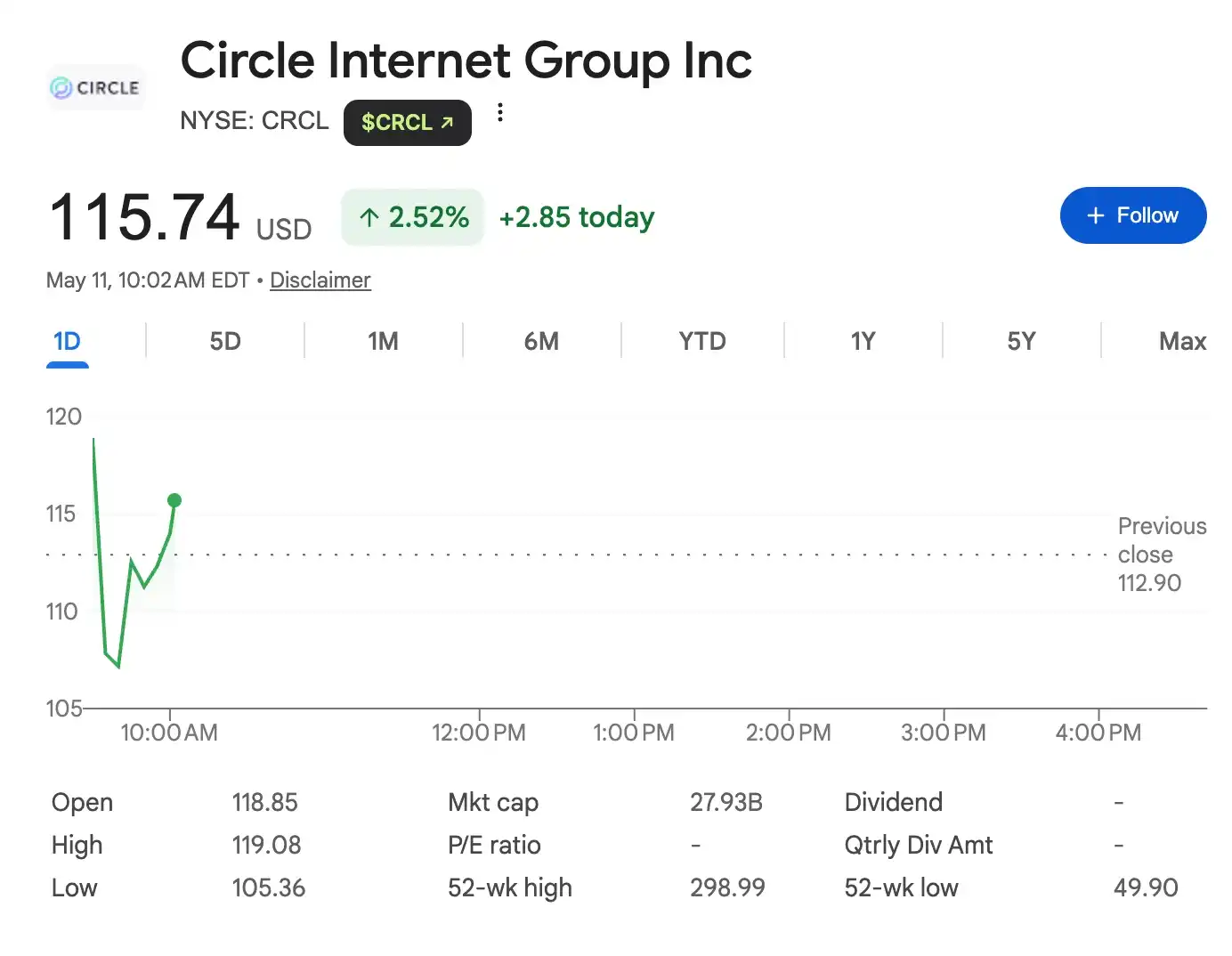
Affected by the earnings release, CRCL experienced significant pre-market volatility, with nearly a 6% pre-market gain gradually being erased amid fluctuations. As of 22:00, after the opening of US stocks, CRCL once continued to plummet but then quickly turned from loss to gain, temporarily quoted at $115.74, with an intraday increase of 2.52%.
Interpretation of Core Data

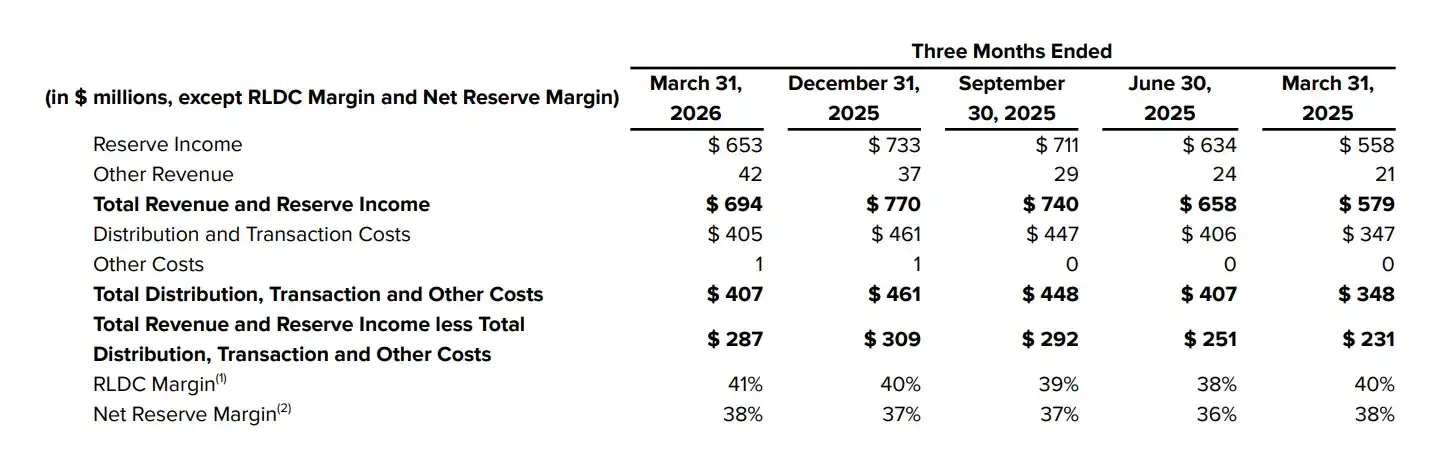
As shown in the report, Circle's total revenue and reserve income for this quarter was $694 million. Although it increased by 20% year-on-year, it broke the growth trend of previous consecutive quarters ($579M → $658M → $740M → $770M → $694M) and also fell short of market expectations.

Circle attributed the slowdown in revenue growth to a decline in the Reserve Return Rate. On December 10, 2025, the Federal Reserve lowered the federal funds rate target range by 25 basis points to 3.5%-3.75%, thereby compressing the yield of Circle's primarily US Treasury-backed reserve assets.
However, despite the relatively weak revenue, this earnings report from Circle still reveals some locally optimistic data.

First, Circle's Other Revenue, excluding Reserve Income, reached a new high of $42 million, showing a growth trend over multiple consecutive quarters ($21M → $24M → $29M → $37M → $42M).

As we mentioned in this afternoon's article "Earnings Report, Bill, Federal Reserve... Circle Faces Three Major Tests This Week", this means Circle's revenue sources are becoming more diversified. Its platform services, API tools, and payment products are generating tangible commercial returns, and reliance on interest income is decreasing.

Another noteworthy data point is RLDC Margin, the profit margin after revenue minus distribution costs. This reflects the core business profitability after deducting distribution expenses and is widely regarded as Circle's most crucial profit metric. This quarter, Circle's RLDC Margin reached 41%, achieving growth for four consecutive quarters (36% → 39% → 40% → 41%). This means Circle's control over distribution costs is becoming more efficient.
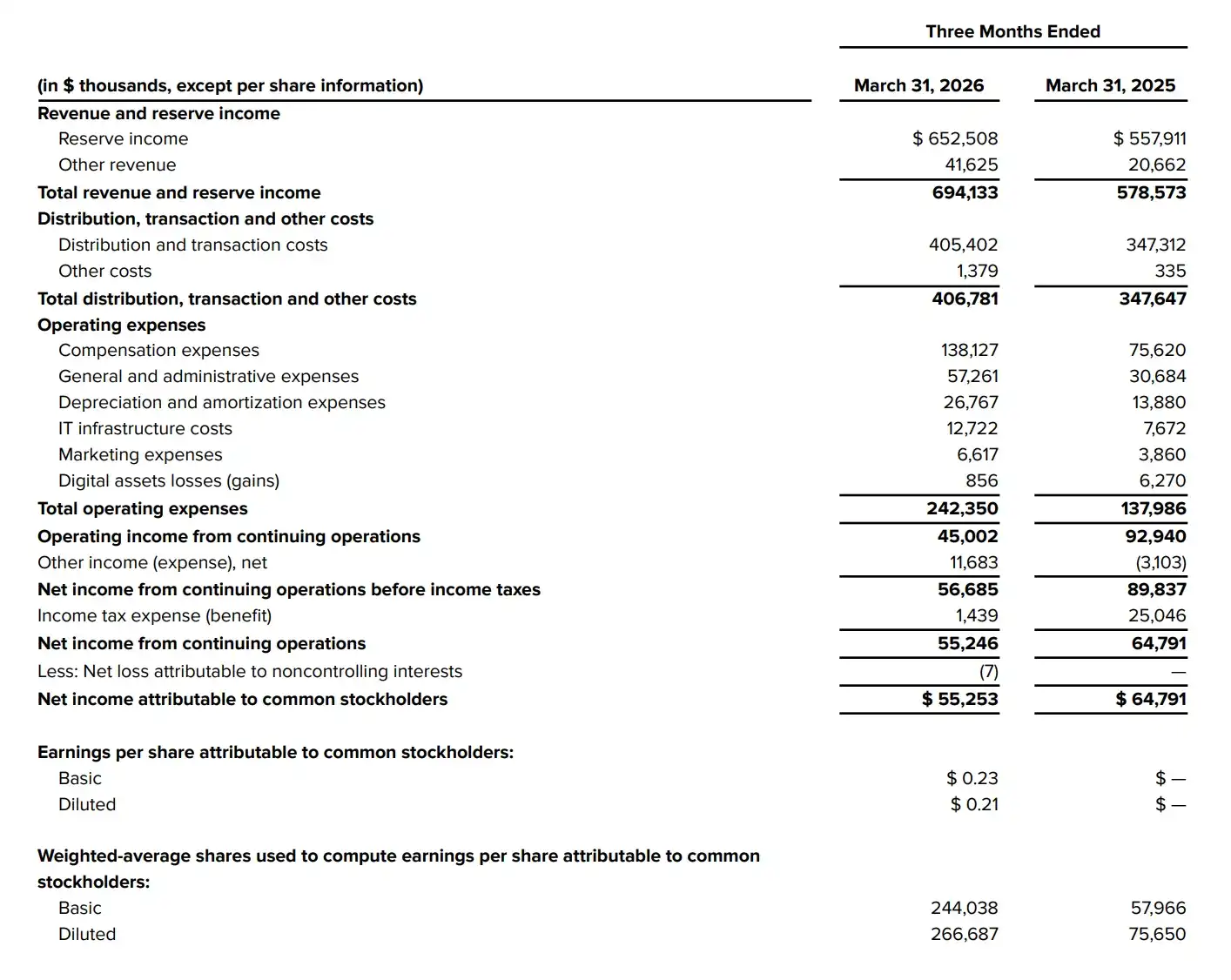
Now let's look at the expense situation. Distribution and Transaction Costs remain Circle's largest expense item, reaching a high of $405 million this quarter, a 17% year-on-year increase. This expense is mainly tied to the USDC distribution contract with Coinbase. This contract is set to expire in August this year. How it is renewed (primarily looking at whether the revenue-sharing ratio will be adjusted) will greatly impact Circle's subsequent expenses and profit status.

Apart from distribution costs, Total Operating Expenses also surged from $138 million last year to $242 million, a year-on-year increase of 76%. The primary increase came from Compensation expenses, which nearly doubled from $75.62 million to $138 million—Circle explained this was mainly due to IPO-related stock-based compensation expenses and related taxes.

Affected by the surge in expenses, Circle's operating profit for this quarter dropped to $45 million from $92.94 million in the same period last year; net profit attributable to common shareholders decreased from $64.79 million to $55.25 million; earnings per share (EPS) were $0.23, diluted to $0.21.

Other Operational Highlights

In addition to core financial data, Circle disclosed several operational highlights in its Q1 earnings report.

The most crucial data point is that USDC's circulation at the end of Q1 reached 77 billion tokens, a year-on-year increase of 28%. However, at the same time, USDC's on-chain transaction volume in Q1 reached a staggering $21.5 trillion, a year-on-year increase of 263%. Visa Onchain Analytics data also shows that USDC accounted for 63% of the total stablecoin transaction volume in Q1.
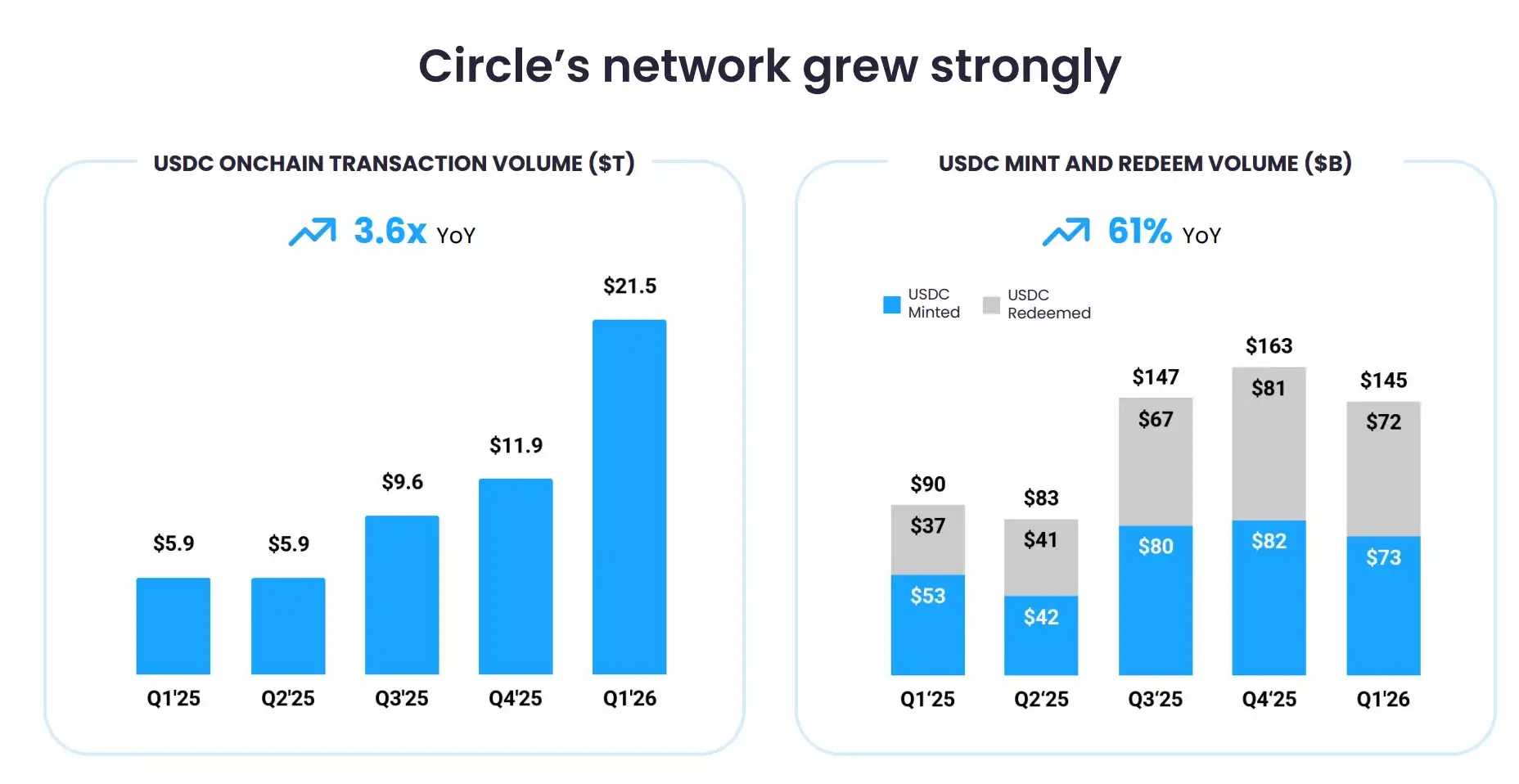
The transaction volume growth rate far exceeding the circulation growth rate means that the turnover and application frequency of each USDC token on-chain has significantly increased — USDC is not lying statically in wallets but is being genuinely and frequently used in scenarios like payments, DeFi, and cross-border settlements.

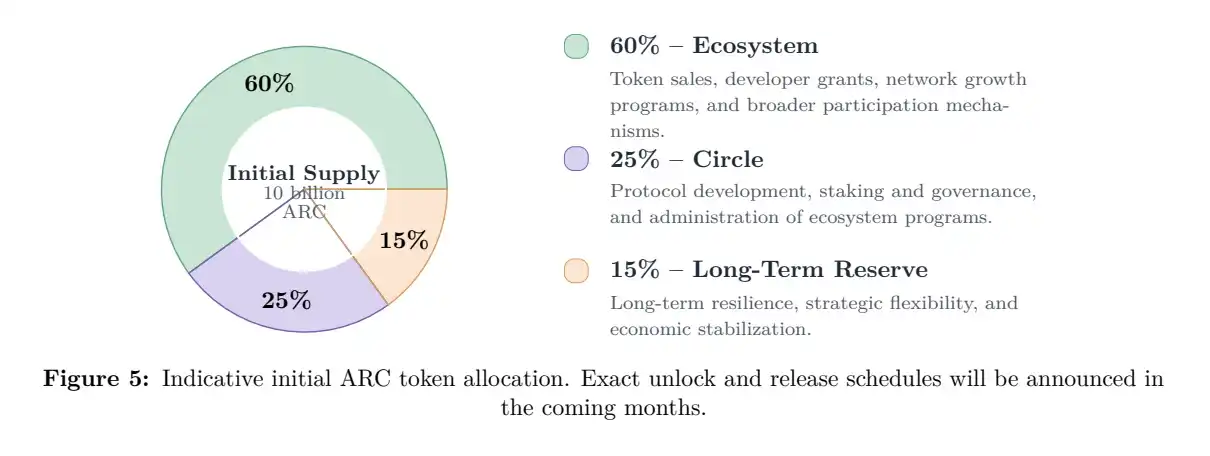
Another important point is that Circle also disclosed that its payment network, Arc Network, has completed a $222 million ARC token pre-sale with a valuation as high as $3 billion. Investors include renowned institutions such as a16z, BlackRock, Intercontinental Exchange, Standard Chartered, and SBI. The ARC token whitepaper disclosed today shows that 60% of the tokens will be allocated to the ecosystem (token sales, developer grants, network growth); 25% will be allocated to Circle (protocol development, staking & governance); 15% will be allocated to a long-term reserve (strategic flexibility & economic stability).
In the subsequent earnings call, when asked how the ARC tokens belonging to Circle would be accounted for, Circle Co-founder and CEO Jeremy Allaire stated: "When ARC tokens are created, they will be recorded on Circle's balance sheet at cost, and their cost is zero. Subsequently, after Circle fulfills its obligations under the token pre-sale agreement, we will recognize the value of these tokens as 'Other Revenue', and this value will then be directly reflected in RLDC and Adjusted EBITDA."

This also means that in a future quarter, Circle's reported revenue data will look "exceptionally good" due to the inclusion of ARC token value.

Furthermore, the estimated annual transaction volume for Circle's institutional payment service, Circle Payments Network (CPN) (extrapolated based on 30-day data as of March 31st), has also reached $8.3 billion; In April, Circle launched the "Managed Payments" product to expand its payment offerings. This product allows financial institutions to launch stablecoin payment services without having to manage digital assets themselves.

To prepare for the AI Agent-driven commercial future, Circle also announced the launch of Agent Stack, a set of infrastructure services and toolkits for the AI Agent economy, designed to provide high-speed, low-cost financial service capabilities for autonomously operating AI Agents. Jeremy Allaire's vision for this is: "With the ARC token pre-sale, the momentum building for Arc Network, and the launch of Agent Stack, we are building trusted infrastructure for AI-native economic activity and a more programmable internet financial system."

Circle's New Chess Game

Against the macroeconomic backdrop of receding high-interest dividends (Warsh is expected to promote a "rate cut + balance sheet reduction" strategy upon succeeding as Fed Chair), Circle clearly does not want to be entirely at the mercy of the Federal Reserve's interest rate policy. Its strategic focus has quietly shifted towards diversified expansion of non-interest revenue.

Judging from the details disclosed in this quarterly report, after successively launching services like CPN, Managed Payments, Agent Stack, and Arc Network, Circle's goal is no longer just to be a "stablecoin issuer." It is attempting to build USDC into the underlying dollar network for the internet era. Under this new vision, Circle's service targets are no longer limited to exchanges or crypto-native users but are extending comprehensively into cross-border payments, corporate settlements, and even the AI Agent economy.

Circle's ambition is now abundantly clear: to transform USDC from a "static reserve asset" into "flowing economic blood." This is perhaps the big chess game Circle truly wants to play.


Questions liées

QWhat were Circle's total revenue and reserve income for Q1 2026, and how did it compare to market expectations?

ACircle's total revenue and reserve income for Q1 2026 was $6.94 billion, which was slightly below the market expectation of $7.15 billion.

QAccording to the article, what are the two key positive data points from Circle's Q1 report despite slowing revenue growth?

ATwo key positive data points are: 1) Other Revenue (excluding Reserve Income) reached a new high of $42 million, showing a consecutive growth trend. 2) The RLDC Margin, a core profitability indicator, reached 41%, marking four consecutive quarters of growth.

QWhat major operational highlight regarding USDC usage is mentioned in the Q1 report?

AA major operational highlight is that the on-chain transaction volume of USDC reached $21.5 trillion in Q1, a 263% year-over-year increase, significantly outpacing its circulation growth of 28%. This indicates much higher frequency of real-world use.

QWhat is the significance of the Arc Network and its ARC token for Circle's future financials, as explained by CEO Jeremy Allaire?

AThe ARC tokens allocated to Circle will be recorded on its balance sheet at cost (which is zero). Once Circle fulfills its obligations under the token presale agreement, the value of these tokens will be recognized as 'other revenue,' which will directly boost the RLDC and Adjusted EBITDA figures in a future quarter.

QHow does the article describe Circle's strategic shift and ultimate ambition in the context of declining interest rate benefits?

ACircle's strategy is shifting from relying on interest income to diversifying into non-interest revenue streams. Its ultimate ambition is to transform USDC from a 'static reserve asset' into 'circulating economic blood,' aiming to build it as the foundational dollar network for the internet era, extending into cross-border payments, corporate settlement, and the AI Agent economy.

Lectures associées

Après trois trimestres consécutifs de baisse, le marché des cryptomonnaies pourra-t-il connaître une fenêtre de stabilisation au troisième trimestre ?

Le marché des cryptomonnaies a enregistré son pire trimestre depuis 2022, avec une capitalisation totale chutant de 12,6% à 2 100 milliards de dollars. Tous les indicateurs clés (volume des échanges, valeur des stablecoins) montrent une sortie nette de capitaux. Le Bitcoin a perdu 14,2% et l'Ethereum 25,4% sur le trimestre, rompant sa corrélation antérieure avec les actions technologiques. Les ETF spot américains sur le Bitcoin ont subi des rachats massifs, avec une sortie nette de 4,67 milliards de dollars au Q2, indiquant une pression de vente continue. Le resserrement de la politique de la Fed et les ventes d'entreprises comme Strategy ont accentué la déleveragisation du secteur. L'attention du marché se porte désormais presque exclusivement sur la réunion de la Fed fin juillet. Une position accommodante pourrait stabiliser le Bitcoin entre 68 000 et 84 000 dollars, tandis qu'un ton hawkish pourrait le faire osciller autour de 50 000-56 000 dollars. Parallèlement, la progression du *CLARITY Act*, une loi cruciale pour la clarté réglementaire, est au point mort au Sénat, réduisant les chances d'adoption en 2026 et maintenant une prime de risque élevée sur l'ensemble du secteur. Malgré ce contexte difficile, quelques secteurs résistent : les marchés de prédiction ont vu leur volume nominal augmenter de 48,7% et les biens collectionnables tokenisés ont progressé d'environ 143%. La tokenisation d'actifs du monde réel (RWA) continue également sa croissance régulière, portée par des fondamentaux indépendants du cycle crypto. Les bases d'un effondrement extrême semblent absentes, mais le marché est désormais guidé par les politiques monétaires, les prix et les attentes de taux, plutôt que par le simple récit haussier. La fin des sorties massives des ETF et le retour des achats des détenteurs à long terme pourraient indiquer une phase de stabilisation potentielle.

marsbitIl y a 15 h

Après trois trimestres consécutifs de baisse, le marché des cryptomonnaies pourra-t-il connaître une fenêtre de stabilisation au troisième trimestre ?

marsbitIl y a 15 h

The SpaceX Trade, Unlocked: SPCXON Débarque sur WEEX

En juin 2026, SpaceX a réalisé la plus grande introduction en bourse de l'histoire, mais l'accès à l'action a été limité pour de nombreux investisseurs en raison de restrictions régionales et de frictions liées aux courtiers. La plateforme WEEX propose désormais une solution via SPCXON/USDT, un instrument tokenisé sur le marché au comptant qui permet d'obtenir une exposition au cours de SpaceX en utilisant l'USDT, sans nécessiter de compte de courtage américain. SPCXON est un produit tokenisé construit sur l'infrastructure d'Ondo, conçu pour refléter l'économie de la détention d'actions SpaceX pour les traders éligibles en dehors des États-Unis, avec des dividendes réinvestis. Le cas d'investissement repose sur la croissance des revenus de Starlink et les progrès de Starship, malgré un valorisation déjà élevée et des risques liés à un flottant public réduit et à des déblocages d'actions internes à venir. Il est important de noter que SPCXON offre une exposition, et non la propriété directe d'actions ou de droits de vote. Son prix peut évoluer avec une prime ou une décote par rapport à la valeur liquidative. WEEX propose également d'autres produits tokenisés comme MSTRON et MUON dans un compte unifié, permettant une rotation entre crypto-monnaies et actions traditionnelles sans transfert de fonds. La plateforme souligne ainsi comment les barrières entre la finance traditionnelle et les actifs numériques s'estompent.

TheNewsCryptoIl y a 15 h

The SpaceX Trade, Unlocked: SPCXON Débarque sur WEEX

TheNewsCryptoIl y a 15 h

BIT Trading Moment : Le BTC reste sous la pression de l'EMA 200 hebdomadaire, un rejet pourrait relancer la baisse, les actions de stockage et de semi-conducteurs qui ont bondi cette nuit ont baissé en séance de nuit

**Résumé des marchés : Bitcoin sous pression, actions technologiques en réajustement** Le marché crypto poursuit son rebond, avec Bitcoin évoluant autour de 66 000 $. Il fait face à une résistance clé vers 68 000 $, niveau correspondant au coût moyen des investisseurs sur cinq mois. Les traders surveillent les moyennes mobiles clés (200 MA à ~63 333 $ et 200 EMA à ~68 328 $ en hebdomadaire). Une rupture au-dessus de 68 000 $ ouvrirait la voie à une hausse, tandis qu'un échec pourrait entraîner un retest des 63 000 $. L'analyse suggère que la dynamique actuelle ressemble à un rebond estival à faible liquidité plutôt qu'au début d'un véritable marché haussier. Sur le marché actions américain, après une forte séance mardi portée par les semi-conducteurs et les titres du stockage (Micron, AMD, Intel...), les contrats à terme indiquent une ouverture en baisse. Les secteurs ayant récemment bondi, comme les semi-conducteurs et le stockage, reculent en séance de nuit. Certaines valeurs se démarquent néanmoins, comme Super Micro Computer (SMCI), en hausse après des résultats et des perspectives robustes liées à la demande de serveurs IA. Des vents contraires persistent : les prix du pétrole (Brent >91$) et les rendements des obligations d'État américaines grimpent, ravivant les craintes inflationnistes. En Asie, les marchés ont suivi le rebond technologique américain, mais de manière hésitante. La tension reste forte sur le yen japonais, qui atteint son plus bas niveau depuis des décennies. **Points clés à surveiller :** * **Crypto :** Niveaux techniques de Bitcoin (68k$/63k$), flux des ETF spot. * **Actions :** Saison des résultats (Tesla, Alphabet, Intel...), activité d'AMD sur l'IA. * **Économie :** Données américaines sur l'emploi, décision de la BCE, tensions géopolitiques et prix de l'énergie.

marsbitIl y a 15 h

BIT Trading Moment : Le BTC reste sous la pression de l'EMA 200 hebdomadaire, un rejet pourrait relancer la baisse, les actions de stockage et de semi-conducteurs qui ont bondi cette nuit ont baissé en séance de nuit

marsbitIl y a 15 h

Gate Research Institute : La vague de « Wall Streetisation » des produits financiers cryptographiques, concurrence ou fusion ?

Le titre de l'article est : "Gate Institute : La vague de 'Wall Street-isation' des produits financiers cryptos, est-ce une compétition ou une fusion ?" Résumé en français (environ 1400 caractères) : Il y a dix-sept ans, Bitcoin fut créé avec une vision décentralisée et anti-establishment financier. Aujourd'hui, paradoxalement, son adoption massive passe souvent par des ETF émis par des géants comme BlackRock. Cet article analyse cette "Wall Street-isation" apparente des actifs cryptos : les institutions traditionnelles s'emparent-elles du pouvoir d'émission, de tarification, de garde et de distribution ? La réalité est plus nuancée. C'est une convergence à double sens. D'un côté, les plateformes cryptos comme Gate.io étendent leurs services aux actions traditionnelles (états-uniennes, hongkongaises, sud-coréennes), aux CFD et aux produits tokenisés, offrant un compte unifié. De l'autre, des courtiers traditionnels comme Robinhood intègrent les cryptomonnaies et explorent la tokenisation d'actions sur blockchain. Cette fusion vise à créer le "super-compte" financier de demain, où actions, cryptos, ETF et obligations tokenisées (RWA) coexistent dans une même interface, comblant les faiblesses de chaque écosystème. Les RWA, notamment les obligations d'État tokenisées, agissent comme une couche intermédiaire unificatrice. En conclusion, Wall Street n'a pas conquis la crypto, et la crypto n'a pas contourné Wall Street. Ils construisent ensemble une nouvelle forme de marché des capitaux, plus efficace et mondial, où l'idéal décentralisé persiste dans les protocoles, tandis qu'une expérience utilisateur unifiée émerge à l'interface.

marsbitIl y a 16 h

Gate Research Institute : La vague de « Wall Streetisation » des produits financiers cryptographiques, concurrence ou fusion ?

marsbitIl y a 16 h

Trading

Spot
活动图片




