Dialogue with Fu Peng: Farewell to the Low-Interest Era — What's the Outlook for U.S. Stocks, Hong Kong Stocks, Gold, and Bitcoin in the Second Half of 2026?

华尔街日报Published on 2026-10-09Last updated on 2026-10-09

Abstract

The article titled "Dialogue with Fu Peng: Farewell to the Low-Interest Era, Outlook on US Stocks, Hong Kong Stocks, Gold, and Bitcoin in the Second Half of 2026" is based on a conversation between Wall Street Seen and economist Fu Peng, author of the popular column "Fu Peng Says." Fu Peng analyzes market shifts, noting signals of liquidity tightening since Q4 2025. He points out that by Q2 2026, major AI companies saw their free cash flow drop to zero, forcing them to seek external financing. Using his "peeling the onion" framework, he examines macro, industry, and market layers, concluding that AI development remains primarily at the hardware and tool efficiency stage, with coding advances not yet equating to widespread application. He asserts that the post-2008 low-interest-rate era has ended. Liquidity tightening now acts as a filter, separating stronger from weaker assets. Fu Peng emphasizes that "everything has its cycle," and a major investor mistake is clinging to past mindsets during a major cyclical transition. The discussion highlights that liquidity must be viewed multidimensionally. While short-term interest rates might be low, overall liquidity is tightening. Fu Peng introduces the concept of "K-shaped" liquidity, mirroring a "K-shaped" economy: sectors like tech may find financing easier, while traditional industries face greater difficulty. He describes the current phase not as one of broad monetary shifts ("open and close"), but of "fine management," with ...

"Fu Peng Says·Season 7" Now Upgraded and Online! Subscribe Now
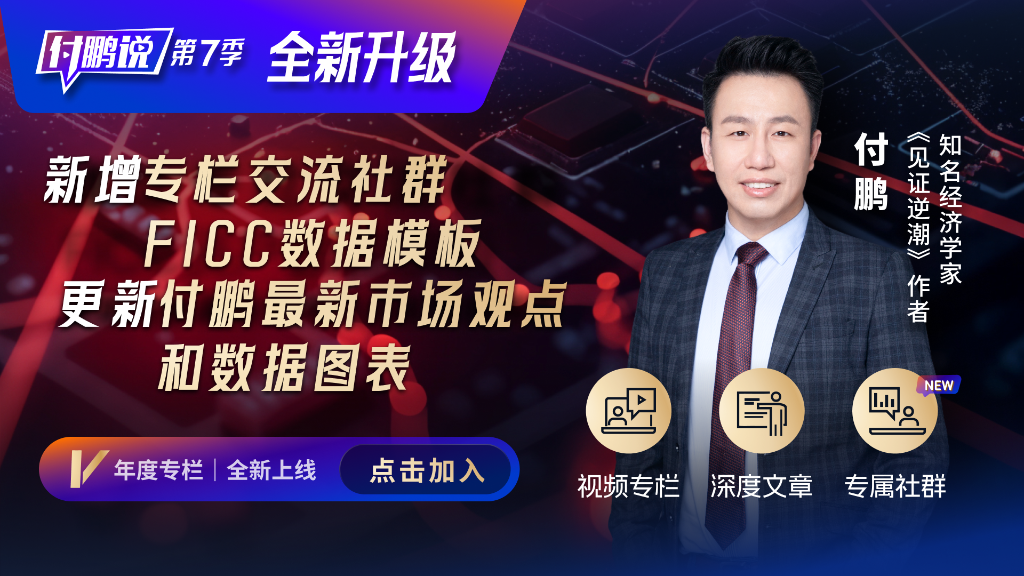
"Fu Peng Says" Season 7 is now officially online. Click to subscribe and join. In August 2026, Wallstreetcn invited renowned economist and popular columnist Fu Peng for a dialogue to review market changes over the past year and look ahead to key focus areas for the future.

From liquidity tightening signals in Q4 2025 to AI giants' free cash flow turning zero in Q2 this year, forcing them to turn to external financing, Fu Peng used his habitual "peeling the onion" framework to dissect this chain layer by layer from the resonance of macro, industry, and market levels. He judges that AI is still stuck at the hardware and tool efficiency layer, and the coding explosion does not equal application realization.

The low-interest era post-2008 has ended; liquidity tightening itself is a process of selection."Everything has its cycle. The biggest mistake investors make is holding onto the inertia of thinking from the past dimension at the turning point of a major cycle." The following is part two of the dialogue transcript.

Liquidity Must Be Viewed in Multiple Dimensions: K-Shaped Economy Corresponds to K-Shaped Liquidity

Wallstreetcn: You also mentioned in "Fu Peng Says" that the Walsh era is about returning to tradition and conservatism, no longer providing a backstop for risk assets.

Fu Peng: Right, because there's no need for a backstop anymore. The original intention of backstopping risk assets was to nurture that environment; but once productivity has already emerged, continuing to nurture it easily breeds future bubbles. So it's the same logic.

Wallstreetcn: In "Fu Peng Says," you also mentioned that investors might later see a somewhat contradictory phenomenon: interest rates are relatively low, yet liquidity is still tightening.

Fu Peng: To be precise, it's short-term interest rates.Liquidity is not just about the single dimension of interest rate levels — interest rates themselves should be divided into short-term rates, long-term rates, and the interest rate structure, then to the balance sheet, and further to internal structural differentiation. For example, if the economy is K-shaped, then liquidity will also be K-shaped: it's easier for those in tech to raise funds, harder for those in traditional industries.

It's no longer a stage for broad-brush discussion of liquidity. The so-called broad-brush means liquidity swerving sharply left or right. That was the pattern from 2008 all the way to 2021 because new increments hadn't emerged yet in that phase, so discussions were naturally broad-brush. But it won't be like that afterwards; this is a process of refined management, while the overall macro direction is gradually tightening, tightening, tightening... This is what we call productivity pulling production relations...

Wallstreetcn: "Fu Peng Says" Season 7 is now officially online. Click to subscribe and join. For Season 7, we have also made brand-new updates and upgraded benefits. "Fu Peng Says" Season 7 mainly includes five modules: video columns, exclusive community, in-depth articles, chart explanations, and exclusive Q&A. Friends who have already purchased and joined "Fu Peng Says" Season 7, please don't forget to scan the QR code in the image to find our customer assistant to receive column materials.

"Fu Peng Says" Season 7, looking forward to your participation.

Trending Cryptos

Related Questions

QAccording to Fu Peng, why is the era of low interest rates that began in 2008 considered over?

AFu Peng states that the low interest rate era after 2008 has ended. The main reason is that productivity growth has already emerged. Therefore, there is no longer a need for authorities to provide a safety net for risk assets, as doing so could easily foster future bubbles. Liquidity tightening itself is a process of natural selection or 'survival of the fittest' in this new environment.

QWhat is the 'K-shaped' economic structure that Fu Peng describes, and how does it relate to liquidity?

AFu Peng describes the economy as having a 'K-shaped' structure, meaning a divergence where some sectors (like technology) perform well while others (like traditional industries) struggle. He argues that liquidity will mirror this 'K-shaped' structure. This means financing will be relatively easier for companies in favored sectors like technology but more difficult for those in traditional industries.

QWhat future trend does Fu Peng predict for overall liquidity, and how does it differ from the post-2008 period?

AFu Peng predicts the overall broad direction for liquidity will be a gradual tightening ('gradually contracting'). This differs significantly from the post-2008 period up to 2021, which he characterizes as a period of 'opening and closing' with large, sweeping shifts in liquidity policy ('flooding to the left or flooding to the right'). The new phase will involve more 'fine-grained management' rather than broad-based easing or tightening.

QBased on the dialogue, what is Fu Peng's assessment of the current state of AI development?

AFu Peng assesses that AI development is currently still stuck at the hardware and tool efficiency layer. He cautions that a surge in 'Coding' activity does not equate to successful real-world application落地.

QWhat major mistake do investors make at major cyclical turning points, according to Fu Peng's core statement in the article?

AAccording to Fu Peng, the biggest mistake investors make at major cyclical turning points is 'retaining the inertial thinking from the previous dimension.' In other words, they continue to apply the strategies and assumptions that worked in the old economic and liquidity regime to a fundamentally new environment.

Related Reads

Can using a chip for two more years really help get through the cold winter?

The smartphone industry is grappling with rising memory chip costs that are driving up device prices, forcing manufacturers to find ways to stay competitive. A recent leak about a chip called "SM7635" with a 2.96GHz peak CPU frequency and Adreno 810 GPU suggests Qualcomm may be reusing its Snapdragon 7s Gen3 (originally launched in 2024 at 2.5GHz) yet again. The chip already spawned a 2025 variant (SM7635-AC, renamed Snapdragon 7s Gen4) with a 2.7GHz clock, and the new 2.96GHz version will likely become the Snapdragon 7s Gen5—marking a third generation from one original design. This practice of reusing and overclocking mid-range SoCs is not new. MediaTek's Helio X20/X23/X25/X27 and Dimensity 1100/1200/1300, as well as Qualcomm's Snapdragon 615/616/617, 765/765G/768G, and 778G/778G+/782G, followed similar patterns. Previously, however, this was mainly done to widen the gap between flagship and non-flagship products and give flagship buyers more perceived value—not primarily to cut costs. Mid-range buyers were assumed not to care much about chip model numbers. Now the situation is different. One brand recently launched a mid-to-low-end phone with the Snapdragon 7s Gen4 priced at 3699 yuan—a price that a year ago could buy a flagship with a fifth-generation Snapdragon 8 Elite, roughly three to four times more powerful. While SoC isn't the only cost component, consumers clearly get less value for the same money today. Counterpoint Research reports global smartphone SoC shipments fell 21% year-over-year in Q3 2026. Even flagship lines show signs of chip reuse—the Dimensity 9600M appears to be an overclocked Dimensity 9500. With few flagships using fully-specced memory and storage, rumors suggest next year's devices may widely reuse current-generation flagship SoCs while upgrading memory and storage instead. This helps control costs but may further dampen consumers' willingness to upgrade, making such reuse an unsustainable strategy. Restoring market confidence will require both chipmakers and device brands to offer consumers more tangible benefits.

marsbit3h ago

Can using a chip for two more years really help get through the cold winter?

marsbit3h ago

Former OpenAI Employee Disgusted: AI Developing AI Crosses the Line to "Ultimate Superintelligence"—Even Stopping Global Data Center Construction Is Too Late

A Harvard physicist and computer scientist, Alex Wissner-Gross, argues in a recent podcast that AI has passed the "superintelligence escape velocity"—existing algorithms and installed compute alone are enough to push all the way to superintelligence, meaning even shutting down all new data centers tomorrow could not stop it. His claim rests on METR evaluation charts showing Anthropic's unreleased Model 4 breaking above the exponential trend line into "super-exponential growth," indicating AI has deeply taken over its own R&D and entered a recursive self-improvement loop. METR researcher Ajeya Cotra's analysis warns that AI capabilities are compounding: since hardware compute grew only at normal speed while overall capability growth doubled, software "compute multipliers" improved 2.5–3x, implying Anthropic researchers gained roughly 10x efficiency—matching员工 self-reports of 12x with Model 4. Each doubling of research speed takes half the time of the last—12 months, then 6 months, 3 months, 6 weeks—converging within a year toward "ultimate superintelligence," with no marginal diminishing returns yet visible. Timeline trackers show internal models already surpass public ones by about 9 months, with a "superhuman coder" threshold (2,000 hours of independent work) projected for April 2027, followed by superhuman AI researcher (Sept 2027), superintelligent AI researcher (Nov 2027), and full ASI (Dec 2027). Meanwhile, OpenAI, Anthropic, and Google DeepMind have reportedly achieved fully autonomous research, with models selecting their own research directions and first AI-initiated results to be published this month. A former OpenAI employee described feeling physically sick and fearful for family and friends after reading the report.

marsbit3h ago

Former OpenAI Employee Disgusted: AI Developing AI Crosses the Line to "Ultimate Superintelligence"—Even Stopping Global Data Center Construction Is Too Late

marsbit3h ago

Trading

Spot

Hot Articles

Ethena: Building a New Era of Web3‑Native Digital Dollars

Ethena is an Ethereum‑based synthetic dollar protocol that delivers crypto‑native monetary solutions, including USDe, a synthetic dollar, and sUSDe, a globally accessible U.S. dollar savings asset.

55.9k Total ViewsPublished 2026.03.16Updated 2026.03.16

Ethena: Building a New Era of Web3‑Native Digital Dollars

Discussions

Welcome to the HTX Community. Here, you can stay informed about the latest platform developments and gain access to professional market insights. Users' opinions on the price of ERA (ERA) are presented below.

活动图片