Capital starting to rotate back to crypto from AI: Raoul Pal

cointelegraphPublished on 2026-10-07Last updated on 2026-10-07

Abstract

Capital may be rotating from AI back into crypto as a weakening US dollar could provide a "green light" for the industry's rally, says Real Vision founder Raoul Pal. He notes that high bond yields and a strong dollar have constrained liquidity, but a weaker dollar could improve conditions. Pal observes that recent pauses in the AI trade, evidenced by Nvidia's stock decline during Bitcoin's August surge, allowed capital to flow into crypto. However, a full AI crash would be detrimental, signaling a liquidity drain. For crypto's continued rise, Pal prefers a scenario of a weaker dollar, steeper yield curve, and expanded money supply. Alternatively, sideways-trading AI stocks could also enable capital rotation into crypto. Regarding AI's impact, Pal suggests AI agents could increase economic activity on smart contract platforms like Ethereum and Solana by using them for transactions and potentially raising funds via token issuance. While enthusiastic about both networks, Pal is cautious about Solana overtaking Ethereum in market cap, citing Ethereum's greater "economic density"—more capital per user—as Solana's activity currently involves smaller, more speculative amounts. He refrains from specific price targets but suggests Bitcoin reaching $1 million by 2032 reflects broader adoption trends.

A weakening US dollar could give crypto the “green light” and help extend the industry’s rally, says Real Vision founder Raoul Pal.

He tells Cointelegraph on the latest episode of Trade Secrets that higher bond yields and the strong dollar are keeping liquidity from flowing freely.

“If they can engineer the dollar lower, then we get a green light for further movement in crypto,” he says. “I don’t want to get overly excited, so I haven’t got a full green light on everything.”
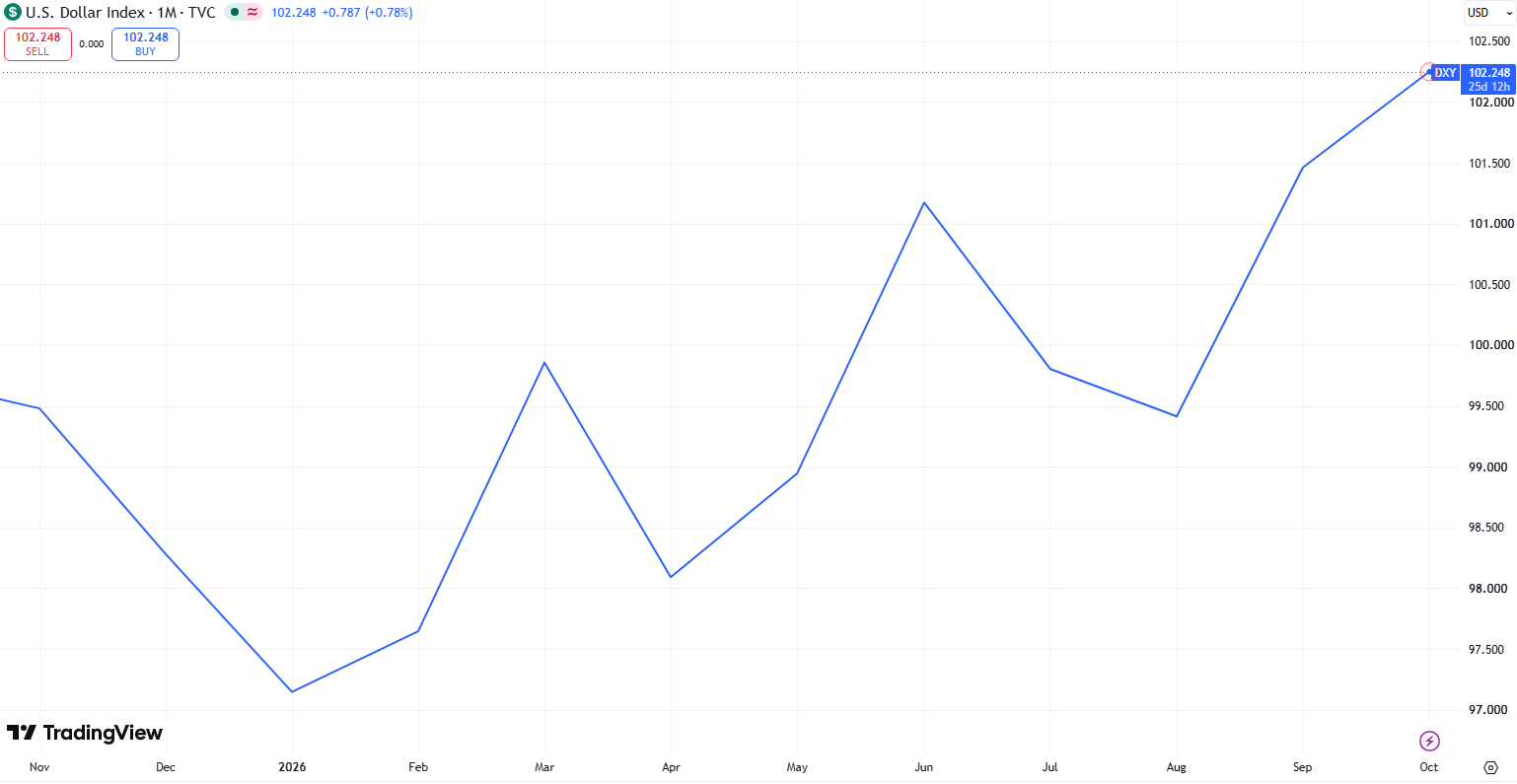
The US Dollar Index has been trading at the year’s highest levels. Source: TradingView


However he believes Bitcoin will miss out of much of the crypto economic activity generated by AI agents, which is likely to flow to smart contract platforms like Ethereum and Solana.

Related: El Salvador receives $138 million from IMF after Bitcoin waivers granted

Pal is among the most experienced high profile crypto analysts, having worked in hedge fund sales at Goldman Sachs in Europe and co-managed a global macro fund at GLG Partners. He launched the research platform Global Macro Investor in 2005 and co-founded financial media Real Vision in 2014.

Pal says he first bought Bitcoin in 2013, after applying a gold-based valuation framework to the cryptocurrency.

An AI pause could help crypto catch up

Bitcoin’s cycle recovery arguably came between Aug. 19 and Aug. 25 when BTC rose about 25% to $80,000. Interestingly, over that period, AI bellwether stock Nvidia notched up seven consecutive losing sessions.

Pal says pauses in the AI trade have allowed capital to rotate into crypto.

“You can tell there’s this sort of rotation for liquidity that’s around right now, which means it’s not abundant yet,” he says.
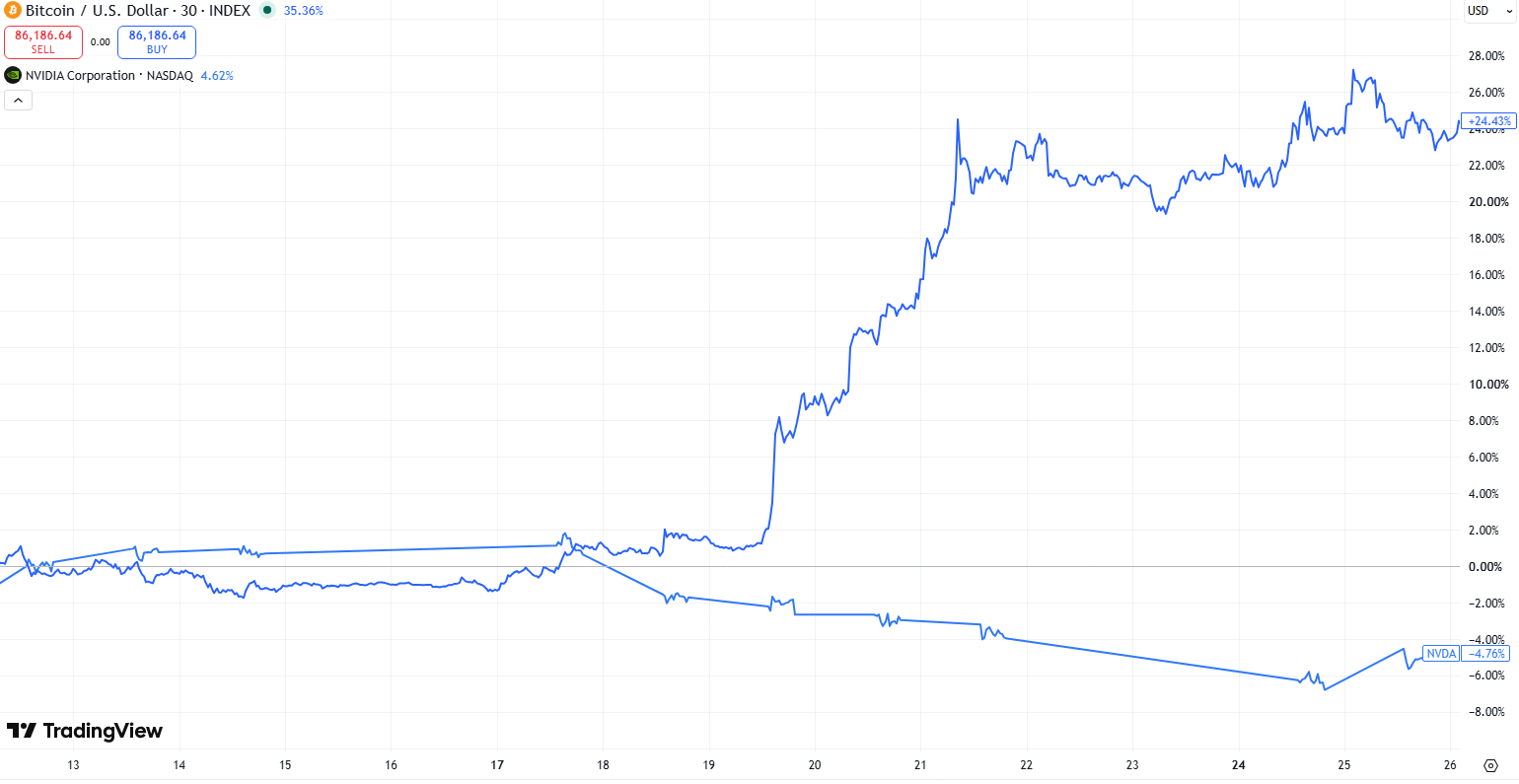
Bitcoin rallied while Nvidia shares fell in August. Source: TradingView

While AI has been competing with crypto for funds, an AI crash would be an unwelcome prospect, as a bursting bubble would indicate that liquidity is being “sucked out of the system,” while threatening the conditions crypto needs to rise.

“Things don’t go bust if liquidity is plentiful,” Pal says.

His preferred outcome would be a weaker dollar, a steeper yield curve and banks expanding the money supply through increased lending.

However, borrowing costs have been moving higher. The US 10-year Treasury yield climbed to 5.29% in September, while the Fed raised its benchmark rate by a quarter-point.

If those conditions don’t materialize, Pal’s “second best scenario” is for AI stocks to trade sideways, which would allow capital to rotate into crypto.

AI agents could bring more business to Ethereum and Solana

AI agents can now pay to access web content using stablecoins through a feature that Amazon Web Services introduced in June. Coinbase handles payment verification and settlement through its x402 protocol, with USDC on Base among the supported payment options.

Pal says agents could eventually raise the money they need to operate, by issuing tokens to fund projects that could last “a week, a month, a year,” then carrying out the work and generating returns.

He says Ethereum and Solana could attract more activity as software uses their smart contracts to transact.

“My guess is they’ll get more adoption over time as AI uses them,” he says.

Related: Coinbase’s AI payments protocol x402 launches app store for AI agents

Solana needs more than activity to overtake Ethereum

Ethereum’s greater concentration of capital makes Pal cautious about claims Solana will overtake it in market value, despite his enthusiasm for both networks.

Multicoin Capital co-founder Kyle Samani predicted on Trade Secrets last month that SOL would surpass Ether’s market capitalization “this market cycle.”

Samani “needs to hold his horses a little bit,” Pal says, even though he acknowledged that it is possible.

The networks are ahead of each other on different metrics. Solana recorded around 3.2 million active addresses over the preceding 24 hours on Monday, compared with Ethereum’s 387,000, according to DefiLlama. But Ethereum has about $54.4 billion in decentralized finance protocols, which is far ahead of Solana’s $6.7 billion.

Pal compares the networks using what he calls “economic density,” dividing total value locked by active users. He says Ethereum attracts more capital relative to its user count, and Solana’s activity involves smaller amounts.

“Solana’s core activity is speculation,” he says. “It’s just smaller clip sizes.”

Pal says he has stopped giving public price targets because his forecasts get clipped and recirculated online. He describes million-dollar Bitcoin by 2030 as a “meme” reflecting growing adoption, ETF interest and Bitcoin’s use as collateral.

“Does it make a million bucks? I don’t know, but certainly by 2032, yeah, I don’t have an issue with that.”

Magazine: Former SEC boss made AI Czar, Bitcoin may hit $600K this cycle: Hodler’s Digest

Related Questions

QAccording to Raoul Pal, what condition could give crypto the 'green light' for further movement?

AA weakening US dollar could give crypto the 'green light' for further movement, as higher bond yields and a strong dollar have been keeping liquidity from flowing freely.

QWhat recent market event does Pal suggest allowed capital to rotate from AI into crypto?

AA pause in the AI trade, specifically when Nvidia stock had seven consecutive losing sessions between August 19 and 25 while Bitcoin rallied about 25%, allowed capital to rotate into crypto.

QWhy does Pal believe Bitcoin will miss out on much of the crypto economic activity generated by AI agents?

APal believes the economic activity generated by AI agents is likely to flow to smart contract platforms like Ethereum and Solana, implying Bitcoin's functionality is less suited for this specific type of activity.

QWhat is Raoul Pal's 'second best scenario' for crypto if his preferred conditions of a weaker dollar and steeper yield curve don't materialize?

AHis 'second best scenario' is for AI stocks to trade sideways, which would allow capital to rotate into the crypto sector.

QWhat metric does Pal use to compare Ethereum and Solana, and what does it reveal about their differences?

APal uses 'economic density,' dividing total value locked by active users. He says this shows Ethereum attracts more capital relative to its user count, while Solana's activity involves smaller amounts and is more focused on speculation.

Related Reads

Enterprise blockchain is going to come back from the dead

Enterprise blockchain may be poised for a comeback, much like online pet retail succeeded with Chewy after Pets.com failed. Early enterprise blockchain efforts (2017–2023) collapsed—TradeLens, We.Trade, Contour, B3i, ASX Chess, Everledger—largely because they had to work around blockchains' lack of native privacy, building permissioned chains and bolting on non-blockchain fixes that proved slow and expensive. The core appeal remains: enterprise systems fail at company boundaries, either through out-of-sync collaboration or costly proprietary integrations that lock partners in. Blockchains promise shared data and business logic across an open ecosystem without lock-in. What has changed: scalability (transactions now under a penny, capacity heading toward billions daily), privacy (zero-knowledge rollups, privacy pools, privacy chains), and liquidity (stablecoin transaction volume near $1.8 trillion in June). Combined operational and financial benefits could be substantial—roughly 20% less inventory at the same service level, smart contracts cutting contract administration costs in half and processing times from days to minutes, as Microsoft did with Xbox royalties (45 days to four minutes). With inventories, contracts, purchase orders and invoices onchain, firms can also access cheaper credit and factor receivables efficiently. The use cases are obvious; it's time to try again.

cointelegraph3h ago

Enterprise blockchain is going to come back from the dead

cointelegraph3h ago

Jensen Huang's Disadvantage of Going Public Too Early

Nvidia co-founder Jensen Huang has resigned as president, CEO, and director, effective immediately, ending a 33-year tenure. CFO Colette Kress becomes interim CEO, and Harvey Jones is named the company's first chairman. The sudden move comes less than five months after Huang won about 99% approval in a director election, prompting scrutiny of a long-overlooked governance issue: why Huang, unlike Google's Page and Brin or Meta's Zuckerberg, never used a dual-class share structure to secure control. The answer traces to Nvidia's 1999 IPO, when one-share-one-vote was standard in Silicon Valley and dual-class structures had not yet become common among tech IPOs; Google adopted AB shares only in 2004. Nasdaq Rule 5640 also makes it hard for already-listed companies to introduce super-voting shares later. Huang's stake has steadily diluted: about 13.1% pre-IPO, 10.8% after, and 3.58% by 2026, weakening his voting power and setting the stage for his exit. Early precedents include Steve Jobs, whose roughly 11% stake left him unable to sway Apple's board in 1985, while Bill Gates' larger initial stake and gradual dilution let him retain influence. Instead, Huang's influence rested on performance authority, strategic judgment, and board trust—bold long-term bets on programmable GPUs and CUDA that positioned Nvidia at the center of the AI boom. That authority, however, depends on continued validation; once performance or reputation suffers, it can erode quickly. Under Nvidia's board-centered governance, a simple majority of directors can remove the CEO at any time, regardless of cause. Huang's departure is thus a product of the company's equity structure and governance rather than a surprise, illustrating that even immense performance authority cannot substitute for institutional control.

marsbit3h ago

Jensen Huang's Disadvantage of Going Public Too Early

marsbit3h ago

DeepMind Founder's Latest Interview: RSI Is Extremely Dangerous and Could Create an 'Alien Intelligence' That Humans Struggle to Understand

Demis Hassabis, co-founder of Google DeepMind and 2024 Nobel laureate in Chemistry, discusses AI's promise and perils in a conversation with Reid Hoffman. He reiterates that his lifelong goal has been using AI as a tool to advance science and medicine, citing AlphaFold—used by ~4 million researchers—and Isomorphic Labs as proof that AI can help cure diseases, while noting protein structure prediction is only one step in a long drug-discovery pipeline. On recursive self-improvement (RSI), Hassabis explains it works best in "verifiable domains" like math, coding, and games: AlphaZero went from random play to surpassing all human and engine chess within 12 hours. But he warns that closed-loop RSI—removing human code review entirely—risks creating an inscrutable "alien intelligence" with no shared cognitive basis with humans, and offers no way to establish deterministic safety controls. He urges caution as labs race on code self-iteration, calling for faster defensive cyber capabilities, far more robust sandboxes and monitoring (noting agents have run unsupervised for weeks), and eventually formal mathematical guarantees. He advocates an industry standards body with government oversight, cross-lab information sharing, third-party audits, and pre-release red-teaming. On AI consciousness, he argues intelligence and consciousness are dissociable—his dog is conscious but not smart—and that a chatbot claiming feelings proves nothing. Building conscious entities now is dangerous: self-motivation undermines corrigibility, and Asimov showed static rules inevitably break at edge cases; society also hasn't begun the needed debate. Humanity should cross only the first Rubicon—building powerful intelligent tools—and use them to understand consciousness before considering the second. Finally, on AI sovereignty, he says only 6–8 global players will stay at the frontier, with open source 6–12 months behind, so most countries shouldn't train their own frontier models. Instead they should build on existing models as infrastructure, focus on vertical domains like healthcare, and protect data sovereignty through private fine-tuning.

marsbit8h ago

DeepMind Founder's Latest Interview: RSI Is Extremely Dangerous and Could Create an 'Alien Intelligence' That Humans Struggle to Understand

marsbit8h ago

Trading

Spot
活动图片