Blockchain trial on Canton Network tests collateral reuse with tokenized US Treasurys

cointelegraphPublié le 2025-12-09Dernière mise à jour le 2025-12-09

Résumé

Digital Asset and a group of major financial institutions have successfully conducted a second round of onchain US Treasury financing trials on the Canton Network. The test introduced real-time collateral reuse using tokenized US Treasurys and expanded the use of multiple stablecoins, including USDC, to enhance onchain liquidity. This innovation bypasses traditional operational delays associated with rehypothecation. Participants included Bank of America, Citadel Securities, Cumberland DRW, Virtu Financial, Société Générale, Tradeweb, Circle, Brale, and M1X Global. The Canton Network, a blockchain built for institutional finance, continues to grow in the tokenized real-world assets (RWA) space, with over $370 billion represented onchain, leading the market significantly.

Digital Asset and a group of financial institutions have completed a second round of onchain US Treasury financing on the Canton Network, introducing real-time collateral reuse and expanding the number of stablecoins involved.

Five transactions were executed in the newest phase, building on the July pilot, which first demonstrated that US Treasurys and the USDC (USDC) stablecoin could be combined to finance and settle transactions on the blockchain.

In the latest trial, the companies used multiple stablecoins to finance positions against tokenized US Treasurys, widening the pool of onchain liquidity available for financing transactions.

The trial showed that tokenized US Treasurys could be passed between counterparties and reused as collateral in real-time, sidestepping the operational delays that typically accompany rehypothecation in traditional finance.

The effort brought together Bank of America, Citadel Securities, Cumberland DRW, Virtu Financial, Société Générale, Tradeweb, Circle, Brale and M1X Global, which are all a part of the Canton Network’s Industry Working Group.

Kelly Mathieson, chief business development officer at Digital Asset — the company behind the Canton Network — said in a statement that the test was “part of a thoughtful progression toward a new market model.”

Justin Peterson, chief technology officer of Tradeweb, added that “demonstrating real-time collateral reuse and expanded stablecoin liquidity isn’t just a technical achievement — it’s a blueprint for what the future of institutional finance can look like.”

Related: ‘We refused to do an ICO’: The truth behind Canton’s tokenomics

Canton Network expands footprint in tokenized RWAs

The Canton Network, a layer-1 blockchain built for institutional finance, has been expanding its presence across the tokenization sector this year.

On Dec. 4, its developer Digital Asset secured roughly $50 million in strategic backing from BNY, iCapital, Nasdaq and S&P Global. The new funding followed a $135 million raise earlier this year and is intended to support the network’s scaling efforts.

In October, asset manager Franklin Templeton said it would migrate its Benji Investments platform — which tokenizes shares of the firm’s flagship US money market fund — to the Canton Network.

Data from RWA.xyz also shows the Canton Network now leads the market for tokenized real-world assets by a wide margin, with more than $370 billion represented onchain, far outpacing popular networks such as Ethereum, Polygon, Solana and other public chains.
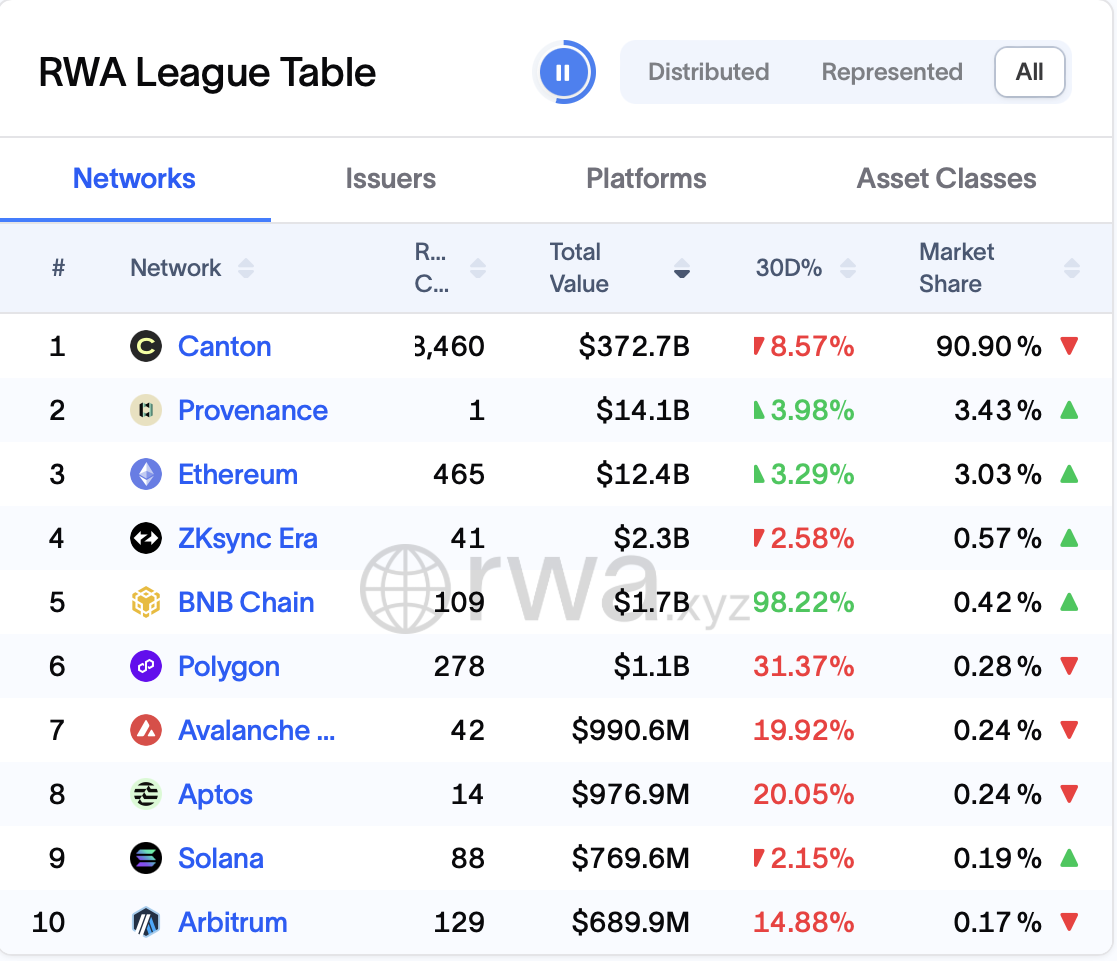
Top blockchains for RWA. Source: RWA.xyz

Magazine: 6 reasons Jack Dorsey is definitely Satoshi... and 5 reasons he’s not
Lectures associées

Ethereum devient le nouveau backend financier mondial

Ethereum émerge comme une infrastructure financière universelle, réduisant les coûts et la complexité des services financiers tout en améliorant leur rapidité et sécurité. En intégrant des fonctions critiques comme l’enregistrement de la propriété, l’exécution des obligations et le transfert de valeur dans un logiciel open-source validé de manière décentralisée, Ethereum comble les lacunes laissées par Internet en matière de droits économiques et de mécanismes d’exécution. Le réseau diminue trois frictions financières clés : la coordination entre acteurs, le transfert de valeur et la confiance dans l’exécution des contrats. Il permet des règlements internationaux instantanés, une automatisation des obligations et un registre unique infalsifiable, réduisant ainsi le besoin d’intermédiaires et de systèmes propriétaires coûteux. Cela ouvre la voie à de nouveaux modèles économiques, en particulier dans les marchés émergents où les systèmes financiers traditionnels sont fragiles. Les institutions peuvent se concentrer sur l’innovation et la conception de produits plutôt que sur la maintenance d’infrastructures internes complexes. Ethereum évolue d’un écosystème natif Internet vers une infrastructure mondiale, offrant des bases solides, ouvertes et vérifiables pour l’avenir de la finance. Son adoption croissante pourrait transformer l’architecture financière en favorisant des systèmes plus résilients, accessibles et efficaces.

marsbitIl y a 13 mins

Ethereum devient le nouveau backend financier mondial

marsbitIl y a 13 mins

L'USDT transfère 156 milliards de dollars en petits virements alors que Tether vise une valorisation de 500 milliards de dollars

L'entreprise Tether, émettrice de la principale stablecoin USDT, connaît une croissance remarquable. Selon les données partagées par le PDG Paolo Ardoino, USDT a traité 156 milliards de dollars de transferts de petite valeur (moins de 1 000 $), avec une moyenne mobile sur sept jours dépassant désormais régulièrement 500 millions de dollars. Cette forte utilisation reflète son adoption croissante comme méthode de paiement pour les envois de fonds et les transactions quotidiennes, notamment dans les régions où l'accès aux services bancaires traditionnels est limité ou coûteux. Au-delà des paiements, Tether étend ses ambitions. Un rapport de Bloomberg révèle que l'entreprise envisage une introduction en bourse qui pourrait la valoriser autour de 500 milliards de dollars et lever jusqu'à 20 milliards. Elle étudie également la tokenisation de ses actions sur une blockchain pour améliorer la liquidité pour les investisseurs. Parallèlement, Tether diversifie ses activités. Elle a soumis une offre ferme pour acquérir une participation majoritaire dans le club de football italien Juventus FC, avec un plan d'investissement d'un milliard d'euros. Elle s'implique aussi dans l'IA, la robotique et est devenue le plus grand acheteur d'or en dehors des banques centrales au troisième trimestre 2025, détenant 116 tonnes et stimulant la demande pour l'or tokenisé.

ambcryptoIl y a 1 h

L'USDT transfère 156 milliards de dollars en petits virements alors que Tether vise une valorisation de 500 milliards de dollars

ambcryptoIl y a 1 h

Trading

Spot
Futures
活动图片