Bitcoin monthly ‘new money’ inflows near $5B as BTC price rally stalls

cointelegraphPublished on 2026-10-08Last updated on 2026-10-08

Abstract

Analysis warns Bitcoin's price gains are not yet fueled by sufficient new capital entering the market. According to Glassnode, monthly "new money" inflows from sources like ETFs and corporate treasuries reached $4.9 billion by October 5. However, this covered less than two-fifths of the $12.8 billion growth in Bitcoin's realized cap over the same period, indicating most of the market's expansion is due to existing investors trading coins at higher prices. This divergence is notable compared to larger inflows seen during the 2024-2025 rallies. Meanwhile, recent price attempts above $87,000 have stalled. As Bitcoin briefly closed above $85,000, profit-taking intensified dramatically, with short-term holders (holding less than 155 days) accounting for over 80% of coins moved to exchanges for profit—the highest share in a year. Their aggregate cost basis remains around $78,250, keeping this cohort in net profit. The data suggests the current price move depends heavily on existing holders, with new capital inflows remaining modest.

Bitcoin (BTC) price gains do not yet reflect enough new capital entering the market, analysis warns.

Key points:

  • Rolling 30-day cumulative inflows of “new money” to Bitcoin reached $4.9 billion on Oct. 5, per Glassnode data.
  • Existing investors still accounted for three-fifths of the $12.8 billion growth in realized cap in that period.
  • Short-term holders accounted for more than 80% of profit-taking above $85,000.


Bitcoin capital inflows not responsible for realized cap growth


In the latest edition of its regular newsletter, The Week Onchain, crypto research platform Glassnode revealed that existing holders were behind much of Bitcoin’s recent upside.

“New money” inflows into Bitcoin — purchases by corporate treasuries, “stablecoin growth” and inflows to the US spot Bitcoin exchange-traded funds (ETFs) — totaled around $4.9 billion in the 30 days to Oct. 5.

Bitcoin’s realized cap, which values each coin at the price it last moved onchain, grew by $12.8 billion, more than twice as much over the same period.

“New money therefore covers less than two fifths of that rise. The rest is coins changing hands at higher prices among money already in the market,” Glassnode commented.
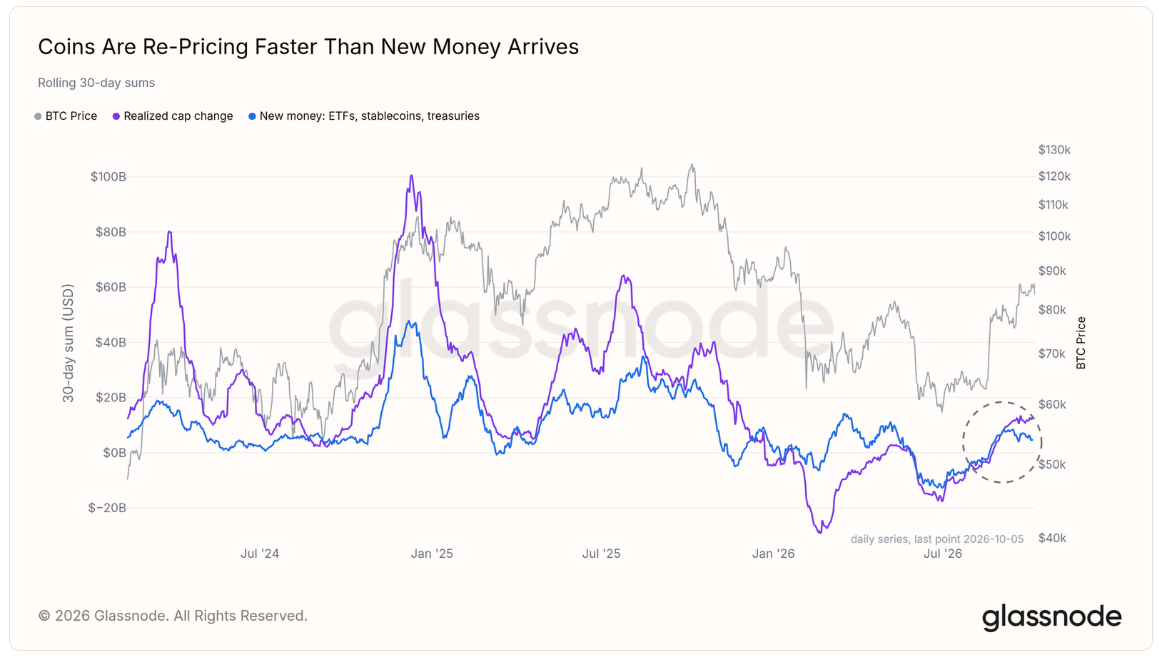
Bitcoin new money inflows vs. realized cap (screenshot). Source: Glassnode


Accompanying data shows that recent rallies in BTC/USD have showed the same divergence since the ETFs launched in January 2024. Currently, however, conditions are different, with inflows still modest compared to short-term realized-cap gains.

“The rallies of 2024 and 2025 showed a similar mix, but on far larger inflows,” Glassnode added.

“Until those inflows pick up, the move depends on existing holders paying more.”


Newer investor profit-taking surged at $85,000


Since Sept. 21, Bitcoin has attempted to rise beyond $87,000 four times. Each of these attempts failed as buyers faced thickening overhead ask liquidity on exchange order books. BTC/USD circled $83,000 at the time of writing on Thursday, down 1% month-to-date.

Related: Bitcoin price drops to $82.7K October low as bond sell-off resumes on Iran nerves

Continuing, Glassnode flagged increased profit-taking among recent buyers over the weekend, when Bitcoin saw its first weekly close above $85,000 since January.

“Of all the coins sent to exchanges that day, about 86% came from short-term holders, those holding for less than 155 days, moving coins at a profit. That is the highest share of any day in the past year; on a typical day it is under two fifths,” it continued.
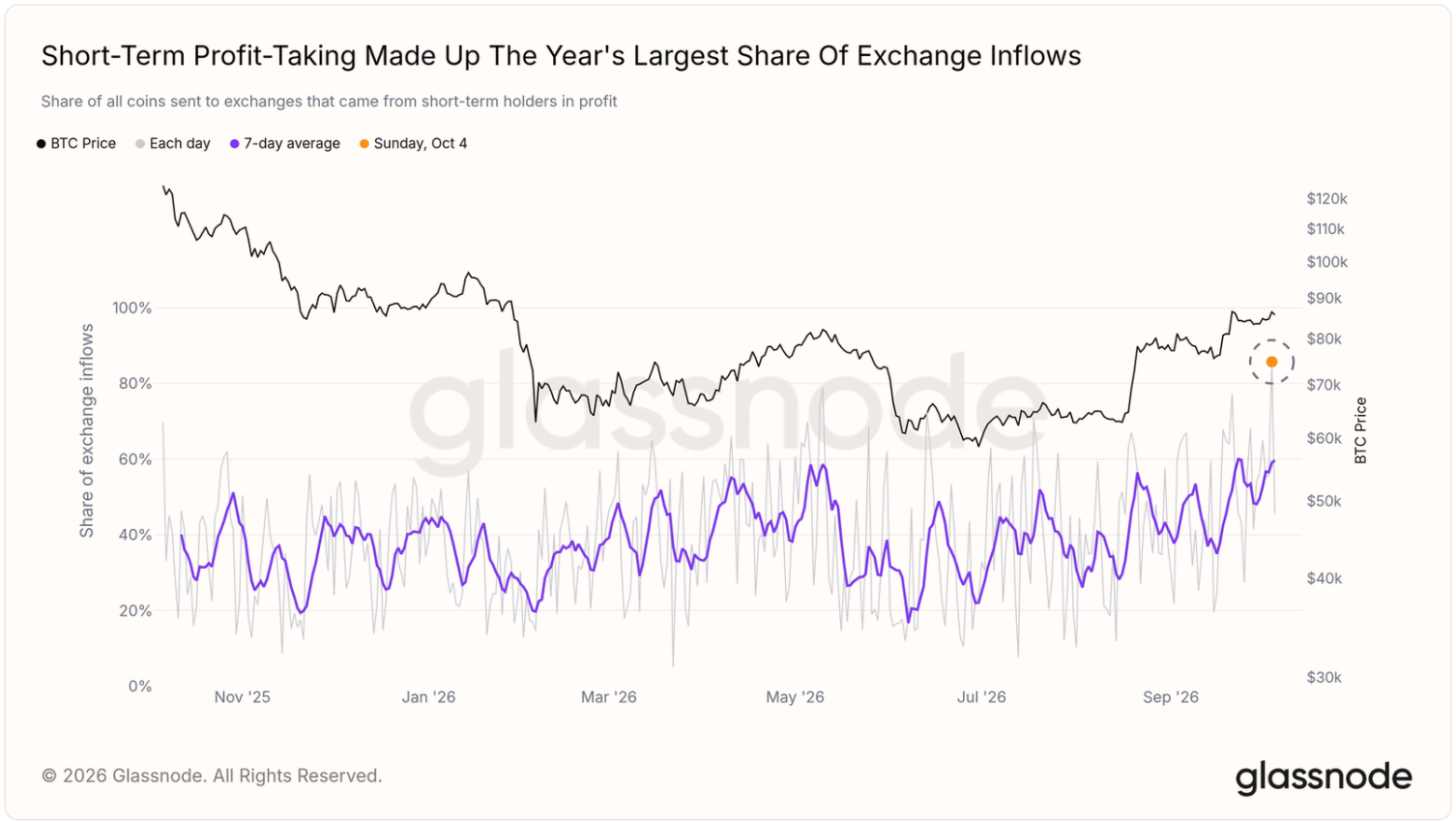
Bitcoin STH profit-taking data (screenshot). Source: Glassnode


Short-term holders are traditionally considered to be more sensitive to price volatility. The cohort remains in net profit, with its aggregate cost basis, also known as realized price, still at around $78,250 as of Oct. 7, per data from CryptoQuant.
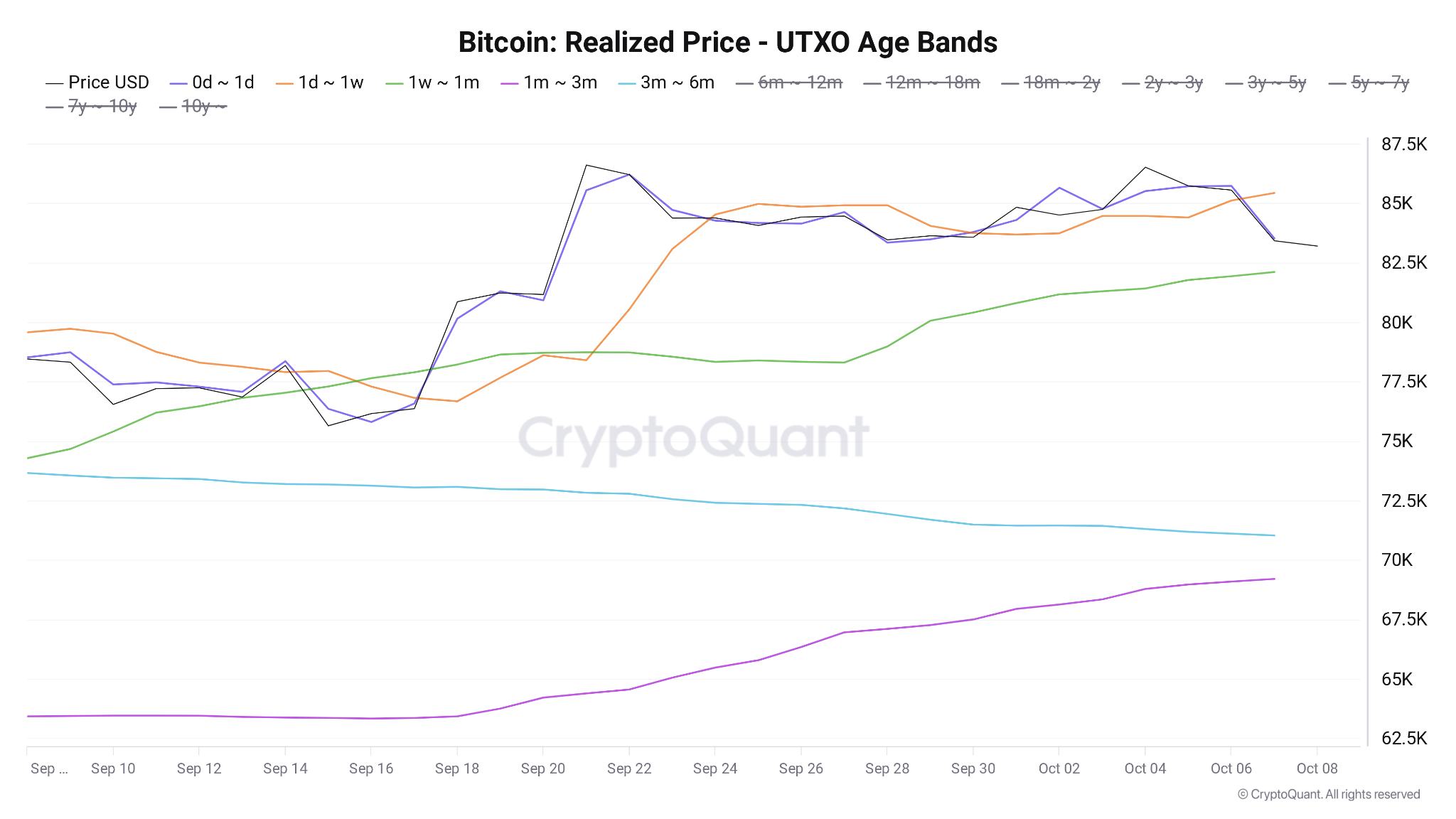

Bitcoin STH realized price by transaction age. Source: CryptoQuant


Trending Cryptos

Related Questions

QWhat is the amount of 'new money' inflows to Bitcoin in the 30 days to Oct. 5, according to Glassnode?

ARolling 30-day cumulative inflows of 'new money' to Bitcoin reached $4.9 billion on Oct. 5, according to Glassnode data.

QHow much did Bitcoin's realized cap grow in the 30-day period ending Oct. 5?

ABitcoin's realized cap grew by $12.8 billion in the 30-day period ending Oct. 5.

QWhat percentage of the profit-taking above $85,000 was attributed to short-term holders?

AShort-term holders accounted for more than 80% (specifically about 86% on the day of the first weekly close above $85,000) of profit-taking above $85,000.

QAccording to Glassnode, who is primarily responsible for Bitcoin's recent realized cap growth?

AAccording to Glassnode, existing investors holding money already in the market were primarily responsible for Bitcoin's recent realized cap growth, accounting for three-fifths of the $12.8 billion increase.

QWhat is the aggregate cost basis (realized price) for Bitcoin short-term holders as of Oct. 7, per CryptoQuant data?

AAs of Oct. 7, the aggregate cost basis (realized price) for Bitcoin short-term holders is approximately $78,250, according to CryptoQuant data.

Related Reads

Mercado Bitcoin begins post-hack reopening without a timeline for withdrawals

Mercado Bitcoin, one of Brazil's largest crypto exchanges, began restoring read-only access to customer accounts in phases on Monday, a week after attackers drained an estimated $49 million from the platform. Access started at 19:00 UTC, with all accounts expected to be viewable by 21:00 UTC, showing holdings as they stood on Nov. 2, the day of the hack. The exchange has yet to say when customers will be able to withdraw funds. Fabricio Tota, vice president of new business, said the exchange hoped read-only access would reassure customers that their assets were still recorded on the platform. He explained that the company opted for "a more conservative approach" to reactivating accounts "to ensure our return happens with the utmost security." The caution follows concerns from blockchain security analysts that attackers were able to access addresses, draining funds through standard transfers rather than a smart contract exploit. Blockchain analysts traced some of the stolen funds to customer deposit addresses, but Mercado Bitcoin says customers won't bear the losses. Tota said the vast majority of assets were never even touched by anyone and were not involved in the incident. On Nov. 4, Mercado Bitcoin pledged to cover all losses with company funds, bolstered by a $20 million investment from stablecoin issuer Tether in July. Tota highlighted that a portion of the stolen funds were also frozen in the hours after the company announced the attack. The next phase of recovery will require users to confirm their registration details before they can move funds. The exchange plans to restore withdrawals via Pix, Brazil's instant payment system, initially allowing customers to withdraw only to accounts in their own name. Tota gave no date for either step. Mercado Bitcoin has yet to explain how the attackers gained access to its wallets. Blockchain data company Bitquery found that as of Nov. 4, wallets linked to the attacker held most of the stolen funds that had escaped freezes, including 106.07 BTC.

cointelegraph5h ago

Mercado Bitcoin begins post-hack reopening without a timeline for withdrawals

cointelegraph5h ago

Avalanche’s AVAX leads crypto gains following NYSE tokenization deal

Avalanche's AVAX token rose as much as 10% on Monday, becoming the top gainer among the 100 largest cryptocurrencies, after the New York Stock Exchange announced plans to use Avalanche's blockchain to settle trades on a new platform for trading tokenized stocks around the clock. AVAX later eased to $8.86, still up over 8% on the day, with a market cap of around $3.95 billion and $439.7 million traded in the past 24 hours. Avalanche's total value locked stands at $633 million, up 4% over the past day. NYSE's head of digital issuance, Dennis Lee, said the exchange is examining how blockchain technology can expand its equities offerings and is picking the right technology for each job. The deal underscores Wall Street's growing effort to use blockchain to make stock trading faster and enable trading outside regular market hours; traditional US markets are open 9:30 am to 4:00 pm EST on weekdays, with trades often taking at least one business day to settle. The NYSE first announced plans for the platform in January, and Ava Labs revealed in September that the exchange had spent about a year testing Avalanche, though the final selection was not confirmed until Monday. Avalanche will record stock trades and help complete transactions on the platform, which will let investors buy and sell digital versions of stocks across different blockchains. Lee said the settlement ledger needs to be fast, reliable, permissioned, cost-predictable, and backed by a large developer community—all of which Avalanche meets. The platform could launch before the end of 2026 pending regulatory approval. Ava Labs chief business officer John Nahas said first conversations with the NYSE began nearly a year ago and called it an important step toward blockchain becoming foundational financial infrastructure. The news comes as other major firms invest in blockchain for faster, round-the-clock trading: Nasdaq plans to invest $100 million in Kraken's parent Payward to launch tokenized stocks by Q2 2027, and the DTCC launched a service in October allowing firms to turn traditional securities into digital tokens. The NYSE deal follows other efforts to bring traditional assets onto Avalanche, including Progmat moving over 452 billion yen in digital securities onto a dedicated Avalanche blockchain in July and Aave Labs' plans for a lending service using tokenized assets as collateral.

cointelegraph6h ago

Avalanche’s AVAX leads crypto gains following NYSE tokenization deal

cointelegraph6h ago

Trading

Spot

Hot Articles

What is $BITCOIN

DIGITAL GOLD ($BITCOIN): A Comprehensive Analysis Introduction to DIGITAL GOLD ($BITCOIN) DIGITAL GOLD ($BITCOIN) is a blockchain-based project operating on the Solana network, which aims to combine the characteristics of traditional precious metals with the innovation of decentralized technologies. While it shares a name with Bitcoin, often referred to as “digital gold” due to its perception as a store of value, DIGITAL GOLD is a separate token designed to create a unique ecosystem within the Web3 landscape. Its goal is to position itself as a viable alternative digital asset, although specifics regarding its applications and functionalities are still developing. What is DIGITAL GOLD ($BITCOIN)? DIGITAL GOLD ($BITCOIN) is a cryptocurrency token explicitly designed for use on the Solana blockchain. In contrast to Bitcoin, which provides a widely recognized value storage role, this token appears to focus on broader applications and characteristics. Notable aspects include: Blockchain Infrastructure: The token is built on the Solana blockchain, known for its capacity to handle high-speed and low-cost transactions. Supply Dynamics: DIGITAL GOLD has a maximum supply capped at 100 quadrillion tokens (100P $BITCOIN), although details regarding its circulating supply are currently undisclosed. Utility: While precise functionalities are not explicitly outlined, there are indications that the token could be utilized for various applications, potentially involving decentralized applications (dApps) or asset tokenization strategies. Who is the Creator of DIGITAL GOLD ($BITCOIN)? At present, the identity of the creators and development team behind DIGITAL GOLD ($BITCOIN) remains unknown. This situation is typical among many innovative projects within the blockchain space, particularly those aligning with decentralized finance and meme coin phenomena. While such anonymity may foster a community-driven culture, it intensifies concerns about governance and accountability. Who are the Investors of DIGITAL GOLD ($BITCOIN)? The available information indicates that DIGITAL GOLD ($BITCOIN) does not have any known institutional backers or prominent venture capital investments. The project seems to operate on a peer-to-peer model focused on community support and adoption rather than traditional funding routes. Its activity and liquidity are primarily situated on decentralized exchanges (DEXs), such as PumpSwap, rather than established centralized trading platforms, further highlighting its grassroots approach. How DIGITAL GOLD ($BITCOIN) Works The operational mechanics of DIGITAL GOLD ($BITCOIN) can be elaborated on based on its blockchain design and network attributes: Consensus Mechanism: By leveraging Solana’s unique proof-of-history (PoH) combined with a proof-of-stake (PoS) model, the project ensures efficient transaction validation contributing to the network's high performance. Tokenomics: While specific deflationary mechanisms have not been extensively detailed, the vast maximum token supply implies that it may cater to microtransactions or niche use cases that are still to be defined. Interoperability: There exists the potential for integration with Solana’s broader ecosystem, including various decentralized finance (DeFi) platforms. However, the details regarding specific integrations remain unspecified. Timeline of Key Events Here is a timeline that highlights significant milestones concerning DIGITAL GOLD ($BITCOIN): 2023: The initial deployment of the token occurs on the Solana blockchain, marked by its contract address. 2024: DIGITAL GOLD gains visibility as it becomes available for trading on decentralized exchanges like PumpSwap, allowing users to trade it against SOL. 2025: The project witnesses sporadic trading activity and potential interest in community-led engagements, although no noteworthy partnerships or technical advancements have been documented as of yet. Critical Analysis Strengths Scalability: The underlying Solana infrastructure supports high transaction volumes, which could enhance the utility of $BITCOIN in various transaction scenarios. Accessibility: The potential low trading price per token could attract retail investors, facilitating wider participation due to fractional ownership opportunities. Risks Lack of Transparency: The absence of publicly known backers, developers, or an audit process may yield skepticism regarding the project's sustainability and trustworthiness. Market Volatility: The trading activity is heavily reliant on speculative behavior, which can result in significant price volatility and uncertainty for investors. Conclusion DIGITAL GOLD ($BITCOIN) emerges as an intriguing yet ambiguous project within the rapidly evolving Solana ecosystem. While it attempts to leverage the “digital gold” narrative, its departure from Bitcoin's established role as a store of value underscores the need for a clearer differentiation of its intended utility and governance structure. Future acceptance and adoption will likely depend on addressing the current opacity and defining its operational and economic strategies more explicitly. Note: This report encompasses synthesised information available as of October 2023, and developments may have transpired beyond the research period.

5.0k Total ViewsPublished 2025.05.14Updated 2025.05.14

What is $BITCOIN

Discussions

Welcome to the HTX Community. Here, you can stay informed about the latest platform developments and gain access to professional market insights. Users' opinions on the price of BTC (BTC) are presented below.

活动图片