Bitcoin ETFs Lost Nearly $390 Million Over the Week, While SOL ETFs Attracted New Capital

cryptonews.ruPublished on 2026-08-16Last updated on 2026-08-16

Abstract

Between August 10 and 14, 2026, the US spot Bitcoin ETF sector experienced a significant net outflow of $389.71 million, according to SoSoValue data. Outflows were recorded on four of the five trading days, primarily affecting major funds like Fidelity's FBTC ($153.23M outflow) and BlackRock's IBIT ($78.96M outflow). While Grayscale's BTC and Morgan Stanley's MSBT saw inflows, most Bitcoin ETFs ended the week with outflows or neutral flows. The spot Ethereum ETF sector also saw a net outflow of $2.26 million for the week, led by BlackRock's ETHA. In contrast, several altcoin-based ETFs attracted new capital. SOL-ETFs led with an inflow of $10.26 million, followed by funds tied to HYPE, XRP, LINK, and HBAR. DOGE-ETFs were an exception with a minor outflow. Activity in the Hong Kong market remained minimal. This follows a week where over $1 billion flowed into various crypto funds.

From August 10 to 14, 2026, the spot Bitcoin ETF sector in the United States recorded a total capital outflow of $389.71 million, according to data from SoSoValue.
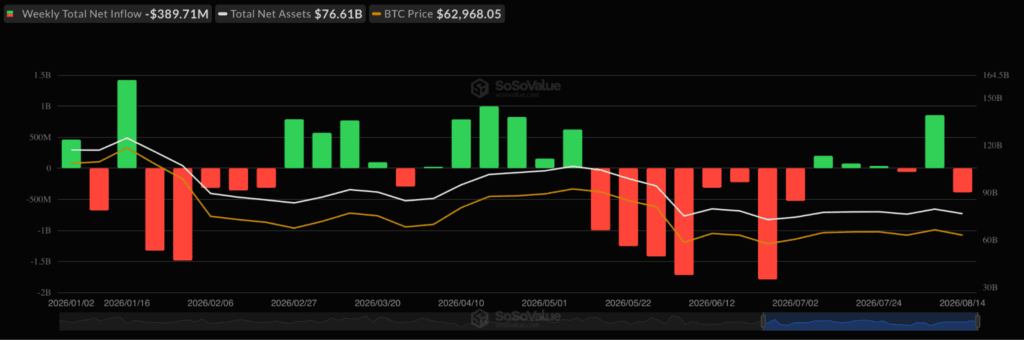
Dynamics of capital inflows/outflows from spot Bitcoin ETFs in the US. Data: SoSoValue.

Outflows were observed on four out of five trading days during the week:

  • August 10 — $144.67 million;
  • August 12 — $61.16 million;
  • August 13 — $131.13 million;
  • August 14 — $57.63 million.

The outflow during the reporting period came from BlackRock's IBIT — $78.96 million. At the same time, the largest single fund to see outflows was Fidelity's FBTC — $153.23 million.

The following funds also showed negative trends:

  • GBTC from Grayscale — $88.3 million;
  • ARKB from ARK Invest/21Shares — $70.36 million.

Only two funds recorded positive results:

  • BTC from Grayscale — $75.98 million;
  • MSBT from Morgan Stanley — $7.08 million.

Other Bitcoin ETFs also ended the week with outflows or without significant capital inflows.

Ethereum ETFs Lost $2.26 Million

The spot Ethereum ETF sector ended the week with a total outflow of $2.26 million, according to SoSoValue data.
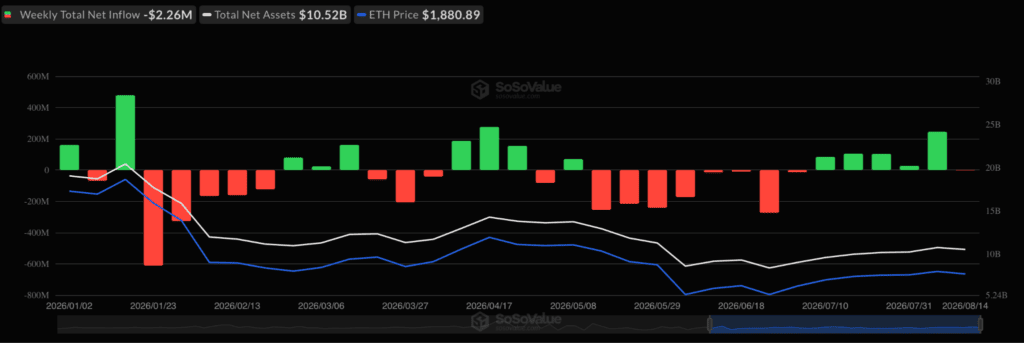
Dynamics of capital inflows/outflows from spot Ethereum ETFs in the US. Data: SoSoValue.

The largest outflow was recorded by BlackRock's ETHA — $16.39 million. Investors withdrew another $5.6 million from Fidelity's FETH.

At the same time, some of the losses were offset by:

  • $ETH from Grayscale — $15.07 million;
  • ETHB from 21Shares — $3.86 million;
  • MSSE from Morgan Stanley — $0.81 million.

Other funds based on Ethereum did not attract any assets under management during the week.

We explained what Ethereum ETFs are in a separate article:

$SOL-ETFs Became Leaders Among Altcoins

Unlike Bitcoin and Ethereum funds, some exchange-traded products based on altcoins showed positive trends.

The largest capital inflows were recorded by:

  • $SOL-ETFs — $10.26 million;
  • HYPE-ETFs — $2.74 million;
  • XRP-ETFs — $2.25 million;
  • LINK-ETFs — $1.23 million;
  • HBAR-ETFs — $0.46 million.

At the same time, DOGE-ETFs recorded an outflow of $0.56 million.

Other funds based on altcoins did not attract investments during the reporting period.

Activity remained minimal in the Hong Kong market as well: only 0.17 $ETH was added to spot Ethereum ETFs over the week.

Recall that last week, investors poured over $1 billion into various crypto funds.

end-content
Trending Cryptos

Related Questions

QWhat was the total net outflow from U.S. spot Bitcoin ETFs for the week of August 10-14, 2026?

AThe U.S. spot Bitcoin ETF sector recorded a total net capital outflow of $389.71 million for the week.

QWhich two Bitcoin ETFs were the only ones to record a positive inflow of capital during the reported week?

AThe two Bitcoin ETFs with a positive inflow were BTC from Grayscale with $75.98 million and MSBT from Morgan Stanley with $7.08 million.

QHow much capital did the U.S. spot Ethereum ETF sector lose during the same week?

AThe U.S. spot Ethereum ETF sector ended the week with a total net outflow of $2.26 million.

QAmong altcoin ETFs, which one attracted the most capital and how much was it?

AThe SOL-ETF was the leader among altcoin ETFs, attracting $10.26 million in capital.

QWhich Bitcoin ETF from a specific issuer experienced the largest single outflow of capital during the week?

AFBTC from Fidelity experienced the largest single outflow among individual Bitcoin ETFs, with $153.23 million withdrawn.

Related Reads

WasabiCard Launches "Global Card Issuance Solution" to Help Businesses Launch Local Card Programs in 100+ Markets

WasabiCard has launched its "WasabiCard Local Issuing Solution," enabling businesses to quickly establish and manage local card issuing programs in over 100 markets through a single API, while meeting regulatory compliance requirements, offering competitive rates, and supporting stablecoin settlement in USDT, USDC, and Open USD (OUSD). CEO Ray Yang noted that companies expanding globally previously had to issue cards from one market and hope the model worked elsewhere, which increased friction around compliance, payment acceptance, and fees. The new solution lets businesses use one API to build local card programs across 100+ markets while flexibly choosing stablecoin settlement, branded experiences, and familiar payment methods. Built on WasabiCard's underlying infrastructure and partnerships with local financial institutions, the solution lets businesses use regional BINs and build card programs around local issuing systems. Local issuing helps reduce cross-border and FX costs and improves the payment experience. After a single API integration, businesses can issue and manage cards across markets, control card lifecycles, and set program rules. Following KYB, compliance, and partner review, accounts can be opened in as little as 24 hours. Businesses can choose corporate or individual BINs, support virtual and physical cards via Apple Pay and Google Pay, and opt for white-label services. The solution combines stablecoin settlement with familiar card payment experiences, offering Visa and Mastercard commercial and individual card options. Compliance checks begin before deposited funds can be spent: on-chain data is cross-verified to understand funding sources and identify links to fraud or stolen assets. Directly high-risk funds are rejected, while indirect links trigger further review. Use cases span global payroll and payouts to Web3 teams, contractors, and partners; creator and commission payouts for content and livestream platforms; digital advertising and AI service subscriptions; and corporate procurement and employee expense management. WasabiCard serves over 700 enterprise clients, with more than 700,000 cards issued and over $1 billion in transaction volume, covering 200+ countries and regions and supporting 70+ card BINs. WasabiCard is a global payment infrastructure platform providing card issuing, global payouts, and cross-border payment capabilities through stablecoin-driven financial infrastructure, serving advertising, AI and SaaS subscriptions, global payroll, treasury management, and digital finance use cases.

marsbit34m ago

WasabiCard Launches "Global Card Issuance Solution" to Help Businesses Launch Local Card Programs in 100+ Markets

marsbit34m ago

Jensen Huang Caught in Another Affair with Subordinate, Probability of Departing NVIDIA by Month's End Nears 90%

NVIDIA CEO Jensen Huang is facing escalating scandal after reports of a second extramarital affair. Following earlier allegations involving Alice Huang, an executive at Singapore data center company Megaspeed, The New York Times reported that Huang also had an affair with Kimberly Powell, a married NVIDIA vice president of healthcare and one of roughly 60 executives reporting directly to him. Powell, 48, joined NVIDIA in 2008 and has led its healthcare business since 2017. NVIDIA's code of conduct prohibits private relationships that could create conflicts of interest. NVIDIA's earlier statement that the matter would not affect Huang's role as CEO has reportedly been withdrawn. The Wall Street Journal reported that the board is considering meeting to discuss Huang's future, potentially appointing an interim leader while searching for a new CEO with outside firms. Polymarket odds of Huang leaving before November 30, 2026 have risen to 88%, and to 93% before March 31, 2027. Elon Musk, responding to a suggestion that he hire Huang, said it "would be an honor." The news triggered sharp stock moves: NVIDIA closed up 2.87% but fell as much as 10% after hours, shedding over $300 billion in market value and dragging down other AI stocks including Intel and Dell. A key concern is succession: NVIDIA has no clear plan, and Huang's unusual management structure—with dozens of direct reports and few layers—makes him the central node of the company. While executives like CFO Colette Kress could handle operations, none can quickly replace Huang's industry influence and role as NVIDIA's public face. Neither Huang nor NVIDIA has confirmed or denied the second affair.

Odaily星球日报59m ago

Jensen Huang Caught in Another Affair with Subordinate, Probability of Departing NVIDIA by Month's End Nears 90%

Odaily星球日报59m ago

Ethereum Plans to Move Post-Quantum and Anti-AI Upgrades Forward to 2027: Ethlabs Proposes Restructuring the Hegotá Hard Fork Plan

Ethlabs, a non-profit Ethereum R&D lab, has submitted the pqai27 community proposal to the Ethereum community forum, calling for 2027 to be the target year for achieving quantum resistance and AI resistance on Ethereum. With Ethereum's on-chain TVL exceeding $41.16 billion as of November 12, the proposal argues that Ethereum should leverage its existing hash-based cryptography and formal verification foundations to reinforce its position as the global value settlement layer as AI evolves rapidly and quantum timelines accelerate. The direct motivation is the compression of external timelines: the U.S. government has moved its quantum-resistance target from 2035 to 2030, and Google plans to complete its full cryptographic migration by 2029. AI attack capabilities are also advancing—OpenAI has used frontier models to find and patch roughly 1,000 Linux vulnerabilities and solve hundreds of math problems. "AI resistance" means relying on minimal hash primitives, formal verification, and client diversity to harden the base layer. The roadmap splits 2027 into two stages. The baseline "pqai-ready" stage requires quantum resistance at the consensus layer and ensures users can migrate to quantum-resistant accounts via the Frames account abstraction proposal EIP-8141; if existing cryptography fails early, the network can degrade to calldata to keep running. The advanced "pqai-scaled" stage targets full-capacity operation, introducing EIP-8288 for quantum-resistant signature aggregation and EIP-8479 for quantum-resistant data availability, so quantum-resistant transactions and blobs can regain normal throughput after scaling. To this end, Ethlabs recommends restructuring the scope of the Hegotá hard fork, stripping out non-critical upgrades and reassessing the impact of the FOCIL anti-censorship proposal (EIP-7805) on progress and compatibility; if the execution layer is decoupled from the consensus layer, Frames could ship independently first. The consensus layer must choose between retrofitting the existing Gasper implementation for quantum resistance and moving to decoupled consensus. Ethlabs announced it is withdrawing its push for Quick Slots (EIP-8198) in Hegotá, deferring it to 2028, while Glamsterdam and its scaling plans proceed as normal. The roadmap remains an Ethlabs community initiative; any Hegotá fork restructuring or consensus-layer switch requires further discussion and agreement among Ethereum's All Core Devs. Ethlabs notes that AI is also accelerating formal verification and zero-knowledge proof benchmark optimization, and that advancing pqai27 aims to consolidate Ethereum and ETH's role as the trust root for global value settlement during extreme security cycles.

marsbit1h ago

Ethereum Plans to Move Post-Quantum and Anti-AI Upgrades Forward to 2027: Ethlabs Proposes Restructuring the Hegotá Hard Fork Plan

marsbit1h ago

Former OpenAI Researcher Changes His Tune: Super AI Researcher Could Arrive as Early as Next Year

Former OpenAI researcher Daniel Kokotajlo and the AI Futures Project have revised their timelines, now predicting superhuman AI researchers (SARs) could arrive as early as 2027 rather than 2029. The key driver is a METR assessment of Anthropic, which found that since October 2025, the benchmark score growth rate of Anthropic's internal models reached about 1.9x the previous pace (95% CI: 1.5–2.8x) — roughly two years' worth of progress in one year. METR estimates that by October 2026, about 80% of the extra acceleration may come from AI itself, though this is a subjective guess with high uncertainty. AI is already helping researchers write experiment code, run tests, and try out more ideas. Using METR's estimates, the team calculated that by early November 2026, AI-driven acceleration alone could push overall model progress to 1.7x the historical rate — a speed that, in the original AI 2027 scenario, wouldn't be reached until around April 2027, about five months later. Notably, METR says most of the evidence underpinning its core conclusions was redacted from the public report at Anthropic's request, to avoid helping competitors; only the benchmark curves are publicly verifiable. Depending on the method used, SAR arrival estimates range from February 2027 to mid-2028. If acceleration compounds across model generations, superintelligence could arrive sooner than expected.

marsbit1h ago

Former OpenAI Researcher Changes His Tune: Super AI Researcher Could Arrive as Early as Next Year

marsbit1h ago

Aave V3.8 Officially Launches: Covering 15 Public Chains, $15.2 Billion Liquidity Pool, Introducing Low-Gas-Cost Reentrancy Protection

Aave has launched V3.8 across 15 active V3 markets, following approval by the Aave DAO and development by Aave Labs. According to DeFiLlama, Aave's total value locked exceeds $16.4 billion, with active V3 markets holding over $15.23 billion. The upgrade was deployed via AIP #541, completing a 22-day governance process that began with a forum proposal on October 21 and a Snapshot vote on October 27. V3.8 covers active instances on Ethereum (Core and Lido), Plasma, Avalanche, BNB Chain, Monad, Base, and Arbitrum, along with Mantle, X Layer, Polygon, Linea, Optimism, Gnosis, MegaETH, and Celo. Legacy markets that were frozen with zero caps were deliberately skipped. The release introduces kernel-level reentrancy protection for external callback operations on liquidity pools. Traditionally, preventing cross-function reentrancy requires writing a lock flag before state changes, but after EIP-3529 capped SSTORE refunds at 20%, maintaining persistent locks in high-frequency lending pools became gas-intensive. V3.8 instead uses EIP-1153 transient storage, where TSTORE and TLOAD cost only 100 gas per read or write and automatically clear at transaction end, providing reentrancy hardening at minimal cost. Aave Labs addressed developer concerns that the lock might block liquidation composability within flash loan callbacks. The flashLoan and flashLoanSimple entry points only check the lock status without setting it, creating asymmetric isolation: users can still compose liquidations, deposits, or repayments inside a flash loan callback, but attempts to initiate a flash loan from within a regular pool operation callback are rejected and reverted. Security verification included Certora formal verification and independent external audits before the AIP vote. The new contract code is published in the official Aave V3 repository under the Business Source License. Developers also noted that downstream integrators reading view functions such as account health factors or reserve data during callbacks should account for intermediate ledger states and ensure peripheral risk controls remain compatible.

marsbit1h ago

Aave V3.8 Officially Launches: Covering 15 Public Chains, $15.2 Billion Liquidity Pool, Introducing Low-Gas-Cost Reentrancy Protection

marsbit1h ago

Trading

Spot

Hot Articles

What is $BITCOIN

DIGITAL GOLD ($BITCOIN): A Comprehensive Analysis Introduction to DIGITAL GOLD ($BITCOIN) DIGITAL GOLD ($BITCOIN) is a blockchain-based project operating on the Solana network, which aims to combine the characteristics of traditional precious metals with the innovation of decentralized technologies. While it shares a name with Bitcoin, often referred to as “digital gold” due to its perception as a store of value, DIGITAL GOLD is a separate token designed to create a unique ecosystem within the Web3 landscape. Its goal is to position itself as a viable alternative digital asset, although specifics regarding its applications and functionalities are still developing. What is DIGITAL GOLD ($BITCOIN)? DIGITAL GOLD ($BITCOIN) is a cryptocurrency token explicitly designed for use on the Solana blockchain. In contrast to Bitcoin, which provides a widely recognized value storage role, this token appears to focus on broader applications and characteristics. Notable aspects include: Blockchain Infrastructure: The token is built on the Solana blockchain, known for its capacity to handle high-speed and low-cost transactions. Supply Dynamics: DIGITAL GOLD has a maximum supply capped at 100 quadrillion tokens (100P $BITCOIN), although details regarding its circulating supply are currently undisclosed. Utility: While precise functionalities are not explicitly outlined, there are indications that the token could be utilized for various applications, potentially involving decentralized applications (dApps) or asset tokenization strategies. Who is the Creator of DIGITAL GOLD ($BITCOIN)? At present, the identity of the creators and development team behind DIGITAL GOLD ($BITCOIN) remains unknown. This situation is typical among many innovative projects within the blockchain space, particularly those aligning with decentralized finance and meme coin phenomena. While such anonymity may foster a community-driven culture, it intensifies concerns about governance and accountability. Who are the Investors of DIGITAL GOLD ($BITCOIN)? The available information indicates that DIGITAL GOLD ($BITCOIN) does not have any known institutional backers or prominent venture capital investments. The project seems to operate on a peer-to-peer model focused on community support and adoption rather than traditional funding routes. Its activity and liquidity are primarily situated on decentralized exchanges (DEXs), such as PumpSwap, rather than established centralized trading platforms, further highlighting its grassroots approach. How DIGITAL GOLD ($BITCOIN) Works The operational mechanics of DIGITAL GOLD ($BITCOIN) can be elaborated on based on its blockchain design and network attributes: Consensus Mechanism: By leveraging Solana’s unique proof-of-history (PoH) combined with a proof-of-stake (PoS) model, the project ensures efficient transaction validation contributing to the network's high performance. Tokenomics: While specific deflationary mechanisms have not been extensively detailed, the vast maximum token supply implies that it may cater to microtransactions or niche use cases that are still to be defined. Interoperability: There exists the potential for integration with Solana’s broader ecosystem, including various decentralized finance (DeFi) platforms. However, the details regarding specific integrations remain unspecified. Timeline of Key Events Here is a timeline that highlights significant milestones concerning DIGITAL GOLD ($BITCOIN): 2023: The initial deployment of the token occurs on the Solana blockchain, marked by its contract address. 2024: DIGITAL GOLD gains visibility as it becomes available for trading on decentralized exchanges like PumpSwap, allowing users to trade it against SOL. 2025: The project witnesses sporadic trading activity and potential interest in community-led engagements, although no noteworthy partnerships or technical advancements have been documented as of yet. Critical Analysis Strengths Scalability: The underlying Solana infrastructure supports high transaction volumes, which could enhance the utility of $BITCOIN in various transaction scenarios. Accessibility: The potential low trading price per token could attract retail investors, facilitating wider participation due to fractional ownership opportunities. Risks Lack of Transparency: The absence of publicly known backers, developers, or an audit process may yield skepticism regarding the project's sustainability and trustworthiness. Market Volatility: The trading activity is heavily reliant on speculative behavior, which can result in significant price volatility and uncertainty for investors. Conclusion DIGITAL GOLD ($BITCOIN) emerges as an intriguing yet ambiguous project within the rapidly evolving Solana ecosystem. While it attempts to leverage the “digital gold” narrative, its departure from Bitcoin's established role as a store of value underscores the need for a clearer differentiation of its intended utility and governance structure. Future acceptance and adoption will likely depend on addressing the current opacity and defining its operational and economic strategies more explicitly. Note: This report encompasses synthesised information available as of October 2023, and developments may have transpired beyond the research period.

5.1k Total ViewsPublished 2025.05.14Updated 2025.05.14

What is $BITCOIN

Discussions

Welcome to the HTX Community. Here, you can stay informed about the latest platform developments and gain access to professional market insights. Users' opinions on the price of BTC (BTC) are presented below.

活动图片