AVAX Shares Surged After South Korean Giant with $200 Billion Market Cap Was Brought Onboard to Launch Tokenized Securities

cryptonews.ruPublished on 2026-09-08Last updated on 2026-09-08

Abstract

The price of Avalanche's AVAX token rose following an announcement by South Korean financial giant Hanwha Investment & Securities. The firm, part of the Hanwha Group, has readied a tokenized securities platform built by FairSquare Lab. This platform integrates the public Avalanche blockchain with the Hyperledger Besu enterprise blockchain, which is prevalent in South Korea's financial sector. The development supports a nationwide initiative to fully launch tokenized securities trading. New South Korean regulations, set to take effect in February 2027, will legally recognize distributed ledgers as securities registries. The nation's financial regulator plans a three-phase integration, and the Korea Securities Depository is building infrastructure connecting to Avalanche, Besu, and Hyperledger Fabric. Avalanche noted this positions it at the center of bringing traditional assets onto global blockchain markets. Hanwha's move is part of a broader digital asset strategy, which includes becoming the largest shareholder in tokenization firm Securitize and investing in Digital Asset, the company behind the Canton Network. The group's CEO aims to transform Hanwha into a digital asset-focused broker built on real-world asset tokenization.

Today, the $AVAX token of the Avalanche blockchain received a development boost after the brokerage arm of South Korean giant Hanwha Group, Hanwha Investment & Securities, which manages $200 billion in assets, announced its tokenized securities platform is ready.

This news, confirmed by Avalanche, advances a nationwide initiative for full-scale trading of tokenized securities, regulations for which are set to take effect in February 2027.

According to CoinMarketCap , $AVAX shares traded at around $8.06, having risen 5.24% in 24 hours, with a market capitalization of $3.48 billion .

When Did Hanwha Launch Its Tokenized Securities Platforms?

The tokenized securities platform introduced by Hanwha in early September has been under development since 2025, built by blockchain company FairSquare Lab.

The brokerage firm developed a system to combine Avalanche's public infrastructure with the corporate blockchain Hyperledger Besu, which is widely used in South Korea's financial sector.

Tokenized securities register capital market instruments such as stocks and bonds on a distributed ledger. Avalanche acknowledged the potential of this launch, noting it positions the network at the center of bringing "traditional assets onto global blockchain markets."

Hanwha itself has not published specific details about the platform for users.

South Korea Approaches the February 2027 Deadline

South Korea's National Assembly passed amendments that will legally recognize distributed ledgers as securities registers in the country from February 4, 2027. The new regime was approved in mid-January when regulators greenlit changes to the Securities Act and the Capital Markets Act.

As Cryptopolitan previously reported, Korea's top financial regulator, the Financial Services Commission (FSC), plans to integrate the issuance of blockchain-based securities into the existing financial system in three stages.

  • The first stage covers private money market investment funds, corporate bonds for institutional investors, unlisted shares issued through a trust structure, and publicly offered securities for equity investment.
  • Subsequent stages will focus on expanding coverage to all publicly offered securities.
  • Finally, infrastructure for direct on-chain settlement is to be created, allowing investors to conduct transactions for tokenized assets using stablecoins.

Korea's Securities Depository is building its own infrastructure, which will be connected to Avalanche, Hyperledger Besu, and Hyperledger Fabric. The inclusion of Avalanche in the project was driven by numerous requests from companies participating in the tokenized securities working group, as a depository spokesperson told the Seoul Economic Daily.

Hanwha's Broader Bets on Tokenization

The Avalanche platform is just one part of a broader digital asset development strategy. Hanwha Group acquired a 9.6% stake in tokenization company Securitize across three subsidiaries, becoming its largest shareholder.

In July, the group's securities unit invested 30 billion Korean won, equivalent to about $22.3 million, in Digital Asset, the company behind the Canton Network.

In February , Cryptopolitan reported that Hanwha CEO Byung-ho Chang wants to transform the company into a digital asset-focused broker built on real-world asset tokenization, with issuance, custody, and real-time trading on the blockchain.

end-content
Related Questions

QWhat major Korean company has announced a tokenized securities platform on Avalanche, leading to a price increase for AVAX?

AHanwha Investment & Securities, the brokerage arm of the Hanwha Group, has announced the readiness of its tokenized securities platform built on Avalanche.

QAccording to the article, what is the key regulatory deadline in South Korea for the full-scale trading of tokenized securities?

AThe legal amendments recognizing distributed ledgers as securities registries in South Korea will take effect from February 4, 2027.

QWhich two blockchain technologies does Hanwha's platform integrate to connect the public Avalanche with the Korean financial sector's corporate standard?

AThe platform integrates the public Avalanche blockchain with the corporate blockchain Hyperledger Besu, which is widespread in the Korean financial sector.

QWhat broader digital asset strategy move by Hanwha Group involved acquiring a significant stake in the tokenization company Securitize?

AHanwha Group acquired a 9.6% stake in Securitize across three subsidiaries, becoming the largest shareholder.

QWhat was the price and 24-hour change for AVAX at the time of the article's reporting?

AAt the time of reporting, AVAX was trading at approximately $8.06, marking a 5.24% increase over 24 hours.

Related Reads

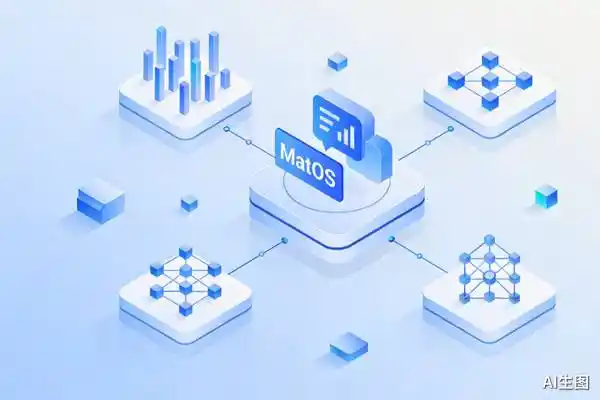
Materials Science Agent MatOS Officially Open-Sourced, Significantly Improving the Success Rate of Materials R&D Tasks

MatOS is an open-source agent operating system for materials research developed by the Beijing Zhongguancun Academy and Zhongguancun Institute of AI. It addresses key challenges in autonomous materials research: integrating new databases and software without rebuilding pipelines, maintaining state over multi-day tasks, and reusing accumulated experience across studies. MatOS organizes data, knowledge, tools, skills, roles, and workflows into six types of scientific assets connected through typed relationships, allowing both researchers and the system itself to build new capabilities on existing assets. Its stateful adaptive workflows use execution graphs with explicit steps and check conditions to keep long tasks on target, support mid-task adjustments after structural, policy, and compilation checks, and preserve snapshots independent of model sessions. An evidence-driven evolution mechanism converts user corrections, tool failures, and workflow results into candidate asset revisions, which are adopted only after structural and semantic review. The asset library currently includes 3,135 datasets, 386 skills, 104 workflows, 51 expert roles, and 48 materials computation tools. On the ResearchClawBench benchmark, MatOS scored 33.6% higher than Codex CLI on average and 80.8% higher on materials tasks; on MatTools it achieved 97.96% full-problem success. Case studies include screening 97 solid-state electrolyte candidates from over 30 million structures, alloy design with melting scores improved from 0.534 to 0.927, and developing DuoCompNet with a mean absolute error of 3.18°C. Next steps include integrating instruments and experimental workflows.

marsbit14m ago

Materials Science Agent MatOS Officially Open-Sourced, Significantly Improving the Success Rate of Materials R&D Tasks

marsbit14m ago

Gemini's New Model is Ready to Launch, Netizens: Going Through the Periodic Table of Elements?

Google's Gemini 4 series has adopted an element-themed naming scheme, and developers have now spotted a new model identifier, gemini-4-neon, in the Gemini web app code, alongside a matching subscription tier labeled TIER_NEON (displayed as "Gemini Ultra" but treated separately internally). Neon is element No. 10, which has amused and confused users, since Hydrogen (No. 1) was followed by Argon (18) and Carbon (6), with no obvious order. The series so far includes Gemini 4 Argon (complex software engineering, deep reasoning, cybersecurity), Gemini 4 Carbon (long-horizon agent tasks, coding, security), and Gemini 4 Hydrogen (speed and efficiency for everyday coding and agent workflows). Rumors of a Krypton model turned out to be a higher-reasoning Gemini 4 Hydrogen. Commenters joke that Google is picking elements at random, that naming is like Starbucks cup sizes, and that at this rate Google will need to discover new elements (with calls for Oganesson, No. 118). Some suggest the names do carry meaning: Argon means "lazy/inactive," fitting stable security work; Carbon is the basis of life and complex structures; Hydrogen is the lightest element, fitting speed; and Neon derives from "neos" (new). Beyond naming, Google's subscription tiers and six Gemini access points are also confusing users, with some Pro subscribers not seeing new models and accounts showing different model access.

marsbit15m ago

Gemini's New Model is Ready to Launch, Netizens: Going Through the Periodic Table of Elements?

marsbit15m ago

Trading

Spot
活动图片