AI 'Claude' revealed the secret of the NSA's seed crypto key 25 years later

cryptonews.ruPublished on 2026-10-17Last updated on 2026-10-17

Abstract

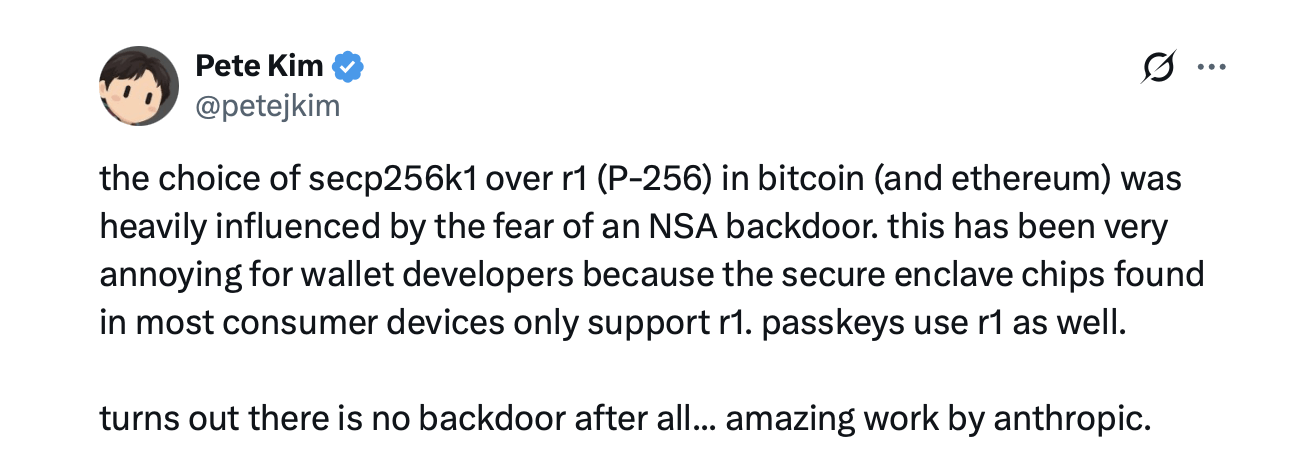
For decades, cryptographers puzzled over five elliptic curves—P-192, P-224, P-256, P-384, and P-521—used to secure internet communications and included in NIST standards. These curves contained mysterious numbers supplied by the NSA, and no one could explain their origin. Theories ranged from forgotten jokes to deliberately embedded vulnerabilities. Now, Anthropic's AI Claude has investigated the mystery and traced the numbers back to an old computer program and timestamps dating nearly three decades ago. The story began in the late 1990s when mathematicians were developing standards for elliptic-curve cryptography, which protects websites, financial transactions, and government communications.

For decades, some of the world's brightest cryptographers chased a ghost. Five mathematical curves used to secure internet communications contained mysterious numbers provided by the National Security Agency (NSA), and no one could satisfactorily explain where those numbers came from. Theories ranged from forgotten jokes to deliberately planted vulnerabilities. Then Anthropic's AI Claude took on solving this puzzle and traced those numbers back to an old computer program and timestamps dating back almost three decades.

A 25-year mystery with the NSA at the center

The story begins in the late 1990s, when mathematicians were developing standards for elliptic-curve cryptography — a method of protecting digital information using complex mathematical techniques. Five curves, known as P-192, P-224, P-256, P-384, and P-521, eventually became part of standards published by the National Institute of Standards and Technology (NIST). Their mathematical properties helped ensure the security of websites, financial transactions, and government communications.

Trending Cryptos

Related Questions

QWhat did Claude AI reveal about the NSA-related cryptographic mystery?

AClaude AI traced mysterious numbers in five elliptic curves back to an old computer program and timestamps dating nearly three decades earlier, helping explain the origin of numbers supplied by the NSA.

QWhich five elliptic curves are mentioned in the article?

AThe five curves are P-192, P-224, P-256, P-384, and P-521.

QWhy were these elliptic curves important?

AThey became part of NIST standards and helped secure websites, financial transactions, and government communications.

QWhat kinds of theories existed before the mystery was solved?

ATheories ranged from forgotten jokes to intentionally embedded vulnerabilities.

QWhen did the story of the 25-year-old mystery begin?

AIt began in the late 1990s, when mathematicians were developing standards for elliptic-curve cryptography.

Related Reads

US Stocks Trend (November 17): Nvidia Falls Another 4% to a 52-Week Low, Nasdaq Plunges 2.49%

Nvidia fell another 4.1% to $156.14, hitting a 52-week low, as the chipmaker's troubles deepened. Micron and Intel each dropped over 7%, and the Nasdaq tumbled 2.49%. The selloff spread to financials, industrials and energy, with all three major indexes closing lower. The Dow fell 739.38 points (-1.41%) to 51,608.17, the S&P 500 lost 145.08 points (-1.92%) to 7,416.59, and the Nasdaq dropped 626.52 points (-2.49%) to 24,509.76. The Russell 2000 fell 1.70%. It was the Nasdaq's biggest one-day decline since Nov. 5, and the S&P 500 and Nasdaq have now fallen for three straight sessions, erasing last week's gains. Nine of the S&P 500's 11 sectors declined, with tech and communication services down 2.98% and 2.82%, while consumer staples and utilities edged higher. The VIX jumped 18.7% to 22.91. Nvidia's board is focused on its investigation of Jensen Huang and has not discussed bringing him back as CEO, according to CNBC. The company has hired law firm Wachtell Lipton to investigate whether his conduct endangered national security or company secrets. Treasury Secretary Bessent called for a major overhaul and urged the board to look externally for a new CEO. The Commerce Department's BIS issued an interim final rule closing a loophole allowing Chinese firms to rent Nvidia compute through third-country data centers. Wall Street kept cutting targets: Mizuho lowered its to $220 from $250 and UBS to $240 from $300, both maintaining buy ratings. Mizuho's Vijay Rakesh said the roughly 32% drop from October's high, larger than the Philadelphia Semiconductor Index's 23% decline, reflects a lost "founder premium," with the CEO departure adding six to seven months of management uncertainty. Chip stocks fell broadly: Micron -7.62% to $719.02, Intel -7.07% to $55.47, Marvell and Arm each down over 7%, AMD about -6%, Broadcom about -4%, and the iShares Semiconductor ETF -5%. SanDisk and Lumentum fell over 8%, Dell about 7%, Oracle about 5%. Financials joined the afternoon selloff, with Morgan Stanley, Goldman Sachs and JPMorgan each down over 2%; Caterpillar fell 4.95% and Boeing 3.66% to a 52-week low. Defensive names outperformed: P&G rose 1.90% to a 52-week high, Molina Healthcare jumped 11.27% and Tyson Foods gained 8.72%. The November Empire State manufacturing index came in at 7.8, down 18 points from October and below the 16.7 expected; new orders fell to 3.0 while employment rose to 18.1, the highest since June 2022. The 10-year Treasury yield fell 2.2 basis points to 5.117% and the 2-year dropped 3.1 basis points to 4.821%, a bull steepener. Fed Chair Warsh's remarks focused on AI, warning it could disappoint, with little on monetary policy. WTI crude fell 3.21% to $85.72 a barrel and Brent dropped 3.55% to $92.44, as reports that the U.S. has no immediate plans to strike Iran outweighed support from an Iranian attack on a Bahrain air base and a tanker hitting a mine in the Strait of Hormuz. Gold fell 0.86% to $3,853 an ounce and silver plunged 4.60%. Bitcoin fell as low as $62,000 over the weekend, its lowest since August, and traded around $65,300 after the close. Looking ahead, Nvidia reports fiscal third-quarter results after the bell on Tuesday, with Bloomberg consensus at $2.47 EPS on about $109.15 billion in revenue; interim CEO Colette Kress will host the call, and options pricing implies an 8% move this week. Disney and Home Depot report before the open Tuesday, alongside October retail sales and import price data. Later in the week, Anthropic is expected to price Wednesday and list on Nasdaq Thursday at $70-78 per share, valuing it around $1.4 trillion, and Take-Two's GTA VI launches Thursday.

marsbit8m ago
US Stocks Trend (November 17): Nvidia Falls Another 4% to a 52-Week Low, Nasdaq Plunges 2.49%

marsbit8m ago

Altman Empathizes with Jensen Huang: 'Heroes Have Flaws,' But Does He Support His Return as NVIDIA CEO...

At the Semafor Silicon Valley Summit on November 16, OpenAI CEO Sam Altman publicly addressed Nvidia founder Jensen Huang's resignation as CEO after 33 years, expressing strong personal empathy. Altman called Huang "a hero of mine" and said it's hard to imagine the AI revolution without him, acknowledging that "heroes have flaws." Nvidia's stock fell about 15% within a week, wiping out over $570 billion in market value, and 180,000 people signed a petition urging his reinstatement—echoing Altman's own 2023 board ouster and dramatic return. Altman noted that Nvidia and OpenAI bet on each other early on. On business matters, he dismissed concerns that Nvidia's commitments—including a $105 billion financial guarantee for an OpenAI data center in Ohio—would lose credibility, saying the company is now a massive giant whose backing remains trusted. He also expressed optimism that the AI industry will keep advancing without Huang, given strong market demand and validated AI value. Altman identified scientific research as the next major AI breakthrough area, citing progress in math and physics, and predicted AI will take over repetitive, process-driven enterprise work. He also clarified his controversial memory chip remarks (saying he actually supports consumers upgrading their own PCs), explained that chip demand projections from multiple suppliers overlap even though real data center demand is solid, said OpenAI has not yet launched fully autonomous recursive self-improvement due to safety concerns, and stated OpenAI is in no rush to IPO despite Anthropic's filing, noting investor demand far exceeds quality supply.

marsbit12m ago

Altman Empathizes with Jensen Huang: 'Heroes Have Flaws,' But Does He Support His Return as NVIDIA CEO...

marsbit12m ago

If you lose money helping a friend trade cryptocurrency, will it be deemed fraud?

When friends entrust you with money to trade cryptocurrency on their behalf and the market turns against them, two distinct legal questions arise: whether you must compensate them, and whether your conduct constitutes fraud. These are separate issues. Civil liability depends on the nature of the relationship—whether it was a loan, a委托 investment, or a joint venture—and on the validity of any agreement. Under Chinese policy, virtual currency investment activities are treated as illegal financial activities, and civil acts involving them that violate public order and good morals are void, with losses generally borne by the parties themselves. Courts have reached different outcomes: in one case, an investor's claim for full repayment was rejected because the loss stemmed from market risk; in another, the operator was ordered to bear 20% of the loss for failing to recognize compliance risks, while the investor bore 80%. Fraud, by contrast, requires proof of deceptive conduct and intent to illegally possess the funds—mere trading losses or refusal to repay do not establish fraud. However, fabricating trade records, misappropriating funds, or secretly using leverage contrary to instructions can change the analysis. If a dispute escalates or police become involved, the priority is to preserve complete records of the agreement, fund flows, and trading history, avoid making unauthorized repayment promises, and cooperate truthfully with authorities while seeking professional legal advice.

marsbit12m ago

If you lose money helping a friend trade cryptocurrency, will it be deemed fraud?

marsbit12m ago

Stop Asking, I Just Love Money! The Naked-Quit Genius Researcher Backtracks, May Want to Return to Big Tech

Jacob Coxon, a 27-year-old Cambridge mathematics graduate and former pretraining researcher at both OpenAI and Anthropic, publicly reversed his stance just two months after a high-profile resignation. Speaking at a Stanford University event hosted by professor Rob Reich, Coxon admitted he is unsure whether leaving was the right decision and suggested he might return to a top AI lab. When pressed on why he still holds OpenAI stock options despite describing frontier labs as existential threats, he candidly replied, "I like money, brother. I admit it's blood money," and deflected further questions by blaming the host for raising the issue. He also said he remains anxious about no longer seeing frontier progress from the inside and feels he is "shouting into the void," questioning whether staying inside a lab would have been more influential. On technical matters, he argued that pretraining is not hitting a wall—compute efficiency is following a "super-exponential" curve—that recursive self-improvement requires only one narrow technical capability rather than broad mastery, and that deceptive or uncontrolled behavior in models originates solely from reinforcement learning during post-training, a loop labs cannot escape because RL remains the only effective tool for making models follow complex instructions. The episode, in which he clings to valuable equity while warning of AI risk, is seen as a candid portrait of Silicon Valley's AI culture.

marsbit16m ago

Stop Asking, I Just Love Money! The Naked-Quit Genius Researcher Backtracks, May Want to Return to Big Tech

marsbit16m ago

Acquisition Complete: Fei-Fei Li Officially Leads Team into AMD, Lisa Su Personally Welcomes Her

AMD has completed its acquisition of World Labs, the spatial intelligence startup co-founded by AI pioneer Fei-Fei Li, in an all-stock deal valued at approximately $8.2 billion (about 14.98 million shares). The transaction, signed September 28 and closed November 13—just 46 days later—marks AMD's second-largest acquisition after Xilinx in 2022. Li now serves as AMD Executive Vice President and Chief Scientist, reporting directly to CEO Lisa Su, while co-founders Justin Johnson and Ben Mildenhall remain to lead an independent frontier research group. World Labs, founded in 2024, focuses on spatial intelligence and 3D world models rather than large language models. Its Atlas world model, released September 2026, uses camera pose-conditioned prediction ("Viewpoint Is All You Need") and topped blind tests with over 500,000 human evaluations, generating coherent 1440p videos over 60 seconds. The company also acquired robotics firm Scenix and opened Atlas to the public on November 12. The deal deepens AMD's push into physical AI and robotics—a market Su calls a multi-trillion-dollar opportunity—allowing Li's team to co-design future Instinct chips and the ROCm software stack. AMD positions this against Nvidia's integrated hardware-software dominance, emphasizing an open AI ecosystem. AMD shares dipped about 5% on announcement day amid a broader semiconductor pullback.

marsbit16m ago

Acquisition Complete: Fei-Fei Li Officially Leads Team into AMD, Lisa Su Personally Welcomes Her

marsbit16m ago

Trading

Spot

Hot Articles

What is DOGE M

Doge Matrix ($doge m): The New Breed of Community-Driven Cryptocurrency Introduction In the ever-evolving landscape of cryptocurrency, new projects constantly emerge, each aiming to capture the interest of investors and enthusiasts alike. One of the latest entrants to this domain is Doge Matrix, represented by the ticker symbol $doge m. This project has attracted attention thanks to its roots in the popular meme culture surrounding Dogecoin, establishing its place within the web3 space. This article aims to provide a comprehensive analysis of Doge Matrix, covering its overview, creator, investors, functionality, timeline, and notable aspects. What is Doge Matrix ($doge m)? Doge Matrix is a community-driven cryptocurrency project that seemingly builds upon the widespread appeal of Dogecoin, a digital currency known for its Shiba Inu mascot and its meme origins. While the overarching objectives of Doge Matrix are not extensively defined, it is characterized by a commitment to harnessing community involvement and support. Unlike traditional cryptocurrencies that often emphasize utility or intrinsic value through underlying technologies, Doge Matrix positions itself within a space that embraces the cultural phenomenon of cryptocurrencies, particularly appealing to those who resonate with the ethos of meme-based assets. Drawing on the strengths of the Dogecoin community, Doge Matrix operates as part of a broader ecosystem, inviting participation and engagement from users who share an interest in cryptocurrency and the digital landscape. Who is the Creator of Doge Matrix ($doge m)? The identity of the creator of Doge Matrix remains unknown. This lack of transparency is not an uncommon occurrence in the cryptocurrency space, where some projects are launched without revealing the identities of their founders. The absence of information regarding the founding team can raise questions among potential investors about the project’s accountability and direction. Who are the Investors of Doge Matrix ($doge m)? As it stands, there is no publicly available information detailing the investors or investment foundations that back Doge Matrix. The project appears to rely primarily on community support rather than institutional investment. This model aligns with the community-driven nature of the initiative, fostering an environment where the direction of the project is shaped by its participants rather than being dictated by a select few financial backers. How Does Doge Matrix ($doge m) Work? The specifics regarding the operational mechanisms of Doge Matrix are somewhat vague, reflecting a broader trend of projects in the meme coin space where innovative functionalities are not always clearly articulated. Nonetheless, Doge Matrix seems designed to tap into the existing cryptocurrency ecosystem by encouraging user participation while tapping into the familiar cultural references associated with Dogecoin. Its potentially unique characteristics derive from community interactions rather than technological advancements, emphasizing shared experiences and collaboration among token holders. While the exact innovations have not been explicitly outlined, the project appears to create a space where community members can engage, share ideas, and propel the project's potential forward. Timeline of Doge Matrix ($doge m) Reflecting on the project’s timeline reveals notable events that have defined its journey thus far: November 25, 2024: Doge Matrix reached its all-time high value, marking a significant milestone in its early history. January 1, 2025: Conversely, Doge Matrix hit its all-time low value, illustrating the volatility often associated with cryptocurrencies, especially in the early stages of a project's lifecycle. Ongoing: The project continues to be actively traded and supported by its community, although specific future milestones or objectives have yet to be disclosed. Key Points About Doge Matrix ($doge m) Community Focus At the heart of Doge Matrix is a commitment to community engagement. The project thrives on the premise of collaboration and shared objectives among its members, emphasizing the importance of collective effort. Unlike centralized projects that often have a defined leadership structure, Doge Matrix at present showcases a more fluid approach to governance, where every community member's voice matters. Volatility The cryptocurrency market is notorious for its volatility, and Doge Matrix is no exception. Its price history reflects significant fluctuations between high and low values, which is typical of many new cryptocurrencies but underscores the risks associated with investment in emerging tokens. Lack of Detailed Information One of the most striking features about Doge Matrix is the scarcity of detailed information regarding its technological underpinnings and operational mechanisms. This ambiguity necessitates that potential investors conduct thorough due diligence before engaging with the project. Conclusion In summary, Doge Matrix ($doge m) illustrates a new wave of cryptocurrency projects that lean heavily on community engagement and cultural relevance. While lacking in certain specifics—such as clear leadership, defined objectives, and detailed functionality—the project has managed to generate interest within the crypto community, leveraging the established appeal of meme culture. As with any investment in the cryptocurrency space, understanding the inherent risks and conducting comprehensive research is essential for potential participants. Doge Matrix stands as a reminder of the dynamic, sometimes unpredictable nature of the crypto industry, marked by constant evolution and enthusiasm for community-driven initiatives.

7.2k Total ViewsPublished 2025.02.03Updated 2025.02.03

What is DOGE M

What is $M

Understanding Mantis ($M): A New Era in Cross-Chain Interoperability In the continually evolving landscape of Web3 and cryptocurrency, new projects strive to offer innovative solutions aimed at enhancing the user experience and expanding functional possibilities within the decentralized financial ecosystem. One such project garnering attention is Mantis ($M), a pioneering protocol founded on the principles of cross-chain interoperability and intent-based settlements. This article delves into the essential aspects of Mantis, including its core functionality, creators, investment backing, innovative features, and critical milestones. What is Mantis ($M)? Mantis is described as a multi-domain intent settlement protocol that simplifies cross-chain interactions, enabling users to execute complex financial transactions across various blockchain platforms seamlessly. The protocol operates through three primary layers: Intent Expression: Users can articulate their transaction goals using natural language facilitated by the DISE LLM, an advanced AI language model. For instance, a user might express a desire to swap Ethereum (ETH) for Solana (SOL) with a specific slippage tolerance of 1%. Execution: This layer employs a network of solvers that compete to fulfill user intents. Transactions are executed using mechanisms such as Coincidence of Wants (CoWs) and Order Flow Auctions (OFAs), which ensure that user demands are met optimally. Settlement: Leveraging the Inter-Blockchain Communication (IBC) protocol, Mantis enables atomic cross-chain transactions, allowing users to operate across various supported chains, including Ethereum, Solana, and Cosmos. Mantis is engineered to introduce native yield generation for idle assets, employing cryptographic proofs to maintain the integrity of transactions throughout the entire process. Creators & Development Team Mantis was conceived by the Composable Foundation, a research-driven organization notable for its emphasis on blockchain interoperability solutions. This foundation collaborates with esteemed academic institutions, including Harvard University and the University of Lisbon, contributing to extensive research and development efforts that inform Mantis's architecture and functionality. The Composable Foundation’s commitment to fostering innovation in the blockchain space positions Mantis as a robust solution for the growing demand for interoperability among multiple blockchain networks. Investors & Backing While specific details about individual investors have not been publicly disclosed, Mantis enjoys substantial backing from various entities, including: Ecosystem grants from IBC-enabled chains, which support the protocol's growth and integration within decentralized finance ecosystems. Strategic partnerships with infrastructure providers that enhance Mantis's network capabilities and deployment strategies. Funding through the Composable Foundation's treasury, ensuring sustained financial support for ongoing development and operational costs. These collaborative efforts reflect a consensus among stakeholders about the importance of enhancing cross-chain functionality and the potential utility of Mantis's infrastructural innovations. Key Innovations Mantis sets itself apart through several pioneering innovations that enhance its functionality and utility: Chain-Agnostic Intents: Users can initiate transactions from any supported chain while settling on another. This flexibility empowers users, driving increased interaction among different platforms. AI-Powered Interface: The integration of DISE LLM allows users to conduct complex DeFi operations using natural language, thereby simplifying interactions and making blockchain technology accessible to a broader audience. Cross-Domain MEV Capture: Mantis creates an internal market for maximal extractable value (MEV) through competitions among solvers. This innovative approach allows for greater efficiency and value extraction in complex transactions. Modular Settlement Layer: The protocol supports various verification methods, including zero-knowledge proofs and optimistic rollups, providing a versatile framework that can adapt to emerging blockchain technologies. Historical Timeline Mantis's development is marked by several critical milestones that chart its trajectory and growth: | Year | Milestone | |————|————————————————————————-| | 2022 | Initial concept development within the Composable Foundation's research division. | | Q3 2024 | Launch of the testnet with bridging capabilities between Solana and Ethereum. | | Q1 2025 | Anticipated Token Generation Event (TGE) alongside the mainnet launch. | | Q2 2025 | Expected integration of DISE LLM and expansion of cross-chain capabilities. | | 2025 H2 | Planned support for over 15 chains through further IBC upgrades. | This timeline outlines Mantis's evolution, from conceptual discussions to active implementation and future growth phases. Ecosystem Growth Strategy Mantis's strategy for ecosystem growth includes several initiatives designed to encourage user participation and developer engagement: Credits System: Users can earn protocol credits by providing liquidity and engaging in referral programs. These credits are redeemable for incentives in the future, fostering a robust user community. Modular Software Development Kit (SDK): This toolkit empowers developers to create applications based on intent-driven models utilizing Mantis's infrastructure, thus promoting innovation within its ecosystem. Governance Model: As the protocol matures, $M token holders will have a voice in protocol governance, allowing them to vote on proposed upgrades and changes, thereby enhancing community engagement and decentralization. Mantis represents a significant advancement in the realm of cross-chain architecture. By seamlessly integrating advanced AI algorithms with a robust settlement framework, Mantis seeks to tackle the problems of fragmentation within multi-chain ecosystems. Its innovative approach prioritizes improved user experiences while adhering to the foundational principles of decentralization and security, setting a new standard for the future interoperability of blockchain technologies. As Mantis continues its journey of growth and implementation, it promises to be a project to watch closely in the competitive landscape of Web3 and decentralized finance. With its focus on crossing boundaries and elevating user engagement, Mantis is poised to be an integral part of the future developments in the cryptocurrency space.

3.2k Total ViewsPublished 2025.03.18Updated 2025.03.18

What is $M

How to Buy M

Welcome to HTX.com! We've made purchasing MemeCore (M) simple and convenient. Follow our step-by-step guide to embark on your crypto journey.Step 1: Create Your HTX AccountUse your email or phone number to sign up for a free account on HTX. Experience a hassle-free registration journey and unlock all features.Get My AccountStep 2: Go to Buy Crypto and Choose Your Payment MethodCredit/Debit Card: Use your Visa or Mastercard to buy MemeCore (M) instantly.Balance: Use funds from your HTX account balance to trade seamlessly.Third Parties: We've added popular payment methods such as Google Pay and Apple Pay to enhance convenience.P2P: Trade directly with other users on HTX.Over-the-Counter (OTC): We offer tailor-made services and competitive exchange rates for traders.Step 3: Store Your MemeCore (M)After purchasing your MemeCore (M), store it in your HTX account. Alternatively, you can send it elsewhere via blockchain transfer or use it to trade other cryptocurrencies.Step 4: Trade MemeCore (M)Easily trade MemeCore (M) on HTX's spot market. Simply access your account, select your trading pair, execute your trades, and monitor in real-time. We offer a user-friendly experience for both beginners and seasoned traders.

13.7k Total ViewsPublished 2025.07.02Updated 2026.06.02

How to Buy M

Discussions

Welcome to the HTX Community. Here, you can stay informed about the latest platform developments and gain access to professional market insights. Users' opinions on the price of M (M) are presented below.

活动图片