Aave weighs closing 6 V3 blockchain markets, offboarding 50 low-use reserves

cointelegraphPublished on 2026-07-31Last updated on 2026-07-31

Abstract

A governance proposal in the Aave ecosystem recommends a major consolidation. It calls for shutting down Aave V3 markets on six blockchains (Sonic, Scroll, zkSync, Metis, Soneium, and Aptos) and offboarding 50 low-use token reserves, affecting approximately $98.1 million in supplied assets and $15.6 million in debt. The move follows the adoption of a new risk framework and aims to reduce the protocol's economic and technical risk. Notably, the Aptos market would be exited just 11 months after its launch due to low liquidity and revenue. The proposal emphasizes this is not a reversal of Aave's multichain strategy but a strategic refocus, with continuous risk assessment for all deployments to continue.

An Aave governance proposal would wind down the lending protocol’s V3 markets on six blockchains and retire dozens of low-use token listings, a cleanup covering $98.1 million in supplied assets and $15.6 million in debt.

Risk service provider LlamaRisk, working with other Aave service providers, recommended offboarding 50 low-use reserves and 21 matured Pendle principal token listings across 11 deployments. It also proposed retiring all 25 reserves on Sonic, Scroll, zkSync, Metis, Soneium and Aptos. The balances were measured on July 28.

An ARFC is a detailed proposal and precursor to an Aave Improvement Proposal; it is not, by itself, proof of a completed final onchain vote or execution.

Aptos exit follows recent launch

The proposed Aptos exit comes just 11 months after Aave launched its V3 market there, with available liquidity down 94% over six months and quarterly revenue below $1,000, according to LlamaRisk.

Every reserve on Scroll, zkSync, Metis and Soneium was already frozen, whereas Sonic and Aptos remained active and are recommended for freezing. The temp check on Aave’s multichain strategy concluded on Dec. 5, 2025, with 923,400 votes in favor and under 1% against increasing the reserve factor on underperforming instances, shutting down the instances on zkSync, Metis and Soneium, and establishing a $2 million annual revenue floor for new instance deployment.

Related: Aave positioned to capture tokenized asset growth in DeFi: Standard Chartered

Scroll was then added to the affected protocols through an accelerated process in April, as LlamaRisk filed a direct-to-AIP proposal to freeze every Scroll reserve and raise selected reserve factors, describing the measure as completing Scroll’s deprecation after a rapid deterioration in network liquidity and Aave market activity. Aave also published an updated risk framework on June 9, covering asset, bridge, monitoring and chain risk and criteria for winding down reserves or deployments, and this month’s announcement indicated de facto adoption of those rules by the protocol.
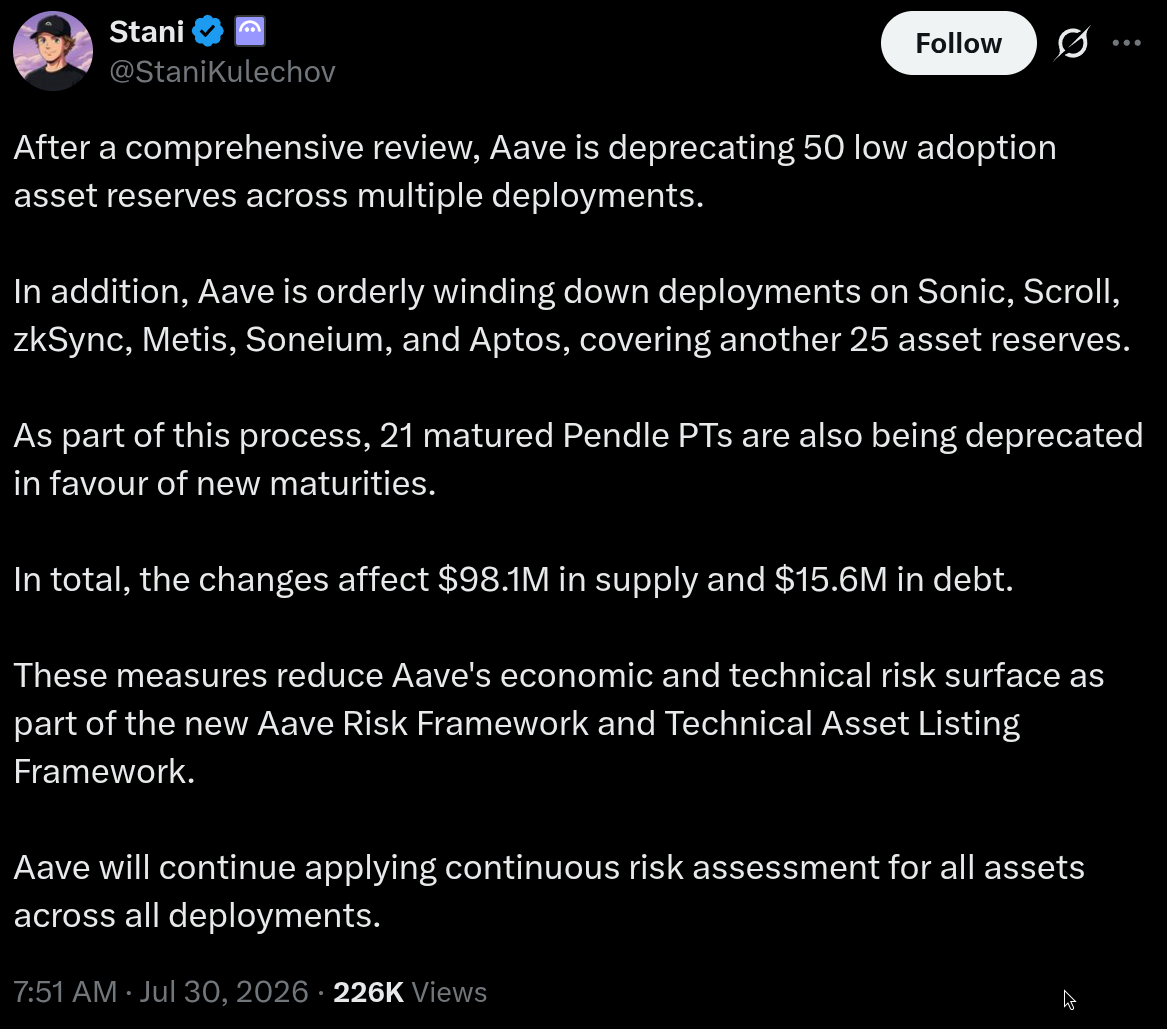
Aave founder comments on development

Source: Stani Kulechov

Aave founder Stani Kulechov said in a Thursday post that this will also “reduce Aave’s economic and technical risk surface as part of the new Aave Risk Framework and Technical Asset Listing Framework.”

Related: Aave brings V3 lending and GHO stablecoin to Monad

Still, this is not a reversal of Aave’s multichain expansion strategy, rather a strategic refocusing on select protocols. “Aave will continue applying continuous risk assessment for all assets across all deployments,” Kulechov said. The comments also follow Aave launching on Avalanche earlier this month.

Magazine: The real reason DeFi projects that survived 2022 crash are shutting down now

Related Questions

QAccording to the article, what is the total value of supplied assets and debt covered by Aave's proposed cleanup?

AThe proposed cleanup covers $98.1 million in supplied assets and $15.6 million in debt.

QHow many low-use reserves across how many deployments does LlamaRisk recommend offboarding?

ALlamaRisk, working with other Aave service providers, recommended offboarding 50 low-use reserves across 11 deployments.

QOn which six blockchains does the governance proposal recommend winding down all Aave V3 market reserves?

AThe proposal recommends retiring all reserves on the Sonic, Scroll, zkSync, Metis, Soneium, and Aptos blockchains.

QWhat was the reason given for adding Scroll to the list of affected protocols via an accelerated process?

AScroll was added due to a rapid deterioration in network liquidity and Aave market activity on the protocol.

QAccording to Aave founder Stani Kulechov, what is the primary goal of this strategic refocusing, and does it mean an end to multichain expansion?

AThe primary goal is to reduce Aave's economic and technical risk surface as part of the new risk framework. It is not a reversal of the multichain strategy but a strategic refocusing on select protocols, with continuous risk assessment continuing for all assets across all deployments.

Related Reads

The Lighter Attack: How a Single API Key Drained Tens of Millions of Dollars?

On November 16, a security incident hit Lighter, a decentralized perpetual contract trading platform. Roughly $15.48 million in USDC was drained from two large market-maker accounts (#714710 and #714723), though Lighter officially confirmed only that a single trader's API key was compromised—not the protocol or smart contracts. The attacker reportedly exploited a leaked API key that lacked direct withdrawal permissions by chaining legitimate product features: closing the victim's trading positions to free margin, creating a 0% fee public pool funded with about $10,000 from an attacker-controlled account to secure ~99.99% of pool shares, then using the victim account's internal transfer permissions to move USDC into the pool in ~$1 million batches. Because internal transfers between accounts linked to the same L1 address may not require additional signatures, and such transfers may not have minted new shares for the victim, the attacker's dominant share position appreciated and could be redeemed for the victim's funds. On-chain records show about 10.39 million USDC withdrawn via withdrawPendingBalance, then swapped through CoW Protocol into ~5,764 ETH/WETH, with some funds later moved to Hyperliquid and converted to XMR. Lighter's LIT token fell over 12% in 24 hours. Lighter attributed the root cause to the affected account using unofficial SDK signing code that reused nonces, allowing private key recovery from public signature data; the official SDK was unaffected. The Guardian mechanism paused withdrawals, the security committee returned about $5 million USDC, and deposits/withdrawals have resumed. Lighter now requires wallet signatures for transfers to public pools, makes API key signatures non-public, and plans IP whitelists, API key permissions and limits, plus monitoring for nonce reuse.

marsbit1h ago

The Lighter Attack: How a Single API Key Drained Tens of Millions of Dollars?

marsbit1h ago

Trading

Spot
活动图片