Bitcoin ETF inflows hit $3.8B in strongest three-week stretch of 2026

cointelegraphPublished on 2026-09-05Last updated on 2026-09-05

Abstract

US-listed spot Bitcoin ETFs recorded their strongest three-week inflow stretch of 2026, attracting $3.8 billion as Bitcoin traded near $80,000. Total net assets reached $101.3 billion. This marks a sharp turnaround from earlier outflows, though year-to-date flows remain slightly negative. Daily inflows cooled to $174.6 million on Friday, led by BlackRock's IBIT, after a surge the previous day. Concurrently, inflows into US spot Ether and XRP ETFs fell significantly compared to the prior week. Despite this slowdown, both Ether and XRP ETFs maintain positive net inflows for the year.

US-listed spot Bitcoin exchange-traded funds (ETFs) have recorded their strongest three-week inflow stretch of 2026 as Bitcoin traded around $80,000.

The funds attracted $986.9 million in the week ending Friday, bringing net inflows over the past three weeks to $3.8 billion, according to SoSoValue data.

Total net assets across the funds stood at $101.3 billion on Friday after briefly rising to $103.3 billion a day earlier, while cumulative net inflows reached $55.6 billion.

ETF demand marks a sharp turnaround from heavy outflows earlier in 2026, though year-to-date net flows remain roughly $1 billion negative.

Bitcoin ETF inflows cool after Thursday surge

US spot Bitcoin ETFs attracted $174.6 million in net inflows on Friday, down sharply from the nearly $731 million recorded a day earlier.

BlackRock’s iShares Bitcoin Trust (IBIT), the largest spot Bitcoin ETF by assets, drew $117.4 million on Friday, accounting for about 67% of the day’s total net inflows, according to Farside Investors data.
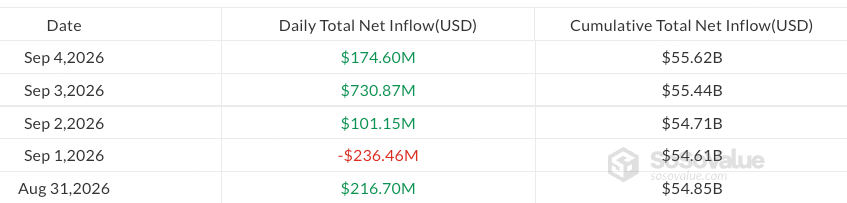
Daily spot Bitcoin ETF flows from Monday through Friday. Source: SoSoValue

Fidelity’s Wise Origin Bitcoin Fund (FBTC) was the only other fund to record net inflows, attracting $57.2 million, while all other US spot Bitcoin ETFs recorded no net flows for the day.

Related: Surprise nonfarm payrolls print sends Bitcoin back below 80K

The slowdown came as Bitcoin fell from around $81,200 to briefly below $79,000 on Friday. Bitcoin traded at $79,716 at the time of publication, still up about 2.6% over the past seven days, according to CoinGecko.

Bitcoin ETF demand strengthens as Ether, XRP flows fade

Compared with the previous week, Bitcoin ETF inflows increased about 7%, while inflows into US spot Ether and XRP ETFs fell about 74% and 83%, respectively.

Spot Ether ETF inflows dropped to $218.4 million from $824.4 million, while XRP ETF inflows declined to $19 million from $110.5 million, according to SoSoValue.

Despite weaker inflows, Ether and XRP ETFs remain in positive territory for the year. US spot Ether ETFs have recorded about $863 million in net inflows year-to-date, while XRP ETFs have attracted roughly $515 million.

Magazine: BTC will hit $1M by 2030... but Arthur Hayes is buying ETH instead

Related Questions

QWhat was the total net inflow for US-listed spot Bitcoin ETFs over the strongest three-week stretch of 2026?

AThe total net inflow for US-listed spot Bitcoin ETFs over the strongest three-week stretch of 2026 was $3.8 billion.

QWhich specific Bitcoin ETF accounted for the majority of net inflows on Friday, and how much did it attract?

ABlackRock’s iShares Bitcoin Trust (IBIT) accounted for the majority of net inflows on Friday, attracting $117.4 million, which was about 67% of the day's total.

QHow did the weekly net inflows into Bitcoin ETFs compare to those of Ether and XRP ETFs in the same period?

ACompared to the previous week, Bitcoin ETF inflows increased about 7%. In contrast, inflows into US spot Ether ETFs fell about 74% and inflows into XRP ETFs fell about 83%.

QWhat were the cumulative net inflows for US spot Bitcoin ETFs as of the Friday mentioned in the article?

AAs of the Friday mentioned in the article, the cumulative net inflows for US spot Bitcoin ETFs reached $55.6 billion.

QWhat is the year-to-date net flow status for Bitcoin ETFs despite the recent strong three-week inflow stretch?

ADespite the recent strong three-week inflow stretch, the year-to-date net flows for Bitcoin ETFs remain roughly $1 billion negative.

Related Reads

Wall Street Collectively Turned Bullish on US Stocks After the Midterms, Only to Be Slapped in the Face One Day Later

After the US midterm elections, major Wall Street trading desks—including JPMorgan, Citadel Securities, and UBS—collectively turned bullish on US equities, arguing that compressed pre-election positioning and fading uncertainty would drive capital back into the market. The S&P 500 rose nearly 2% and the Dow gained over 3% on Wednesday, briefly validating that view. But the rally reversed within a single day: anxiety over AI investment returns and computing infrastructure costs erupted, wiping $2.3 trillion from Nasdaq 100 market value and sending the S&P 500 down 4.4%, with every sector falling. Goldman Sachs' John Flood said Thursday was the mirror opposite of Wednesday's busiest trading day, with long-only investors frozen again. Barclays' Alex Altmann, one of the few skeptics, had warned that the election would not resolve the core issues压制ing stocks—AI return prospects and financing costs for compute buildout. The selloff was amplified by systematic strategies: volatility-control funds may have cut roughly 30 percentage points of equity exposure in a single day, implying about $135 billion in futures selling over 24-48 hours, while Thursday was likely the largest leveraged ETF rebalancing sell day on record. Retail investors, previously a dip-buying force, also retreated, with Vanda Research data showing net sales of $338 million by 3pm Thursday, potentially the largest single-day net selling since the pandemic. Despite the blowup, bullish views were not fully abandoned—S&P 500 futures rose 0.3% and Nasdaq 100 futures jumped 1.5% Friday morning—but the episode underscored how even top institutions struggle to predict market direction amid structural AI valuation repricing.

marsbit1m ago

Wall Street Collectively Turned Bullish on US Stocks After the Midterms, Only to Be Slapped in the Face One Day Later

marsbit1m ago

This Round of Sharp Decline: Technology Giants Clearly Oversold

The article argues that the recent market selloff—triggered by Democratic wins in the midterms and new state governors in data-center hubs like Texas and Ohio pledging to pause approvals—has conflated two very different things: companies whose revenue is tightly bound to new data-center construction, and companies holding scarce assets or whose demand doesn't depend on that path. The former deserve repricing; the latter are being wrongly sold off. The author applies three criteria—scarcity, order visibility, and reasonable or undervalued pre-crash valuation—to identify the truly mispriced names. TSMC is the clearest case, meeting all three: it is the only scalable 3nm/2nm pure-play foundry with ~90% AI chip foundry share, its advanced-node capacity is booked past 2028, and only about 30% of revenue ties to AI data centers, with HPC at 68% but smartphones, auto, and IoT providing a buffer. Its ADR trades near 24x PE after the drop, low for semiconductors. Nvidia fell ~10% overnight and 25% in a month; its 17x forward PE is a three-year low and order visibility is strong (management cites chip supply, not demand, as the constraint), but with data-center revenue over 90% of the total, it is a high-beta bet rather than a defensive mispricing. Apple is defensive—capex is only ~2.5% of sales and on-device AI runs on already-sold chips—but its 36x forward PE sits at the 99th percentile of its own history, so it fails the valuation test. Google and Amazon have huge backlogs ($514B and $496B respectively) but their conversion depends on compute supply, so they aren't fully decoupled. Meta, at 18–19x forward PE near a three-year low, is partly mispriced: its three flagship US projects (Ohio, Louisiana, Texas) are already past permitting, though new pipelines will slow. Broadcom, AMD, and Intel are falling for real exposure reasons, not mispricing. In China, SMIC best fits the criteria, with 89.6% China revenue tied to domestic fabless demand rather than US cloud orders; North China Innovation has strong visibility but a fuller valuation; ChangXin Memory shows an emotional discount versus fundamentals. Among model makers, US pure-plays are hit hardest, while Chinese firms' structural cost advantages are amplified—Zhipu, running GLM-5.3 on AWS Bedrock with revenue sharing, benefits from existing cloud capacity and may be somewhat mispriced. The conclusion: only TSMC truly satisfies all three criteria; the broad "anything AI rises" phase is over, and differentiation will favor companies with real orders, revenue, and compute reserves.

marsbit30m ago

This Round of Sharp Decline: Technology Giants Clearly Oversold

marsbit30m ago

Breaking News: Claude Cracks the First Prokaryotic Giant Protein, a 40-Year Mystery Structure Revealed

In a breakthrough spanning less than four months, Anthropic's Claude helped solve a 40-year-old biological mystery: the first three-dimensional structure of a prokaryotic "Vault" particle. Discovered in 1986 by Leonard Rome's UCLA team, vaults are among the largest protein complexes in cells—three times the mass of a ribosome—but their function remained unknown, since common model organisms like yeast, fruit flies, and nematodes lack them, and mice lacking vault genes develop normally. The team used Claude to search roughly 15 billion protein sequences, expanding the known vault protein family from 41 to 1,507 members—a 36-fold increase—across 29 bacterial phyla and 4 archaeal phyla, often near antiviral defense genes. Of 44 candidate proteins, 15 produced soluble protein in E. coli. Claude initially opposed using size-exclusion chromatography, correctly noting that misfolded protein aggregates would co-elute with vaults, but after being overruled it helped optimize the approach—including the counterintuitive suggestion to load crude lysate directly onto the column, cutting purification from three days to just 90 minutes. Eight candidates yielded clear vault particles, the first ever seen outside eukaryotes. Using a multi-agent framework, Claude ran RELION across hundreds of GPUs to reconstruct the phage L05 vault in just 34 hours, reaching 3.2 Å resolution within a week. The structure revealed 96 identical chains forming a shell 25% larger inside than human vaults, plus a hidden coenzyme A molecule tucked into each chain's inner pocket—hinting the vault serves as a molecular container during viral attack or metabolic stress. Engineered single-amino-acid changes opened the shell into flat "protein lotus" arrays, while inserting repeat modules expanded interior volume by 50% over human vaults. All code and computational analysis were performed by Claude, which the paper formally credits. Leonard Rome himself praised the work as opening new paths to understanding vault function, signaling a "Moore's Law" moment for basic science discovery.

marsbit33m ago

Breaking News: Claude Cracks the First Prokaryotic Giant Protein, a 40-Year Mystery Structure Revealed

marsbit33m ago

Tibo Reassigned: The GPT Reset Button Has a New Owner

Tibo, OpenAI's "reset god" known for frequently resetting usage limits, has been reassigned to lead OpenAI's internal systems security project, according to Reuters. His replacement appears to be Andrew Ambrosino, a founding member of the Codex App team, who has already begun handling user complaints and product feedback publicly. Tibo's move comes amid longstanding employee concerns about operational security at OpenAI, including overly broad access to sensitive code, insufficient security reviews of internal tools, and insider threats. In October, an engineer was prosecuted after planting listening devices in an executive meeting room and hiding a recorder in toilet paper. Since August, Tibo had already reassigned roughly a quarter of OpenAI's production engineers to security infrastructure work, and he has publicly announced forming a world-class cybersecurity team. Andrew Ambrosino studied computer science at UMass Lowell and previously worked at MITRE and Microsoft, founded fintech startup Catch where he served as CTO/CPO for seven years, and later worked at Noyo before joining OpenAI in 2025 as a core member of the Codex App team. He has since led that team and expanded into ChatGPT product work. Recently he announced restored double usage limits for Pro and Business Premium tiers and pledged to improve ChatGPT's simplicity and performance. Users have flocked to Andrew's comments with requests, including better treatment for Plus users, keeping Chat and Work separate, removing the five-hour usage limit, opening Dots to Plus users, and—most notably—begging him to hit the reset button on day one. OpenAI has not officially confirmed Andrew's full takeover of Tibo's former responsibilities, but his public actions suggest he is already stepping into the role.

marsbit34m ago

Tibo Reassigned: The GPT Reset Button Has a New Owner

marsbit34m ago

Zcash Activates NU7 Mainnet Upgrade, Cuts Block Time to 25 Seconds

Zcash has activated its NU7 network upgrade on mainnet, introducing faster block production and changes to how transaction fees support the network's long-term security. The upgrade went live at block height 3,543,405 on November 6 at 02:34 UTC, reducing the target time between blocks from 75 seconds to 25 seconds, allowing transactions to receive their first confirmation more quickly. This could make Zcash payments more practical for everyday transfers, exchange deposits and merchant transactions, though actual wait times will depend on network conditions and confirmation requirements set by individual services. NU7 also introduces changes to the network's shielded transaction system. One major change involves the Network Sustainability Mechanism (NSM): miners now receive 40% of transaction fees, while the remaining 60% goes into a reserve intended to support future mining rewards, with scheduled reissuance expected to begin around February 2031 at block height 8,939,664. The upgrade also retires Zcash's original Sprout privacy pool, introduced in 2016; version 4 transactions are now invalid, making approximately 12,224 ZEC remaining in Sprout unspendable through the existing protocol, with no approved recovery mechanism currently available. NU7 introduces limits on shielded transactions per block to reduce blockchain data wallets must download when searching for private payments, potentially increasing capacity for simple Orchard transactions from approximately 2.9 to 6.6 transactions per second. Despite the faster block schedule and revised fee system, Zcash's maximum supply remains unchanged at 21 million ZEC, and the block subsidy is adjusted to maintain the same daily issuance. NU7 marks a major change to Zcash's transaction processing and mining economics.

TheNewsCrypto36m ago

Zcash Activates NU7 Mainnet Upgrade, Cuts Block Time to 25 Seconds

TheNewsCrypto36m ago

Trading

Spot
活动图片