Author: Rita
Retail investors saw weekly inflows of $5.7 billion, below the 12-month average of $6.7 billion. The inflow percentile for tech sector ETFs jumped from 4% four weeks ago to 73%. In a report dated October 7, 2026, JPMorgan noted that retail funds have rebounded from the September lows, with tech regaining focus.
JPMorgan believes retail investors were net buyers across the entire tech sector, with software also gaining favor. Whether this rotation can continue depends on validation from the Q3 earnings season. The consensus expects earnings growth of 31% for the season, with all sectors stronger than the same period last year.
Tech ETF Inflow Percentile Jumps to 73%
Retail flows this week were $5.7 billion, below the 12-month average of $6.7 billion. ETF inflows were $4.7 billion, while single-stock inflows were $1 billion. ETF inflows rebounded from the September low to near the 12-month average, with the single-stock inflow percentile at 43%.
The inflow percentile for tech sector ETFs surged from 4% four weeks ago to 73%. Tech ex-Mag7 is also strengthening, with SNDK and MU ranking as the third and fourth largest net buys last week. Retail investors were net buyers across semiconductors, hardware, and software.
JPMorgan pointed out that retail investors bought into themes like AI data centers & electrification, Mag7, growth, AI software, and monetization. International ETF activity was limited, with volatility in France and Brazil not triggering large-scale repositioning. ETF inflows broadly rebounded across broad-based, style, and fixed-income categories, except for commodity and crypto ETFs.
NVIDIA Sees $830 Million in Net Buys
Among the Mag7, retail investors bought NVIDIA ($834M), Google ($265M), Tesla ($122M), Amazon ($81M), Microsoft ($34M), and Meta ($34M), while selling Apple ($15M).
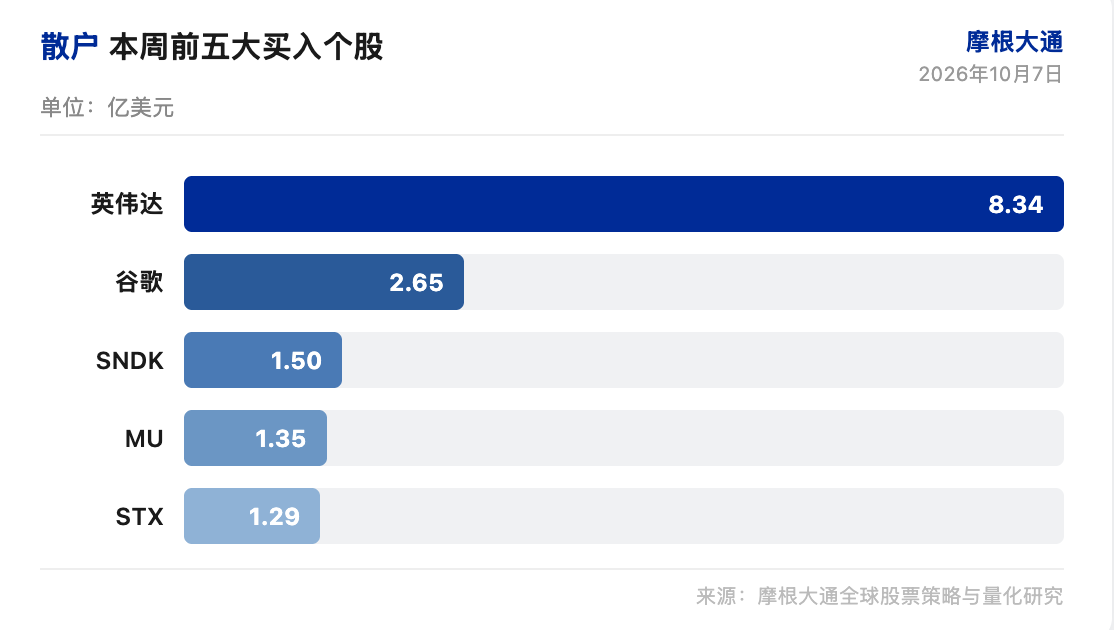
The top five net buy single stocks were NVIDIA ($834M), Google ($265M), SNDK ($150M), MU ($135M), and STX ($129M). The top five net sell single stocks were SPCX ($177M), INTC ($148M), MRVL ($54M), SMCI ($51M), and MRNA ($48M). Tech as a whole saw net buys of $602 million, Industrials saw $143 million in net buys, while Communication Services, Financials, Healthcare, and Materials saw net selling.
The Google buying occurred on October 6. Constellation Energy and Google announced a 20-year power purchase agreement for 890MW of new nuclear power, plus a 15-year agreement for 2,700MW of existing nuclear. Previously, Constellation signed a 20-year agreement with Amazon for 690MW from the Cliffs Clean Energy Center. Vistra rose 15% the same day on reports that the US government plans to provide approximately $4.2 billion in loans to upgrade three nuclear plants.
Q3 Earnings Expected to Grow 31%
The Q3 earnings season kicks off on Tuesday. Consensus expects earnings growth of 31%, or 27% ex-Energy. Revenue growth is expected at 12%, or 11% ex-Energy. All sectors are expected to see stronger earnings growth than in Q3 2025, led by Energy and Tech, with Consumer Staples being the weakest. FY2026 estimate revisions have been trending lower since early September.
About 5% of the S&P 500's market cap is scheduled to report in the next 7 days, heavily concentrated in the Financials sector. JPMorgan analysts believe large banks have a chance for a pre-earnings bounce after recent underperformance, with improving net interest income expectations and potentially stronger trading revenue. Retail investors have not significantly bought into the Financials ETF or single-stock weakness this week.
Regarding Brazil, Flavio Bolsonaro led Lula in the first round. EWZ rose 13% on Monday, prompting retail profit-taking with $6.6 million in net selling. JPMorgan strategists believe the index could rise about 20% short-term, with forward P/E multiple re-rating roughly 20-25% to 11x. Retail also sold Brazilian ADRs like NU, PBR, and VALE.
Brazil and Meme Stocks Carry Respective Risks
The momentum factor performed strongly in September. The top 20 momentum stocks rose about 12%, the top 30 rose 10%, and the top 100 were roughly flat. Lagging stocks broadly weakened, with the bottom 100 down about 11% and the bottom 20 down about 12%. Crowding in lagging stocks fell to 20%, from about 47% at the end of August. Large-cap crowding remains at the 84.6th percentile.
Regarding meme stocks, social media-trending names like KURA, PVLA, and CABO exhibit both retail buying and high hedge fund short interest. KURA saw $500k in buys last week, with short interest around 8% of float. PVLA saw $700k in sells, with short interest around 25%. CABO saw $100k in sells, with short interest around 20%. Unexpected flows can occur when trading in such names is active.
In software, Synopsys provided a target of ~15% revenue CAGR from FY26 to FY30E at its investor day, with ~50% operating margin by FY30E, versus current FY26E guidance of ~41.5%. JPMorgan analysts believe this target implies ~$35 EPS by FY30E, translating to low-20s% EPS CAGR. The company also announced a $1 billion share repurchase authorization.
PTC agreed to be acquired by Schneider Electric for $205 per share in cash. The deal values PTC equity at ~$22.6 billion, with an enterprise value of ~$23.7 billion, representing ~21x 2027E EBITA, or ~13x including full synergies. PTC rose 33% on Monday. C.H. Robinson Worldwide fell 11% after announcing its acquisition of RXO. JPMorgan analysts find the $300 million net cost synergies credible, with negative revenue synergy being the primary concern.
Retail funds have rebounded from the September low, with tech regaining focus. The substance of this rotation will be validated by the earnings season, with earnings realization and the direction of interest rates being the next focal points. The Q3 consensus expects 31% earnings growth. The Financials sector reports first, and whether large banks can meet expectations will determine if this wave of fund inflows can be sustained.

Disclaimer
This article is Tide Research's compilation and interpretation of a third-party brokerage research report (JPMorgan, October 7, 2026), combined with publicly available market information. The ratings, target prices, earnings forecasts, and related judgments cited herein are the views of that brokerage's analysts, representing only the stance of their affiliated institution. They do not represent the views of Tide Research and do not constitute any investment advice.
The market carries risks, and investment decisions should be made independently. This article should not be used as the basis for trading any securities.