$60 Billion, Buying a Ticket.
On October 10th, at the X Takeover event with over two thousand attendees, Elon Musk joined remotely. The host directly asked him: Why did you buy Cursor?
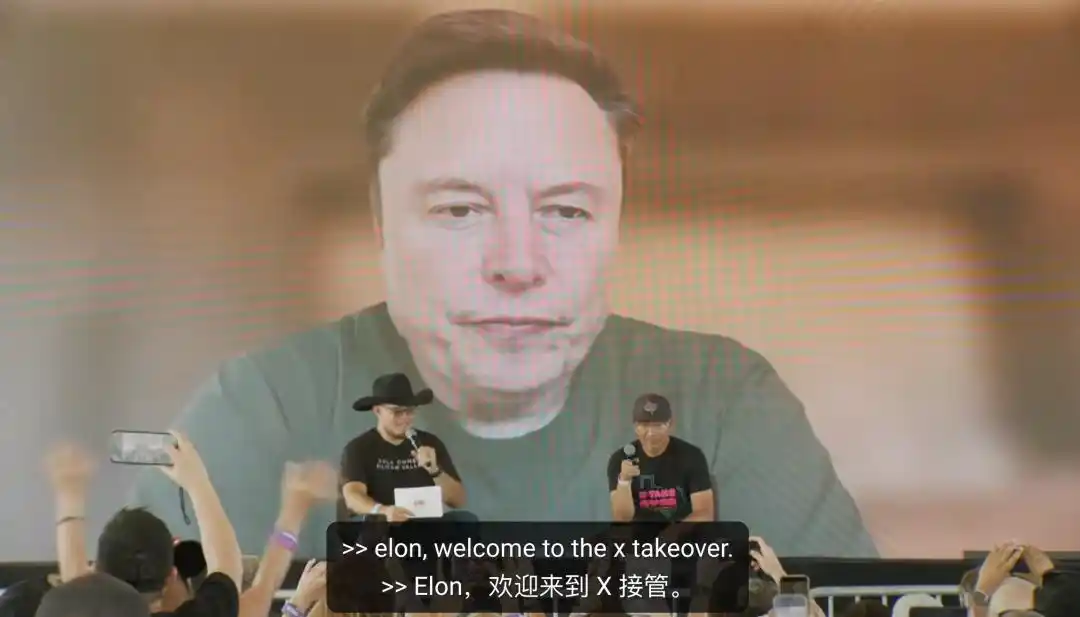
Musk's answer took only 61 seconds and quickly spread across the internet.
He said, to build a proper superintelligence, you have to solve programming. And as far as he knows, only three entities in the world have amassed enough programming training data—
OpenAI, Anthropic, and Cursor. Google barely counts as half.
His own name, xAI, or Grok, were not on that list.
A man holding rockets, the Colossus supercomputing power, and Tesla admitted in front of two thousand people:
On the most critical path to superintelligence, he originally did not have a ticket.
So, he bought Cursor.
What Makes Programming Data So Valuable?
Cursor is the editor where programmers write code every day.
The AI gives you a suggestion, you can accept it by pressing Tab, delete it, or modify a few lines before using it.
Each such operation is equivalent to grading a piece of homework for the AI—checking what's right, crossing out what's wrong, and even providing the correct answer for partially correct ones.

Reports indicate Cursor's training involved trillions of tokens of this real developer interaction data.
This kind of data cannot be scraped from the web or manufactured in a lab. It can only be accumulated day by day, line by line, by thousands of real programmers.
Musk himself explained in the same interview why programming is most unique: software logic is deterministic, it can run unit tests.
Whether the code is correct or not can be determined by running it; the answer isn't based on subjective grading.
Programming is the subject where AI can most easily 'practice and level up' on its own. The larger the question bank and the more grading there is, the faster it learns.
And the quality of that grading is crucial.
Musk shared a detail that left a deep impression. He looked at the reinforcement learning logs for the new Grok and found that sometimes the AI gave the correct answer but was marked wrong because the question itself was flawed. The AI would then desperately try random answers, as if held at gunpoint.
He said he would hate that feeling too.
If the question is wrong, the AI practices in vain, or even learns incorrectly. And every real programmer's decision—accepting this snippet, rejecting that one, modifying a few lines here—constitutes the most reliable grading record because it comes from real work, judged right or wrong by a real person.
Whoever holds the largest, cleanest question bank is one step closer to ASI.
He Has Everything Except This One Piece
Looking back at Musk's assets: X has vast amounts of text, Tesla has road data, SpaceX has engineering data, Colossus has top-tier global GPU computing power. Nothing seems lacking.
Except for the piece about real people actually writing code.
There's telling evidence. In an IDC analysis from early September this year, it was mentioned that Musk admitted in sworn testimony that xAI used OpenAI's outputs to train Grok.
When your own question bank isn't enough, you can only copy others' answers to practice. But Musk knows better than anyone that this path doesn't go far.
Computing power can be built with money, models can be chased with time. But programming data must be accumulated line by line by users.
Cursor is a company founded in 2022. In just a few years, it has amassed what Musk said only three entities in the world possess.
In April this year, SpaceX and Cursor announced a partnership, with SpaceX securing an option: either pay $10 billion to continue the collaboration, or spend approximately $60 billion to buy the entire company.
SpaceX chose to buy it all.
$60 billion, the most expensive acquisition in startup history. Musk himself gave the reason—this isn't buying a product; it's buying a ticket.
Four Things for Building Superintelligence, the Fourth is the Most Surprising
At this event, Musk bluntly shared the recipe for building superintelligence:
Data, talent, computing power, plus a good enterprise sales team.
The first three are widely agreed upon. The fourth is the truly surprising one—an enterprise sales team?
What does building superintelligence have to do with sales?
Everything. Relationships with thousands of companies mean Cursor is already installed on the computers of programmers at these companies.
For superintelligence to enter real work scenarios, these are ready-made doors. The more doors opened, the more users, the more new programming data generated, the better the model trains, and the more companies it can sell into.
Building it and using it connect to form a flywheel here.
Musk's calculation is actually sharper than anyone's: in real companies, programmers write code and reject suggestions every day. Questions come from real tasks, correctness judged by real people. Every company door the sales team knocks on means the AI gets another real workbook.
Superintelligence isn't just a technical problem; it's also a business problem.
On July 8th, SpaceXAI and Cursor jointly released Grok 4.5, focusing on programming and Agent capabilities, trained on tens of thousands of NVIDIA GB300 chips.
Musk called it Opus-level, faster, more token-efficient, and cheaper.
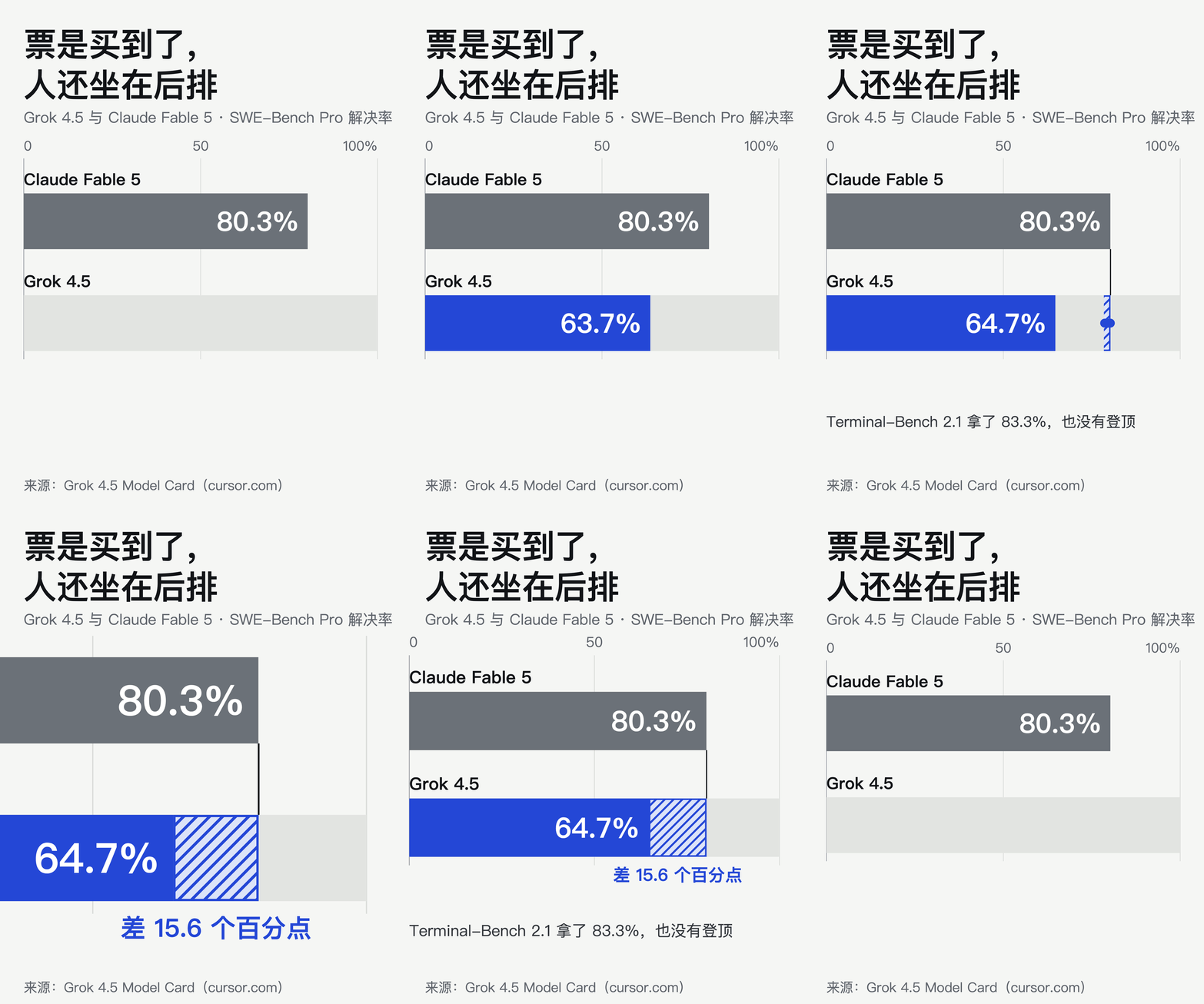
But actual scores: a 64.7% solve rate on SWE-Bench Pro, behind Claude Fable 5's 80.3%; 83.3% on Terminal-Bench 2.1, also not topping the charts.
The ticket is bought, but he's still sitting in the back row.
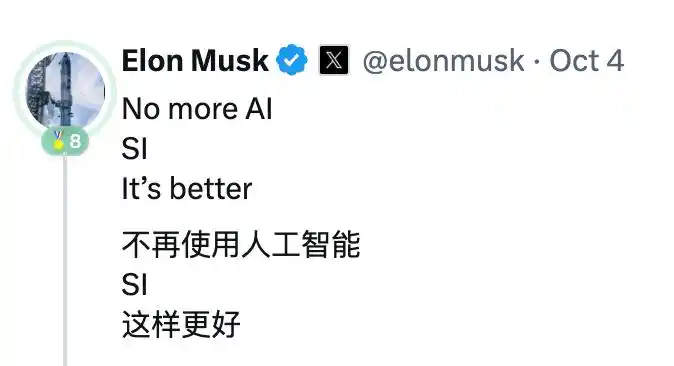
On October 4th, Musk confirmed on X that SpaceXAI was renamed SpaceXSI—SI stands for Super Intelligence. The destination is written in the name; whether it's been reached is another matter.
OpenAI has Codex and massive amounts of programming dialogue within ChatGPT.
Anthropic has Claude Code, with an astonishingly large volume of programming scenario usage.
The first two entities Musk named have long held their models, programming products, and programming data in their own hands.
Interestingly, Musk's evaluation of his competitors isn't low. In the interview, discussing AI-made music videos, he specifically praised Claude, saying "give them a lot of credit." Talking about AI safety, he added, "agree with some of the things Anthropic has said."
You Think You're Writing Code, But You're Actually Teaching Superintelligence to Write Code
Musk's interview essentially publicly rewrote the scoring rules for the ASI race.
In recent years, everyone was counting chips. Who has more GPUs, who is closer to the finish line.
But now, the man holding the world's largest computing cluster掏出the highest price in startup acquisition history to buy something computing power can't replace—
Human judgment.
Computing power can be stacked with money; data can only be accumulated by people. Every record in programming data is a real programmer's single decision: accept this snippet, reject that one, modify a few strokes before submitting. Right or wrong is judged by a real person, verified by the machine, undiluted.
So, the tuition for superintelligence isn't paid by giants burning electricity; it's paid by programmers worldwide, one keystroke at a time.
References:
https://x.com/ns123abc/status/2109105516941107311
Editor: Solomon
This article is from the WeChat public account "New Zhiyuan", author: ASI Revelation