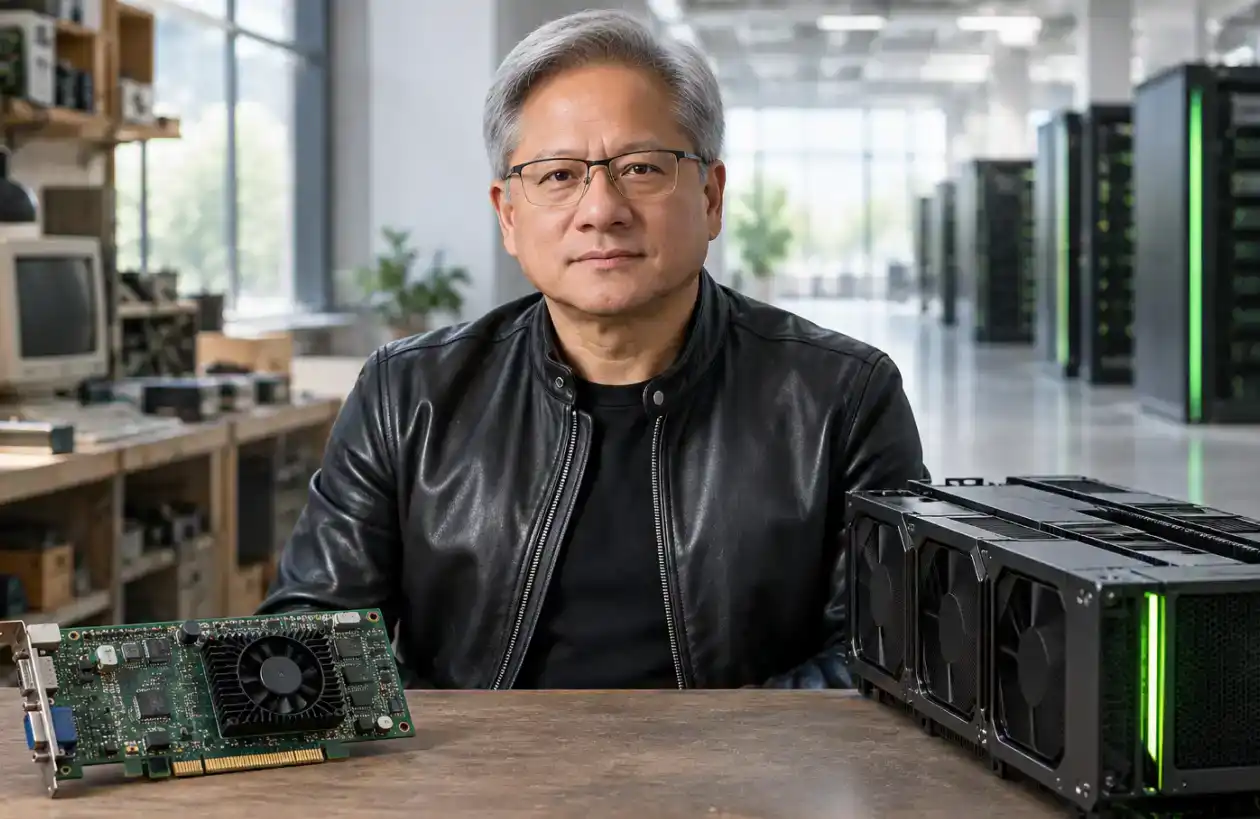
Nvidia Agrees to Acquire Hugging Face for $12.93 Billion

cryptonews.ruPublished on 2026-09-04Last updated on 2026-09-04

Abstract

Nvidia has agreed to acquire the AI developer platform Hugging Face for $12.93 billion, as announced by CEO Jensen Huang. According to a press release, Hugging Face will remain an open platform post-acquisition, and developers will not be forced to use Nvidia's infrastructure. Users will retain the freedom to choose their preferred models, frameworks, cloud services, and compute platforms. Nvidia believes its resources will enhance the platform's reliability, security, and capabilities for model evaluation, inference, and deployment. Hugging Face reportedly hosts over 3 million models and is used by more than 18 million developers and 200,000 companies. The deal aligns with Nvidia's ongoing AI investments, including recent partnerships with Amazon Web Services and MediaTek.

Nvidia has agreed to acquire the AI developer platform Hugging Face for $12.93 billion. This was announced by the corporation's CEO, Jensen Huang.

Exciting day for NVIDIA and @huggingface.

Open models strengthen safety and cybersecurity, accelerate innovation and diffusion, and enable sovereignty. They allow every developer, startup, university, industry and country to build with, customize and benefit from AI.

Thank you...

— Jensen Huang (@JensenHuang) September 3, 2026

The deal amount was stated in a separate press release. According to the statement, Hugging Face will remain an open platform after the acquisition.

The company emphasized that developers will not be forced to adopt Nvidia's infrastructure.

"Users will be able to choose the models, frameworks, cloud services and service providers, as well as computing platforms they need. Creating or deploying applications via Hugging Face will not require using Nvidia's computing resources," the announcement states.

The AI platform will continue to support models from various developers, including open weights.

Nvidia believes that the corporation's infrastructure and engineering resources will enhance the platform's reliability and security, as well as improve model evaluation, inference, and deployment.

According to the company, Hugging Face is used by over 18 million developers, researchers, and creators. The platform hosts over 3 million models, 500,000 datasets, and 1 million applications. The service is used by more than 200,000 companies for finding, evaluating, customizing, and deploying AI.

Nvidia reminded that it has been investing in AI and related platforms for many years. The company called itself "the largest provider of open models and data for Hugging Face," having published over 500 models and 250 datasets under its own brand.

Recall that in August, Nvidia expanded its partnership with Amazon Web Services. The companies will additionally deploy two million graphics processing units in the AWS cloud infrastructure in 2027–2028.

Nvidia Invests $3.5 Billion in MediaTek and Expands AI Partnership
end-content

Trending Cryptos

Related Questions

QWhat is the total acquisition price that Nvidia has agreed to pay for Hugging Face?

A$12.93 billion.

QAccording to the announcement, will Hugging Face remain an open platform after the acquisition?

AYes, Hugging Face will remain an open platform after the purchase by Nvidia.

QWhat specific assurance did Nvidia give regarding the use of its own infrastructure on the Hugging Face platform?

ANvidia stated that developers will not be forced to use Nvidia's infrastructure; users can choose their own models, frameworks, cloud services, service providers, and compute platforms.

QHow many developers, researchers, and creators currently use Hugging Face according to the article?

AMore than 18 million developers, researchers, and creators use Hugging Face.

QHow many AI models, datasets, and applications are currently hosted on the Hugging Face platform as reported in the article?

AThe platform hosts over 3 million models, 500,000 datasets, and 1 million applications.

Related Reads

From Near Bankruptcy to Five Trillion: Jensen Huang and His Thirty-Three Years at NVIDIA

In November, at NVIDIA's Santa Clara headquarters, a two-page press release announced CEO Jensen Huang's immediate resignation as president, CEO, and director, following his admission of marital infidelity and a board investigation into related conduct. CFO Colette Kress became interim CEO, and Harvey Jones was named board chairman. Huang, who had just overseen NVIDIA's rise to become the first company worth $5 trillion, retained only his roughly 3% stake and no operational role. The article traces NVIDIA's 33-year history from its 1993 founding at a Denny's in East San Jose, where Huang and two engineers bet on making graphics chips for PCs. Their first chip, NV1, failed, but a pivotal meeting with Sega's Shoichiro Irimajiri converted a $5 million contract payment into an investment, saving the company. After layoffs and self-teaching from Silicon Graphics textbooks, NVIDIA's RIVA 128 succeeded in 1997. The company went public in 1999 and weathered crises including defects, financial downturns, and industry consolidation. Huang's long-term bet on CUDA, initially met with silence and skepticism, positioned NVIDIA for the AI boom. After AlexNet in 2012, he committed the company to deep learning, personally delivering the first DGX-1 to OpenAI in 2016. ChatGPT's 2022 launch triggered explosive growth, with revenue reaching $215.9 billion. Despite surviving decades of near-collapse, it was personal scandal—not business failure—that ended his tenure. As the article notes, for 33 years he woke believing the company was 30 days from collapse; this time, the 30th day was his own.

marsbit1h ago

From Near Bankruptcy to Five Trillion: Jensen Huang and His Thirty-Three Years at NVIDIA

marsbit1h ago

Solo brings human verification to Venmo co-founder’s JellyJelly app as AI agents beat CAPTCHA

Solo, a privacy-preserving proof-of-humanity company, is bringing its human verification SDK to JellyJelly, a Solana-based social video app co-founded by Venmo co-founder Iqram Magdon-Ismail. The integration confirms every account belongs to a real, unique person without government ID or puzzles. The move comes as AI agents learn to beat CAPTCHA: in a Solo experiment, an AI agent named Gary joined over 50 Discord servers overnight and sent 500+ messages without being detected, passing every CAPTCHA through ordinary browsing and clicking. Solo CEO Edison Siu says CAPTCHA's assumption that humans can do what bots cannot is increasingly hard to sustain, and that platforms should verify the human directly rather than adding friction or requiring identity documents. JellyJelly lets users share short videos and send crypto payments, and rising AI-generated video and automated accounts make it harder to know who is behind each account; Solo's SDK distinguishes genuine users from automated ones and prevents one person from registering multiple verified identities. The process uses a facial scan from a standard smartphone camera, converted into a biometric representation encrypted on-device with fully homomorphic encryption (FHE), allowing comparison against existing records without decrypting data. No special hardware or ID is needed, raw facial images are not stored, and apps receive only a verification result. The SDK can also serve gaming platforms and payment services. Solo is backed by Draper Associates, which led a $1 million round in March 2025, and was selected for Solana Incubator cohort 5. Solo is now building tools letting verified users authorize their own AI agents and enabling AI companies to pay verified people for human-only work. Magdon-Ismail, advising Solo, says the next step after Venmo is your AI agent paying on your behalf, with recipients needing to know a real person authorized it.

cointelegraph2h ago

Solo brings human verification to Venmo co-founder’s JellyJelly app as AI agents beat CAPTCHA

cointelegraph2h ago

Arthur Hayes ‘flattered’ as Coinbase backs US stock perps

Arthur Hayes, co-founder of BitMEX, said he was "flattered" by Coinbase's support for the CFTC in a US legal dispute over stock perpetual futures. Hayes noted that when BitMEX launched the perpetual swap in 2016, Washington's reaction was "less than warm," and remarked that "imitation is the sincerest form of regulation." Coinbase and five other companies submitted a brief opposing the Capital Markets Alliance Association's (CMAA) request to block trading in perpetual futures tied to individual stocks. The CMAA argues these contracts should be treated as security-based swaps, which face tighter retail trading restrictions. The SEC reportedly submitted a proposed brief opposing the alliance's request to temporarily halt trading, saying it is reviewing the exchanges' rules for listing the contracts. The CMAA said the CFTC approved the contracts without adequately explaining its decision or addressing unresolved regulatory questions, citing about $375 million in reported 24-hour notional trading volume for Kalshi's stock perpetuals shortly after launch. US District Judge Valerie Caproni denied the group's request for a temporary restraining order, finding the alliance was likely to succeed on its claim that the CFTC exceeded its authority. Stock perpetuals let traders speculate on share prices without owning the underlying stocks and have no fixed expiration date. Wojciech Kaszycki, strategy adviser to BTCS SA, said the lack of a fixed expiration or delivery date could complicate treating perpetual contracts as futures, but warned that a ruling against the CFTC could push trading toward offshore and decentralized platforms: "The product doesn't die; it just changes address."

cointelegraph4h ago

Arthur Hayes ‘flattered’ as Coinbase backs US stock perps

cointelegraph4h ago

Trading

Spot

Hot Articles

How to Buy NVDA

Welcome to HTX.com! We've made purchasing Nvidia (NVDA) simple and convenient. Follow our step-by-step guide to embark on your crypto journey.Step 1: Create Your HTX AccountUse your email or phone number to sign up for a free account on HTX. Experience a hassle-free registration journey and unlock all features.Get My AccountStep 2: Go to Buy Crypto and Choose Your Payment MethodCredit/Debit Card: Use your Visa or Mastercard to buy Nvidia (NVDA) instantly.Balance: Use funds from your HTX account balance to trade seamlessly.Third Parties: We've added popular payment methods such as Google Pay and Apple Pay to enhance convenience.P2P: Trade directly with other users on HTX.Over-the-Counter (OTC): We offer tailor-made services and competitive exchange rates for traders.Step 3: Store Your Nvidia (NVDA)After purchasing your Nvidia (NVDA), store it in your HTX account. Alternatively, you can send it elsewhere via blockchain transfer or use it to trade other cryptocurrencies.Step 4: Trade Nvidia (NVDA)Easily trade Nvidia (NVDA) on HTX's spot market. Simply access your account, select your trading pair, execute your trades, and monitor in real-time. We offer a user-friendly experience for both beginners and seasoned traders.

1.5k Total ViewsPublished 2026.08.08Updated 2026.11.11

How to Buy NVDA

Discussions

Welcome to the HTX Community. Here, you can stay informed about the latest platform developments and gain access to professional market insights. Users' opinions on the price of NVDA (NVDA) are presented below.

活动图片