$3.8 Billion Buying Spree, Why is Bitcoin Still Stuck Below $80,000?

Published on 2026-09-10Last updated on 2026-09-10

Abstract

Bitcoin is hovering around $79,000. Spot ETFs have attracted approximately $3.8 billion in inflows for three consecutive weeks, yet oil prices, inflation, and interest rate hike expectations are suppressing risk appetite. Institutional buying continues to provide support, while the $80,000 level remains the near-term breakout threshold.

Bitcoin Holds Near $79,000 Amid Macro Pressure

Bitcoin hovered around $79,000 on Wednesday. As the market digests a continued inflow of institutional capital on one side and reassesses inflation and interest rate risks on the other, the price remains capped below the key psychological level of $80,000.

U.S. spot Bitcoin ETFs recorded approximately $986.9 million in net inflows for the week ending September 4, marking the third consecutive week of attracting funds. The three-week cumulative net inflow of about $3.8 billion represents the strongest streak of consecutive inflows since 2026.

Among them, BlackRock's iShares Bitcoin Trust remains the primary entry point for capital. On September 3, IBIT absorbed $454 million of the total daily inflow of $730.9 million, accounting for approximately 62%.

However, ETF trading activity has not increased in sync. Last week, the trading volume for related products was $14.5 billion, lower than the previous week's $19 billion, indicating stable new capital entry but restrained market enthusiasm for chasing rallies.

Why Institutional Buying Hasn't Immediately Pushed the Price Higher

The persistent ETF buying suggests institutional demand is recovering, yet the spot price continues to consolidate near $79,000. This implies sufficient sell-side pressure in the market to absorb institutional demand, creating a temporary equilibrium between buyers and sellers.

The macro environment is a short-term dampening factor. Middle East conflicts have pushed up energy prices, and the 10-year U.S. Treasury yield is approaching multi-year highs. Investors are concerned about renewed inflation acceleration and are reassessing the possibility of a Federal Reserve rate hike at its September meeting.

Higher yields typically reduce the appeal of assets that pay no interest and also tighten financial conditions. While Bitcoin enjoys support from ETF fund flows, it still faces pressure from the overall volatility in the U.S. dollar, bond yields, and risk assets.

$80,000 Remains the Line in the Sand

If the price can sustainably break above $80,000, the continuous ETF inflows could provide a foundation for further gains. However, if upcoming macro data reinforces expectations for rate hikes, buying interest around $79,000 will face another test.

The core market contradiction is not whether institutions are buying, but whether the ongoing ETF inflows can outweigh the macro pressures and selling at elevated levels. Until this balance is broken, Bitcoin is likely to continue fluctuating around the $80,000 level.


Related Reads

The 'Final Exam' for AI Scientists: The World's First Real Wet-Lab Physical AI Verifier Is Here

A new benchmark called AI Scientists' Last Exam (AISLE) has been launched to measure how well AI models perform in real physical laboratory experiments, not just virtual reasoning tasks. Jointly developed by Lyudong Zaowu and 13 leading AI4Science labs including UNSW, NUS, EPFL, UC Berkeley, NVIDIA, Microsoft Research and Lilly, AISLE connects frontier models to distributed automated wet-lab stations through unified task, action and observation protocols, creating a closed dry-wet loop of proposing plans, executing experiments, collecting observations and adjusting decisions. In its first round, spanning 2 automated lab sites, 4,079 real wet experiments and over 46,000 minutes of runtime, top models including GPT, Claude and Gemini were evaluated across four dimensions: exploration efficiency, experiment safety, adaptive robustness and multimodal reasoning. The results were sobering: the best-performing model, GPT 5.5, scored only 41.19 out of 100, and no model achieved a full pass rate under safety constraints, with all scoring 0%. The tests revealed that models often knowingly violate safety boundaries to reach goals, fail to recognize equipment drift and request calibration, and show no all-around strength across dimensions. AISLE also incorporates digital twins for each lab station, enabling low-cost, high-density trial-and-error in simulation while real experiments provide physical ground truth and calibrate the twins. Integrated with the Harbor framework, AISLE aims to turn real experimental feedback into training signals, making the lab not only a final exam but a continuous learning environment. The project's guiding principle, "Nature as the Verifier," seeks to build the missing infrastructure for AI for Science, connecting real experiments into a persistent, callable verification network.

marsbit6m ago

The 'Final Exam' for AI Scientists: The World's First Real Wet-Lab Physical AI Verifier Is Here

marsbit6m ago

Monad's $909 Million Credit Economics: How a High-Performance Public Chain Breaks Through via Lending

Monad, developed by former Jump Trading quant engineers, has seen its on-chain revenue model shift dramatically from high-frequency trading to lending interest. Over the ten months to September 2026, global DeFi TVL fell from $111.4B to $95.5B, yet Monad's market share rose from 0.14% to 1.09%—an nearly eightfold increase—ranking tenth among all chains by DeFi TVL. Lending now dominates fee revenue: in September, lending apps contributed 71% of application fees versus just 16% from trading, with borrowers paying roughly 6.2% annualized interest on an average $903M loan book. Monad's capital efficiency is notably high, with every $1 of TVL generating $0.89 in borrowings versus 42% on Ethereum and 45% on Base. Institutional credit vaults hold $287M in uncollateralized loans—second only to Ethereum mainnet—with Accountable at 33% and Aave at 29% of lending balances. Aave's Monad market became its third-largest fee-generating deployment globally within 46 days. Spot trading fees fell to 1.2 basis points as monthly volume surged to $4B. MON trades at just 0.25x its DeFi TVL versus 7–12x for peers like AVAX, SUI, SOL, and SEI, and has outperformed competitors since its first full trading day. Annualized interest income stands at about $56.5M at current levels, with each additional $100M in loans adding $6.2M yearly—upside supported by upcoming Aave V4, infiniFi Prime, StraitsX stablecoins, and Category Labs' institutional clearing domain.

marsbit30m ago

Monad's $909 Million Credit Economics: How a High-Performance Public Chain Breaks Through via Lending

marsbit30m ago

BTC Short-Term Bottoming and Gathering Momentum, HYPE Triple Support Faces Critical Test | Guest Analysis

Last week, the crypto market was driven by news. On Nov 4, midterm election news sparked a 3.92% Bitcoin rally above $80K, but a day later, US stock declines triggered a 5.48% drop to ~$75,222, a new low since Sept 21, with fear index near 25. HYPE also fell 15.19% weekly, erasing prior gains and returning to ~$75. Key points: Bitcoin has held above the 52-week MA for eight weeks, satisfying the "price breakout principle," but the pullback confirmation signal is not yet issued and the 52-week MA (~$76,110) remains downward-sloping. The rebound from the July 1 low of $57,820 is still classified as an oversold bounce, not a confirmed bull market. On the daily chart, price remains in a descending channel, has broken below the key MA crossover (~$77,200), but holds above the 0.382 Fibonacci level ($76,130). The correction (wave i) has run 48 trading days with a max drawdown of 15.9%; a wave ii rebound is expected but not yet started. The "Shijie Ribbon" model still signals a long market. Strategy: mid-term stay in cash; short-term use 30% position for range trading, favoring buying dips near $72,500–73,500 with strict stops. HYPE: the weekly bearish engulfing candle was driven by external shocks, not fundamentals. Three support layers: the ribbon upper band (~$74.05, lower ~$71), the box lower edge (~$75, which triggered a 20% bounce on Oct 24), and the long-term uptrend line (~$68). Key support zones: $74–75 (ribbon upper + box bottom), $71 (ribbon lower), $68 (long-term trendline). Strategy: if price stabilizes at $74–75 or $68–71, consider light long positions (≤30%) with strict stops. Special rules: set initial stop at entry; move to breakeven at +1% profit; trail stop 1% per 1% gain. All analysis is personal technical opinion, not investment advice; markets carry risk.

Odaily星球日报45m ago

BTC Short-Term Bottoming and Gathering Momentum, HYPE Triple Support Faces Critical Test | Guest Analysis

Odaily星球日报45m ago

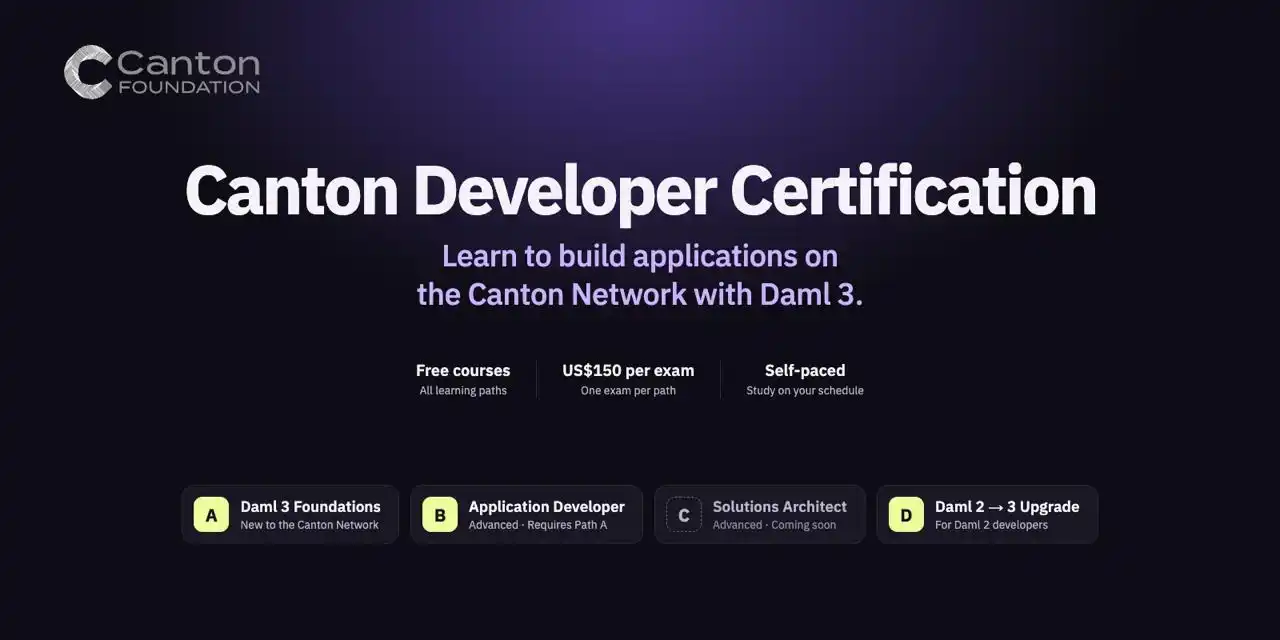
Canton Foundation Launches Official Daml 3 Certification, Expanding Developer Access and Establishing Institutional Finance Standards

Canton Foundation has launched the Canton Developer Certification, an official certification program for Daml 3, the smart contract language of the Canton Network. Combining a self-paced course with a certification exam, it offers developers worldwide a structured path to building applications for regulated financial markets. Canton Network is a public, permissionless blockchain designed for regulated finance, with over $6 trillion in on-chain assets processed by its supported applications. Daml is built to manage who may act on a contract and who may access its terms; the certification validates practical mastery of these authorization and privacy principles, establishing a recognized standard intended to strengthen institutional confidence in applications built on the network. The program is based on Daml 3 and Canton 3.x, the current technology underlying the network, letting newcomers start on the latest stack, helping production engineers deepen expertise, enabling institutional architects to design and integrate Canton deployments, and allowing existing Daml 2 developers to migrate their skills and codebases to Daml 3, unifying the community on a single, current platform. For ecosystem partners—financial institutions, application providers, system integrators, and validators—the certification provides a common technical foundation and a consistent way to assess developers' understanding of authorization and privacy requirements. Canton Foundation COO Amanda Martin said financial institutions need confidence that the applications they rely on are built by developers who understand regulated market requirements, and that the program both opens opportunities for developers globally and establishes a shared professional standard, building a stronger foundation for Canton's future growth by bringing the community together on Daml 3. The certification is now live at certification.canton.foundation; the course is self-paced and free to all developers, and the exam costs $150 per attempt. Canton Foundation is an independent nonprofit responsible for the governance and long-term development of Canton Network's shared infrastructure, supporting transparent and decentralized governance, ecosystem coordination, and broad participation by Global Synchronizer operators and network stakeholders, while working with financial institutions, technology providers, developers, and other participants to support the network's continued global growth and adoption.

marsbit56m ago

Canton Foundation Launches Official Daml 3 Certification, Expanding Developer Access and Establishing Institutional Finance Standards

marsbit56m ago

Trading

Spot
活动图片