After the Cooldown, Let's Review: Who Actually Made Money on Papertrade?

marsbitPublished on 2026-10-13Last updated on 2026-10-13

Abstract

"Papertrade Review: Who Actually Made Money?" Following Papertrade's launch, $23.9M in dividends were distributed to stakers in the first 8 hours, but only $2.4M over the next 37 hours, highlighting the game's rapid shift. Research accurately predicted the mechanics but underestimated the speed of evolution. Real traders on Papertrade collectively lost $32.4M. The majority of the $26.3M distributed to stakers was captured by early, large-scale depositors before UTC 22:00 on launch day, facilitated by a relayer prioritizing large orders. Two key strategies emerged: 1) A "hunting" address (0x2025...) profited ~$1.1M by manipulating ETH prices on another platform and placing massive opposing orders on Papertrade. 2) A "volume farming" address (0x35b2...) executed $10.1B in trades, broke even on cash flow, but secured a massive 4% share of the staked PAPER supply, generating substantial passive yield. For new entrants, the economics are now challenging. The cost to farm 1000 PAPER is ~$33 via direct loss or ~$4.50 via hedged arbitrage. With current staking yields (~$0.055 daily per 1000 PAPER), payback periods are ~80 days and ~590 days respectively, assuming static conditions—which is unlikely. The situation will worsen on October 17th when the dividend trigger threshold rises from $5M to $10M in the house LP pool. Stakers will only receive fees until the pool refills. The future hinges on four metrics: the house LP pool exceeding and sustaining above $8M, genuine non-farmi...

This article is from:Max

Compiled by|Odaily Planet Daily(@OdailyChina);Translator|Azuma(@azuma_eth)
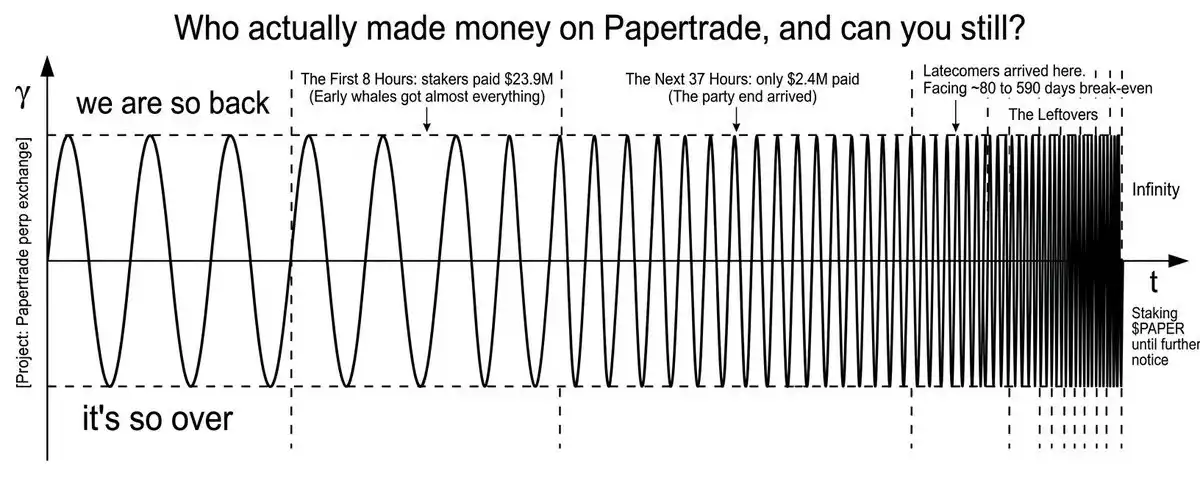
Within the first 8 hours of its launch, Papertrade distributed a total of $23.9 million in dividends to stakers; in the subsequent 37 hours, only $2.4 million was distributed.
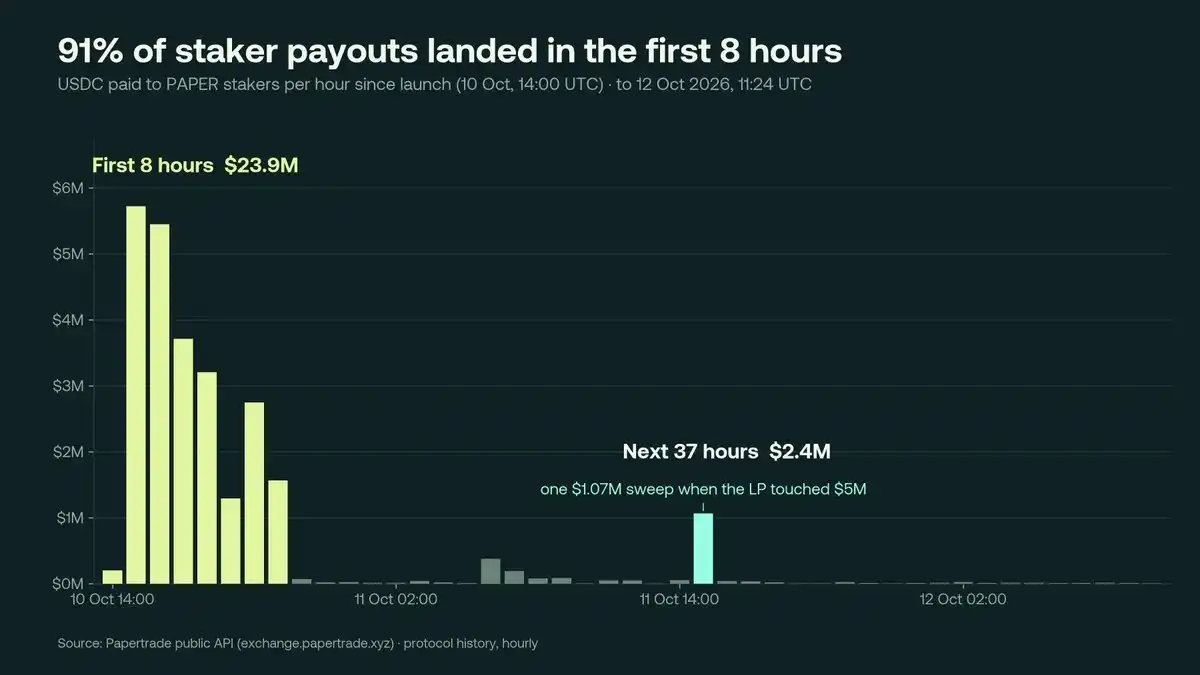
These two numbers essentially summarize the state of the game. However, who exactly made the money, and how they did it, is still worth a few minutes to unpack, especially if you plan to farm PAPER tokens this week.

All Research Reports Understood the Mechanism but Misjudged the Timeline

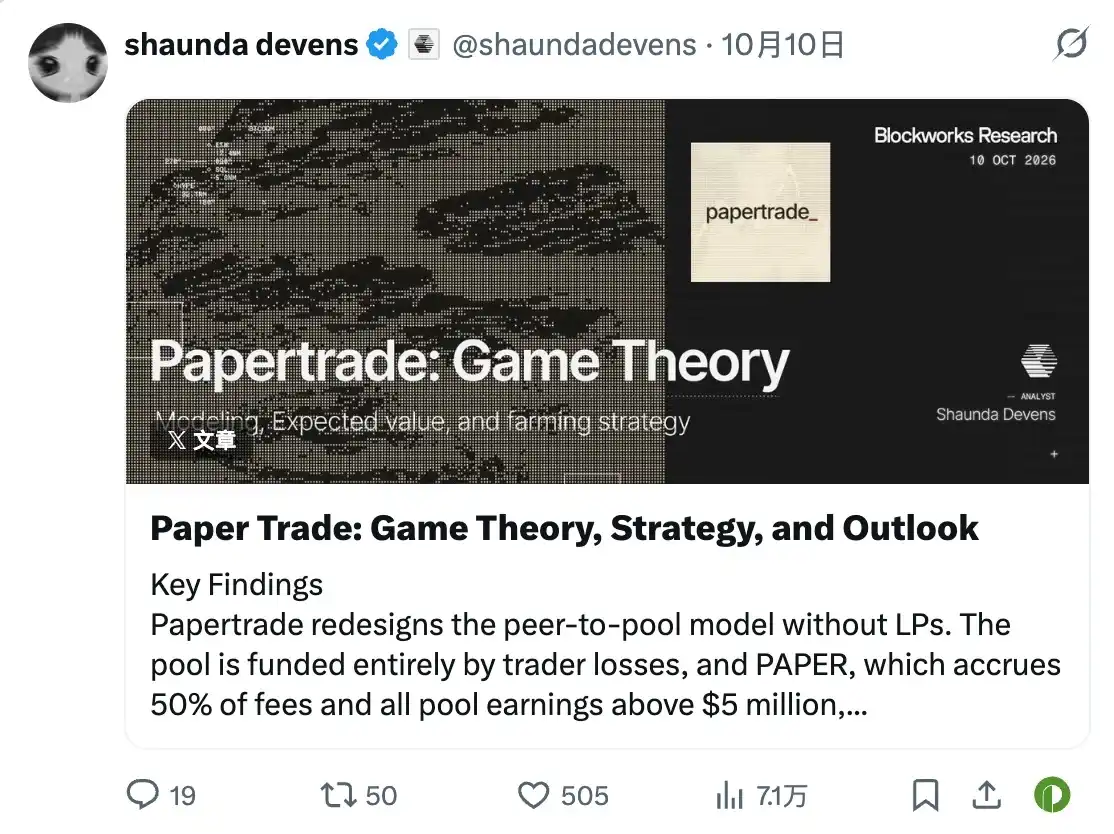
The highest-quality pre-launch research came from Shaunda Devens of Blockworks Research, tempest of Delphi Digital, and another investment firm, schema. All three explained the underlying mechanism thoroughly, but they all estimated the game would last for weeks.
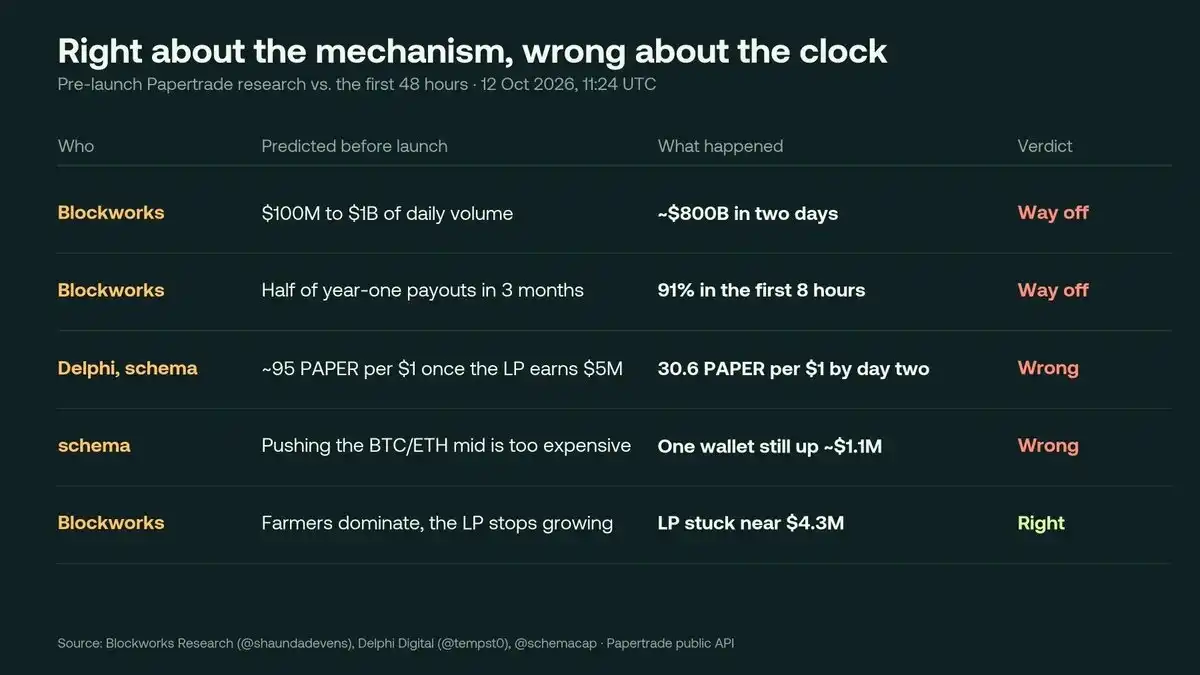
The only warning that stood the test of time was an unsettling one – Blockworks Research had cautioned that hedging arbitrage farmers could crowd out real traders, leading the protocol's LP into stagnation. This is precisely our current situation.
To be honest, nobody was foolish; it's just that the mechanism evolved far faster than anyone had priced in.

Who Actually Made Money?

Real traders incurred a net loss of $32.4 million on Papertrade, of which:

  • $26.3 million flowed to PAPER stakers;
  • $4.3 million settled in the house LP pool;
  • The remainder went to developer fees and small amounts.
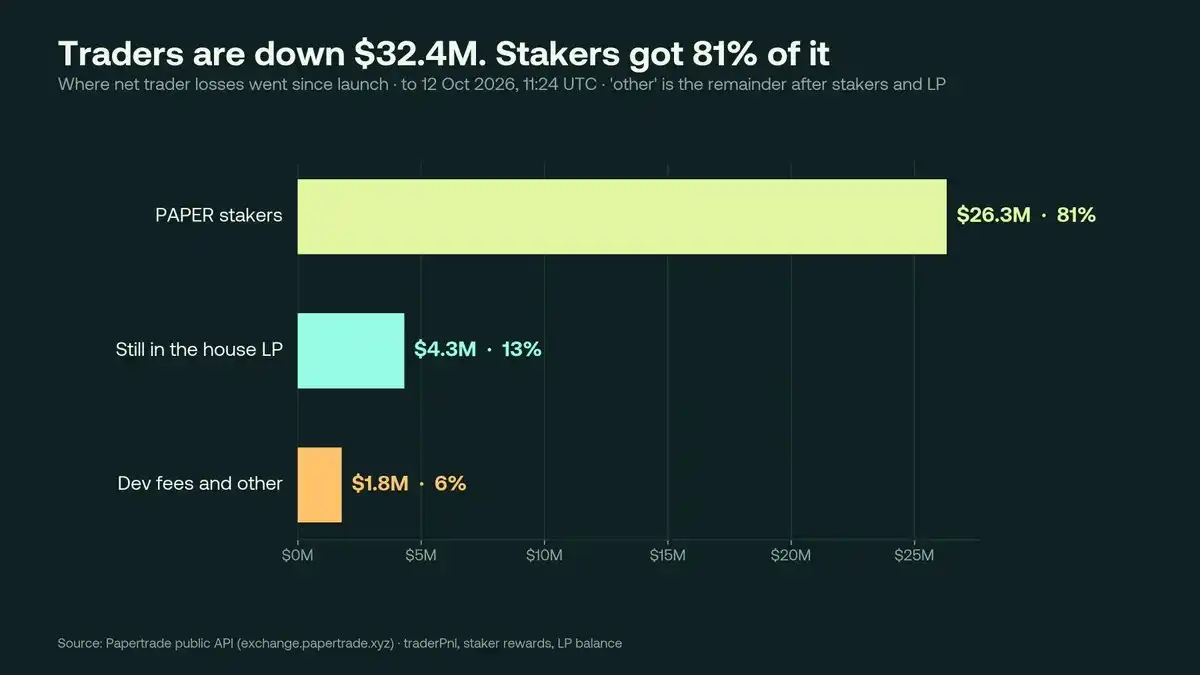
The vast majority of this $26.3 million was divided among early users who staked before approximately 22:00 UTC on launch day. In practice, this meant "whales took all" – Papertrade's relayer prioritized large orders, causing an order of about $75,000 to be queued beyond position 3000, while eight-figure orders could be matched within seconds.

Two of the most representative addresses showcase two distinctly different profit strategies.
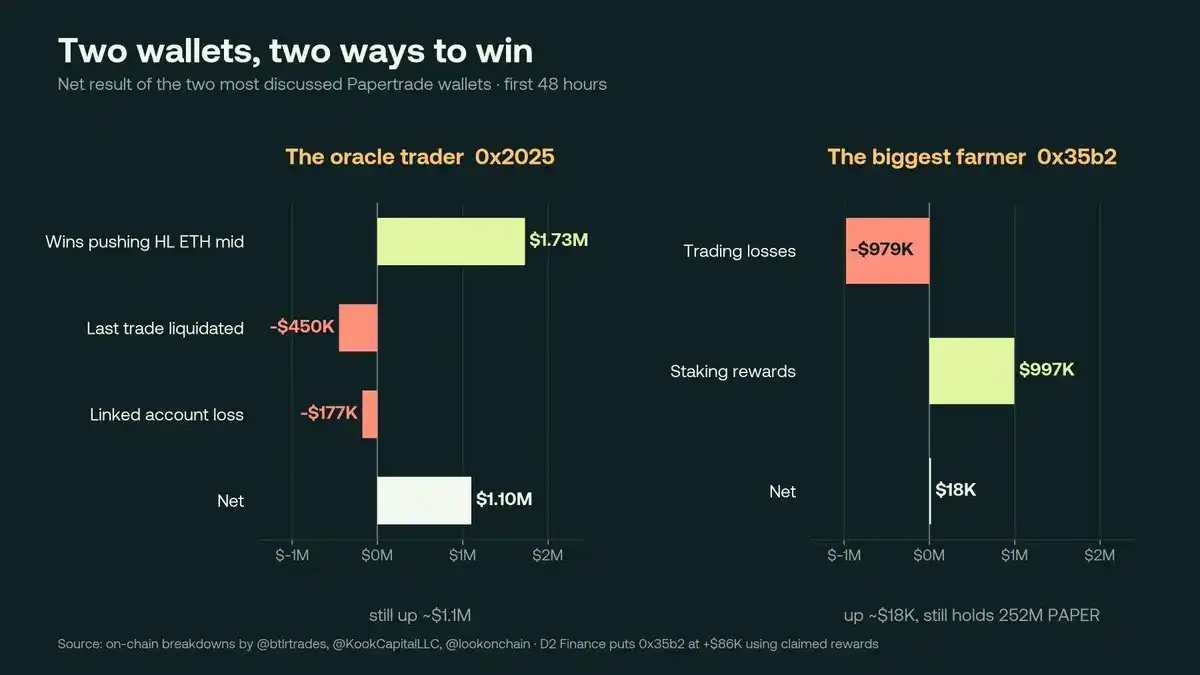
  • Address starting with 0x2025 (Arbitrage Looter Type):

This address would move the ETH mid-price by 10 to 20 basis points on Hyperliquid, then place massive orders of around $200 million in the opposite direction on Papertrade. Out of 305 trades, they won 296, with an average holding time of only 98 seconds. Although one stuck order liquidated for a loss of $450,000, they still netted about $1.1 million. The Papertrade team (Jez, Blurr) claimed he returned most of the funds, but on-chain analysts butler and kook presented seemingly contradictory on-chain evidence.
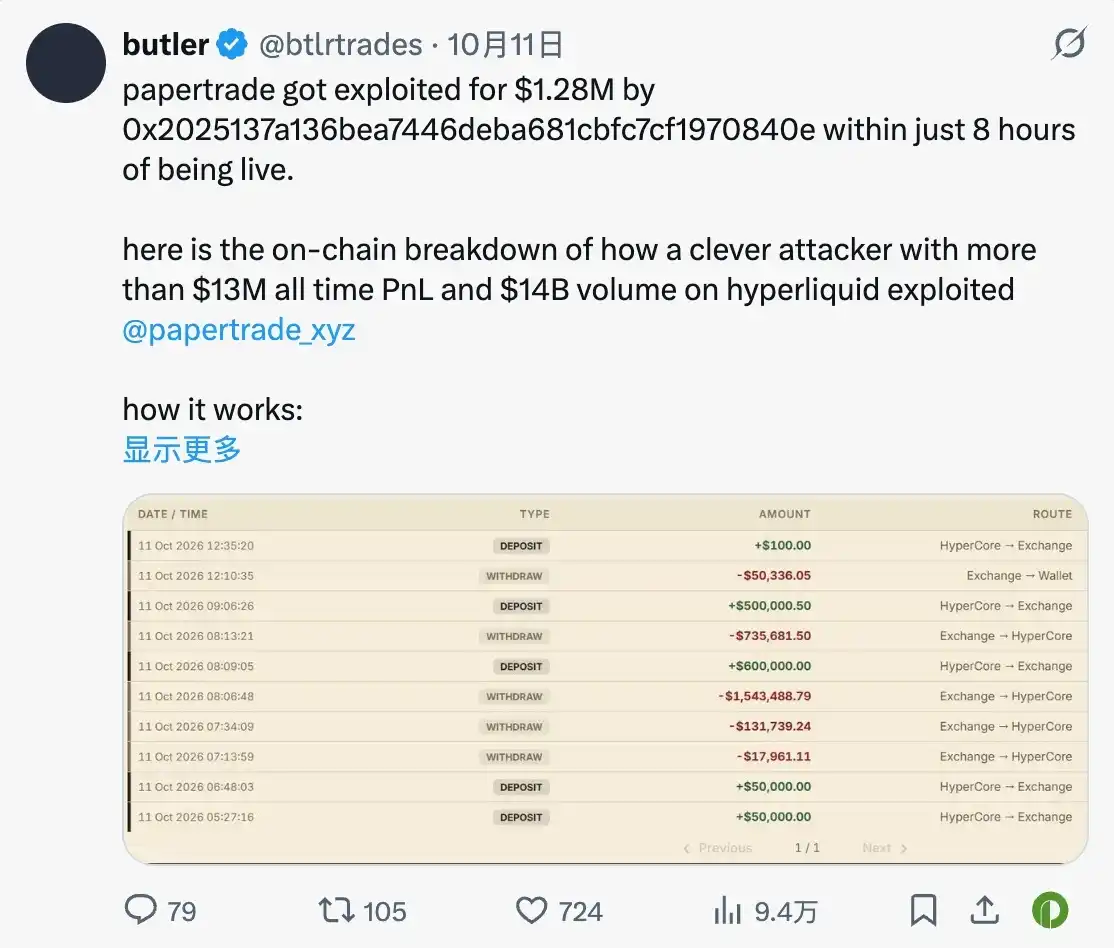
  • Address starting with 0x35b2 (Scale Volume Grinder Type):

According to Lookonchain data, this address generated $10.1 billion in trading volume, incurred a loss of $979,000, but recouped about $1 million in cash through staking, basically breaking even in fiat terms. However, the key point is they still hold 252 million PAPER tokens (about 4% of the total staked supply). At the current yield rate, these tokens generate roughly $14,000 in passive income per day. This is the true big winner.

By the way, let's debunk a rumor: the Papertrade team did not "slash staking yield from 99% to 1%" as on-chain analyst onchainmonk claimed.

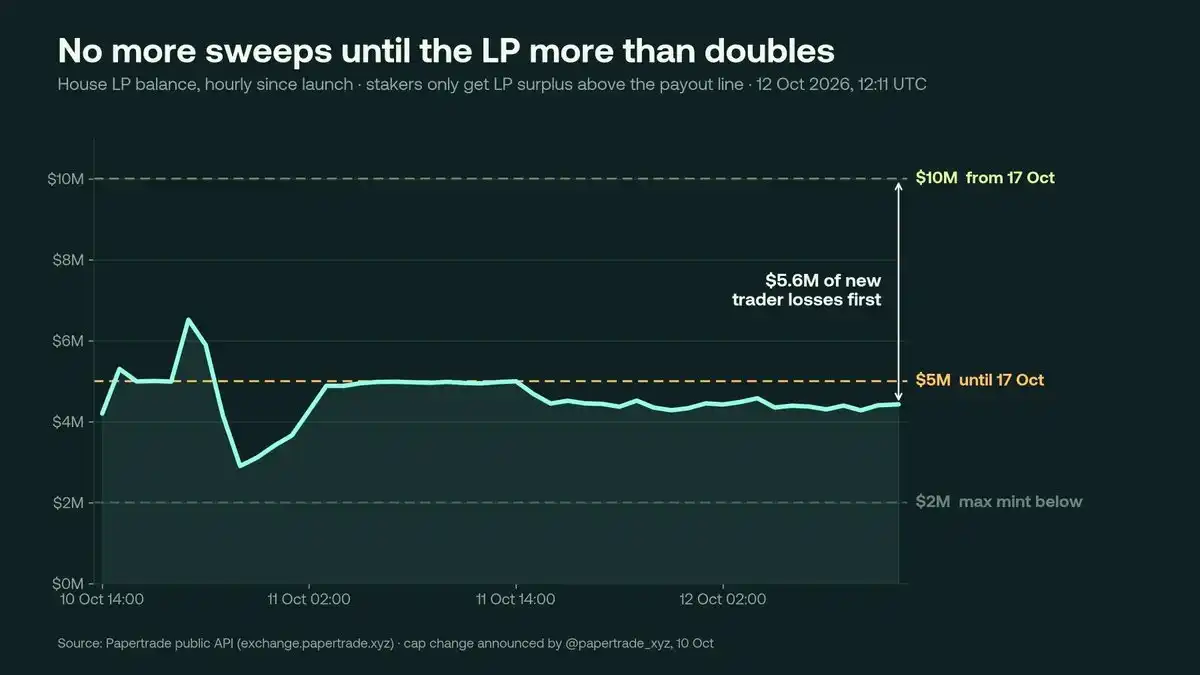
The rule for staking rewards is – distribute the surplus from the LP pool exceeding $5 million, plus half of the 2% fee from profitable orders. As the LP pool dropped below $5 million, the surplus distribution automatically paused. The rule never changed; only the state of the pool did.

Can You Still Make Money Entering Now?

Here's the formula for newcomers planning to enter today:

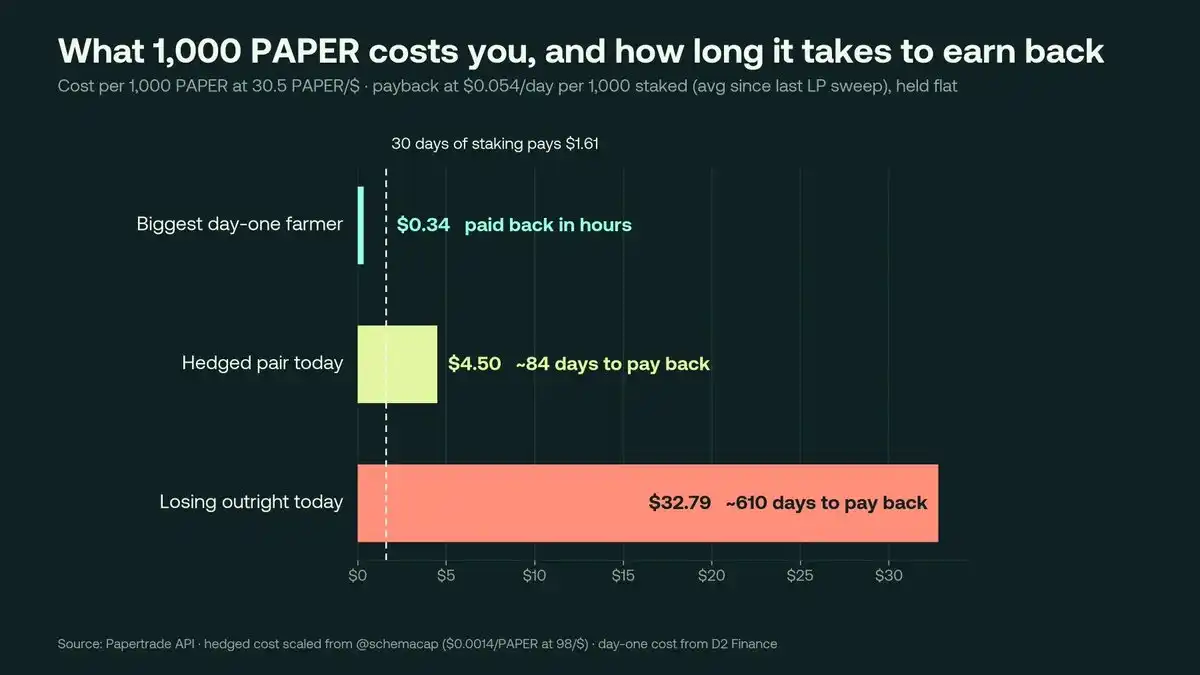
  • Active Wear-and-Tear is Suicide: At today's minting rate, incurring a hard loss to acquire 1,000 PAPER costs about $33;
  • Hedged Volume Grinding: Using a hedged long-short combo (opening 100x long and short positions, closing when volatility reaches about 1%), the cost is approximately $4.50;
  • Dividend Income: Since the last LP liquidation distribution, staking 1,000 PAPER earns about $0.055 per day.
This means:

  • The payback period for hedge farmers is about 80 days;
  • The payback period for one-sided hard-loss farmers is as long as 590 days.
  • This assumes stable yields and no one else continuing to mint new tokens – which is fundamentally impossible.

Even more critically, the difficulty will sharply increase starting October 17th, when the dividend trigger line will be raised from $5 million to $10 million on that day. As I write this, the house LP pool has only $4.3 million. This means that approximately $5.7 million of future trader losses will entirely refill the LP base pool before any dividends are distributed to stakers. Until the base pool is filled, stakers will only receive pure fee revenue.
Personally, I believe entering to farm now is not a stable income strategy, but a gamble – a bet that genuine gamblers will continue to come in and lose money, and that the losses will be sufficient to push the LP pool past the $10 million mark. If you subscribe to this logic, then use 100x leverage for hedging, strictly guard against one-sided liquidation, and ensure both sides of your orders are truly matched; if you don't believe it, there's no need to rush in now.

Four Key Metrics

Four key metrics will determine whether this is just the first act or the grand finale:

  • The LP pool breaking through $8 million and climbing steadily: This is the prelude to the next large dividend distribution.
  • Non-mining real trading volume: Only directional speculative traders can inject liquidity into the LP; hedged farmers are essentially just inflating the supply.
  • Net long open interest (OI): The current net long exposure is about $150 million, while the base pool holds less than $4 million. A clean 2.5% market pump would mean profitable positions need to be paid via the queue, not immediate cash settlement.
  • Whether the settlement queue can consistently remain at zero.

I will revisit this with the same data model after October 17th.

Related Questions

QAccording to the article, what is the primary reason why analysts failed to accurately predict the outcome of Papertrade?

AAnalysts correctly understood the underlying mechanisms but severely underestimated the speed at which the game theory evolved. The process played out in hours, not weeks as anticipated.

QWho were the biggest winners in the Papertrade event according to the breakdown provided?

AEarly PAPER stakers who staked before approximately 22:00 UTC on launch day captured the vast majority of the profits. This disproportionately benefited whales due to transaction processing priority.

QWhat are the two distinct winning strategies exemplified by the highlighted wallet addresses (0x2025 and 0x35b2)?

AThe 0x2025 address used an arbitrage-predatory strategy, manipulating ETH prices on Hyperliquid and placing massive opposite orders on Papertrade for quick profits. The 0x35b2 address used a high-volume scalping strategy, generating huge trading volume to mine PAPER tokens, effectively breaking even on fiat but securing a large stake for future passive income.

QWhat key change is scheduled for October 17th that will significantly impact the profitability for new stakers?

AThe threshold for the liquidity pool (LP) to begin distributing excess profits to stakers will increase from $5 million to $10 million. Until the LP balance exceeds this new threshold, stakers will only receive a share of trading fees.

QWhat does the author conclude about the viability of mining PAPER tokens after the initial hype phase?

AThe author concludes that mining PAPER is no longer a stable yield opportunity but a speculative gamble. It is a bet that enough genuine, losing traders will enter later to push the LP pool above the new $10 million threshold to trigger profit distributions again.

Related Reads

How Various Assets Have Performed So Far This Year: Bitcoin at -22% Return, Dead Last

As of November 13, 2026, Bitcoin has posted a -22.0% year-to-date return, ranking last among major asset classes. In contrast, the Philadelphia Semiconductor Index gained 43.2% despite a sharp pullback from its mid-year peak of 106.6%, while the S&P 500 and Nasdaq Composite held steady gains of roughly 8% to 10%. Even the CSI 300 (-13.3%) and gold GLD (-10.3%) outperformed Bitcoin. The article argues the key difference lies in the presence of real buying support. Semiconductors are backed by massive capital expenditure and order backlogs from major tech companies, giving them an earnings floor even after steep corrections. Bitcoin, by contrast, lacks such support. After spot ETFs helped Wall Street finish building core positions in 2024–2025, 2026 brought neither broad macro liquidity nor a new narrative capable of drawing fresh capital. ETF inflows slowed from a flood to a seasonal trickle. Without sustained new buyers, Bitcoin's high beta works only to the downside: in a stock-picking, zero-sum market it becomes the asset everyone wants to sell into strength. The article further notes that Bitcoin's positioning is losing focus. It has failed to act as either a "digital gold" hedge or a high-beta proxy for tech stocks. It lagged the Nasdaq and S&P 500 during the tech rally, and fell harder than gold when global assets contracted in November. The conclusion: Wall Street treats Bitcoin not as a safe haven but as a highly liquid, 24/7 liquidation tool—the first asset sold when institutions need to meet margin calls or lock in yearly profits. Crypto has been admitted to the table, but often as the one picked to pay the bill.

marsbit20m ago

How Various Assets Have Performed So Far This Year: Bitcoin at -22% Return, Dead Last

marsbit20m ago

From QR Codes to Physical Goods: How Consumer RWA Verifies Products and Rights

A single QR code can be printed on two bottles and scanned twice to open the same page, so verifying a physical item requires confirming the binding between the bottle in hand and its listed number. Consumer RWA verification has two parts: whether the goods or services are real, and whether the rights recorded in the digital credential are valid. For rights provenance, take a co-branded gift box: authorization documents define the term and scope in which a brand may use the co-branded mark, production and warehousing records show whether the box was stocked by batch, and rights registration states what holders can redeem and who delivers it. Linking all three lets consumers check authorization scope, supply, and their own eligibility. Identifiers, events, and evidence must work together. High-value items can use unique serial numbers, uniform-spec goods can use batch numbers, and courses or events can use session numbers. Events such as warehousing, sampling, outbound shipment, receipt, and redemption should be tied to the corresponding object, with operation time and responsible party retained. Test reports correspond to submitted samples; linking results to specific goods also requires checking the sample, batch, and inbound/outbound records. Ordinary batch goods can combine serialized QR codes with abnormal-scan records, while high-value items may add tamper-evident labels or independent authentication. Trusted records must also reflect current status. If a coffee batch has 500 bags at warehousing, 10 used for sampling, and 100 reserved for other channels, then absent other changes, 390 bags remain available for new rights. The warehousing record shows historical quantity; current redeemable quantity must be updated based on actual occupancy. A query page should at minimum state the goods or service, evidence source, last update time, and whether the credential is currently usable.

marsbit55m ago

From QR Codes to Physical Goods: How Consumer RWA Verifies Products and Rights

marsbit55m ago

10 Years Is Too Slow: Gu Quanquan's Team Challenges Dario, Compressing Cancer Cure to 4 Years

A UCLA professor, Quanquan Gu, has founded Geodesic Intelligence, a 15-person startup that after only five months has released NovaAtom-Lite, an all-atom structure prediction model that outperforms DeepMind's Isomorphic Labs flagship IsoDDE on FoldBench, the toughest biomolecular benchmark. The model predicts the 3D coordinates of every heavy atom in protein, DNA, RNA, and ligand complexes with near-experimental precision. NovaAtom-Lite posted top scores on two core pharma tests: antibody-antigen binding (79.07% success, 31 points above AlphaFold 3 and 3.5 above IsoDDE, with 2.2x AlphaFold 3's accuracy at high-precision thresholds) and protein-ligand binding (top 1 on both RMSD and contact metrics). On the Runs N' Poses benchmark, which separates memorization from genuine physics understanding, NovaAtom-Lite's lead grows on the most novel, out-of-distribution ligands (47.6% vs AlphaFold 3's 24%), showing it learns transferable physical rules rather than memorizing structures. The model also supports test-time scaling—raising sampling from 1 to 100 seeds lifts antibody success from 74.3% to 83.1%—and condition constraints, where a single contact-pair hint boosts success to 91.28% and full pocket hints lift hard-case ligand accuracy by nearly 16 points. It solved two nightmare cases: a wildly flexible 22-residue MERS nanobody loop (0.56 Å error, all 25 samples correct) and the KRAS G13D hidden switch-II pocket (0.98 Å ligand RMSD vs OpenDDE's 17.74 Å). Gu previously led ByteDance's SeedFold, the first model to beat AlphaFold 3 on FoldBench, forcing Isomorphic Labs to respond with IsoDDE. A stronger NovaAtom-Pro is coming. Days after launch, a16z cited NovaAtom-Lite in a report arguing pharma is entering its "GPT-3 moment," naming Geodesic as the sole company highlighted in its industry map. Geodesic's closed loop spans structure prediction, scientific reasoning, and wet-lab validation—aiming to compress drug discovery from a decade to four years.

marsbit1h ago

10 Years Is Too Slow: Gu Quanquan's Team Challenges Dario, Compressing Cancer Cure to 4 Years

marsbit1h ago

Trading

Spot
活动图片