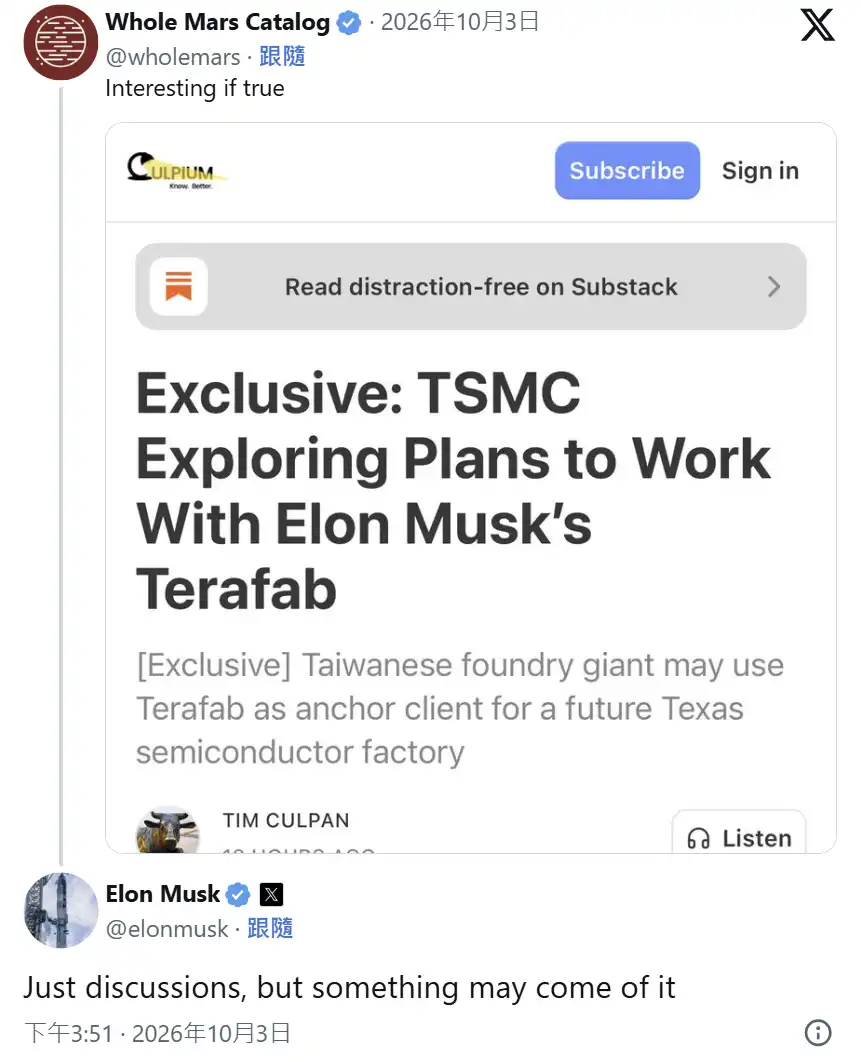
October 4, News - Independent tech journalist Tim Culpan disclosed in his newsletter "Culpium" that TSMC is evaluating cooperation with the Terafab super fab project in Texas, owned by Tesla and SpaceX CEO Elon Musk.
Regarding this, Musk personally confirmed the news on the social media platform "X." TSMC officially maintained its usual low-key stance and did not make any public response. Several industry insiders revealed to the media that the two parties have indeed been in contact, but it is "still far from signing," currently more like the "dating stage."
TSMC's Entry: Two Possible Cooperation Models
According to sources cited by Tim Culpan, the specific form of cooperation has not yet been determined. However, the two most likely models are: either TSMC invests to hold and operate Terafab, with Tesla and SpaceX acquiring shares and signing capacity purchase commitments; or Tesla and SpaceX hold the majority stake, with TSMC investing a small amount of capital while providing technology and operations.
The former model resembles TSMC's joint-venture fab projects in Kumamoto, Japan (JASM) and Dresden, Germany (ESMC): TSMC holds about 86.5% of JASM, with local partners like Sony, Denso, and Toyota holding minority shares and providing order commitments; in ESMC, TSMC holds about 70%, with Bosch, Infineon, and NXP each holding 10%. Under this model, TSMC maintains absolute dominance in advanced node technology and operational management, while partners primarily provide funding and capacity commitments.
The second model is more uncommon: Tesla and SpaceX would hold the majority stake in the joint venture, with TSMC holding only a minority stake but still providing advanced node technology and fab operational expertise. If this model materializes, it would break TSMC's past practice of insisting on leading fab operations. However, tech industry insiders familiar with TSMC directly dismissed the possibility of this scheme, emphasizing that TSMC would not relinquish control, with the core reason being the need to ensure technology remains in its own hands.
After X user Whole Mars Catalog (@wholemars) reposted the above leak on the X platform, Musk responded in the comment section on October 3: "It's just in the discussion stage at the moment, but there might be progress."
Other sources indicate that TSMC has been considering plans to set up a fab in Texas for several months, which would be a new layout in addition to its Arizona expansion plan. In late September this year, Taiwanese media cited sources from semiconductor equipment suppliers reporting that TSMC intends to expand its US manufacturing footprint by launching a plan to build a second US campus, likely located in Texas, with a total investment expected to exceed the $265 billion in Arizona.
Combining the above leaks, if true, it would likely mean TSMC will lead the "Terafab" project.
Intel's Position at Risk of Being Marginalized?
Musk's move makes Intel's role in the Terafab plan delicate.
In early April this year, Intel announced it was honored to join the Terafab project, and Musk publicly confirmed at the time that the Terafab plan would use Intel's next-generation 14A process to produce chips.
In June this year, former Intel Fab Manager Gary Jiang joined Tesla and assumed the role of Terafab Project Director. This move was seen as helpful in subsequently promoting cooperation between the Terafab project and Intel.
However, Tim Culpan indicated that cooperation between Terafab and Intel has made limited progress so far. If TSMC definitively enters the fray and introduces its own advanced processes, Intel's 14A technology is highly likely to be marginalized or even excluded.
Nonetheless, some industry analysts suggest that, given TSMC's globally leading advanced packaging technology, Musk might produce front-end chips using Intel's 14A process at Terafab in Texas, and complete back-end advanced packaging with TSMC's technology, also in Texas.
Another netizen commented that TSMC's involvement in any Terafab cooperation would basically be supplementary, as Terafab itself would be extremely large in scale. Musk retweeted and responded: "Quantity changes quality. A single-celled bacterium and a human with 35 trillion cells are vastly different, even though both are made of cells."
Patent Barrier: Another Layer of Consideration for Musk Bringing TSMC Onboard
Beyond TSMC's advantages in advanced process technology and fab operational expertise, patent risks may also be a key reason for Musk to bring TSMC into the Terafab project.
Intel and TSMC have a broad patent cross-licensing agreement, but Terafab itself is not covered by this protective umbrella. According to the 2022 patent license agreement signed between TSMC and Intel, both parties granted each other licenses to specific patents.
However, if Terafab uses Intel's technology to independently produce chips, it could easily fall into the legal risk of infringing key TSMC technology patents. Bringing TSMC into the community of interest becomes a key strategy for Terafab to avoid potential patent disputes.
Terafab is Not for Foundry, But to Ensure Supply Autonomy
The "Terafab" project was officially announced in March this year by Tesla, SpaceX, and xAI. It plans to build a vertically integrated, massive chip manufacturing base at the north campus of the Gigafactory in Austin, Texas, integrating design, lithography, manufacturing, storage, packaging, and testing.
The core reason for Musk building Terafab is precisely dissatisfaction with the existing supply chain. He has bluntly stated that the expansion speed of existing suppliers like TSMC and Samsung is far from meeting the computing power demands of Tesla vehicles, the Optimus humanoid robot, and SpaceX/xAI, with current global chip capacity meeting only about 2% of its "future demand."
According to Musk's plan, 80% of the computing chips produced by Terafab in the future will be transferred to low Earth orbit in space, with only 20% of computing chips reserved for ground applications.
Public hearing documents from SpaceX in Grimes County, Texas, show that the initial phase investment for the "Terafab" project is $55 billion, and if all phases are completed, the total investment could be as high as $119 billion. The initial target is starting at 100,000 wafers per month, with a long-term target of 1 million wafers per month.
This scale far exceeds Musk's earlier personal estimate of $20 billion. Analysts point out that Musk is launching a "15-year-long strategy."
Clearly, the ultimate goal of Musk promoting Terafab is not to create another commercial foundry competing with TSMC, Intel, or Samsung. Its core need lies in obtaining stable, uninterrupted, and sufficient capacity of customized chips to support Tesla's electric vehicles and autonomous driving technology, SpaceX's aerospace equipment, and xAI's enormous computing power demands.
Therefore, even if the Terafab project is led by Musk's Tesla and SpaceX, it will not be in direct competition with TSMC and Intel. This is also the foundation for the three parties to sit at the same negotiating table to discuss cooperation. After all, facing the massive plan of Terafab's future production of 1 million wafers per month as proposed by Musk, becoming its main technical cooperation partner would undoubtedly occupy a favorable position in future market competition.
This article is from the WeChat public account: 芯智讯 , edited by: 芯智讯-浪客剑, author: 芯智讯浪客剑, original title: "TSMC Joins Terafab Project? Musk: Under Discussion!"