NFTs That Can Earn Stock Tokens? What Exactly is StonkBrokers?

Foresight NewsPublié le 2026-07-21Dernière mise à jour le 2026-07-21

Résumé

Title: How StonkBrokers Connects NFTs to Stock Token Earnings StonkBrokers is an NFT project from the Web3 development team Clutch Labs (CLUTCH) built on Robinhood Chain. It consists of 4,444 "pixel broker" NFTs. Unlike typical NFTs, each one is linked to an ERC-6551 token-bound account, meaning it functions as its own wallet capable of holding assets like stock tokens. The project's ecosystem includes: 1. **STONKBROKER (ERC-20 Token)**: The fungible token connected to the NFTs via the Anvil AMM. Users can trade tokens for NFTs at a base rate of 666,666 STONKBROKER (plus ETH fees). 2. **NFT Activation & Rewards**: NFT holders must spend STONKBROKER tokens to "activate" their NFT into one of five tiers, which determines their weight in receiving stock token rewards. These rewards are funded by 70% of the ETH trading fees generated on the Anvil AMM. 3. **Lending**: NFTs can be used as collateral to borrow STONKBROKER tokens. 4. **Future Products**: The roadmap includes the Stonk Launcher (a token launchpad) and the Stonk Exchange (a "vote-directed DEX" based on Uniswap V3), scheduled for late July and August 2026, respectively. The project aims to provide NFTs with ongoing utility as active financial agents rather than static collectibles. Its token (STONKBROKER) and NFT collection have seen significant price increases recently. However, the project's long-term viability depends on successful product delivery, sustainable protocol revenue, and navigating risks like market vo...


Author: KarenZ, Foresight News


Most NFTs, once bought and sent to a wallet, have a primary job of "sitting around."


StonkBrokers, however, has assigned 4444 pixel brokers an on-chain job: each NFT comes with its own wallet capable of receiving stock tokens; holders can use the project's token to activate it, increase its reward weight, or pledge it for loans. Around these NFTs and the related token STONKBROKER, CLUTCH is also planning token issuance and decentralized exchange products.


The market has shown high enthusiasm for this design. According to GMGN data, the StonkBrokers token STONKBROKER once saw its market capitalization exceed $15 million, with a 24-hour increase of over 300%, rising more than 14 times in the past 2 days, and is currently oscillating around $13 million. OpenSea data shows the StonkBrokers NFT floor price has also risen to 1.88 ETH, up over 306% in 24 hours.
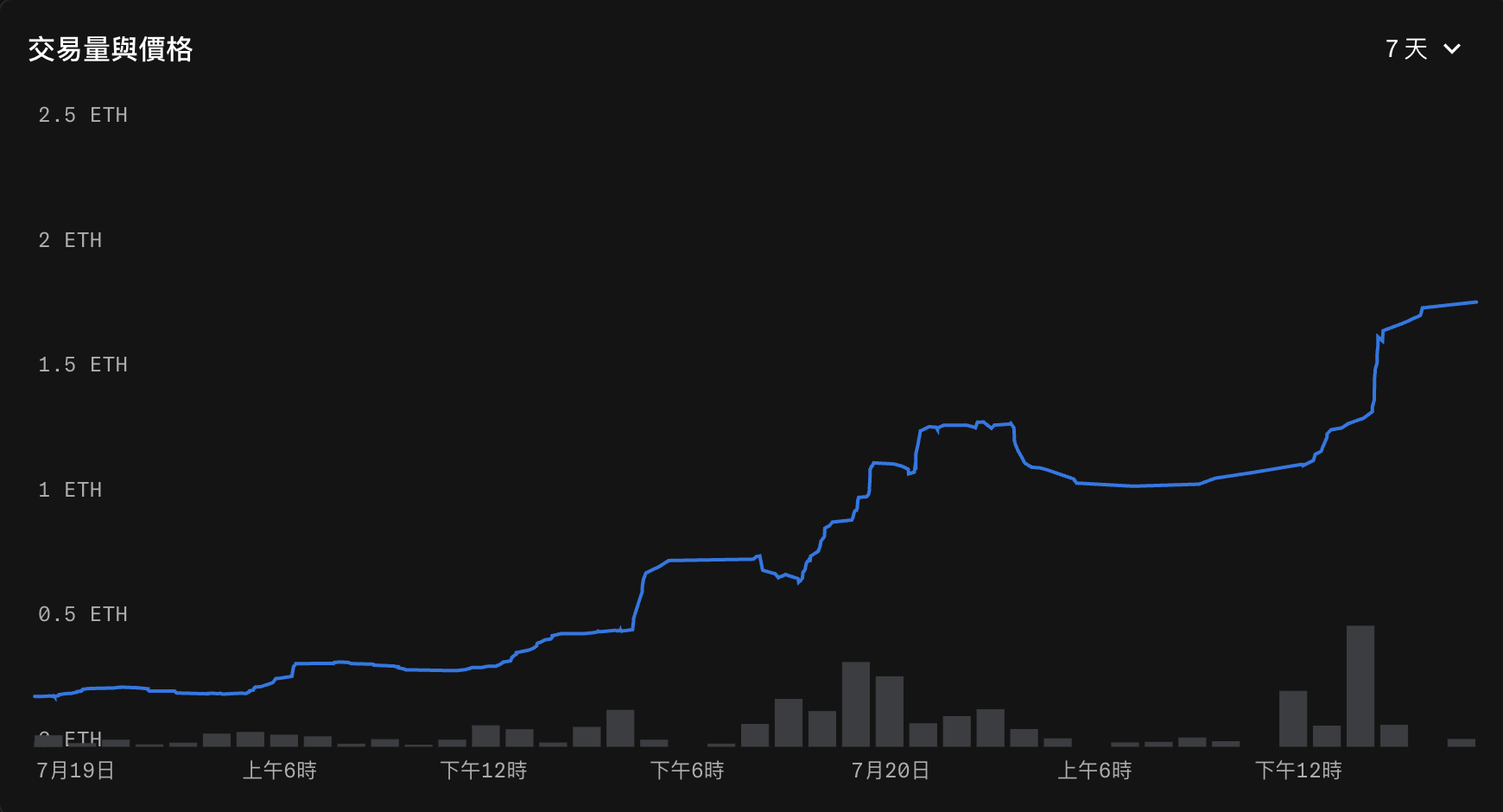

StonkBrokers NFT trading volume and price, Source: OpenSea


Who is CLUTCH, and What is StonkBrokers?


CLUTCH, more fully known as Clutch Labs, is an independent Web3 development team focused on on-chain market infrastructure. Its publicly disclosed products involve directions such as prediction markets, NFT liquidity protocols, perpetual contracts, on-chain games, and AI Agents.


The CLUTCH website lists 0xSimpleFarmer as a project builder, and their X account also introduces themself as the founder of Clutch Markets.


CLUTCH didn't start developing products with StonkBrokers. According to the timeline on its website, the team initially entered the market with on-chain parlay prediction markets and subsequently launched products like prediction markets, Clutch Puppies, Pixel Pups, an NFT marketplace, and the Anvil NFT AMM on networks such as Arbitrum, ApeChain, and Ethereum.


StonkBrokers can be understood as CLUTCH's combinatorial attempt, applying their previous experience with NFTs, AMMs, and DeFi on the Robinhood Chain.


The project was originally an experimental development by the team on the Robinhood Chain testnet during the Arbitrum Buildathon. 0xSimpleFarmer stated that this test version was showcased by the Robinhood Chain team at the event. About seven months later, the project launched on the Robinhood Chain mainnet on July 17, 2026, and completed the issuance of 4444 NFTs.


The mainnet launch of StonkBrokers was described by the project as a "free mint," but "free" here only refers to the NFT mint price being 0, not that all participants could obtain NFTs at zero cost. Users needed to burn the Pup Cup NFT on Ethereum or the Clutch Puppies NFT on ApeChain before the deadline to receive corresponding StonkBrokers minting slots, with one old NFT corresponding to one slot. This channel is now closed, and all 4,444 StonkBrokers have been minted. To obtain an NFT now, one must purchase it through the Anvil AMM or on the secondary market.


How Do NFTs, Bound Accounts, and the STONKBROKER Token Connect?


Each StonkBroker NFT is associated with an ERC-6551 Token-Bound Account.


In simple terms, an NFT is not just a picture in a wallet; it itself possesses an on-chain account. This account can hold ERC-20 tokens or other on-chain assets, and control of the account follows the transfer of NFT ownership: whoever owns the NFT can control its bound wallet.


The NFT receives initial stock tokens upon minting, and subsequent stock token rewards also go directly into the corresponding bound account. If a StonkBroker's bound account holds stock tokens, these assets will transfer along with the NFT to the new holder.


The StonkBroker NFT is a non-fungible ERC-721 asset, with a total supply of 4444; STONKBROKER is a freely divisible and transferable ERC-20 token. The two are connected via CLUTCH's Anvil NFT AMM.


The protocol sets a base redemption unit of 666,666 STONKBROKER tokens for each NFT. Users can pay 666,666 STONKBROKER plus a transaction fee in ETH to the Anvil treasury to redeem the next NFT from the treasury; if a specific token ID is desired, they can use the "snipe" function to select a designated NFT (with a higher ETH fee). The project's current documentation lists ETH transaction fees as 10% for regular redemption and 15% for designated NFT redemption. Relevant parameters should still be verified against the actual trading interface and contract calls.


This structure can, to some extent, address liquidity issues for certain NFTs. Traditional NFT trading relies on buyers and sellers placing orders; if an NFT temporarily has no buyer, the holder might find it difficult to exit immediately. Anvil establishes a protocol-based redemption channel between NFTs and ERC-20 tokens of the same series.


It's important to note that "each NFT corresponds to 666,666 tokens" should not be misinterpreted as a risk-free price guarantee. Both NFTs and STONKBROKER will fluctuate with market trading, and the actual value paid or received by users is also affected by token price, ETH fees, treasury inventory, and protocol parameters.


Furthermore, Anvil provides a protocol-level redemption channel with a 10%/15% ETH fee, which is better than having no liquidity, but it is not a low-cost, high-efficiency liquidity solution.


From Activation to Clock In: How Are Stock Token Rewards Generated?


However, initial stock token funding and subsequent rewards are two different mechanisms. Subsequent stock token rewards supported by Anvil trading fees will only be distributed to already activated StonkBrokers, with weights calculated based on activation level.


Merely holding a StonkBroker does not mean automatically receiving subsequent stock token rewards. Holders need to first activate the NFT using STONKBROKER tokens on the project's page to include it in the reward distribution system.


The current StonkBrokers documentation sets five activation tiers: the base tier requires 66,666 STONKBROKER, the highest tier requires 1,666,666, with corresponding reward weights increasing from 1x to approximately 3.33x.
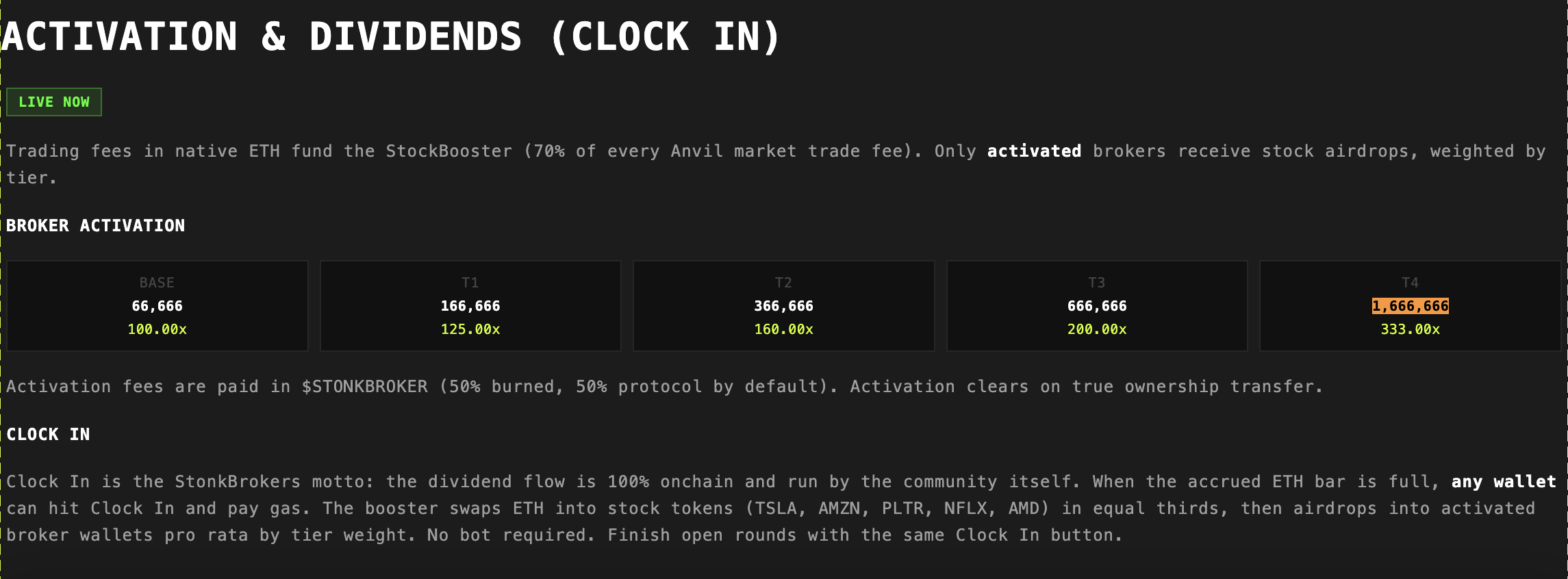


According to current contract parameters, the StonkBroker activation fee is set by default to 50% burned and 50% sent to the protocol; after a genuine ownership transfer of the NFT, the previous activation status is cleared, and the new holder needs to reactivate. However, stock tokens already deposited into the bound account are not cleared.


The funds for stock token rewards currently primarily come from Anvil's ETH transaction fees. According to the current documentation, 70% of these fees go to StockBooster, and 30% go to the protocol. When StockBooster accumulates to a set condition, any user can call the "Clock In" function and pay Gas, triggering the protocol to swap ETH for the currently configured stock tokens, which are then distributed to the bound wallets of each NFT based on activation level weights.


The whole process can be simplified as:


Trading NFTs on Anvil generates ETH fees → 70% of fees go to StockBooster → Community users call Clock In → ETH is swapped for stock tokens → Stock tokens enter the bound accounts of activated NFTs.


From NFT Lending to Launcher and vDEX


On top of this, StonkBrokers also offers NFT collateralized lending functionality. Holders can lock their NFT into the Loan Vault to borrow principal denominated in STONKBROKER. Documentation lists the principal benchmark as 666,666 STONKBROKER, with borrowing fees prepaid in ETH and calculated based on loan duration, a 15% annualized fee rate, and the ETH market value of the NFT.


Borrowing fees are also distributed with 70% going to StockBooster and 30% to the protocol. After the borrower repays the agreed amount of STONKBROKER, they can retrieve the NFT; if overdue, additional ETH fees must be paid, and persistent default may lead to loss of the pledged NFT.


Furthermore, StonkBrokers will subsequently launch the launch platform Stonk Launcher and Stonk Exchange on July 30.


Among these, the launch platform supports fixed-price, bonding curve, and custom launch configurations. According to the project design, this step will also automatically create LP positions, fee distribution contracts, and the token's own staking vault. Token holders can deposit newly issued tokens into the staking vault and share the corresponding LP fees proportionally.


The project describes Stonk Launcher as a launch platform governed by STONKBROKER holders and activated StonkBroker NFTs, sharing governance and fee streams. A portion of the fees and royalties generated by Launcher is planned to support stock token rewards. Specific allocation ratios and implementation methods still need to be verified against the officially deployed mainnet contracts.


The Stonk Exchange, accompanying Launcher, is scheduled to launch on August 29 at 8:00 PM Eastern Time, corresponding to the morning of August 30 Beijing time. The project calls it a "Vote Directed DEX," or vDEX for short, meaning a DEX where the flow of trading fees can be determined by voting.


At the basic trading level, Stonk Exchange plans to adopt the Uniswap V3 architecture. Users can perform token swaps, create concentrated liquidity pools, and allocate funds within custom price ranges. Unlike traditional AMMs that spread liquidity uniformly across the entire price range, Uniswap V3 liquidity providers can concentrate their capital in price ranges expected to be more active to improve capital efficiency. However, once the price moves outside the selected range, the LP position may stop earning trading fees and face risks like impermanent loss.


Project documentation outlines three tiers of trading fees: 0.05% primarily for relatively stable trading pairs, 0.3% for ordinary pairs, and 1% for assets with lower liquidity or higher volatility. STONKBROKER is planned as a governance tool, allowing holders to vote on the direction of some fee flows, such as which liquidity pools or ecosystem incentive programs receive support.


It's important to distinguish that existing information does not confirm that trading fees generated by Stonk Exchange will be fixedly directed to StockBooster or the stock token reward system. What can be confirmed currently is that the flow of these fees will be determined by STONKBROKER governance mechanisms; whether they are used for stock token rewards still depends on the contract design and governance outcomes at that time.


Conclusion


The most noteworthy aspect of StonkBrokers might not be "how much ETH an NFT rose to" or "how high the token's market cap climbed," but rather its attempt to answer a long-standing question plaguing the NFT market: beyond being a profile picture or community status symbol, can an NFT become a truly operable on-chain account and maintain an ongoing relationship with trading, lending, and RWA?


CLUTCH has already deployed part of the mechanism to the mainnet, but subsequent modules like Stonk Launcher and Stonk Exchange still await delivery. Whether StonkBrokers ultimately forms a sustainable on-chain financial system or merely completes a high-volatility product experiment under attention remains to be answered by real protocol revenue, subsequent product implementation, and more thorough security verification.


Simultaneously, the Robinhood Chain ecosystem is still in its early stages, with network activity, asset liquidity, and infrastructure maturity all requiring observation. StonkBrokers also faces uncertainties such as smart contract security, team delivery, governance parameter adjustments, and regulatory policy changes. Its NFTs, STONKBROKER token, and related stock tokens may all experience significant price volatility. The stock token rewards mentioned by the project are not equivalent to stable returns or traditional stock dividends, and participants still need to fully assess the associated risks.


Questions liées

QWhat is StonkBrokers and how does it utilize NFTs?

AStonkBrokers is a Web3 project built on Robinhood Chain that utilizes 4,444 unique pixel broker NFTs. Each NFT is associated with an ERC-6551 Token-Bound Account, essentially giving it its own wallet capable of receiving tokenized stock rewards. These NFTs can be activated with the project's native token (STONKBROKER) to increase their reward weight, used as collateral for loans, and traded through the Anvil NFT AMM.

QWhat is the purpose of the STONKBROKER token within the ecosystem?

AThe STONKBROKER token is the ERC-20 utility and governance token of the StonkBrokers ecosystem. Its primary functions include: activating StonkBroker NFTs to qualify them for stock token rewards and increase their reward weight, serving as the quote asset for NFT/ERC-20 swaps on the Anvil AMM, and being the currency for governance votes that direct fee flows within the upcoming Stonk Exchange (vDEX).

QHow does the 'stock token' reward mechanism for activated NFTs work?

AStock token rewards for activated NFTs are funded primarily by ETH transaction fees generated from trading NFTs on the Anvil AMM. 70% of these fees go into a 'StockBooster' pool. When a user triggers the 'Clock In' function, the protocol swaps the accumulated ETH in the StockBooster for the configured stock tokens. These tokens are then distributed to the Token-Bound Accounts of all *activated* NFTs, with the amount each receives weighted by its activation level.

QWhat is the Stonk Exchange (vDEX), and how does it differ from a traditional DEX?

AStonk Exchange is a planned decentralized exchange (DEX) that the article calls a 'Vote Directed DEX' (vDEX). While it will be built on Uniswap V3 architecture for core trading functionality, its key differentiator is governance. Holders of STONKBROKER tokens can vote to direct where a portion of the trading fees generated on the exchange are allocated, such as to specific liquidity pools or ecosystem incentive programs.

QWhat are some of the key risks or challenges associated with StonkBrokers mentioned in the article?

AThe article highlights several risks: 1) The project's full vision (Stonk Launcher and Stonk Exchange) is not yet deployed. 2) The ecosystem is built on the early-stage Robinhood Chain, which may have limited network activity and liquidity. 3) The project faces standard Web3 risks like smart contract security, team execution, and potential regulatory changes. 4) All assets (NFTs, STONKBROKER, stock tokens) are subject to high price volatility, and stock token rewards are not guaranteed stable income or traditional dividends.

Lectures associées

Après trois trimestres consécutifs de baisse, le marché des cryptomonnaies pourra-t-il connaître une fenêtre de stabilisation au troisième trimestre ?

Le marché des cryptomonnaies a enregistré son pire trimestre depuis 2022, avec une capitalisation totale chutant de 12,6% à 2 100 milliards de dollars. Tous les indicateurs clés (volume des échanges, valeur des stablecoins) montrent une sortie nette de capitaux. Le Bitcoin a perdu 14,2% et l'Ethereum 25,4% sur le trimestre, rompant sa corrélation antérieure avec les actions technologiques. Les ETF spot américains sur le Bitcoin ont subi des rachats massifs, avec une sortie nette de 4,67 milliards de dollars au Q2, indiquant une pression de vente continue. Le resserrement de la politique de la Fed et les ventes d'entreprises comme Strategy ont accentué la déleveragisation du secteur. L'attention du marché se porte désormais presque exclusivement sur la réunion de la Fed fin juillet. Une position accommodante pourrait stabiliser le Bitcoin entre 68 000 et 84 000 dollars, tandis qu'un ton hawkish pourrait le faire osciller autour de 50 000-56 000 dollars. Parallèlement, la progression du *CLARITY Act*, une loi cruciale pour la clarté réglementaire, est au point mort au Sénat, réduisant les chances d'adoption en 2026 et maintenant une prime de risque élevée sur l'ensemble du secteur. Malgré ce contexte difficile, quelques secteurs résistent : les marchés de prédiction ont vu leur volume nominal augmenter de 48,7% et les biens collectionnables tokenisés ont progressé d'environ 143%. La tokenisation d'actifs du monde réel (RWA) continue également sa croissance régulière, portée par des fondamentaux indépendants du cycle crypto. Les bases d'un effondrement extrême semblent absentes, mais le marché est désormais guidé par les politiques monétaires, les prix et les attentes de taux, plutôt que par le simple récit haussier. La fin des sorties massives des ETF et le retour des achats des détenteurs à long terme pourraient indiquer une phase de stabilisation potentielle.

marsbitHier 08:42

Après trois trimestres consécutifs de baisse, le marché des cryptomonnaies pourra-t-il connaître une fenêtre de stabilisation au troisième trimestre ?

marsbitHier 08:42

The SpaceX Trade, Unlocked: SPCXON Débarque sur WEEX

En juin 2026, SpaceX a réalisé la plus grande introduction en bourse de l'histoire, mais l'accès à l'action a été limité pour de nombreux investisseurs en raison de restrictions régionales et de frictions liées aux courtiers. La plateforme WEEX propose désormais une solution via SPCXON/USDT, un instrument tokenisé sur le marché au comptant qui permet d'obtenir une exposition au cours de SpaceX en utilisant l'USDT, sans nécessiter de compte de courtage américain. SPCXON est un produit tokenisé construit sur l'infrastructure d'Ondo, conçu pour refléter l'économie de la détention d'actions SpaceX pour les traders éligibles en dehors des États-Unis, avec des dividendes réinvestis. Le cas d'investissement repose sur la croissance des revenus de Starlink et les progrès de Starship, malgré un valorisation déjà élevée et des risques liés à un flottant public réduit et à des déblocages d'actions internes à venir. Il est important de noter que SPCXON offre une exposition, et non la propriété directe d'actions ou de droits de vote. Son prix peut évoluer avec une prime ou une décote par rapport à la valeur liquidative. WEEX propose également d'autres produits tokenisés comme MSTRON et MUON dans un compte unifié, permettant une rotation entre crypto-monnaies et actions traditionnelles sans transfert de fonds. La plateforme souligne ainsi comment les barrières entre la finance traditionnelle et les actifs numériques s'estompent.

TheNewsCryptoHier 08:34

The SpaceX Trade, Unlocked: SPCXON Débarque sur WEEX

TheNewsCryptoHier 08:34

BIT Trading Moment : Le BTC reste sous la pression de l'EMA 200 hebdomadaire, un rejet pourrait relancer la baisse, les actions de stockage et de semi-conducteurs qui ont bondi cette nuit ont baissé en séance de nuit

**Résumé des marchés : Bitcoin sous pression, actions technologiques en réajustement** Le marché crypto poursuit son rebond, avec Bitcoin évoluant autour de 66 000 $. Il fait face à une résistance clé vers 68 000 $, niveau correspondant au coût moyen des investisseurs sur cinq mois. Les traders surveillent les moyennes mobiles clés (200 MA à ~63 333 $ et 200 EMA à ~68 328 $ en hebdomadaire). Une rupture au-dessus de 68 000 $ ouvrirait la voie à une hausse, tandis qu'un échec pourrait entraîner un retest des 63 000 $. L'analyse suggère que la dynamique actuelle ressemble à un rebond estival à faible liquidité plutôt qu'au début d'un véritable marché haussier. Sur le marché actions américain, après une forte séance mardi portée par les semi-conducteurs et les titres du stockage (Micron, AMD, Intel...), les contrats à terme indiquent une ouverture en baisse. Les secteurs ayant récemment bondi, comme les semi-conducteurs et le stockage, reculent en séance de nuit. Certaines valeurs se démarquent néanmoins, comme Super Micro Computer (SMCI), en hausse après des résultats et des perspectives robustes liées à la demande de serveurs IA. Des vents contraires persistent : les prix du pétrole (Brent >91$) et les rendements des obligations d'État américaines grimpent, ravivant les craintes inflationnistes. En Asie, les marchés ont suivi le rebond technologique américain, mais de manière hésitante. La tension reste forte sur le yen japonais, qui atteint son plus bas niveau depuis des décennies. **Points clés à surveiller :** * **Crypto :** Niveaux techniques de Bitcoin (68k$/63k$), flux des ETF spot. * **Actions :** Saison des résultats (Tesla, Alphabet, Intel...), activité d'AMD sur l'IA. * **Économie :** Données américaines sur l'emploi, décision de la BCE, tensions géopolitiques et prix de l'énergie.

marsbitHier 08:34

BIT Trading Moment : Le BTC reste sous la pression de l'EMA 200 hebdomadaire, un rejet pourrait relancer la baisse, les actions de stockage et de semi-conducteurs qui ont bondi cette nuit ont baissé en séance de nuit

marsbitHier 08:34

Gate Research Institute : La vague de « Wall Streetisation » des produits financiers cryptographiques, concurrence ou fusion ?

Le titre de l'article est : "Gate Institute : La vague de 'Wall Street-isation' des produits financiers cryptos, est-ce une compétition ou une fusion ?" Résumé en français (environ 1400 caractères) : Il y a dix-sept ans, Bitcoin fut créé avec une vision décentralisée et anti-establishment financier. Aujourd'hui, paradoxalement, son adoption massive passe souvent par des ETF émis par des géants comme BlackRock. Cet article analyse cette "Wall Street-isation" apparente des actifs cryptos : les institutions traditionnelles s'emparent-elles du pouvoir d'émission, de tarification, de garde et de distribution ? La réalité est plus nuancée. C'est une convergence à double sens. D'un côté, les plateformes cryptos comme Gate.io étendent leurs services aux actions traditionnelles (états-uniennes, hongkongaises, sud-coréennes), aux CFD et aux produits tokenisés, offrant un compte unifié. De l'autre, des courtiers traditionnels comme Robinhood intègrent les cryptomonnaies et explorent la tokenisation d'actions sur blockchain. Cette fusion vise à créer le "super-compte" financier de demain, où actions, cryptos, ETF et obligations tokenisées (RWA) coexistent dans une même interface, comblant les faiblesses de chaque écosystème. Les RWA, notamment les obligations d'État tokenisées, agissent comme une couche intermédiaire unificatrice. En conclusion, Wall Street n'a pas conquis la crypto, et la crypto n'a pas contourné Wall Street. Ils construisent ensemble une nouvelle forme de marché des capitaux, plus efficace et mondial, où l'idéal décentralisé persiste dans les protocoles, tandis qu'une expérience utilisateur unifiée émerge à l'interface.

marsbitHier 08:09

Gate Research Institute : La vague de « Wall Streetisation » des produits financiers cryptographiques, concurrence ou fusion ?

marsbitHier 08:09

Trading

Spot
活动图片




