Hyperliquid Pre-IPO Contract Priced CXMT at $7.2, Foreign Capital Engaging with China's Storage Narrative via DeFi

marsbitPublié le 2026-07-15Dernière mise à jour le 2026-07-15

Résumé

Hyperliquid, a blockchain-based perpetual contracts platform, has launched a pre-IPO contract for Chinese memory chipmaker Changxin Technology (CXMT) ahead of its STAR Market debut. Priced at 7.2 USDC (approx. $7.2) per share, the contract implies a market cap of about $500 billion, exceeding the official IPO valuation of roughly $80 billion and sitting at the upper end of analyst estimates. This marks the first time such a crypto derivative has targeted a STAR Market listing. It provides global investors, particularly those unable to meet China's 500,000 yuan ($69,000) investment threshold for the STAR Market, a direct avenue to gain exposure to the "China storage substitution" narrative. The 24/7 tradable, leveraged contract also fills a gap for those seeking to hedge or speculate around the A-share listing, which operates under T+1 settlement and restricts short-selling. Changxin Technology, the world's fourth-largest DRAM supplier, is raising nearly $8 billion in one of Asia's largest IPOs this year, buoyed by a DRAM super-cycle and strategic shifts by major competitors. While the Hyperliquid contract offers a novel parallel pricing mechanism, the lack of direct arbitrage with the underlying A-shares may lead to persistent price divergence. Nevertheless, its emergence underscores significant international interest in China's key semiconductor players.

Author: Claude, TechFlow

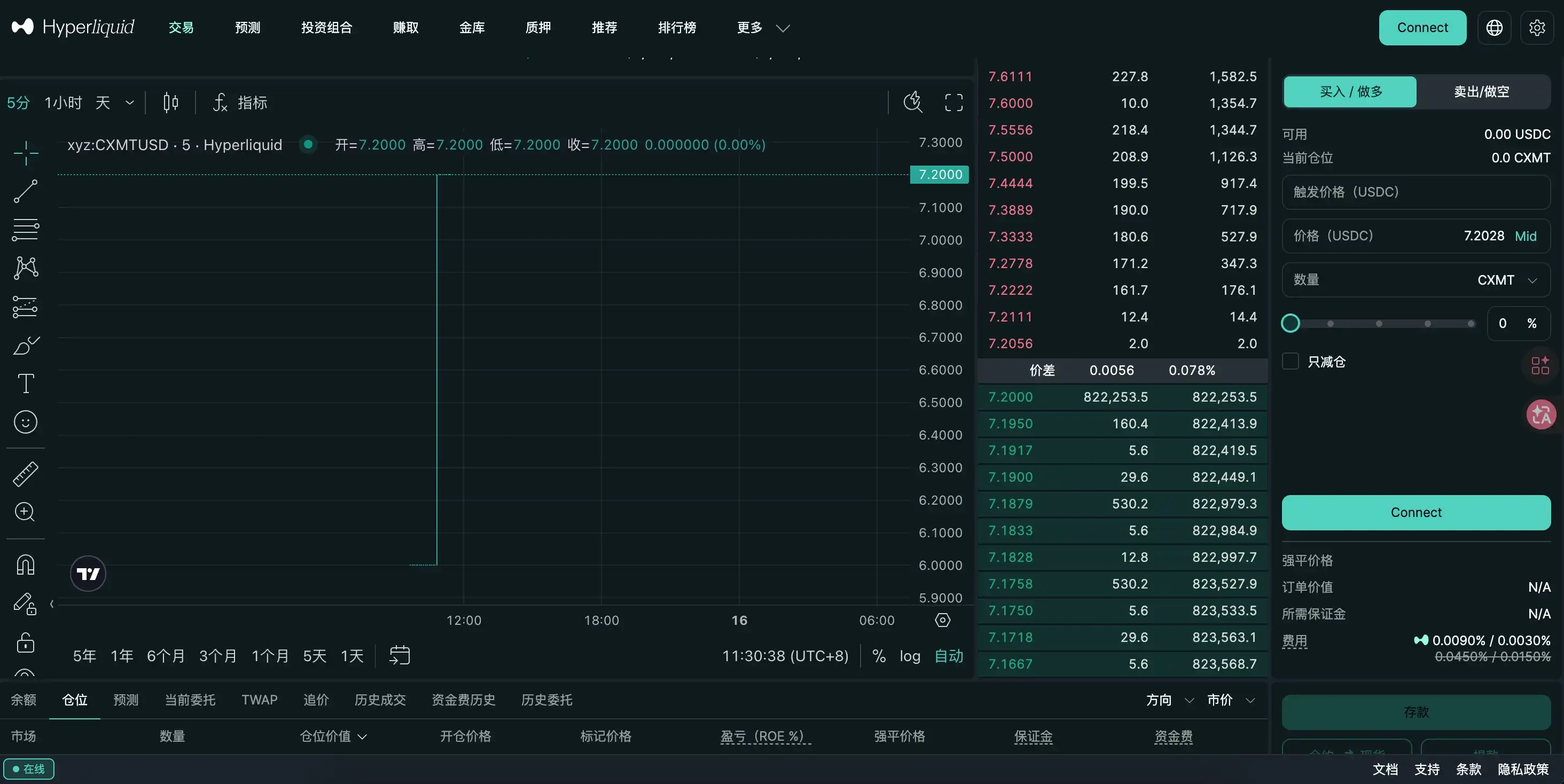
Deep Tide Guide: ChangXin Memory Technologies (CXMT) has priced its Sci-Tech Innovation Board (STAR Market) IPO at 8.66 yuan per share, raising 57.9 billion yuan, with subscriptions starting on July 16. On the eve of the subscription, Trade.xyz deployed a CXMT perpetual contract on Hyperliquid, currently trading at 7.2 USDC (approximately 52 yuan per share), with a 24-hour trading volume of $1.32 million and an open interest of $2.41 million, implying a market capitalization of about 3.5 trillion yuan, at the upper end of institutional expectations of 2-3 trillion yuan. This marks the first time an on-chain pre-IPO contract has targeted an A-share STAR Market listing, becoming the most direct entry point for overseas investors to engage with the 'China storage substitution' narrative.
Even before ChangXin Memory Technologies rings the bell on the Shanghai Stock Exchange, price discovery has already begun in the crypto market.

According to a July 15 Bloomberg report, Trade.xyz deployed a ChangXin Memory Technologies (CXMT) perpetual contract on the Hyperliquid blockchain under the symbol xyz:CXMTUSD. As of publication, the contract's 24-hour trading volume is approximately $1.32 million, with an open interest of about $2.41 million and a funding rate of 0.0014%. The price has risen from an initial marking price of around $6 to $7.2, a 24-hour gain of 20%.

This is not the first time Hyperliquid has facilitated pre-IPO pricing. In May this year, just before AI chip company Cerebras went public, the difference between Hyperliquid's pre-IPO contract price and the Nasdaq opening price was only 1.3%; in June, on the day of SpaceX's IPO, on-chain contracts saw a daily trading volume of $1.38 billion. However, targeting a STAR Market A-share company is a first.

$7.2 Equates to ~52 Yuan per Share, Implied Market Cap ~3.5 Trillion Yuan

The contract tracks the per-share price in USDC, employing the same logic used for SpaceX and Cerebras pre-IPO contracts.

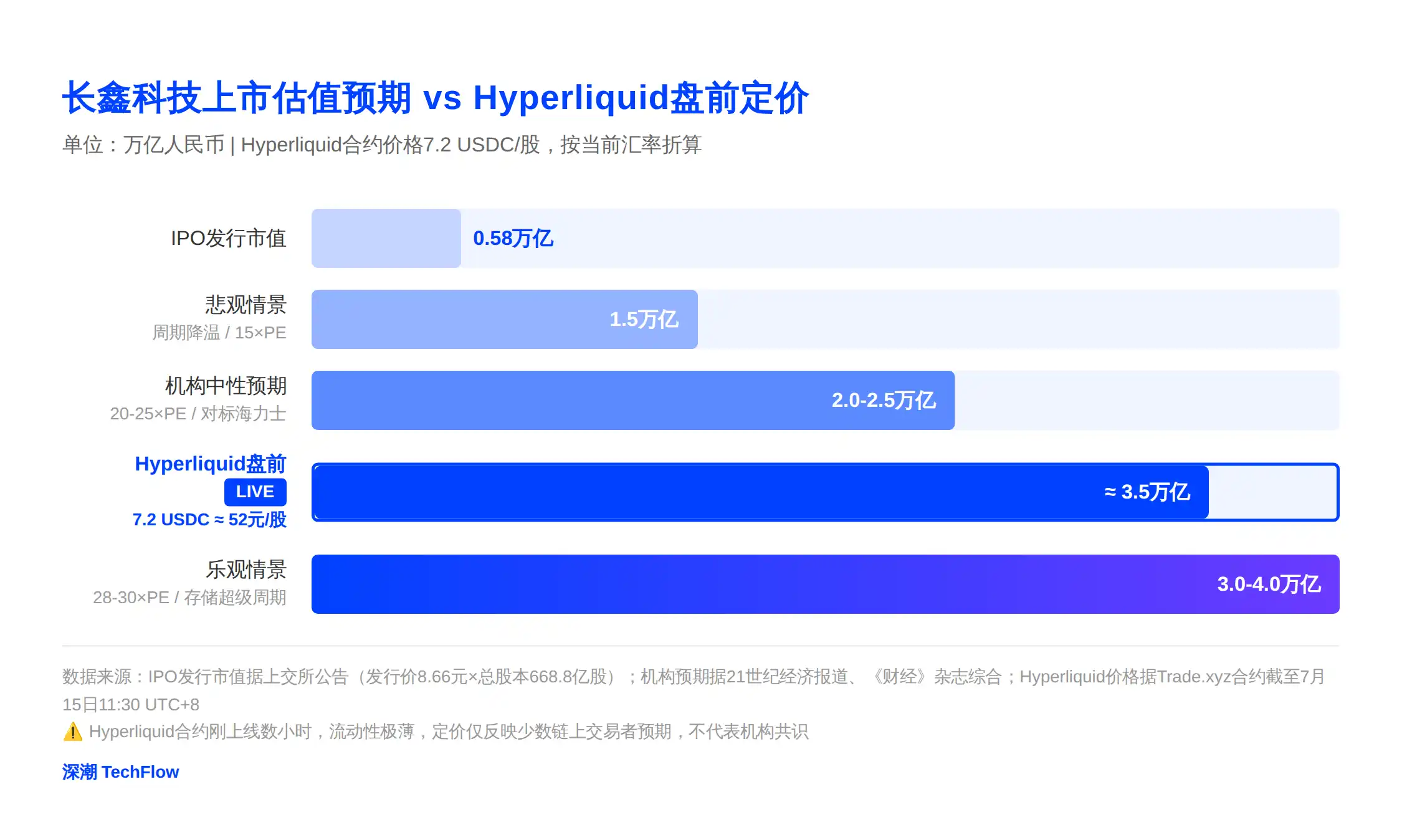
Converted at the current exchange rate, $7.2 equates to approximately 52 yuan per share. Multiplying this by the post-issuance total shares of 66.88 billion yields an implied total market capitalization of about 3.5 trillion yuan, roughly 6 times the IPO's issuance market cap of 579.2 billion yuan.

This pricing falls within the optimistic range of sell-side institution expectations. The 21st Century Business Herald cited investment bankers predicting an estimated post-listing valuation of 2 to 2.5 trillion yuan for CXMT; Caijing magazine, synthesizing estimates from multiple institutions, suggested an optimistic scenario of 3 to over 4 trillion yuan. Hyperliquid's pre-market pricing of 3.5 trillion yuan sits between the upper end of the neutral range and the lower end of the optimistic range.

Another interpretation: if these on-chain traders' judgment is accurate, ChangXin's stock might open around 50 yuan per share on its first trading day, approximately 6 times the 8.66 yuan IPO price. The average first-day gain for A-share STAR Market IPOs in the first half of this year was 489%, making a 6-fold opening not outlandish.

With the contract live for less than 24 hours, the $1.32 million trading volume and $2.41 million open interest represent initial liquidity for the on-chain market, but there remains an order-of-magnitude gap compared to the $1.38 billion single-day volume during SpaceX's listing. This price reflects the directional bets of early participants, not an institutional-grade valuation.
A-Shares: Can't Sell or Short on Day One – Perpetual Contracts Naturally Fill the Gap

Why would crypto traders pay attention to a Chinese A-share? Perspectives from some investors on overseas social media platforms might explain. The structural limitations of A-shares are precisely the opportunity for perpetual contracts.

A-shares have two key structural limitations. T+1 settlement means you cannot sell shares on the same day you buy them, and short selling is not available for individual STAR Market stocks. For a stock like ChangXin, which could experience extreme volatility on its debut, A-share holders face an awkward situation: even if they profit from a limit-up move, they cannot lock in those gains that day, fully exposed to the risk of a gap-down opening the next day.

The perpetual contracts on Hyperliquid have none of these restrictions. Trading is 24/7, long or short positions are possible, and leverage is adjustable. Theoretically, investors holding A-share positions in ChangXin could open short positions on Hyperliquid to hedge overnight risk.

However, the lack of an arbitrage path is a reality that must be acknowledged. Cerebras and SpaceX listed on Nasdaq, allowing global investors to arbitrage freely between the underlying stock and the contract, leading to rapid price convergence. ChangXin is listing on the Shanghai Stock Exchange's STAR Market, where a 500,000 yuan asset threshold and QFII quota restrictions prevent the vast majority of overseas retail investors from directly buying the underlying shares.

A price gap may persist for a long time between the contract price and the actual A-share trading price, for which investors will need to assign a premium.

Foreign Investors Can't Buy A-Shares, DeFi Becomes the Entry Point for the 'China Storage Substitution' Theme

Blockchain.News explicitly pointed out in its coverage: the CXMT contract provides overseas traders a channel to bypass the STAR Market's 500,000 yuan threshold.

This demand isn't fabricated. ChangXin Memory Technologies is the world's fourth-largest DRAM supplier, with a 7.7% global market share in Q1. SemiAnalysis predicts it may surpass Micron to become the world's third-largest by year-end. Apple has reportedly begun testing ChangXin's DRAM chips for devices in the Chinese market (according to a July 8 Financial Times report). Forecasted net profit for the first half of 2026 is 50-57 billion yuan, with profit margins around 70%, comparable to SK Hynix's 73% and Samsung's 81%.

Global storage industry investors are watching the IPO of such a company, but most cannot buy its shares. The crypto research firm Citrini has repeatedly recommended Hyperliquid's perpetual contract scenario in paid research reports while also expressing a bullish view on ChangXin.

With foreign capital unable to directly participate in A-shares, Hyperliquid's contracts may become the most convenient channel for them to engage with the 'China storage substitution' theme.

From a broader perspective, this is the first time DeFi infrastructure is being used to create a parallel pricing market for a Chinese STAR Market target. Hyperliquid's HIP-3 framework allows any entity staking 500,000 HYPE tokens (approximately $28 million) to deploy perpetual contracts. Utilizing this mechanism, Trade.xyz has successively launched pre-IPO contracts for companies like SpaceX, Cerebras, OpenAI, and Anthropic, generating over $1.46 billion in cumulative trading volume. Following TradingView's integration of Hyperliquid and Trade.xyz data sources on July 2, the price movements of these on-chain perpetual contracts have entered mainstream trading terminals.

It's worth noting that Hyperliquid's policy center and TradeXYZ recently met with the SEC's Cryptocurrency Working Group to discuss crypto regulation. From the current regulatory trajectory, US regulation appears to be the primary compliance focus for the platform, with potential Chinese regulatory risks associated with A-share targets not yet a major consideration.

(Note: Hyperliquid is not accessible to users in China.)

57.9 Billion Yuan IPO, H1 Net Profit of ~66 Billion Yuan: ChangXin's IPO is the Event Itself

Returning to the A-share context, even without the Hyperliquid contract, ChangXin's IPO is already a landmark event for China's capital markets in 2026.

Priced at 8.66 yuan per share, based on an initial issuance of 6.688 billion shares, the IPO is expected to raise 57.9 billion yuan, nearly double the original plan of 29.5 billion yuan. If the overallotment option is fully exercised, the total could reach 66.6 billion yuan, making it Asia's largest IPO this year and the largest semiconductor IPO in A-share history. The P/E ratio is 308.92 times, far exceeding the industry average of 76.32 times, but the market seems unconcerned as Q1 net profit of 33 billion yuan is rapidly digesting the valuation. The company expects H1 2026 revenue of 110-120 billion yuan and net profit attributable to shareholders of 50-57 billion yuan, representing year-on-year growth exceeding 2244%.

More crucially, timing. The global DRAM market is in a rare super-cycle boom. Samsung, SK Hynix, and Micron are shifting significant capacity towards HBM (High Bandwidth Memory) for AI servers, creating a shortage in consumer DRAM supply. Q1 DRAM contract prices surged 90%-95% quarter-on-quarter, the largest single-quarter increase in history. ChangXin focuses on consumer-grade DDR5 and LPDDR5X products, with a monthly capacity of 200,000-300,000 wafers. It is one of the few global manufacturers expanding production of consumer DRAM against the trend, capturing the capacity gap strategically vacated by the three giants.

On the A-share subscription side, all 71 new listings in the first half of this year rose on their debut, with STAR Market IPOs averaging a 489% first-day gain. Retail investors can participate in the online subscription on July 16 using subscription code 787825, with listing expected on July 27.

For A-share investors, the July 16 subscription is the main gate. For overseas investors, Hyperliquid's CXMT contract has opened a side door. Whether the contract price can rapidly converge to the actual trading price after the July 27 listing, as it did with Cerebras, will be a key test of whether this model can be replicated for A-shares. But even if the prices don't converge, the very existence of this parallel market demonstrates that global capital's interest in China's storage substitution narrative is more than just talk.


Questions liées

QWhat is the significance of Hyperliquid listing a pre-IPO perpetual contract for CXMT (ChangXin Memory Technologies)?

AIt is the first time a pre-IPO perpetual contract has been created for a Shanghai STAR Market (A-share) IPO on a blockchain. It serves as a direct channel for overseas investors to gain exposure to the 'China storage alternative' narrative, which they typically cannot access due to regulatory and capital barriers in the Chinese A-share market.

QWhat is the implied market capitalization of ChangXin Memory Technologies based on the Hyperliquid contract price of 7.2 USDC?

ABased on the contract price of 7.2 USDC (approx. 52 RMB/share) and the post-issue total shares of 66.88 billion, the implied market capitalization is approximately 3.5 trillion RMB. This is around 6 times the IPO issuance valuation of 579.2 billion RMB and sits at the upper end of institutional expectations.

QHow does the A-share market's structural limitations create an opportunity for the CXMT perpetual contract on Hyperliquid?

AThe A-share market imposes T+1 settlement (can't sell on the purchase day) and prohibits short-selling for STAR Market stocks. This creates a risk for investors who cannot lock in profits or hedge against overnight volatility on listing day. The Hyperliquid perpetual contract, with its 24/7 trading, ability to go long or short, and leverage, can theoretically fill this gap by allowing hedging strategies, though direct arbitrage with the underlying stock is difficult.

QWhat are some key financial and operational highlights of ChangXin Memory Technologies mentioned in the article?

AKey highlights include: an IPO fundraising target of ~579 billion RMB; estimated H1 2026 revenue of 1.1-1.2 trillion RMB and net profit of 500-570 billion RMB (up over 2244% YoY); a Q1 2026 net profit of 330 billion RMB; a 7.7% global DRAM market share in Q1, positioning it as the 4th largest supplier; and a focus on consumer-grade DDR5/LPDDR5X memory while major competitors shift capacity to HBM for AI servers.

QWhat is the role of Trade.xyz in the context of this article, and what precedent does it set?

ATrade.xyz is the entity that deployed the CXMT perpetual contract on the Hyperliquid chain using its HIP-3 framework. It has previously deployed similar pre-IPO contracts for companies like SpaceX and Cerebras. This marks the first use of DeFi infrastructure to create a parallel pricing market for a Chinese STAR Market IPO, expanding the model beyond traditional U.S.-listed Nasdaq offerings.

Lectures associées

Après trois trimestres consécutifs de baisse, le marché des cryptomonnaies pourra-t-il connaître une fenêtre de stabilisation au troisième trimestre ?

Le marché des cryptomonnaies a enregistré son pire trimestre depuis 2022, avec une capitalisation totale chutant de 12,6% à 2 100 milliards de dollars. Tous les indicateurs clés (volume des échanges, valeur des stablecoins) montrent une sortie nette de capitaux. Le Bitcoin a perdu 14,2% et l'Ethereum 25,4% sur le trimestre, rompant sa corrélation antérieure avec les actions technologiques. Les ETF spot américains sur le Bitcoin ont subi des rachats massifs, avec une sortie nette de 4,67 milliards de dollars au Q2, indiquant une pression de vente continue. Le resserrement de la politique de la Fed et les ventes d'entreprises comme Strategy ont accentué la déleveragisation du secteur. L'attention du marché se porte désormais presque exclusivement sur la réunion de la Fed fin juillet. Une position accommodante pourrait stabiliser le Bitcoin entre 68 000 et 84 000 dollars, tandis qu'un ton hawkish pourrait le faire osciller autour de 50 000-56 000 dollars. Parallèlement, la progression du *CLARITY Act*, une loi cruciale pour la clarté réglementaire, est au point mort au Sénat, réduisant les chances d'adoption en 2026 et maintenant une prime de risque élevée sur l'ensemble du secteur. Malgré ce contexte difficile, quelques secteurs résistent : les marchés de prédiction ont vu leur volume nominal augmenter de 48,7% et les biens collectionnables tokenisés ont progressé d'environ 143%. La tokenisation d'actifs du monde réel (RWA) continue également sa croissance régulière, portée par des fondamentaux indépendants du cycle crypto. Les bases d'un effondrement extrême semblent absentes, mais le marché est désormais guidé par les politiques monétaires, les prix et les attentes de taux, plutôt que par le simple récit haussier. La fin des sorties massives des ETF et le retour des achats des détenteurs à long terme pourraient indiquer une phase de stabilisation potentielle.

marsbitHier 08:42

Après trois trimestres consécutifs de baisse, le marché des cryptomonnaies pourra-t-il connaître une fenêtre de stabilisation au troisième trimestre ?

marsbitHier 08:42

The SpaceX Trade, Unlocked: SPCXON Débarque sur WEEX

En juin 2026, SpaceX a réalisé la plus grande introduction en bourse de l'histoire, mais l'accès à l'action a été limité pour de nombreux investisseurs en raison de restrictions régionales et de frictions liées aux courtiers. La plateforme WEEX propose désormais une solution via SPCXON/USDT, un instrument tokenisé sur le marché au comptant qui permet d'obtenir une exposition au cours de SpaceX en utilisant l'USDT, sans nécessiter de compte de courtage américain. SPCXON est un produit tokenisé construit sur l'infrastructure d'Ondo, conçu pour refléter l'économie de la détention d'actions SpaceX pour les traders éligibles en dehors des États-Unis, avec des dividendes réinvestis. Le cas d'investissement repose sur la croissance des revenus de Starlink et les progrès de Starship, malgré un valorisation déjà élevée et des risques liés à un flottant public réduit et à des déblocages d'actions internes à venir. Il est important de noter que SPCXON offre une exposition, et non la propriété directe d'actions ou de droits de vote. Son prix peut évoluer avec une prime ou une décote par rapport à la valeur liquidative. WEEX propose également d'autres produits tokenisés comme MSTRON et MUON dans un compte unifié, permettant une rotation entre crypto-monnaies et actions traditionnelles sans transfert de fonds. La plateforme souligne ainsi comment les barrières entre la finance traditionnelle et les actifs numériques s'estompent.

TheNewsCryptoHier 08:34

The SpaceX Trade, Unlocked: SPCXON Débarque sur WEEX

TheNewsCryptoHier 08:34

BIT Trading Moment : Le BTC reste sous la pression de l'EMA 200 hebdomadaire, un rejet pourrait relancer la baisse, les actions de stockage et de semi-conducteurs qui ont bondi cette nuit ont baissé en séance de nuit

**Résumé des marchés : Bitcoin sous pression, actions technologiques en réajustement** Le marché crypto poursuit son rebond, avec Bitcoin évoluant autour de 66 000 $. Il fait face à une résistance clé vers 68 000 $, niveau correspondant au coût moyen des investisseurs sur cinq mois. Les traders surveillent les moyennes mobiles clés (200 MA à ~63 333 $ et 200 EMA à ~68 328 $ en hebdomadaire). Une rupture au-dessus de 68 000 $ ouvrirait la voie à une hausse, tandis qu'un échec pourrait entraîner un retest des 63 000 $. L'analyse suggère que la dynamique actuelle ressemble à un rebond estival à faible liquidité plutôt qu'au début d'un véritable marché haussier. Sur le marché actions américain, après une forte séance mardi portée par les semi-conducteurs et les titres du stockage (Micron, AMD, Intel...), les contrats à terme indiquent une ouverture en baisse. Les secteurs ayant récemment bondi, comme les semi-conducteurs et le stockage, reculent en séance de nuit. Certaines valeurs se démarquent néanmoins, comme Super Micro Computer (SMCI), en hausse après des résultats et des perspectives robustes liées à la demande de serveurs IA. Des vents contraires persistent : les prix du pétrole (Brent >91$) et les rendements des obligations d'État américaines grimpent, ravivant les craintes inflationnistes. En Asie, les marchés ont suivi le rebond technologique américain, mais de manière hésitante. La tension reste forte sur le yen japonais, qui atteint son plus bas niveau depuis des décennies. **Points clés à surveiller :** * **Crypto :** Niveaux techniques de Bitcoin (68k$/63k$), flux des ETF spot. * **Actions :** Saison des résultats (Tesla, Alphabet, Intel...), activité d'AMD sur l'IA. * **Économie :** Données américaines sur l'emploi, décision de la BCE, tensions géopolitiques et prix de l'énergie.

marsbitHier 08:34

BIT Trading Moment : Le BTC reste sous la pression de l'EMA 200 hebdomadaire, un rejet pourrait relancer la baisse, les actions de stockage et de semi-conducteurs qui ont bondi cette nuit ont baissé en séance de nuit

marsbitHier 08:34

Gate Research Institute : La vague de « Wall Streetisation » des produits financiers cryptographiques, concurrence ou fusion ?

Le titre de l'article est : "Gate Institute : La vague de 'Wall Street-isation' des produits financiers cryptos, est-ce une compétition ou une fusion ?" Résumé en français (environ 1400 caractères) : Il y a dix-sept ans, Bitcoin fut créé avec une vision décentralisée et anti-establishment financier. Aujourd'hui, paradoxalement, son adoption massive passe souvent par des ETF émis par des géants comme BlackRock. Cet article analyse cette "Wall Street-isation" apparente des actifs cryptos : les institutions traditionnelles s'emparent-elles du pouvoir d'émission, de tarification, de garde et de distribution ? La réalité est plus nuancée. C'est une convergence à double sens. D'un côté, les plateformes cryptos comme Gate.io étendent leurs services aux actions traditionnelles (états-uniennes, hongkongaises, sud-coréennes), aux CFD et aux produits tokenisés, offrant un compte unifié. De l'autre, des courtiers traditionnels comme Robinhood intègrent les cryptomonnaies et explorent la tokenisation d'actions sur blockchain. Cette fusion vise à créer le "super-compte" financier de demain, où actions, cryptos, ETF et obligations tokenisées (RWA) coexistent dans une même interface, comblant les faiblesses de chaque écosystème. Les RWA, notamment les obligations d'État tokenisées, agissent comme une couche intermédiaire unificatrice. En conclusion, Wall Street n'a pas conquis la crypto, et la crypto n'a pas contourné Wall Street. Ils construisent ensemble une nouvelle forme de marché des capitaux, plus efficace et mondial, où l'idéal décentralisé persiste dans les protocoles, tandis qu'une expérience utilisateur unifiée émerge à l'interface.

marsbitHier 08:09

Gate Research Institute : La vague de « Wall Streetisation » des produits financiers cryptographiques, concurrence ou fusion ?

marsbitHier 08:09

Trading

Spot
活动图片




