Crude Oil Surges 10% in Intraday Trading! US Military Restores Blockade on Iran, Trump Warns of 'Heavy Blows' Tonight and Tomorrow, Imposes 20% Fee on Strait Shipping

marsbitPublié le 2026-07-14Dernière mise à jour le 2026-07-14

Résumé

Crude oil prices surged up to 10% intraday as tensions between the US and Iran escalated sharply. President Trump announced the reinstatement of a maritime blockade against Iran, targeting its ships and their customers, while stating the Strait of Hormuz would remain open to all other nations. He further declared that the US, as the "guardian" of the strait, would impose a 20% fee on all cargo transiting the strategic waterway to compensate for security costs. The US Central Command confirmed the naval blockade would commence on July 14 (GMT). Following Trump's statements, reports emerged of explosions near Iran's Larak Island and the port of Bandar Abbas, though Iranian authorities did not confirm their nature. Iran's Foreign Minister criticized the proposed 20% fee as excessive, asserting Iran's role as the guardian of the strait. An Iranian military spokesperson warned of a strong response to any unauthorized US interference in the waterway. The United Nations' International Maritime Organization (IMO) expressed opposition to charging tolls for passage through international straits, stating such measures lack legal foundation. Market reactions were pronounced, with Brent crude briefly surpassing $83 and WTI above $78. The situation intensified as Trump notified Congress of renewed hostilities with Iran, following US airstrikes on Iranian targets.

Authors: Li Dan, Li Jia

The situation between the US and Iran has escalated abruptly, with transit risks through the Strait of Hormuz sharply rising, leading to a robust rebound in international crude oil futures.

According to Xinhua News Agency, US President Trump stated on Monday the 13th that he is restoring a maritime blockade on Iran. According to CCTV News, Trump posted on his social media platform on Monday, saying the Strait of Hormuz is currently open and will remain open regardless of Iran's involvement. The US will reinstate "blockade measures against Iran," targeting only Iranian vessels or their clients, restricting their access to the strait, while all other countries can use the strait fairly and openly. He also stated that the US will impose a 20% fee on all goods transported through here, with the relevant procedures and deployment to commence immediately.

In his social media post, Trump framed this fee as "compensation" for the US acting as the guardian of the strait. He wrote: "From now on, the United States will be regarded as the 'Guardian of the Strait of Hormuz'; as the guardian, and in the spirit of 'fairness,' the US will impose a 20% fee on all transported goods to compensate for the necessary expenditures required to maintain the security and safety of this turbulent region of the world."

After Trump's post during early US stock market hours on Monday, international crude oil prices rose further, with WTI crude breaking above $75, expanding its intraday gain to 5%, and Brent crude approaching the $80 mark, also up nearly 5%; the US Dollar Index and Treasury yields rose in tandem, the S&P 500 extended its decline to 0.5%, while spot gold plummeted nearly 3%.

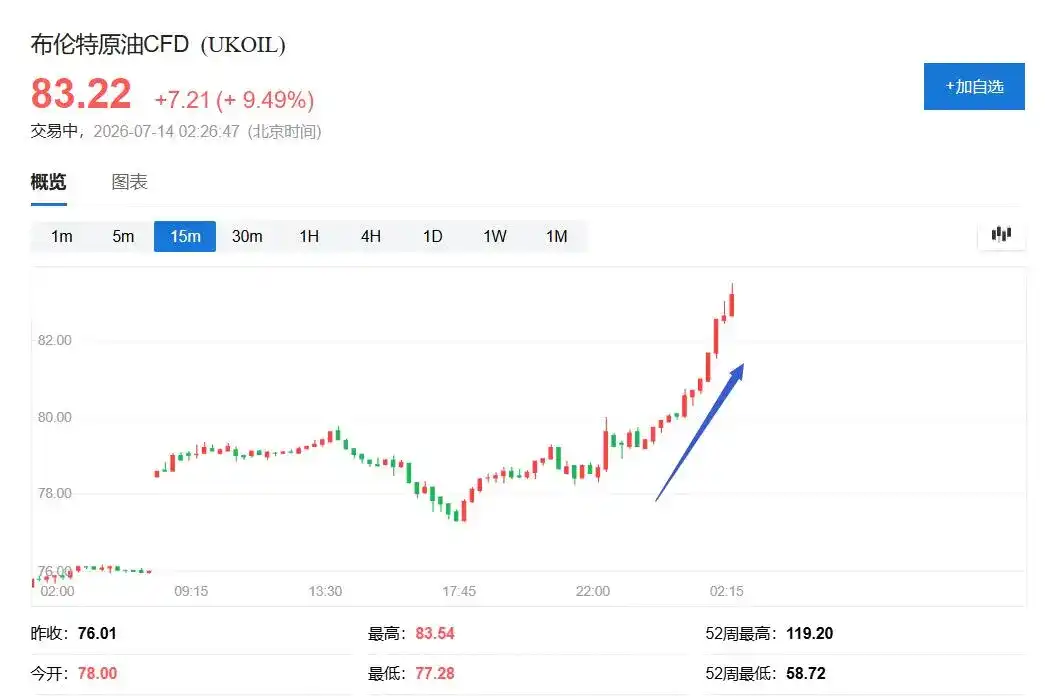
During the US stock market's lunch hour, the US Central Command confirmed that US forces would begin the maritime blockade on Iran at 4:00 PM EST on Tuesday, July 14, which is 4:00 AM Beijing time on Wednesday. International crude oil gains expanded to nearly 10%. Iranian Foreign Minister Araghchi stated that Trump's proposed 20% fee for the Strait of Hormuz was "too much" and added that Iran has always been the guardian of the Strait of Hormuz.

During the US stock market's late trading hours, according to Iranian media Tasnim, explosions were heard on Iran's Larak Island, located in the Strait of Hormuz, and explosions were also reported in the southern Iranian ports of Bandar Abbas and Konarak. Subsequently, CCTV reported that on the evening of the 13th local time, four explosions were heard east of Bandar Abbas port. After the US market closed, CCTV reported at around 2:00 AM local time on the 14th that three more explosions were heard in Bandar Abbas port. Iranian authorities have not confirmed the nature of the explosions.

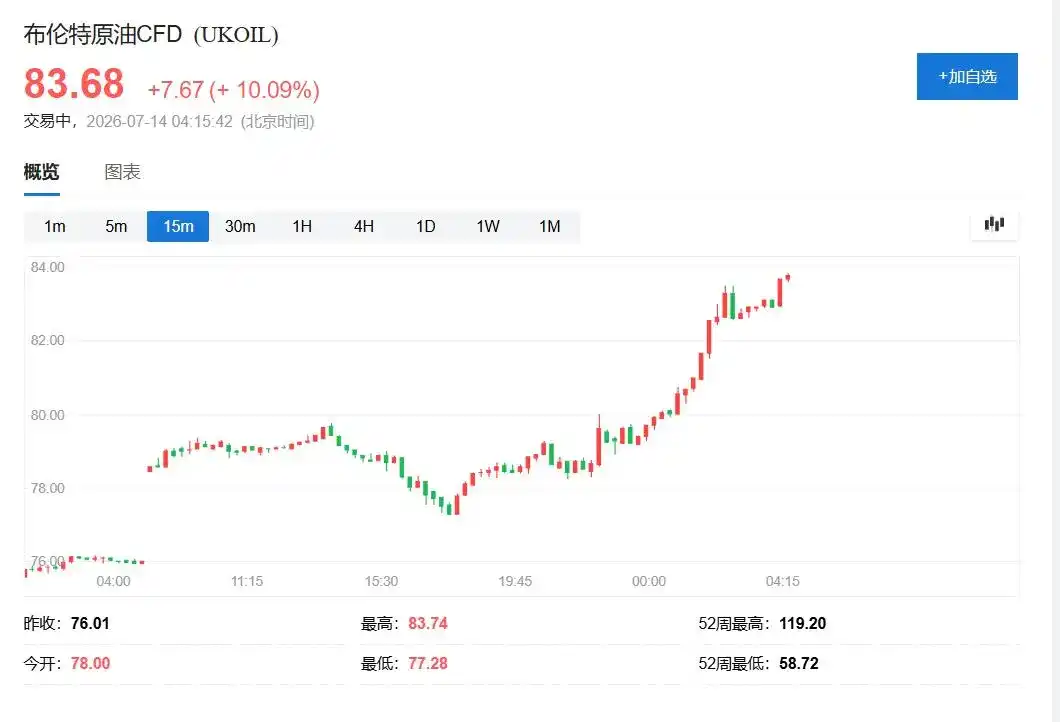
During late US trading, after the news about explosions in the mentioned Iranian areas was released, international crude oil maintained gains of around 9%. After the US market closed on Monday, Trump stated that the US would deliver "heavy blows" to Iran tonight and tomorrow. Crude oil remained high, with Brent crude up over 10% compared to Friday's close.

Later, Trump claimed that he believed an Iran deal might be reached. He said, "I want 'compensation' for the Strait of Hormuz. The US is providing protection for shipping in the Strait of Hormuz and will receive compensation from countries that have benefited from US assistance."
After the US market closed on Monday, according to Xinhua citing Iran's Fars News Agency on Monday the 13th, a US MQ-1 drone was shot down by Iran's Islamic Revolutionary Guard Corps (IRGC) air defense system late that night over the Strait of Hormuz. Earlier on Monday, the US Central Command revealed on social media that US forces had struck a submarine and ship repair facility at Iran's Bandar Abbas naval base on Sunday, marking the first combat use of armed unmanned surface vessels by the US military.

Citing a post from the US Central Command, CCTV reported that under Trump's directive, US forces began a third consecutive night of airstrikes on Iran starting at 4:45 PM EST on Monday. The post also stated that the operations would continue to inflict heavy costs on Iran's armed forces and degrade their ability to attack innocent civilians and commercial shipping in the Strait of Hormuz.

US Military to Begin Maritime Blockade on Iran Starting Tuesday, US/Europe Time

The United Nations' International Maritime Organization (IMO) stated after Trump's post that it opposes charging fees for ships passing through international sea lanes but would wait for more details. During the US stock market's lunch hour, according to CCTV, the Joint Maritime Information Center, overseen by the US Navy, indicated that US forces will begin enforcing a maritime blockade on all Iranian ports and coastal areas starting at 20:00 GMT on July 14 (4:00 AM Beijing time on the 15th).

The blockade applies to all vessels, regardless of their flag. The blockade area covers the entire coastline of Iran, including but not limited to Iranian ports and oil terminals. The blockade operation will not hinder the transit passage of neutral vessels through the Strait of Hormuz to or from non-Iranian destinations. Humanitarian shipments will be permitted passage but subject to inspection.

After the news of the US maritime blockade during the US lunch hour, oil price gains continued to expand. WTI and Brent crude rose above $78 and $83 respectively, with intraday gains reaching 9.86% and 9.9%, approaching 10%.
Although Trump said the fee plan would begin formulation and implementation immediately, the White House did not immediately provide more details about the proposal, including how it would be enforced or whether communication had occurred with US allies. Comments suggest that Trump's remarks have intensified the dispute between the US and Iran over whether this crucial shipping corridor remains open to traffic.

Previously, according to Xinhua citing Iranian media reports on the 13th, a spokesperson for Iran's Armed Forces General Staff's Khatam al-Anbiya Central Headquarters stated on that day that they would never allow the US to interfere in the management of the Strait of Hormuz.

The spokesperson said that the Iranian armed forces would respond forcefully to any unauthorized entry by US forces into designated sea lanes or interference with the passage of merchant ships and oil tankers. "The recent actions of Iran's Islamic Revolutionary Guard Corps and the Iranian Islamic Republic Army are clear proof."

Earlier on Monday, Trump said in a phone interview with Fox News Channel that the US plans to control the Strait of Hormuz and should be compensated for "guarding" this vital waterway. He said, "We've been guarding that strait for 50 years and have never gotten a penny. We want to be compensated because we're putting our people in harm's way."

Iran Calls Southern Route in Strait of Hormuz 'Unsafe'

Additionally, according to Xinhua, the Iranian embassy in the UK stated on social media on the 13th that the southern route in the Strait of Hormuz is "unsafe, unreliable, and prone to accidents."

The Iranian embassy in the UK said that in compliance with the Islamabad Memorandum of Understanding, Iran established a temporary maritime security corridor. This corridor has no technical or military obstacles and has been notified to the IMO. However, "the US is directing vessels towards a dangerous southern parallel route. This route is not only legally questionable but also unsafe, unreliable, and prone to accidents."

The Iranian embassy said that US "acts of military aggression," such as attacking Iranian ports, have made the Strait of Hormuz a highly tense and high-risk area.

After the US-Iran understanding was reached, two traffic routes formed in the strait: the northern route controlled by Iran and the southern route closer to Oman's side, where US forces provide navigation assistance.

The Iranian IRGC Navy announced early Sunday morning local time on the 12th that, due to the unsafe situation caused by illegal foreign interference, the Strait of Hormuz is closed as of now until further notice and until the US ceases interference in the region. The US Central Command posted on social media on Sunday morning Eastern Time, stating that "transit continues" in the Strait of Hormuz. Iran does not control the strait.

International Maritime Organization: Opposes Toll Charges for Transit Through Straits Used for International Navigation

After Trump's post, a spokesperson for the International Maritime Organization (IMO) said: "We have noted the remarks and are awaiting further details."

The spokesperson stated: "Our position on fees is clear and consistent—the IMO firmly opposes the imposition of charges for transit through straits used for international navigation. Mandatory transit fees levied solely for passing through a strait are legally untenable."

Media noted that shipping industry officials expressed concern about Trump's latest move regarding fees, saying their assessment is that such measures would violate international law.

One industry official questioned Trump's remarks: "How exactly will this make navigation safer? And what kind of guarantee will it provide?"

Trump Has Notified Congress of Resumption of Hostilities with Iran

According to CCTV citing US reports on Monday the 13th, Trump has formally notified Congress that hostilities with Iran have resumed. Trump wrote in a letter to congressional leaders dated the 10th that US forces conducted a "defensive strike" on targets within Iran on the 7th.

It is reported that this letter has reignited the dispute between Congress and the White House. Although both houses of Congress previously voted to require the President to end the war or seek approval to continue actions, the White House insists that Trump is acting within his constitutional powers as Commander-in-Chief.


Cryptos en tendance

Questions liées

QWhat major action did President Trump announce regarding the Strait of Hormuz and what was the stated reason?

APresident Trump announced the U.S. would begin charging a 20% fee on all cargo transported through the Strait of Hormuz. He stated this was 'compensation' for the U.S. acting as the 'guardian of the Strait of Hormuz,' covering the necessary costs for maintaining security and safety in the turbulent region.

QHow did the announcement of U.S. actions against Iran impact international oil prices?

AThe announcements of U.S. actions, including the planned blockade and fee, caused international oil prices to surge sharply. U.S. crude oil prices rose by up to nearly 10%, briefly surpassing $78 per barrel, while Brent crude neared $83 per barrel, also with a near 10% increase.

QWhen was the U.S. naval blockade of Iran scheduled to begin, and what are its key conditions?

AThe U.S. naval blockade of all Iranian ports and coastal areas was scheduled to begin at 20:00 GMT on July 14th (04:00 Beijing Time on July 15th). The blockade applies to all vessels regardless of flag but allows neutral ships transit through the Strait of Hormuz to non-Iranian destinations. Humanitarian shipments are permitted but subject to inspection.

QWhat was the response of the International Maritime Organization (IMO) to the proposed fee for the Strait of Hormuz?

AThe International Maritime Organization (IMO) stated its firm opposition to imposing fees on passage through straits used for international navigation. An IMO spokesperson said such a compulsory toll for merely passing through a strait is 'legally untenable.'

QWhat significant military incident involving a U.S. drone was reported following the announcements?

AAccording to Iran's Fars News Agency, an American MQ-1 drone was shot down over the Strait of Hormuz by Iran's Islamic Revolutionary Guard Corps air defense system late on Monday night (July 13th).

Lectures associées

Après trois trimestres consécutifs de baisse, le marché des cryptomonnaies pourra-t-il connaître une fenêtre de stabilisation au troisième trimestre ?

Le marché des cryptomonnaies a enregistré son pire trimestre depuis 2022, avec une capitalisation totale chutant de 12,6% à 2 100 milliards de dollars. Tous les indicateurs clés (volume des échanges, valeur des stablecoins) montrent une sortie nette de capitaux. Le Bitcoin a perdu 14,2% et l'Ethereum 25,4% sur le trimestre, rompant sa corrélation antérieure avec les actions technologiques. Les ETF spot américains sur le Bitcoin ont subi des rachats massifs, avec une sortie nette de 4,67 milliards de dollars au Q2, indiquant une pression de vente continue. Le resserrement de la politique de la Fed et les ventes d'entreprises comme Strategy ont accentué la déleveragisation du secteur. L'attention du marché se porte désormais presque exclusivement sur la réunion de la Fed fin juillet. Une position accommodante pourrait stabiliser le Bitcoin entre 68 000 et 84 000 dollars, tandis qu'un ton hawkish pourrait le faire osciller autour de 50 000-56 000 dollars. Parallèlement, la progression du *CLARITY Act*, une loi cruciale pour la clarté réglementaire, est au point mort au Sénat, réduisant les chances d'adoption en 2026 et maintenant une prime de risque élevée sur l'ensemble du secteur. Malgré ce contexte difficile, quelques secteurs résistent : les marchés de prédiction ont vu leur volume nominal augmenter de 48,7% et les biens collectionnables tokenisés ont progressé d'environ 143%. La tokenisation d'actifs du monde réel (RWA) continue également sa croissance régulière, portée par des fondamentaux indépendants du cycle crypto. Les bases d'un effondrement extrême semblent absentes, mais le marché est désormais guidé par les politiques monétaires, les prix et les attentes de taux, plutôt que par le simple récit haussier. La fin des sorties massives des ETF et le retour des achats des détenteurs à long terme pourraient indiquer une phase de stabilisation potentielle.

marsbitHier 08:42

Après trois trimestres consécutifs de baisse, le marché des cryptomonnaies pourra-t-il connaître une fenêtre de stabilisation au troisième trimestre ?

marsbitHier 08:42

The SpaceX Trade, Unlocked: SPCXON Débarque sur WEEX

En juin 2026, SpaceX a réalisé la plus grande introduction en bourse de l'histoire, mais l'accès à l'action a été limité pour de nombreux investisseurs en raison de restrictions régionales et de frictions liées aux courtiers. La plateforme WEEX propose désormais une solution via SPCXON/USDT, un instrument tokenisé sur le marché au comptant qui permet d'obtenir une exposition au cours de SpaceX en utilisant l'USDT, sans nécessiter de compte de courtage américain. SPCXON est un produit tokenisé construit sur l'infrastructure d'Ondo, conçu pour refléter l'économie de la détention d'actions SpaceX pour les traders éligibles en dehors des États-Unis, avec des dividendes réinvestis. Le cas d'investissement repose sur la croissance des revenus de Starlink et les progrès de Starship, malgré un valorisation déjà élevée et des risques liés à un flottant public réduit et à des déblocages d'actions internes à venir. Il est important de noter que SPCXON offre une exposition, et non la propriété directe d'actions ou de droits de vote. Son prix peut évoluer avec une prime ou une décote par rapport à la valeur liquidative. WEEX propose également d'autres produits tokenisés comme MSTRON et MUON dans un compte unifié, permettant une rotation entre crypto-monnaies et actions traditionnelles sans transfert de fonds. La plateforme souligne ainsi comment les barrières entre la finance traditionnelle et les actifs numériques s'estompent.

TheNewsCryptoHier 08:34

The SpaceX Trade, Unlocked: SPCXON Débarque sur WEEX

TheNewsCryptoHier 08:34

BIT Trading Moment : Le BTC reste sous la pression de l'EMA 200 hebdomadaire, un rejet pourrait relancer la baisse, les actions de stockage et de semi-conducteurs qui ont bondi cette nuit ont baissé en séance de nuit

**Résumé des marchés : Bitcoin sous pression, actions technologiques en réajustement** Le marché crypto poursuit son rebond, avec Bitcoin évoluant autour de 66 000 $. Il fait face à une résistance clé vers 68 000 $, niveau correspondant au coût moyen des investisseurs sur cinq mois. Les traders surveillent les moyennes mobiles clés (200 MA à ~63 333 $ et 200 EMA à ~68 328 $ en hebdomadaire). Une rupture au-dessus de 68 000 $ ouvrirait la voie à une hausse, tandis qu'un échec pourrait entraîner un retest des 63 000 $. L'analyse suggère que la dynamique actuelle ressemble à un rebond estival à faible liquidité plutôt qu'au début d'un véritable marché haussier. Sur le marché actions américain, après une forte séance mardi portée par les semi-conducteurs et les titres du stockage (Micron, AMD, Intel...), les contrats à terme indiquent une ouverture en baisse. Les secteurs ayant récemment bondi, comme les semi-conducteurs et le stockage, reculent en séance de nuit. Certaines valeurs se démarquent néanmoins, comme Super Micro Computer (SMCI), en hausse après des résultats et des perspectives robustes liées à la demande de serveurs IA. Des vents contraires persistent : les prix du pétrole (Brent >91$) et les rendements des obligations d'État américaines grimpent, ravivant les craintes inflationnistes. En Asie, les marchés ont suivi le rebond technologique américain, mais de manière hésitante. La tension reste forte sur le yen japonais, qui atteint son plus bas niveau depuis des décennies. **Points clés à surveiller :** * **Crypto :** Niveaux techniques de Bitcoin (68k$/63k$), flux des ETF spot. * **Actions :** Saison des résultats (Tesla, Alphabet, Intel...), activité d'AMD sur l'IA. * **Économie :** Données américaines sur l'emploi, décision de la BCE, tensions géopolitiques et prix de l'énergie.

marsbitHier 08:34

BIT Trading Moment : Le BTC reste sous la pression de l'EMA 200 hebdomadaire, un rejet pourrait relancer la baisse, les actions de stockage et de semi-conducteurs qui ont bondi cette nuit ont baissé en séance de nuit

marsbitHier 08:34

Gate Research Institute : La vague de « Wall Streetisation » des produits financiers cryptographiques, concurrence ou fusion ?

Le titre de l'article est : "Gate Institute : La vague de 'Wall Street-isation' des produits financiers cryptos, est-ce une compétition ou une fusion ?" Résumé en français (environ 1400 caractères) : Il y a dix-sept ans, Bitcoin fut créé avec une vision décentralisée et anti-establishment financier. Aujourd'hui, paradoxalement, son adoption massive passe souvent par des ETF émis par des géants comme BlackRock. Cet article analyse cette "Wall Street-isation" apparente des actifs cryptos : les institutions traditionnelles s'emparent-elles du pouvoir d'émission, de tarification, de garde et de distribution ? La réalité est plus nuancée. C'est une convergence à double sens. D'un côté, les plateformes cryptos comme Gate.io étendent leurs services aux actions traditionnelles (états-uniennes, hongkongaises, sud-coréennes), aux CFD et aux produits tokenisés, offrant un compte unifié. De l'autre, des courtiers traditionnels comme Robinhood intègrent les cryptomonnaies et explorent la tokenisation d'actions sur blockchain. Cette fusion vise à créer le "super-compte" financier de demain, où actions, cryptos, ETF et obligations tokenisées (RWA) coexistent dans une même interface, comblant les faiblesses de chaque écosystème. Les RWA, notamment les obligations d'État tokenisées, agissent comme une couche intermédiaire unificatrice. En conclusion, Wall Street n'a pas conquis la crypto, et la crypto n'a pas contourné Wall Street. Ils construisent ensemble une nouvelle forme de marché des capitaux, plus efficace et mondial, où l'idéal décentralisé persiste dans les protocoles, tandis qu'une expérience utilisateur unifiée émerge à l'interface.

marsbitHier 08:09

Gate Research Institute : La vague de « Wall Streetisation » des produits financiers cryptographiques, concurrence ou fusion ?

marsbitHier 08:09

Trading

Spot

Articles tendance

Comment acheter AB

Bienvenue sur HTX.com ! Nous vous permettons d'acheter AB (AB) de manière simple et pratique. Suivez notre guide étape par étape pour commencer votre parcours crypto.Étape 1 : Création de votre compte HTXUtilisez votre adresse e-mail ou votre numéro de téléphone pour ouvrir un compte sur HTX gratuitement. L'inscription se fait en toute simplicité et débloque toutes les fonctionnalités.Créer mon compteÉtape 2 : Choix du mode de paiement (rubrique Acheter des cryptosCarte de crédit/débit : utilisez votre carte Visa ou Mastercard pour acheter instantanément AB (AB).Solde :utilisez les fonds du solde de votre compte HTX pour trader en toute simplicité.Prestataire tiers :pour accroître la commodité d'utilisation, nous avons ajouté des modes de paiement populaires tels que Google Pay et Apple Pay.P2P :tradez directement avec d'autres utilisateurs sur HTX.OTC (de gré à gré) : nous offrons des services personnalisés et des taux de change compétitifs aux traders.Étape 3 : stockage de vos AB (AB)Après avoir acheté vos AB (AB), stockez-les sur votre compte HTX. Vous pouvez également les envoyer ailleurs via un transfert sur la blockchain ou les utiliser pour trader d'autres cryptos.Étape 4 : tradez des AB (AB)Tradez facilement AB (AB) sur le marché Spot de HTX. Il vous suffit d'accéder à votre compte, de sélectionner la paire de trading, d'exécuter vos trades et de les suivre en temps réel. Nous offrons une expérience conviviale aux débutants comme aux traders chevronnés.

477 vues totalesPublié le 2025.02.18Mis à jour le 2026.06.02

Comment acheter AB

Discussions

Bienvenue dans la Communauté HTX. Ici, vous pouvez vous tenir informé(e) des derniers développements de la plateforme et accéder à des analyses de marché professionnelles. Les opinions des utilisateurs sur le prix de AB (AB) sont présentées ci-dessous.

活动图片