First Long-Horizon Doc2Repo Training Dataset: Code Agents Move Beyond Bug Fixing and Begin Creating Repositories

marsbitPublié le 2026-06-25Dernière mise à jour le 2026-06-25

Résumé

With the advancement of LLM Code Agents, the research focus is shifting towards long-horizon, real-world tasks, moving beyond simple bug fixes to full repository generation. To address this, researchers from Renmin University of China introduced the DeNovoSWE dataset. This dataset focuses on long-term software engineering tasks, specifically the "document-to-repository" challenge—generating an entire, executable code repository from a task description. The DeNovoSWE construction method employs a Divide & Conquer approach. It breaks down target repositories into core capabilities and uses a multi-agent Draft-Critic-Repair workflow to automatically generate high-quality, evaluation-aligned task documents. The dataset also implements difficulty-aware filtering to balance quality and diversity. The result is a high-quality, anti-leakage dataset of 4,818 instances. Experiments show that models trained on DeNovoSWE achieve significant improvements in long-horizon repository generation. For instance, Qwen3-30B-A3B-Instruct's performance on the BeyondSWE-Doc2Repo benchmark increased from 5.8% to 47.2%, and on NL2RepoBench from 4.3% to 23.0%. Similar gains were observed with stronger backbones, demonstrating that dedicated long-horizon training data is crucial for advancing Code Agents from maintainers to architects capable of planning and building complete software projects from scratch.

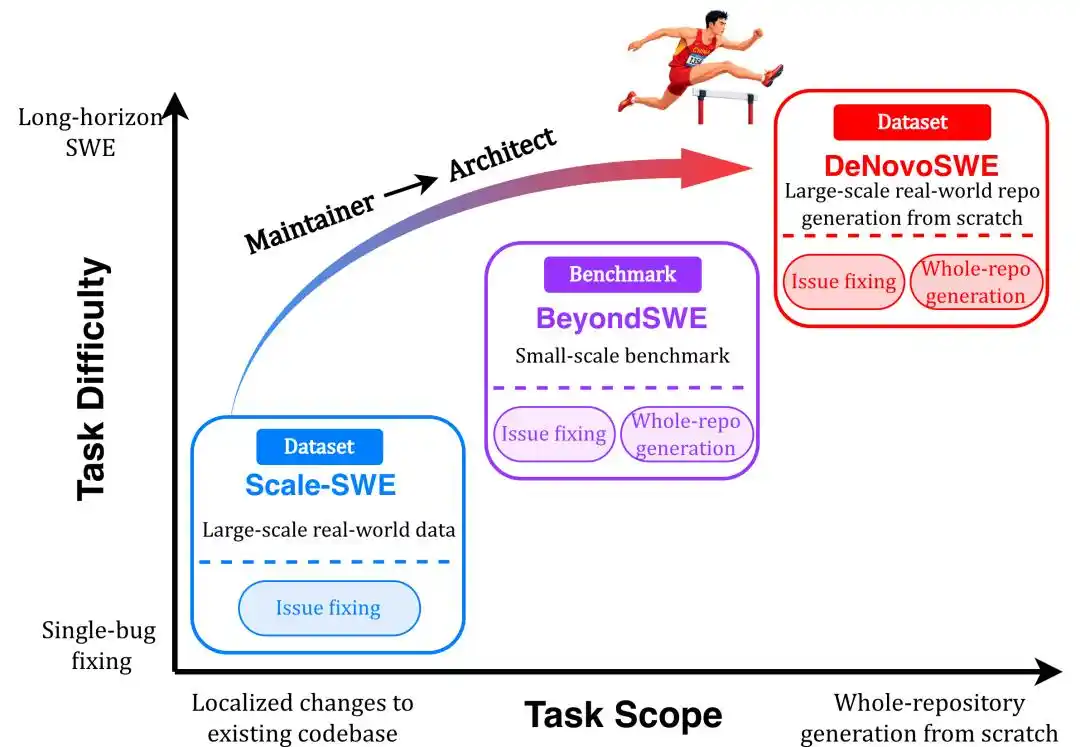
With the continuous improvement of LLM Code Agent capabilities, more and more researchers are realizing it's time to advance to the next stage of long-horizon tasks that are closer to real-world scenarios. Consequently, some benchmarks for evaluating long-horizon tasks have emerged, such as NL2RepoBench and BeyondSWE. The expected role of Code Agents is gradually shifting from repository maintainers to architects, capable of planning and completing long-horizon coding tasks for entire repositories.

Recently, the Gaoling School of Artificial Intelligence at Renmin University of China completed related research and officially released the DeNovoSWE dataset, focusing on long-horizon software engineering tasks, particularly repository-level code generation from scratch.
Paper link: https://arxiv.org/pdf/2606.10728

Repository link: https://github.com/AweAI-Team/DeNovoSWE

Data link: https://huggingface.co/collections/AweAI-Team/denovoswe

Through the mechanisms of Divide & Conquer and Critic & Repair, a high-quality dataset was constructed, successfully achieving scaling for long-horizon SWE tasks. This effort resulted in DeNovoSWE, an open-source, high-quality long-horizon SWE task dataset containing 4,818 real-world instances. This achievement provides large-scale data for training Code Agents' long-horizon capabilities, significantly enhancing their performance on such tasks.
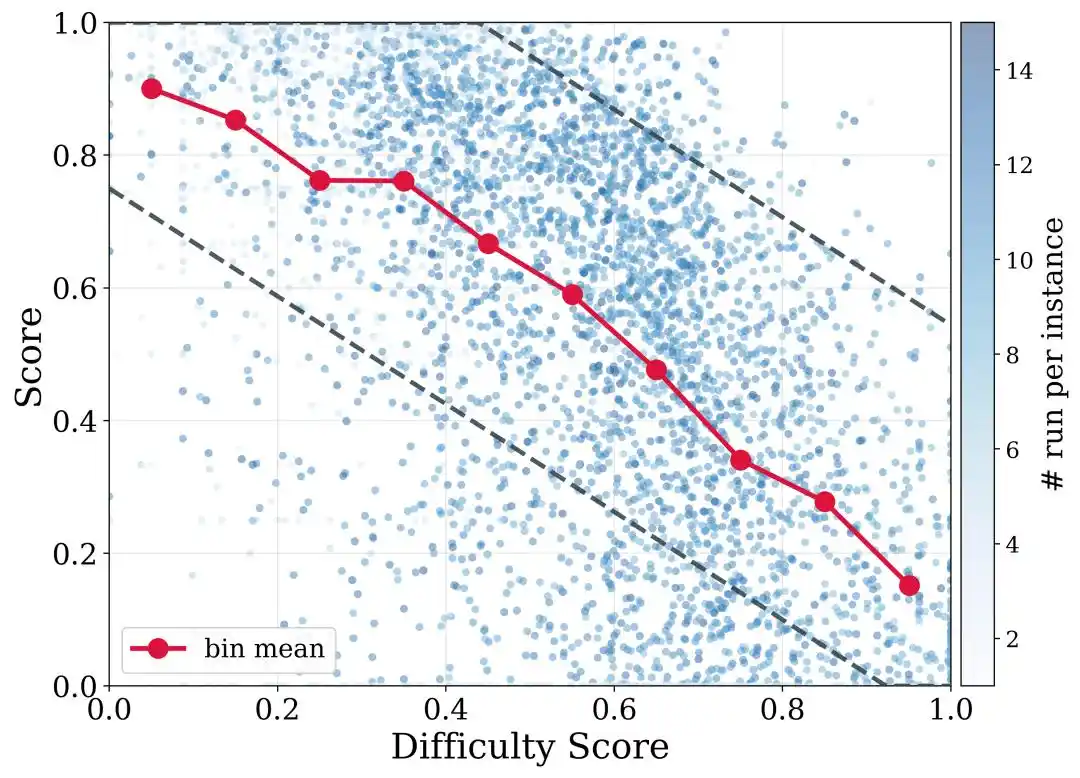
The paper also proposes methods based on difficulty score filtering, effectively alleviating the trade-off between the proportion of difficult problems and trajectory quality.
Experiments show that the Qwen3-30B-A3B-Instruct model trained on DeNovoSWE improved from 5.8% to 47.2% on BeyondSWE-Doc2Repo and from 4.3% to 23.0% on NL2RepoBench, demonstrating the significant boost in repository-level code generation capabilities brought by long-horizon data.

Rebuilding an Entire Repository from a Single Document

Over the past year, with the scaling of large-scale SWE data in works like Scale-SWE, code agents have rapidly progressed on real software engineering tasks like SWE-bench. But as models become increasingly adept at "fixing an issue" or "changing a few lines of buggy code," a more critical question arises: Do agents truly possess long-horizon software engineering capabilities? Judging from the performance of frontier models on BeyondSWE-Doc2Repo and NL2RepoBench, the results are not ideal.

Real-world software development often isn't about modifying a single function or adding a conditional statement. It involves understanding requirements, planning architecture, creating files, designing APIs, handling dependencies, connecting modules, and ultimately making the entire repository run successfully in tests.

In other words, the real challenge lies in long-horizon repository-level generation: starting from a task document and generating a complete, executable, and verifiable software repository. This is precisely the problem DeNovoSWE aims to solve.

High-Quality "Generate from Scratch" Task Documents

In document-to-repository generation, the document is not just a README, nor a simple API list. It is essentially the sole task entry point for the agent to rebuild the entire repository.

A high-quality task document needs to meet at least two core standards.

First, it must be well-organized.

Repository-level tasks are inherently complex, involving multiple modules, interfaces, configurations, data structures, and interaction flows. If the document merely piles up function descriptions, the agent can easily get lost in fragmented information. Therefore, the document should first provide a clear overview of the repository, then divide into chapters based on capabilities or workflows, ensuring each part corresponds to a clear functional boundary.

Second, it must be written from the perspective of reliable evaluation.

The document cannot be too sparse, otherwise the task becomes an underdefined problem, potentially requiring the model to guess aimlessly to pass evaluation. Nor can it be too detailed, as that would directly leak implementation details, making the task unchallenging.

A truly high-quality document should describe the key behaviors on which evaluation depends: including import paths, public APIs, inputs and outputs, default parameters, exception behaviors, configuration items, pattern strings, return fields, etc., while also outlining the general functionalities to be implemented. In other words, the document should be sufficient for the agent to reproduce testable behaviors, but it should not become a copy of the implementation code.

This is also the core idea of DeNovoSWE: making documents readable, implementable, and verifiable.

The DeNovoSWE Method

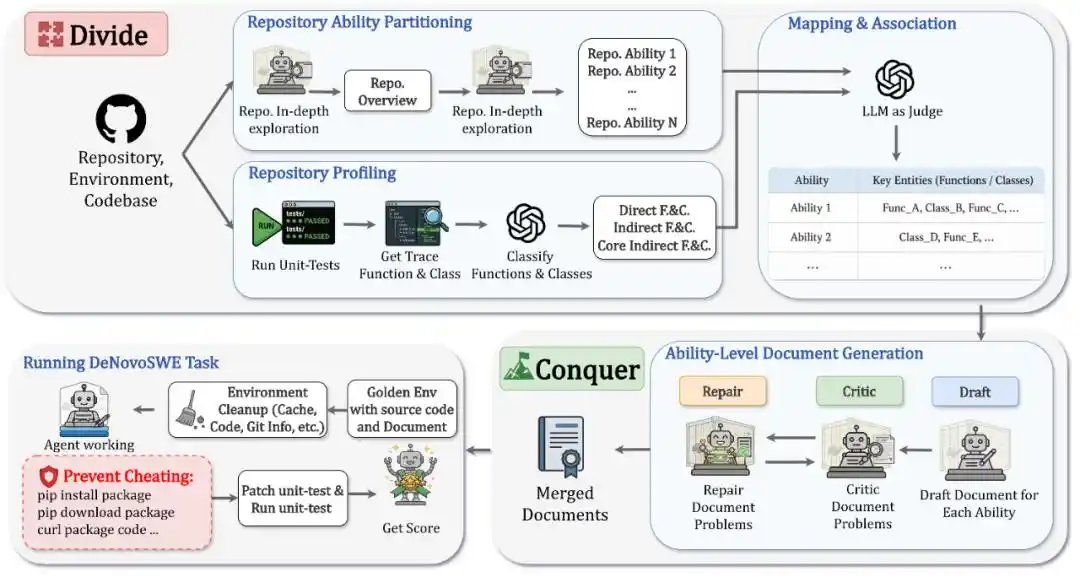
DeNovoSWE frames "generating a complete repository from a document" as a large-scale, verifiable long-horizon software engineering task. It does not rely on manually written documents but automatically constructs high-quality instances through a sandboxed multi-agent workflow. The entire method can be summarized in two steps: Divide and Conquer.

In the Divide stage, the system first analyzes the target repository, decomposing it into multiple repository capabilities.

Each capability corresponds to a core function or workflow within the repository, such as authentication and connection, data reading/writing, batch processing, export flows, etc. This way, the originally massive repository generation problem is split into several structurally clear document chapters.

Simultaneously, DeNovoSWE runs the original unit tests and collects execution traces to identify which functions, classes, and interfaces actually impact evaluation. This further distinguishes between direct components, core indirect components, and non-core indirect components: interfaces directly called by tests must be documented in detail; core indirect components that affect observable behaviors also need coverage; while non-core internal implementations can be left for the agent to handle freely.

In the Conquer stage, DeNovoSWE uses a Draft-Critic-Repair mechanism to generate documents for each capability one by one. The Draft agent writes an initial draft; the Critic agent checks for omissions of key APIs, behavioral contracts, or structural information; the Repair agent then fixes the document based on the feedback. This cycle iterates until each capability chapter is clear, complete, and aligned with evaluation.

Finally, the documents for different capabilities are merged into a single, comprehensive task document, serving as the sole basis for the agent to generate the repository from scratch.

Difficulty: Why is This a Long-Horizon Task?

The difficulty of DeNovoSWE tasks stems from a fundamental change: it's no longer issue-level fixing, but whole-repository generation.

In traditional SWE tasks, agents typically face an existing repository, needing only to locate a bug, modify local code, and pass tests.

In DeNovoSWE, the agent faces a cleaned environment: the original source code and tests are removed, git history is reset, and potential leakage channels like caches, site-packages residues, pip wheels, temporary compilation artifacts, etc., are also cleared. This means the agent must truly rely on the document to complete the entire repository rebuild. It needs to plan the project structure, create module files, define public interfaces, implement cross-file interactions, handle dependencies and configurations, and continuously fix errors across multiple rounds of editing and test feedback.

Any deviation in an API signature, return field, exception type, or default behavior can cause test failures. Errors can also accumulate over the long horizon: an early poorly designed module can affect multiple subsequent files and call chains.

To further address the difficulty variance across different repositories, DeNovoSWE also proposes difficulty-aware trajectory filtering. In simple terms, easy tasks should require a higher pass rate, while difficult tasks should not be entirely discarded just for failing to achieve a perfect score. DeNovoSWE sets different filtering thresholds for different difficulty intervals based on structural complexity and LLM difficulty assessment, thereby balancing quality and diversity.

This is particularly important for long-horizon tasks: the more complex the repository, the harder it is to pass all tests in one go. Yet, the trajectories from challenging repositories, even with low scores or partial success, still contain valuable long-horizon planning and implementation capabilities.
Experimental Results

DeNovoSWE ultimately constructed 4,818 high-quality document-to-repository task instances. It is an executable, evaluable, and trainable long-horizon software engineering environment.
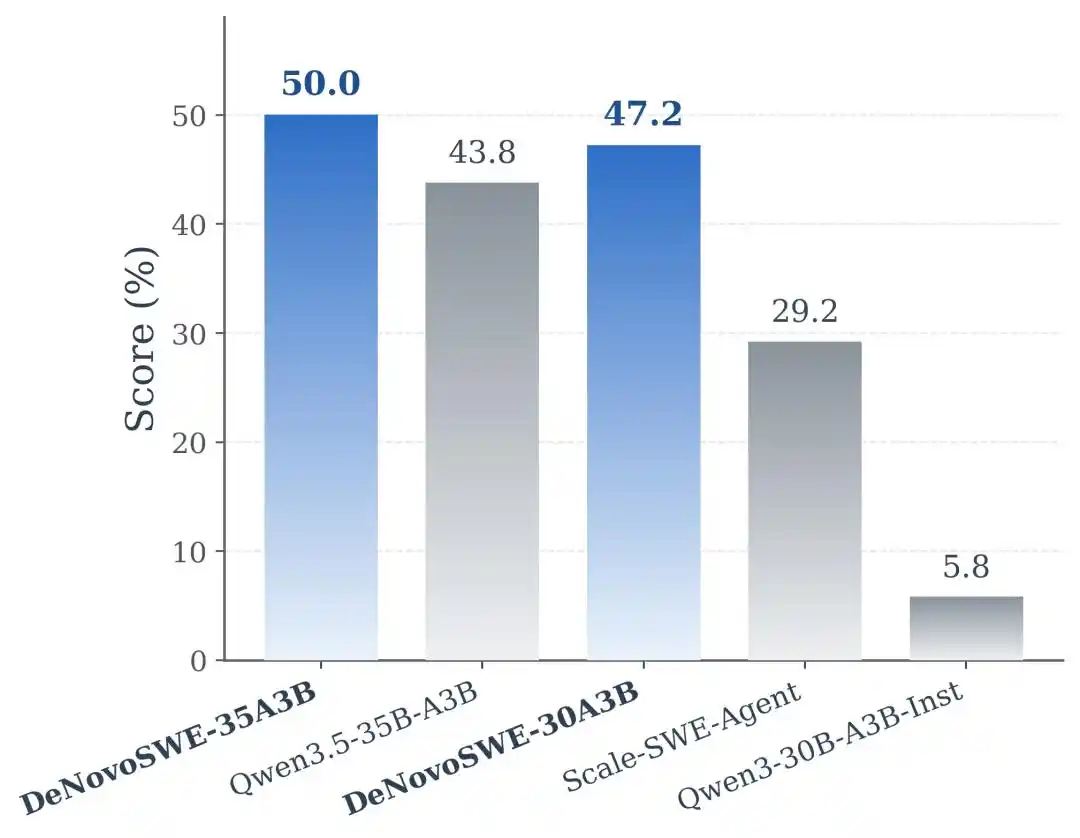
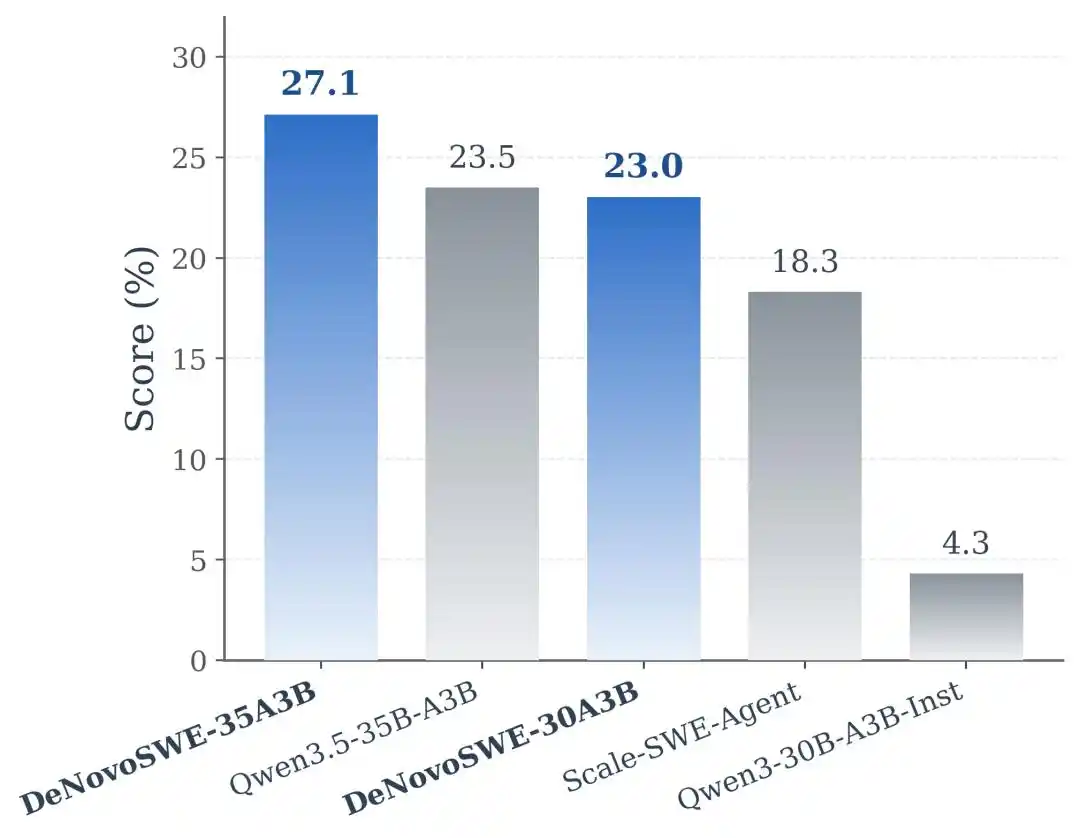
Experimental results show that DeNovoSWE brings significant improvements to models' long-horizon repository generation capabilities. For Qwen3-30B-A3B-Instruct, the original model scored only 5.8% on BeyondSWE-Doc2Repo and 4.3% on NL2RepoBench. Training with conventional issue-level SWE data like Scale-SWE-Agent improved these to 29.2% and 18.3%, indicating that general SWE data does have transfer effects. However, when the model was trained using DeNovoSWE, performance further increased to 47.2% and 23.0%.

This demonstrates that data oriented towards "fixing bugs" cannot fully replace data oriented towards "generating complete repositories" for long-horizon tasks. To truly teach agents repository-level engineering, specialized training environments built for long-horizon tasks are needed.

On the stronger Qwen3.5-35B-A3B backbone, DeNovoSWE similarly brought stable gains: BeyondSWE-Doc2Repo improved from 43.8% to 50.0%, and NL2RepoBench from 23.5% to 27.1%. This further indicates that the benefits of DeNovoSWE are not due to accidental adaptation to a specific model, but stem from the high-quality long-horizon data itself.

Conclusion

The next stage for code agents is not just about fixing individual issues faster, but about understanding documents, planning architecture, organizing modules, implementing interfaces, and ultimately generating a complete, runnable software repository.

DeNovoSWE systematically frames this goal into a trainable, verifiable, and scalable dataset. It answers a key question: What kind of data can truly train agents with long-horizon software engineering capabilities?

The answer is not more fragmented code, nor simpler problems, but high-quality, structured, evaluation-aligned, anti-leakage, full-repository generation tasks.

Starting from a single document, rebuild the entire repository. This is the threshold that long-horizon code agents need to cross.

Reference: https://arxiv.org/pdf/2606.10728

This article is from the WeChat public account "AI Era," edited by LRST.

Cryptos en tendance

Questions liées

QWhat is the main contribution of the research from Renmin University of China's Gaoling School of Artificial Intelligence?

AThe research introduces and releases the DeNovoSWE dataset, which is the first long-horizon Doc2Repo training set focused on repository-level code generation from scratch in software engineering tasks.

QHow does the DeNovoSWE dataset address the challenge of long-horizon software engineering tasks?

AIt uses a sandboxed multi-agent workflow based on 'Divide & Conquer' and 'Draft-Critic-Repair' mechanisms to automatically construct high-quality task documents, ensuring they are well-organized and evaluation-aligned for whole-repository generation.

QWhat were the performance improvements observed after training a model on the DeNovoSWE dataset?

AThe Qwen3-30B-A3B-Instruct model showed significant improvement, increasing its performance on BeyondSWE-Doc2Repo from 5.8% to 47.2% and on NL2RepoBench from 4.3% to 23.0%.

QWhat are the two core standards mentioned for a high-quality task document in document-to-repository generation?

AFirst, the document must be well-organized, providing a clear overview and structured chapters. Second, it must be evaluation-aligned, describing key behaviors for verification without leaking implementation details.

QWhat is the purpose of the difficulty-aware trajectory filtering mechanism in DeNovoSWE?

AIt sets different filtering thresholds for tasks of varying difficulty levels to balance quality and diversity, ensuring that valuable but partially successful trajectories from complex repositories are not discarded.

Lectures associées

Après trois trimestres consécutifs de baisse, le marché des cryptomonnaies pourra-t-il connaître une fenêtre de stabilisation au troisième trimestre ?

Le marché des cryptomonnaies a enregistré son pire trimestre depuis 2022, avec une capitalisation totale chutant de 12,6% à 2 100 milliards de dollars. Tous les indicateurs clés (volume des échanges, valeur des stablecoins) montrent une sortie nette de capitaux. Le Bitcoin a perdu 14,2% et l'Ethereum 25,4% sur le trimestre, rompant sa corrélation antérieure avec les actions technologiques. Les ETF spot américains sur le Bitcoin ont subi des rachats massifs, avec une sortie nette de 4,67 milliards de dollars au Q2, indiquant une pression de vente continue. Le resserrement de la politique de la Fed et les ventes d'entreprises comme Strategy ont accentué la déleveragisation du secteur. L'attention du marché se porte désormais presque exclusivement sur la réunion de la Fed fin juillet. Une position accommodante pourrait stabiliser le Bitcoin entre 68 000 et 84 000 dollars, tandis qu'un ton hawkish pourrait le faire osciller autour de 50 000-56 000 dollars. Parallèlement, la progression du *CLARITY Act*, une loi cruciale pour la clarté réglementaire, est au point mort au Sénat, réduisant les chances d'adoption en 2026 et maintenant une prime de risque élevée sur l'ensemble du secteur. Malgré ce contexte difficile, quelques secteurs résistent : les marchés de prédiction ont vu leur volume nominal augmenter de 48,7% et les biens collectionnables tokenisés ont progressé d'environ 143%. La tokenisation d'actifs du monde réel (RWA) continue également sa croissance régulière, portée par des fondamentaux indépendants du cycle crypto. Les bases d'un effondrement extrême semblent absentes, mais le marché est désormais guidé par les politiques monétaires, les prix et les attentes de taux, plutôt que par le simple récit haussier. La fin des sorties massives des ETF et le retour des achats des détenteurs à long terme pourraient indiquer une phase de stabilisation potentielle.

marsbitIl y a 15 h

Après trois trimestres consécutifs de baisse, le marché des cryptomonnaies pourra-t-il connaître une fenêtre de stabilisation au troisième trimestre ?

marsbitIl y a 15 h

The SpaceX Trade, Unlocked: SPCXON Débarque sur WEEX

En juin 2026, SpaceX a réalisé la plus grande introduction en bourse de l'histoire, mais l'accès à l'action a été limité pour de nombreux investisseurs en raison de restrictions régionales et de frictions liées aux courtiers. La plateforme WEEX propose désormais une solution via SPCXON/USDT, un instrument tokenisé sur le marché au comptant qui permet d'obtenir une exposition au cours de SpaceX en utilisant l'USDT, sans nécessiter de compte de courtage américain. SPCXON est un produit tokenisé construit sur l'infrastructure d'Ondo, conçu pour refléter l'économie de la détention d'actions SpaceX pour les traders éligibles en dehors des États-Unis, avec des dividendes réinvestis. Le cas d'investissement repose sur la croissance des revenus de Starlink et les progrès de Starship, malgré un valorisation déjà élevée et des risques liés à un flottant public réduit et à des déblocages d'actions internes à venir. Il est important de noter que SPCXON offre une exposition, et non la propriété directe d'actions ou de droits de vote. Son prix peut évoluer avec une prime ou une décote par rapport à la valeur liquidative. WEEX propose également d'autres produits tokenisés comme MSTRON et MUON dans un compte unifié, permettant une rotation entre crypto-monnaies et actions traditionnelles sans transfert de fonds. La plateforme souligne ainsi comment les barrières entre la finance traditionnelle et les actifs numériques s'estompent.

TheNewsCryptoIl y a 15 h

The SpaceX Trade, Unlocked: SPCXON Débarque sur WEEX

TheNewsCryptoIl y a 15 h

BIT Trading Moment : Le BTC reste sous la pression de l'EMA 200 hebdomadaire, un rejet pourrait relancer la baisse, les actions de stockage et de semi-conducteurs qui ont bondi cette nuit ont baissé en séance de nuit

**Résumé des marchés : Bitcoin sous pression, actions technologiques en réajustement** Le marché crypto poursuit son rebond, avec Bitcoin évoluant autour de 66 000 $. Il fait face à une résistance clé vers 68 000 $, niveau correspondant au coût moyen des investisseurs sur cinq mois. Les traders surveillent les moyennes mobiles clés (200 MA à ~63 333 $ et 200 EMA à ~68 328 $ en hebdomadaire). Une rupture au-dessus de 68 000 $ ouvrirait la voie à une hausse, tandis qu'un échec pourrait entraîner un retest des 63 000 $. L'analyse suggère que la dynamique actuelle ressemble à un rebond estival à faible liquidité plutôt qu'au début d'un véritable marché haussier. Sur le marché actions américain, après une forte séance mardi portée par les semi-conducteurs et les titres du stockage (Micron, AMD, Intel...), les contrats à terme indiquent une ouverture en baisse. Les secteurs ayant récemment bondi, comme les semi-conducteurs et le stockage, reculent en séance de nuit. Certaines valeurs se démarquent néanmoins, comme Super Micro Computer (SMCI), en hausse après des résultats et des perspectives robustes liées à la demande de serveurs IA. Des vents contraires persistent : les prix du pétrole (Brent >91$) et les rendements des obligations d'État américaines grimpent, ravivant les craintes inflationnistes. En Asie, les marchés ont suivi le rebond technologique américain, mais de manière hésitante. La tension reste forte sur le yen japonais, qui atteint son plus bas niveau depuis des décennies. **Points clés à surveiller :** * **Crypto :** Niveaux techniques de Bitcoin (68k$/63k$), flux des ETF spot. * **Actions :** Saison des résultats (Tesla, Alphabet, Intel...), activité d'AMD sur l'IA. * **Économie :** Données américaines sur l'emploi, décision de la BCE, tensions géopolitiques et prix de l'énergie.

marsbitIl y a 15 h

BIT Trading Moment : Le BTC reste sous la pression de l'EMA 200 hebdomadaire, un rejet pourrait relancer la baisse, les actions de stockage et de semi-conducteurs qui ont bondi cette nuit ont baissé en séance de nuit

marsbitIl y a 15 h

Gate Research Institute : La vague de « Wall Streetisation » des produits financiers cryptographiques, concurrence ou fusion ?

Le titre de l'article est : "Gate Institute : La vague de 'Wall Street-isation' des produits financiers cryptos, est-ce une compétition ou une fusion ?" Résumé en français (environ 1400 caractères) : Il y a dix-sept ans, Bitcoin fut créé avec une vision décentralisée et anti-establishment financier. Aujourd'hui, paradoxalement, son adoption massive passe souvent par des ETF émis par des géants comme BlackRock. Cet article analyse cette "Wall Street-isation" apparente des actifs cryptos : les institutions traditionnelles s'emparent-elles du pouvoir d'émission, de tarification, de garde et de distribution ? La réalité est plus nuancée. C'est une convergence à double sens. D'un côté, les plateformes cryptos comme Gate.io étendent leurs services aux actions traditionnelles (états-uniennes, hongkongaises, sud-coréennes), aux CFD et aux produits tokenisés, offrant un compte unifié. De l'autre, des courtiers traditionnels comme Robinhood intègrent les cryptomonnaies et explorent la tokenisation d'actions sur blockchain. Cette fusion vise à créer le "super-compte" financier de demain, où actions, cryptos, ETF et obligations tokenisées (RWA) coexistent dans une même interface, comblant les faiblesses de chaque écosystème. Les RWA, notamment les obligations d'État tokenisées, agissent comme une couche intermédiaire unificatrice. En conclusion, Wall Street n'a pas conquis la crypto, et la crypto n'a pas contourné Wall Street. Ils construisent ensemble une nouvelle forme de marché des capitaux, plus efficace et mondial, où l'idéal décentralisé persiste dans les protocoles, tandis qu'une expérience utilisateur unifiée émerge à l'interface.

marsbitIl y a 15 h

Gate Research Institute : La vague de « Wall Streetisation » des produits financiers cryptographiques, concurrence ou fusion ?

marsbitIl y a 15 h

Trading

Spot

Articles tendance

Comment acheter RE

Bienvenue sur HTX.com ! Nous vous permettons d'acheter Re (RE) de manière simple et pratique. Suivez notre guide étape par étape pour commencer votre parcours crypto.Étape 1 : Création de votre compte HTXUtilisez votre adresse e-mail ou votre numéro de téléphone pour ouvrir un compte sur HTX gratuitement. L'inscription se fait en toute simplicité et débloque toutes les fonctionnalités.Créer mon compteÉtape 2 : Choix du mode de paiement (rubrique Acheter des cryptosCarte de crédit/débit : utilisez votre carte Visa ou Mastercard pour acheter instantanément Re (RE).Solde :utilisez les fonds du solde de votre compte HTX pour trader en toute simplicité.Prestataire tiers :pour accroître la commodité d'utilisation, nous avons ajouté des modes de paiement populaires tels que Google Pay et Apple Pay.P2P :tradez directement avec d'autres utilisateurs sur HTX.OTC (de gré à gré) : nous offrons des services personnalisés et des taux de change compétitifs aux traders.Étape 3 : stockage de vos Re (RE)Après avoir acheté vos Re (RE), stockez-les sur votre compte HTX. Vous pouvez également les envoyer ailleurs via un transfert sur la blockchain ou les utiliser pour trader d'autres cryptos.Étape 4 : tradez des Re (RE)Tradez facilement Re (RE) sur le marché Spot de HTX. Il vous suffit d'accéder à votre compte, de sélectionner la paire de trading, d'exécuter vos trades et de les suivre en temps réel. Nous offrons une expérience conviviale aux débutants comme aux traders chevronnés.

186 vues totalesPublié le 2026.06.18Mis à jour le 2026.06.29

Comment acheter RE

Discussions

Bienvenue dans la Communauté HTX. Ici, vous pouvez vous tenir informé(e) des derniers développements de la plateforme et accéder à des analyses de marché professionnelles. Les opinions des utilisateurs sur le prix de RE (RE) sont présentées ci-dessous.

活动图片