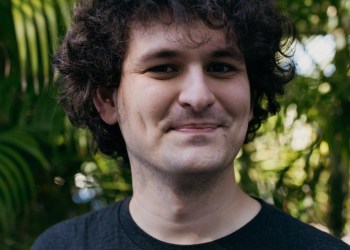
Unveiling the 'White-Haired Stock God' Serenity: The Mental Elixir for Anxious Retail Investors

marsbitPublié le 2026-06-11Dernière mise à jour le 2026-06-11

Résumé

The anonymous stock influencer known as "White-Haired Stock God" Serenity has ignited a frenzy in the A-share market. From June 5-9, Serenity's posts on platform X mentioning A-shares like LeaderDrive, Easun, and Innolight triggered sharp price surges, with some stocks hitting 20% daily limits. Serenity, who claims a 3612% personal return this year, gained fame internationally using a "chokepoint investment" strategy focused on small, monopolistic AI supply chain companies. With over 810k X followers, his influence rivals top analysts. His recent foray into Chinese stocks, which he claims is "for fun" to offer a "foreign perspective," has drawn scrutiny. While Serenity denies holding positions in these A-shares and states his posts are not recommendations, his actions have caused significant market volatility. He monetizes through a $1/month subscription, earning an estimated $54k monthly. Facing accusations of market manipulation, he maintains he promotes "information democracy." Community analysis suggests Serenity is likely an English-speaking Chinese national living in Japan, based on his posting patterns and shared personal details. He maintains anonymity due to past harassment. Ultimately, Serenity is seen by many as a manifestation of the current AI bull market's euphoria—a mysterious, seemingly successful figure who fulfills the market's desire for a "stock god," though such personas often face intense scrutiny when market sentiment shifts.

Author | Golem (@web 3_golem)

In the A-share market, the "White-Haired Stock God" Serenity has completely gone viral.

From June 5th to June 9th, Serenity successively "shilled" three A-shares on platform X. They were the embodiment intelligence robotics concept stock LeaderDrive, the digital intelligence new energy concept stock Yashi, and the leading optical module stock Innolight. The stock prices of the first two were vertically pulled to a 20cm limit-up on the same day, and LeaderDrive has already risen over 30% in June.

The reason Serenity possesses such strong "pumping power" is because before entering the view of domestic A-share investors, he had already gained extremely high popularity in international retail investor communities.

Serenity's investment characteristic is using the "Chokepoint Investment Method" to screen out small monopolistic companies in the AI industry chain that are not fully priced in. Because the over 16 stocks he has shilled this year have all achieved investment returns exceeding 100%, and his personal year-to-date investment return exceeds 3612%, coupled with his professional background as a former AI research scientist and his rigorous analysis of the AI industry and favored companies each time, Serenity has accumulated a large number of loyal retail followers in Europe, America, Japan, and South Korea. His X account subscribers exceed those of Musk, ranking first on the platform. Therefore, his influence on a single stock's price fluctuation surpasses that of ordinary stock analysts.

For example, on May 27th, Serenity posted on platform X announcing he had completed building a position in the European stock XFAB at a market cap of $1.28 billion. XFAB's stock price was subsequently pushed up continuously, with a single-day intraday maximum increase of 77%, and the stock price rose to a high of 13.13 euros. Since then, XFAB's stock price began a continuous decline and is currently trading around 8.8 euros, having returned to pre-shill levels.

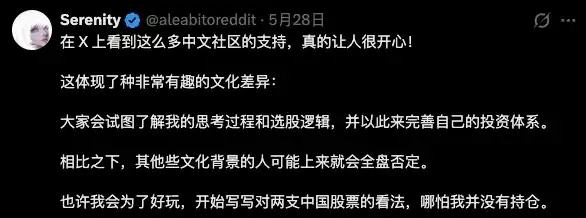
Just the day after causing significant volatility in XFAB's stock price, Serenity posted in Chinese on platform X, saying, "Because I see so much support from the Chinese community... I might, just for fun, start writing about my views on a couple of Chinese stocks."

A storm of blood and rain sweeping the A-share market thus began.
Disrupting the A-Share Market Without Holding Positions, Just for Fun?

In hindsight, these two stocks Serenity mentioned were LeaderDrive and Yashi.

On June 5th, Serenity posted in Chinese, specifically emphasizing "written specifically for my Chinese readers," stating that LeaderDrive (688017, 57.73 billion RMB) was his most favored Chinese listed target when positioning in the humanoid robotics sector. The main reason is its absolute dominance in certain robot component supply chains, with over 60% domestic market share and more than 1,800 global customers.
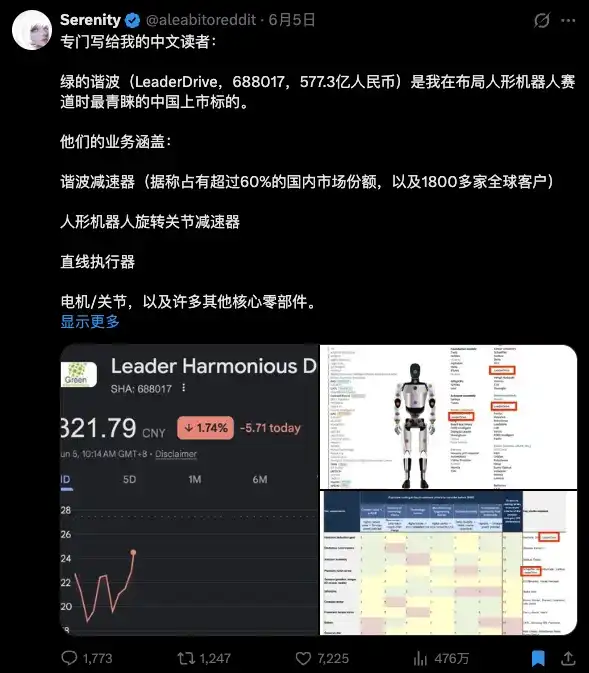
As of now, this post has been viewed over 4 million times and has been disseminated to multiple domestic social media platforms. LeaderDrive's stock price triggered a 20% limit-up on June 5th. By June 10th, in just 4 trading days, the stock price had risen over 30%.

On June 8th, the same market script played out again. Serenity posted a crowdsourced list of over 30 companies in the "800V DC" concept on platform X, which included the A-share company Yashi. The news quickly fermented domestically, with Yashi's stock price happily receiving a 20CM limit-up within an hour, and by June 10th, its increase also exceeded 30%.

Serenity himself even seemed surprised, posting, 'Does everyone know this is just a crowdsourced list? How did 300376 (Yashi) go up 20%?'

Immediately after, he posted again saying, 'These are stocks recommended by fans, not my personal recommendations,' attempting to distance himself from it.
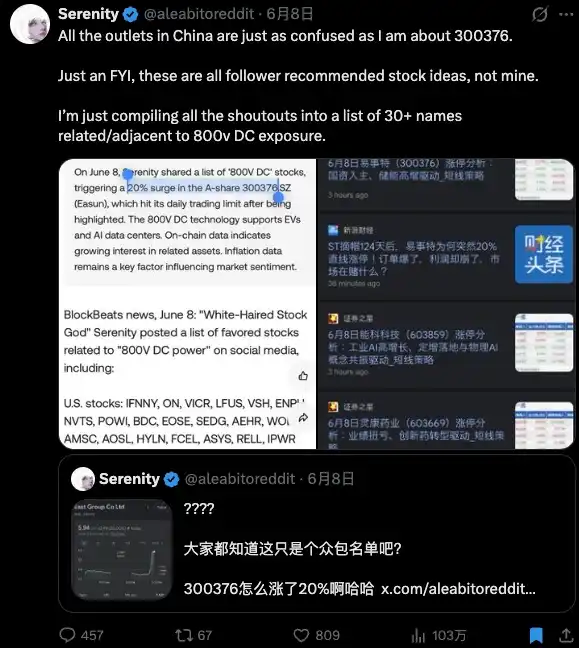
Besides these two stocks, Serenity also mentioned a third A-share, Innolight, on June 9th, stating it was the only Chinese listed company he invested in last year. However, because some AI mistranslated "Innolight" as another A-share listed company, Inno Laser, this caused Inno Laser to be violently pumped nearly 10% within 10 minutes. This "misunderstanding incident" also reveals the retail investors' FOMO towards Serenity himself—"blindly, just asking what to buy, afraid of missing out on the hot stuff."

Serenity's actions quickly drew the attention of domestic financial media and securities analysts, who began speculating about his purpose for "cross-border stock promotion." On June 9th, Cailian Press published a lengthy article warning domestic investors to be wary of overseas information flowing back in. If Serenity's sharing involved profit-sharing, the behavior would be classic "export-for-domestic-sale style cross-border pumping," requiring legal accountability. Some domestic securities analysts even openly vented on social media, "These clowns will be finished sooner or later, thinking they can act lawlessly just because they ran abroad."

Facing domestic media's questioning about him "harvesting retail investors," Serenity responded that shilling A-shares was just because he thought "foreigners could bring a different perspective to A-shares." He also stated, "Although I really like LeaderDrive, I do not hold its stock." Perhaps, as he initially said, the original intention behind all this was just for fun.
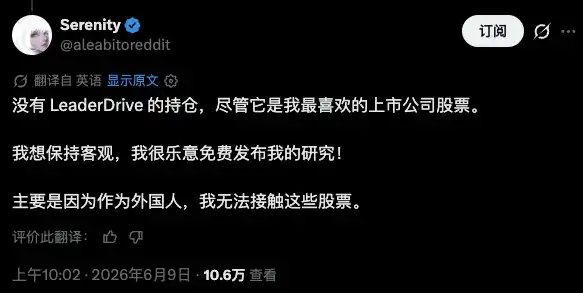
Serenity appears almost like a "philanthropist." He emphasizes he does not do any paid promotions or marketing. The only paid thing is a $1 monthly subscription service. He is not a member of any institution or the Illuminati. The reason for his continuous free sharing is his belief that the stock market is a positive-sum game. He hopes retail investors can buy quality stocks without joining any expensive paid communities, even before institutions enter. He claims he is promoting information democratization.

In the investment field, don't overly deify anyone. Serenity may not seek profit, but he certainly seeks fame. Since starting to shill A-shares on June 5th, Serenity's follower count has surged again by over 200,000. As of June 11th, his X platform followers exceed 8.1 million, and account subscribers have grown to 54,000, surpassing Musk (46,000). With such a massive number of subscribers, even at $1, Serenity's fixed monthly income reaches $54,000, easily earning over a million RMB annually.

Serenity's pinned posts celebrate his account subscriber count surpassing Musk, calling it his goal. The fact that an anonymous account can have such high influence and attention makes investors even more curious about his real identity. Behind this account, is it a person, a team, or even just an AI?

Most Likely a Chinese National Living in Japan?

Serenity explains that his reason for remaining anonymous is to be able to freely express ideas online. He stated that when he first published negative views about IREN (a Nasdaq-listed stock), he received threats and harassment from dozens of accounts in real life, which is why he continues to remain anonymous.

Nevertheless, the community has gradually pieced together an image of Serenity from various collected fragments of information. It is highly likely he is a Chinese national living in Japan.

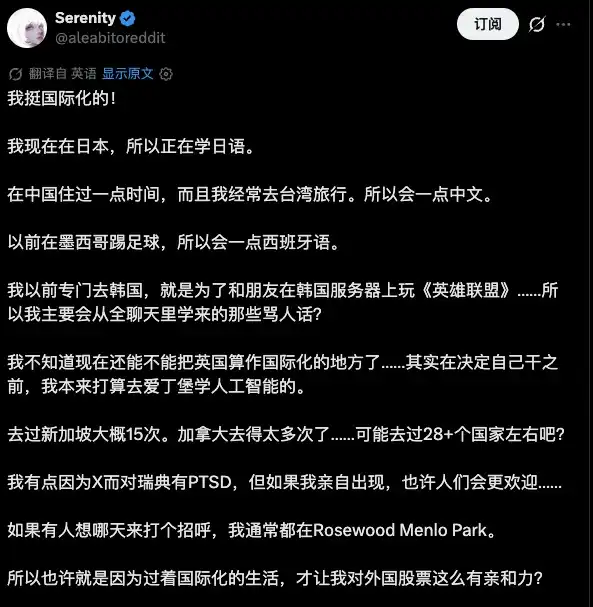
At the end of May, Serenity revealed some personal information. He said he is quite international, currently studying Japanese in Japan. Because he once lived in mainland China for a period and often traveled to Taiwan, he knows a bit of Chinese. Additionally, he played football in Mexico for two or three years, went to South Korea specifically to play League of Legends... his life seems quite comfortable.
Serenity has lived in Japan for at least half a year. At the end of 2025, he often posted photos of his life in Japan on platform X, but since becoming popular, he rarely mentions personal life.
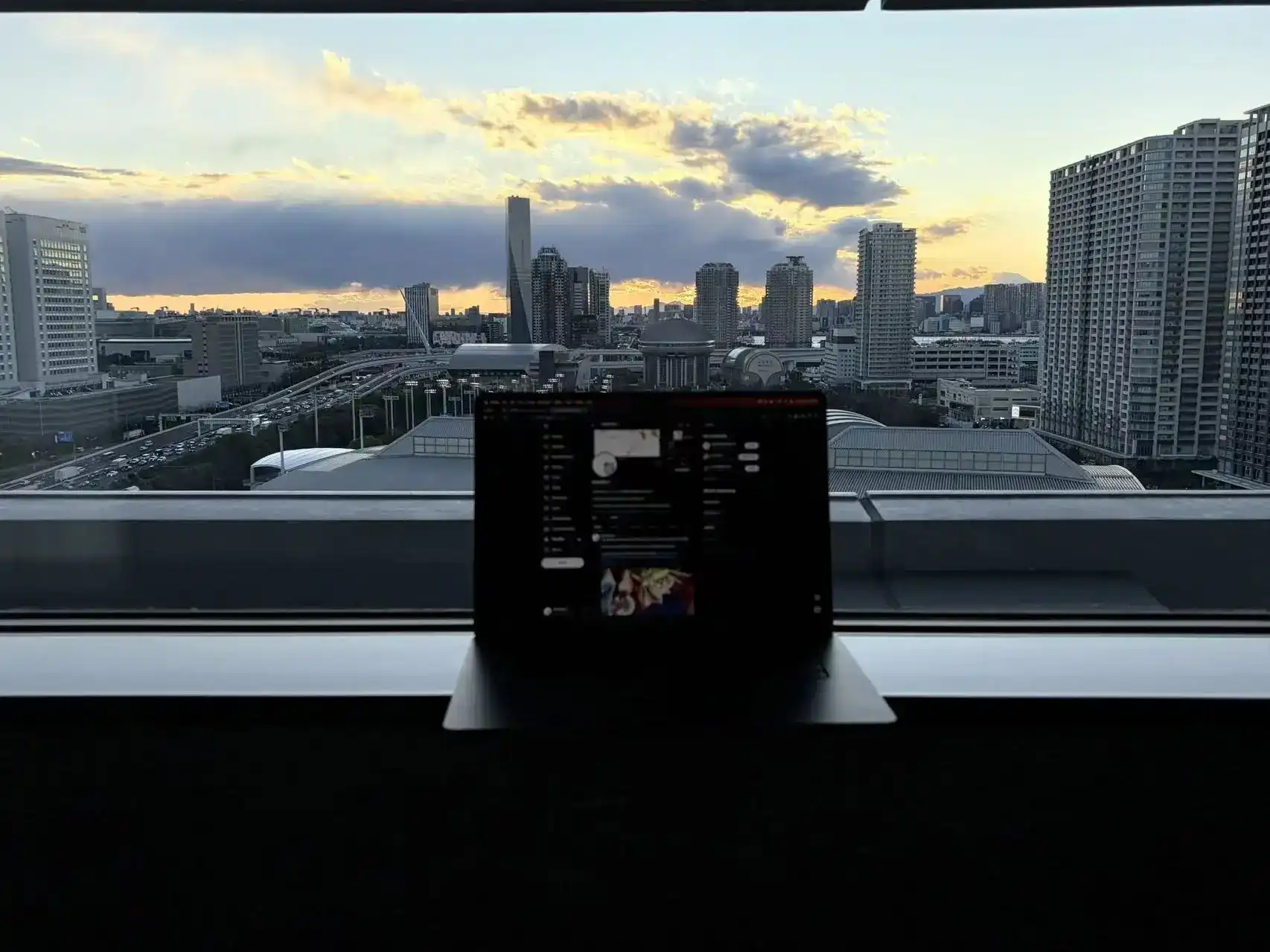
Serenity in Japan

Serenity is a high-frequency poster, averaging 9~10 posts per day, peaking at over 20. Looking at his daily posting frequency using AI statistics, he has about 5 hours of absolute account silence each day. This silence period is likely when Serenity is resting or sleeping. This timeframe corresponds roughly to the early morning hours (3:00 to 8:00) in some Asian time zones (UTC+8, UTC+9). Combined with the previous information, this basically locks Serenity's location to Japan.

The community leans towards thinking Serenity is a Chinese national, but Serenity emphasizes English is his native language. Most of his posts are still in English. Occasional posts in Chinese seem only to cater to Chinese fans. Moreover, if you count posts in different languages, his Japanese post count is higher than his Chinese.

Combining this with Serenity's early experiences—active on Reddit WSB (Odaily Note: Wall Street Bets is the largest US retail trading community) before moving to X, rejected an offer from Nvidia's AI team in 2018, and was reported by overseas renowned media like Bloomberg and Reuters—it is therefore possible to basically rule out Serenity being a Chinese citizen.

Serenity's anonymous identity, non-transparent investment returns, and excessive craving for influence are all increasing market controversy around him. But interestingly, everyone who questions him is also constantly refreshing his homepage.

Stock investment has always seen different idols in different eras: Warren Buffett, Cathie Wood, Roaring Kitty. Each era has its own spiritual totem. Bull markets magnify returns and also magnify faith. When more and more people start making money, we always want to find someone who can "scientifically explain the bubble." Serenity might just be the outward projection of this round of AI bull market sentiment—mysterious, professional, successful, fitting all the public imagination of a "stock god."

But next to the altar is the guillotine, because when the market turns, it will want to find someone to blame for the losses, and Serenity might then be the most suitable candidate. History repeats, the market moves forever forward, people enjoy creating idols and are also adept at "destroying idols." As for who Serenity really is, it probably isn't that important anymore.


Questions liées

QWho is Serenity, and what recent impact has he had on the A-share market?

ASerenity, known as the 'White-Haired Stock God,' is an anonymous influential figure in international retail investment communities. Recently, he 'called' three A-share stocks—LeaderDrive (绿的谐波), EAST (易事特), and Innolight (中际旭创)—on platform X, causing significant price surges, with the first two hitting 20cm daily limit-ups. His posts led to increased volatility and widespread attention in the A-share market.

QWhat is Serenity's claimed investment strategy, and what is his reported performance?

ASerenity employs a 'Chokepoint Investment Method,' focusing on small monopoly companies in the AI industry chain that are undervalued. He claims that over 16 stocks he recommended this year have yielded returns exceeding 100%, and his personal investment return for the year-to-date is over 3612%.

QHow does Serenity respond to accusations of market manipulation or 'pump-and-dump' schemes in China?

ASerenity denies any manipulative intent, stating that his discussions about A-shares aim to offer a 'different perspective from foreigners.' He emphasizes that he does not hold positions in stocks like LeaderDrive and claims his actions are 'just for fun.' He also distances himself from recommendations in crowdsourced lists, attributing them to fans.

QWhat is known about Serenity's background and identity based on community investigations?

ACommunity analysis suggests Serenity is likely a Chinese-speaking individual living in Japan. He has shared details about studying Japanese, traveling in Taiwan, and past stays in Mexico and South Korea. His posting patterns indicate he operates in Asian time zones (UTC+8/9). While he claims English as his native language, his ability to use Chinese and Japanese, along with his lifestyle posts from Japan, supports this profile.

QWhat are the potential motivations and risks associated with Serenity's activities according to the article?

AThe article suggests Serenity may seek fame and influence, as seen in his celebration of surpassing Elon Musk in X subscriptions. Financially, his subscription service could generate substantial income. However, his anonymity, opaque investment disclosures, and market impact raise concerns about accountability. The article warns that during market downturns, such figures often become scapegoats for losses, highlighting the cyclical nature of 'creating' and 'destroying' market idols.

Lectures associées

Un pays qui a miné du Bitcoin pendant 8 ans a créé une banque cryptographique qui lui est dédiée

Un petit royaume himalayen, le Bhoutan, lance une banque cryptographique unique après huit années d'expérience dans le minage de Bitcoin. La DK Bank, située dans la nouvelle ville de Gelephu Mindfulness City (GMC), est la seule banque agréée de la zone, conçue pour combler le déficit de services bancaires pour les entreprises de cryptomonnaies. Dirigée par le PDG Zheng YD, la banque permet la gestion conjointe de devises fiduciaires et de stablecoins comme l'USDT ou l'USDC sur un compte unique, avec des services de garde et de prêt sur nantissement de Bitcoin. Pour y parvenir, elle a dû relever le défi technique d'intégrer des systèmes bancaires traditionnels avec le marché cryptographique actif 24h/24. La zone économique spéciale de GMC opère sous une gouvernance distincte du reste du Bhoutan, s'inspirant du droit commun de Singapour et des régulations d'Abu Dhabi (ADGM) pour attirer les entreprises internationales. Les autorités soulignent que les processus accélérés d'obtention de licence ne signifient pas un assouplissement des normes, exigeant une présence physique réelle pour bénéficier d'avantages fiscaux. Cette initiative s'inscrit dans une stratégie nationale plus large. Le Bhoutan exploite le minage de Bitcoin depuis 2018, utilisant son énergie hydroélectrique. Les responsables insistent sur une approche diversifiée et prudentielle, ne misant pas uniquement sur le Bitcoin mais explorant aussi la tokenisation d'actifs réels. Le projet vise à positionner GMC comme une plaque tournante financière pour l'Asie du Sud. Alors que des infrastructures comme un aéroport international sont en cours de développement, la DK Bank représente déjà un pas concret pour ce petit pays, qui mise sur l'innovation cryptographique régulée pour son avenir économique.

marsbitIl y a 16 mins

Un pays qui a miné du Bitcoin pendant 8 ans a créé une banque cryptographique qui lui est dédiée

marsbitIl y a 16 mins

Tendance des marchés américains (18 juin) : Le revirement de Waller déclenche une vente généralisée, première baisse pour SpaceX, les semi-conducteurs comme unique refuge

Le 18 juin, les marchés américains ont connu une vente généralisée après la réunion de la Fed. Le président Warsh a abandonné les orientations prospectives et le "dot plot" a surpris par son ton hawkish, avec la majorité des officiels prévoyant des hausses de taux en 2024. Les principaux indices (S&P 500, Nasdaq, Dow Jones) ont tous chuté de plus de 1%. Les géants technologiques comme Meta ( -5%) ont été durement touchés par la réévaluation des valorisations sensibles aux taux. SpaceX a clôturé en baisse pour la première fois depuis son introduction en bourse. Seul le secteur des semi-conducteurs a résisté, l'indice PHLX progressant de 1,38%. Des valeurs comme Applied Materials ont fortement augmenté, les investisseurs se tournant vers la chaîne d'approvisionnement en matériel informatique, considérée comme un refuge durable porté par les dépenses en IA. Les rendements des obligations d'État ont bondi, le dollar a atteint un sommet de deux mois, tandis que l'or et les cryptomonnaies ont reculé. La volatilité (VIX) a augmenté. Malgré la signature imminente d'un mémorandum avec l'Iran, l'incertitude règne. Le marché doit maintenant digérer ce choc hawkish sans les repères habituels de la Fed, ce qui pourrait prolonger la pression à la baisse, notamment sur les actifs risqués.

marsbitIl y a 37 mins

Tendance des marchés américains (18 juin) : Le revirement de Waller déclenche une vente généralisée, première baisse pour SpaceX, les semi-conducteurs comme unique refuge

marsbitIl y a 37 mins

L'équipe NVIDIA permet à un Agent de programmation de prendre en charge des expériences robotiques réelles avec un taux de réussite de 99%

NVIDIA a dévoilé le projet ENPIRE, un système où des agents de programmation (Codex, Claude Code, Kimi Code) pilotent de manière autonome des recherches sur des robots physiques. Ce cadre repose sur quatre modules qui forment une boucle fermée : l'environnement, l'amélioration des stratégies, l'évaluation des déploiements et l'évolution par analyse des journaux. Les agents peuvent ainsi automatiser des tâches complexes comme serrer des attaches, ranger des épingles ou installer des GPU, en atteignant un taux de réussite de 99%. Une observation clé est qu'il est souvent plus facile de réinitialiser un environnement robotique que d'accomplir la tâche elle-même. Les agents commencent donc par créer des routines de réinitialisation automatique. L'équipe a constaté une "loi d'échelle physique" : augmenter le nombre de robots parallèles (par exemple, passer à 8) accélère considérablement la résolution des tâches. Le système fonctionne désormais toute la nuit sans intervention humaine. Deux nouvelles métriques sont proposées : le MRU (taux d'utilisation moyen des robots), souvent inférieur à 50%, et le MTU (taux d'utilisation moyen des tokens). Le projet, destiné à être open source, vise à permettre à quiconque de mettre en place un système similaire de recherche robotique autonome.

marsbitIl y a 1 h

L'équipe NVIDIA permet à un Agent de programmation de prendre en charge des expériences robotiques réelles avec un taux de réussite de 99%

marsbitIl y a 1 h

Un petit modèle de 3B, avec des scores en programmation comparables à ceux d’Opus 4.5, suscite un vif débat, et il est chinois

Récemment, un petit modèle de langage de 3 milliards de paramètres, nommé VibeThinker-3B, a suscité un vif intérêt sur les réseaux sociaux. Développé par l'équipe de Weibo, ce modèle affiche des performances en programmation et en raisonnement vérifiable comparables à celles de grands modèles de pointe comme GPT-5, Claude Opus 4.5 ou Gemini 3 Pro, malgré sa taille réduite. Spécialement conçu pour les tâches de raisonnement où la réponse peut être objectivement vérifiée (mathématiques, programmation compétitive, raisonnement STEM), VibeThinker-3B obtient des scores remarquables sur plusieurs benchmarks : 94.3 à l'AIME26, 89.3 au HMMT25, 80.2 au LiveCodeBench v6, et un taux de réussite de 96.1% sur des problèmes récents de LeetCode. Sa construction repose sur Qwen2.5-Coder-3B, suivie d'un processus de post-entraînement avancé nommé "Spectrum-to-Signal". Ce processus combine un fine-tuning supervisé en deux étapes basé sur un curriculum, un apprentissage par renforcement appliqué à plusieurs domaines de raisonnement, une auto-distillation hors ligne, et enfin un apprentissage par renforcement sur instructions (Instruct RL) pour améliorer la contrôlabilité. Le rapport technique introduit également une stratégie d'évaluation à la volée, la "Claim-Level Reliability" (CLR), qui permet de booster davantage les performances sur les tests mathématiques. Les auteurs proposent l'"hypothèse de compression paramétrique sélective", suggérant que les capacités de raisonnement vérifiable sont hautement compressibles et dépendantes d'une utilisation intensive des paramètres, contrairement aux connaissances factuelles générales qui nécessitent une grande échelle. Cela indique un découplage partiel entre la faculté de raisonner et la connaissance du monde. L'objectif n'est pas de remplacer les grands modèles, mais d'explorer les limites des petits modèles sur des capacités spécifiques, démontrant qu'ils peuvent atteindre des performances de pointe dans des domaines où des signaux de vérification clairs existent. Le modèle est disponible en open source sur HuggingFace et arXiv.

marsbitIl y a 1 h

Un petit modèle de 3B, avec des scores en programmation comparables à ceux d’Opus 4.5, suscite un vif débat, et il est chinois

marsbitIl y a 1 h

Trading

Spot
Futures
活动图片