NodeStrategy: The First Ordinals DAT Project, Bringing the Strategy Treasury Narrative to NFTs

marsbitPublié le 2026-05-25Dernière mise à jour le 2026-05-25

Résumé

**Summary: The Fundamental Flaws of NodeStrategy, the 'First Ordinals DAT'** NodeStrategy presents itself as the first Ordinals Digital Asset Treasury (DAT) on Bitcoin. Its model mirrors MicroStrategy's treasury narrative but for NFTs, specifically targeting the NodeMonkes collection (not officially affiliated). The project's core mechanism is a four-step flywheel: a 10% fee on all trades (90% to treasury, 10% to radFi/Bound marketplace) is used to buy NodeMonkes. These NFTs are then listed for sale on Satflow, with 100% of the sale proceeds used to buy back and burn the project's token, NODESTRAT, aiming to create a perpetual value cycle. However, the design contains critical, self-defeating flaws: 1. **Platform Lock-In:** As a Bitcoin Rune, NODESTRAT lacks smart contract functionality and cannot natively enforce the 10% fee. The fee can only be collected on the radFi/Bound marketplace itself. This makes the entire flywheel dependent on a single platform. If liquidity moves elsewhere, fee revenue drops to zero, halting the mechanism. 2. **Self-Suffocating Economics:** The 10% fee acts both as the flywheel's fuel and a major drag on demand. A buy/sell roundtrip incurs a 20% cost, creating a massive hurdle for traders. This strangles the very trading volume needed to generate fees. 3. **Ineffective Value Support:** The flywheel is starved. Low daily volume (~$9K) generates minimal fees for NFT purchases. The NFT "ladder" sales are slow and unpredictable (only 39 total ...

Author: 798.eth

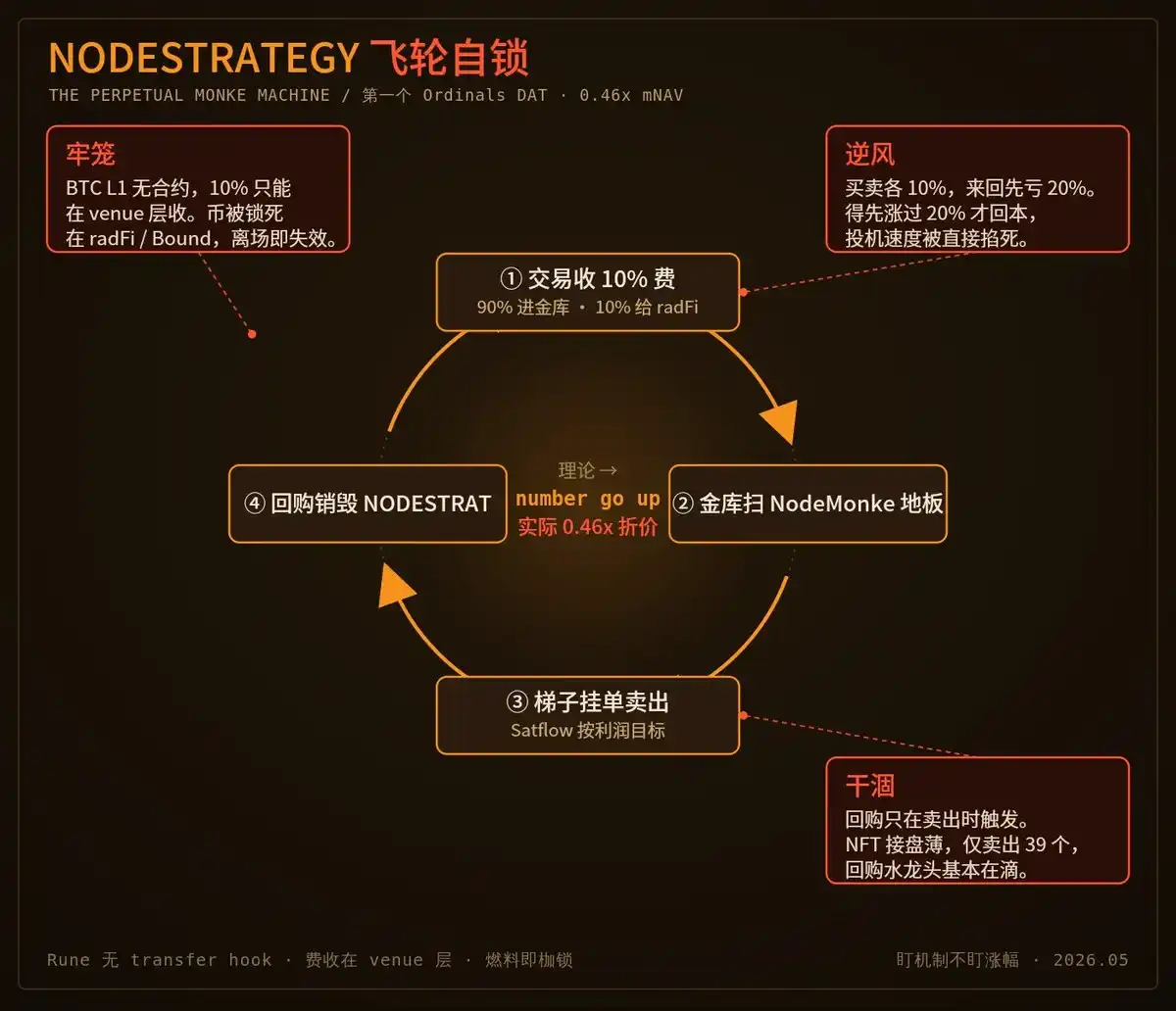
NodeStrategy claims to be the first Ordinals DAT project on Bitcoin. It transplants MicroStrategy's treasury narrative onto NFTs: treasury buys monkeys, buys back and burns, number go up—it sounds smooth. But it's currently at a 0.46x depth discount, and the price is stagnant. The problem lies in the design itself. The fuel that feeds this machine and the cage that locks it are the same thing: that 10% transaction fee. Let's break it down step by step.

First, what is NodeStrategy? It's a Bitcoin Rune token called NODESTRAT, with a total supply of 1 billion. It calls itself The Perpetual Monke Machine, the first Ordinals digital asset treasury on Bitcoin L1. The treasury's underlying assets are NodeMonkes, a blue-chip Ordinals NFT series. Note that it is not affiliated with the official NodeMonkes. The trading venue is radFi, which is now Bound.

Next, how does the flywheel turn? The story it paints is a four-step closed loop. A 10% fee is charged on each transaction, with 90% going to the treasury and 10% to radFi. The treasury uses this fee to sweep the floor of NodeMonkes. The purchased monkeys are listed in a ladder on Satflow, for sale at different profit targets. The BTC from sold monkeys is 100% used to buy back and burn NODESTRAT. Reduced supply leads to price increases, attracting more traders, which in turn generates more fees. It claims to become more valuable the more it spins. There's only one script, and it sounds self-consistent. But it's not spinning. Here's why.

Point one: Why NODESTRAT can only be traded on radFi / Bound.

First, recognize its lifeline. The entire flywheel—sweeping, selling, buyback and burn—relies entirely on that 10% fee for sustenance. Without this fee, the treasury has no money, and the machine stops instantly.

So who collects this 10%, and at which layer? On Ethereum or Solana, this is simple; the token's contract itself can collect it. ERC20 can implement fee-on-transfer, and Solana's Token-2022 has TransferFee. With each transfer, the token's own code deducts the tax; you can trade it anywhere, and the tax follows the token.

But NODESTRAT is a Rune on Bitcoin. Bitcoin L1 does not have smart contracts. A Rune is just a balance entry on the Runes protocol ledger, etched as a number. It has no code, no transfer hooks, no executable logic whatsoever. You cannot create a Rune that automatically collects taxes. Transferring a Rune is simply a regular Bitcoin transaction moving a balance from one place to another; nothing in between can intercept it and take 10%.

Therefore, this 10% cannot be attached to the token itself; it can only be attached to the trading venue. It's radFi / Bound's liquidity pool that deducts the 10% at the moment you trade NODESTRAT, when constructing the transaction. The tax is collected at the platform layer; the token itself cannot deduct a single satoshi.

The corollary is clear. This 10% fee only exists when trading on radFi / Bound. If you transfer NODESTRAT as a regular Rune peer-to-peer to a friend, or sell it on another Ordinals marketplace, there is no 10% fee, because no place outside of Bound knows about this rule, let alone can enforce it.

Thus, the project is left with only one path to survive: locking all trading strictly within radFi / Bound. This is the only place in the world where this toll fee can be collected. If liquidity flows elsewhere, fee income drops to zero, the treasury stops sweeping, and the flywheel dies immediately.

This also explains that portion of the 10% allocated to radFi. radFi is the toll booth, and NodeStrategy is responsible for directing all traffic onto this road. This token is almost literally Bound by its name; it's honest naming. Its entire value mechanism is held hostage, like a pawn, on a single platform. This fragility is written into its design.

Point two: Why the price isn't rising, and where the root cause lies.

Its script is number go up, so why is it flat? The real issue is that the very fuel for this machine is poisoning its own demand.

First, the machine is out of gas. The flywheel burns on trading volume, and the volume is basically dead—$9K per day. A 10% cut is $900; 90% goes to the treasury, $810, which buys less than 0.01 BTC per day. No volume means no fees, no fees mean no sweeping, no sweeping means no monkeys on the ladder to sell, no sales mean no buybacks, no buybacks mean no burns—resulting in nothing happening to the price. The entire chain is spinning idly.

An even more critical point. That 10% is not just fuel; it is simultaneously a headwind pressing down on its own price. Buying incurs a 10% fee, selling incurs another 10%—a round trip loses 20% upfront. This token needs to rise over 20% just for a trader to break even. You're essentially inviting people to buy something that charges 10% on entry and another 10% on exit, directly strangling speculative velocity. On one side is the tailwind from buybacks and burns, and on the other side is the 20% round-trip tax acting as a headwind—both blowing on the same token. It's fighting itself.

The buyback pipe itself is already tightly screwed. Buybacks only trigger when a NodeMonke is actually sold from the ladder; only the money from sold monkeys goes towards buybacks. But the NFT market has thin order books, sells slowly, and is uncertain. It has only sold 39 monkeys in total, with 15 in the short bucket, and 0 in the medium and long buckets. The buyback faucet is basically dripping. The 30.77% that has been burned so far...

Burning itself does not create demand. Reducing supply can push up the price, but only if demand still exists. There's no volume, and entering the market gets hit with a 10% fee. Burning 30% of the supply results in a smaller, yet equally illiquid, market with no one bidding. Price is about supply and demand at the margin; it's aggressively attacking the denominator while the demand on the numerator side is locked down by the tax and dead volume.

That 0.46x discount is a self-locking trap. The token price is only half of NAV. A normal DAT, when at a premium, can issue more tokens to buy more assets, compounding and growing thicker—that's the real leverage for number go up. The only remaining lever to push the price is buybacks, which are starved by the earlier point. The path to premium is blocked, the path via buybacks is sluggish, and the discount just hangs there, with no mechanism to close it.

Finally, NAV is double the market cap; why isn't the price converging towards NAV?

Holding NODESTRAT offers no redemption channel; you cannot exchange the token for its implied 0.46x worth of NodeMonkes. Your only exit is to sell it to the next bidder on radFi, paying another 10%. That NAV is a marketing number, not a floor price. The market naturally doesn't recognize it, pricing it solely based on cash flow.

That 10% fee was meant to feed the flywheel. Instead, on one hand, it tax-strangles the very demand and volume the flywheel needs most; on the other hand, it can only collect it by locking the token onto a single platform, thereby limiting liquidity. Add to that the fact that the backing is non-redeemable and non-realizable, so NAV cannot anchor the price. This machine's design lets its own fuel source restrict its own demand.

This is not an assessment of price movements, just the mechanism.

Are there any good solutions to get this otherwise well-conceived flywheel spinning again?
Questions liées

QWhat is NodeStrategy and what is its primary function as described in the article?

ANodeStrategy is the first Ordinals DAT (Digital Asset Treasury) project on Bitcoin. Its primary function is to serve as a 'Perpetual Monke Machine'—a digital asset treasury for NodeMonkes NFTs on Bitcoin L1. The project aims to mirror the MicroStrategy treasury model on the Ordinals/NFT ecosystem.

QWhat is the four-step flywheel mechanism designed for NodeStrategy, and why does it fail to operate as intended?

AThe four-step flywheel is: 1) Collect a 10% fee on every NODESTRAT trade. 2) Use 90% of that fee to buy NodeMonkes NFTs from the floor. 3) List the purchased NFTs on Satflow at different profit targets. 4) Use 100% of the proceeds from NFT sales to repurchase and burn NODESTRAT. It fails because the 10% fee, which is its fuel, simultaneously chokes the trading volume and liquidity it needs to function, and the tax is only enforceable on the Bound (radFi) platform.

QWhy is the NODESTRAT token effectively locked to trading on the radFi/Bound platform?

ANODESTRAT is a Rune token on Bitcoin, which lacks smart contract functionality. Therefore, the 10% trading fee cannot be programmed into the token itself and can only be enforced by the trading platform (Bound) when constructing transactions on its order book. If the token trades elsewhere, no fee is collected, starving the treasury and stopping the flywheel.

QWhat are the two main contradictions or self-defeating aspects of the 10% trading fee mechanism?

AFirst, the fee suppresses the very trading volume it relies on for fuel. A round-trip trade incurs a 20% cost, killing speculative demand. Second, the mechanism relies on locking all liquidity to a single platform (Bound) to enforce the fee, creating fragility and limiting market access.

QWhy does the NODESTRAT token trade at a significant discount to its Net Asset Value (NAV) according to the article?

AThe NAV is not actionable for holders. There is no redemption mechanism to exchange NODESTRAT for its underlying NodeMonkes NFTs. The only exit is to sell on the open market (with another 10% fee), so the price is set purely by trading demand and liquidity, which are weak. The NAV is thus a marketing metric, not a functional price floor.

Lectures associées

Après trois trimestres consécutifs de baisse, le marché des cryptomonnaies pourra-t-il connaître une fenêtre de stabilisation au troisième trimestre ?

Le marché des cryptomonnaies a enregistré son pire trimestre depuis 2022, avec une capitalisation totale chutant de 12,6% à 2 100 milliards de dollars. Tous les indicateurs clés (volume des échanges, valeur des stablecoins) montrent une sortie nette de capitaux. Le Bitcoin a perdu 14,2% et l'Ethereum 25,4% sur le trimestre, rompant sa corrélation antérieure avec les actions technologiques. Les ETF spot américains sur le Bitcoin ont subi des rachats massifs, avec une sortie nette de 4,67 milliards de dollars au Q2, indiquant une pression de vente continue. Le resserrement de la politique de la Fed et les ventes d'entreprises comme Strategy ont accentué la déleveragisation du secteur. L'attention du marché se porte désormais presque exclusivement sur la réunion de la Fed fin juillet. Une position accommodante pourrait stabiliser le Bitcoin entre 68 000 et 84 000 dollars, tandis qu'un ton hawkish pourrait le faire osciller autour de 50 000-56 000 dollars. Parallèlement, la progression du *CLARITY Act*, une loi cruciale pour la clarté réglementaire, est au point mort au Sénat, réduisant les chances d'adoption en 2026 et maintenant une prime de risque élevée sur l'ensemble du secteur. Malgré ce contexte difficile, quelques secteurs résistent : les marchés de prédiction ont vu leur volume nominal augmenter de 48,7% et les biens collectionnables tokenisés ont progressé d'environ 143%. La tokenisation d'actifs du monde réel (RWA) continue également sa croissance régulière, portée par des fondamentaux indépendants du cycle crypto. Les bases d'un effondrement extrême semblent absentes, mais le marché est désormais guidé par les politiques monétaires, les prix et les attentes de taux, plutôt que par le simple récit haussier. La fin des sorties massives des ETF et le retour des achats des détenteurs à long terme pourraient indiquer une phase de stabilisation potentielle.

marsbitIl y a 21 h

Après trois trimestres consécutifs de baisse, le marché des cryptomonnaies pourra-t-il connaître une fenêtre de stabilisation au troisième trimestre ?

marsbitIl y a 21 h

The SpaceX Trade, Unlocked: SPCXON Débarque sur WEEX

En juin 2026, SpaceX a réalisé la plus grande introduction en bourse de l'histoire, mais l'accès à l'action a été limité pour de nombreux investisseurs en raison de restrictions régionales et de frictions liées aux courtiers. La plateforme WEEX propose désormais une solution via SPCXON/USDT, un instrument tokenisé sur le marché au comptant qui permet d'obtenir une exposition au cours de SpaceX en utilisant l'USDT, sans nécessiter de compte de courtage américain. SPCXON est un produit tokenisé construit sur l'infrastructure d'Ondo, conçu pour refléter l'économie de la détention d'actions SpaceX pour les traders éligibles en dehors des États-Unis, avec des dividendes réinvestis. Le cas d'investissement repose sur la croissance des revenus de Starlink et les progrès de Starship, malgré un valorisation déjà élevée et des risques liés à un flottant public réduit et à des déblocages d'actions internes à venir. Il est important de noter que SPCXON offre une exposition, et non la propriété directe d'actions ou de droits de vote. Son prix peut évoluer avec une prime ou une décote par rapport à la valeur liquidative. WEEX propose également d'autres produits tokenisés comme MSTRON et MUON dans un compte unifié, permettant une rotation entre crypto-monnaies et actions traditionnelles sans transfert de fonds. La plateforme souligne ainsi comment les barrières entre la finance traditionnelle et les actifs numériques s'estompent.

TheNewsCryptoIl y a 22 h

The SpaceX Trade, Unlocked: SPCXON Débarque sur WEEX

TheNewsCryptoIl y a 22 h

BIT Trading Moment : Le BTC reste sous la pression de l'EMA 200 hebdomadaire, un rejet pourrait relancer la baisse, les actions de stockage et de semi-conducteurs qui ont bondi cette nuit ont baissé en séance de nuit

**Résumé des marchés : Bitcoin sous pression, actions technologiques en réajustement** Le marché crypto poursuit son rebond, avec Bitcoin évoluant autour de 66 000 $. Il fait face à une résistance clé vers 68 000 $, niveau correspondant au coût moyen des investisseurs sur cinq mois. Les traders surveillent les moyennes mobiles clés (200 MA à ~63 333 $ et 200 EMA à ~68 328 $ en hebdomadaire). Une rupture au-dessus de 68 000 $ ouvrirait la voie à une hausse, tandis qu'un échec pourrait entraîner un retest des 63 000 $. L'analyse suggère que la dynamique actuelle ressemble à un rebond estival à faible liquidité plutôt qu'au début d'un véritable marché haussier. Sur le marché actions américain, après une forte séance mardi portée par les semi-conducteurs et les titres du stockage (Micron, AMD, Intel...), les contrats à terme indiquent une ouverture en baisse. Les secteurs ayant récemment bondi, comme les semi-conducteurs et le stockage, reculent en séance de nuit. Certaines valeurs se démarquent néanmoins, comme Super Micro Computer (SMCI), en hausse après des résultats et des perspectives robustes liées à la demande de serveurs IA. Des vents contraires persistent : les prix du pétrole (Brent >91$) et les rendements des obligations d'État américaines grimpent, ravivant les craintes inflationnistes. En Asie, les marchés ont suivi le rebond technologique américain, mais de manière hésitante. La tension reste forte sur le yen japonais, qui atteint son plus bas niveau depuis des décennies. **Points clés à surveiller :** * **Crypto :** Niveaux techniques de Bitcoin (68k$/63k$), flux des ETF spot. * **Actions :** Saison des résultats (Tesla, Alphabet, Intel...), activité d'AMD sur l'IA. * **Économie :** Données américaines sur l'emploi, décision de la BCE, tensions géopolitiques et prix de l'énergie.

marsbitIl y a 22 h

BIT Trading Moment : Le BTC reste sous la pression de l'EMA 200 hebdomadaire, un rejet pourrait relancer la baisse, les actions de stockage et de semi-conducteurs qui ont bondi cette nuit ont baissé en séance de nuit

marsbitIl y a 22 h

Gate Research Institute : La vague de « Wall Streetisation » des produits financiers cryptographiques, concurrence ou fusion ?

Le titre de l'article est : "Gate Institute : La vague de 'Wall Street-isation' des produits financiers cryptos, est-ce une compétition ou une fusion ?" Résumé en français (environ 1400 caractères) : Il y a dix-sept ans, Bitcoin fut créé avec une vision décentralisée et anti-establishment financier. Aujourd'hui, paradoxalement, son adoption massive passe souvent par des ETF émis par des géants comme BlackRock. Cet article analyse cette "Wall Street-isation" apparente des actifs cryptos : les institutions traditionnelles s'emparent-elles du pouvoir d'émission, de tarification, de garde et de distribution ? La réalité est plus nuancée. C'est une convergence à double sens. D'un côté, les plateformes cryptos comme Gate.io étendent leurs services aux actions traditionnelles (états-uniennes, hongkongaises, sud-coréennes), aux CFD et aux produits tokenisés, offrant un compte unifié. De l'autre, des courtiers traditionnels comme Robinhood intègrent les cryptomonnaies et explorent la tokenisation d'actions sur blockchain. Cette fusion vise à créer le "super-compte" financier de demain, où actions, cryptos, ETF et obligations tokenisées (RWA) coexistent dans une même interface, comblant les faiblesses de chaque écosystème. Les RWA, notamment les obligations d'État tokenisées, agissent comme une couche intermédiaire unificatrice. En conclusion, Wall Street n'a pas conquis la crypto, et la crypto n'a pas contourné Wall Street. Ils construisent ensemble une nouvelle forme de marché des capitaux, plus efficace et mondial, où l'idéal décentralisé persiste dans les protocoles, tandis qu'une expérience utilisateur unifiée émerge à l'interface.

marsbitIl y a 22 h

Gate Research Institute : La vague de « Wall Streetisation » des produits financiers cryptographiques, concurrence ou fusion ?

marsbitIl y a 22 h

Trading

Spot
活动图片





