Secures Over $60 Million in Funding from Dragonfly, Sequoia, and Others. An In-Depth Look at the On-Chain Derivatives Protocol Variational | CryptoSeed

链捕手Publié le 2026-05-22Dernière mise à jour le 2026-05-22

Résumé

Variational, a decentralized derivatives trading platform, has raised over $61.8 million in total funding, including a recent $50 million Series A led by Dragonfly Capital. Investors include Sequoia Capital, Coinbase Ventures, Bain Capital Crypto, and Hack VC. The platform, with over $810 million in Open Interest (ranking 4th among on-chain derivatives protocols), is founded by Lucas Schuermann and Edward Yu. Both are Columbia University graduates and former partners at quant fund Qu Capital. They later held senior roles at Genesis Trading, handling billions in trading volume. The broader team includes talent from Google, Meta, and top trading firms like Jane Street. Operating on Arbitrum, Variational distinguishes itself by aggregating external liquidity from CEXs, DEXs, and traditional market makers using an RFQ (Request-for-Quote) model, positioning itself more as a broker than an exchange like Hyperliquid. Its dual product line features Omni for retail users (offering up to 50x leverage on ~450+ crypto and TradFi pairs) and Pro for institutional OTC trading. Currently in a pre-TGE phase, Variational has launched an "Omni Points" system, with 50% of its upcoming $VAR token supply allocated for community incentives through trading-based rewards and referrals until Q3 2026.

Author: momo, ChainCatcher

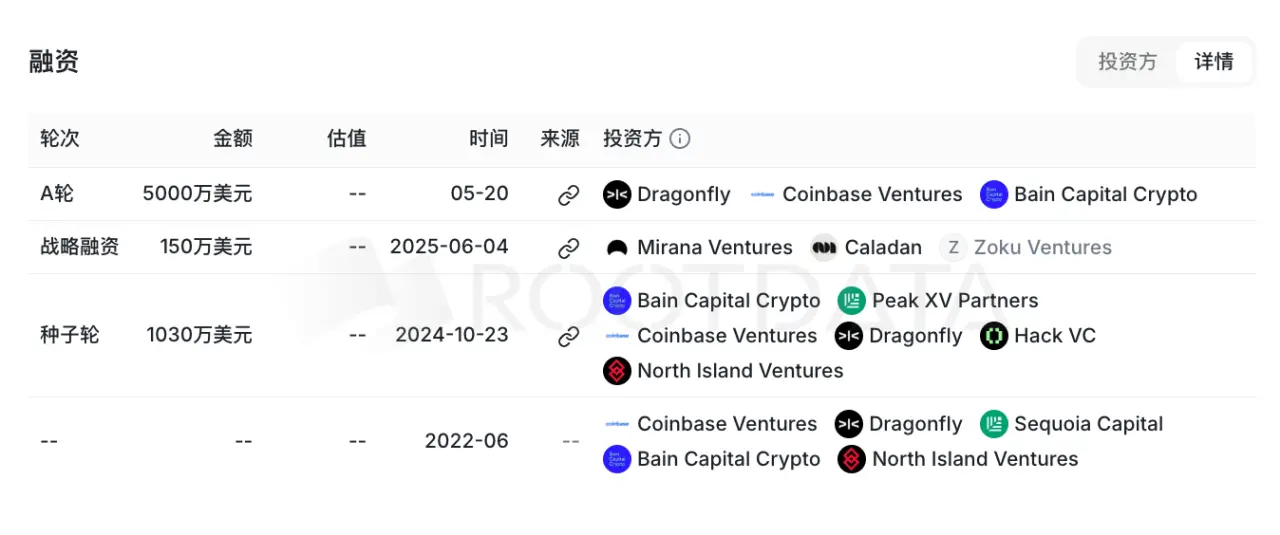
Recently, the decentralized derivatives trading platform Variational announced the completion of a $50 million Series A financing round led by Dragonfly. Combined with three previous funding rounds, Variational has raised a cumulative total of $61.8 million. Its investor lineup is quite impressive, including not only Dragonfly but also renowned institutions such as Sequoia Capital, Coinbase Ventures, Bain Capital Crypto, Hack VC, and others.
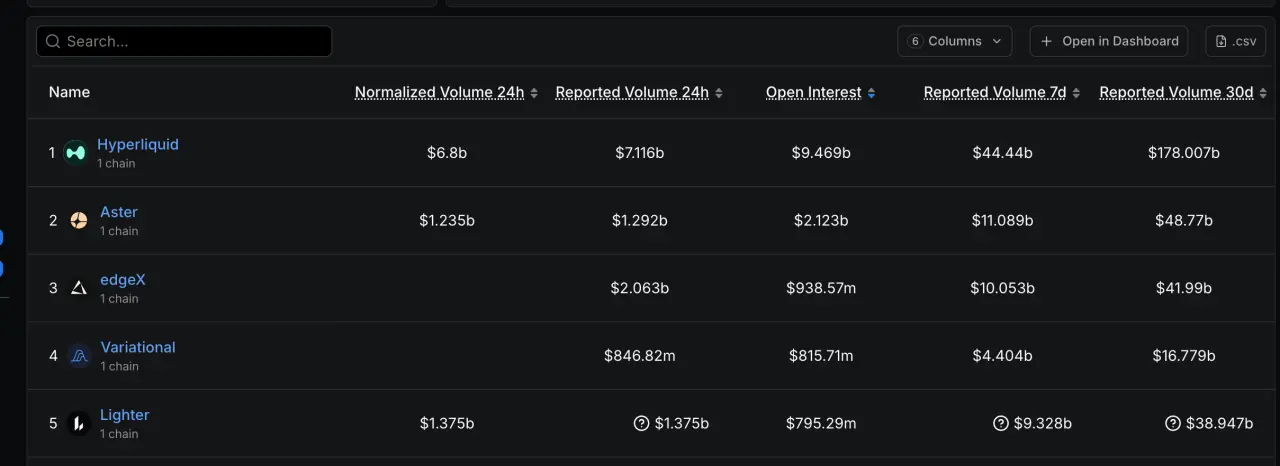
According to DeFiLlama data, the open interest (OI) on Variational has exceeded $810 million. While there remains a significant gap compared to Hyperliquid's $9.4 billion, its OI currently ranks fourth among on-chain derivatives protocols.
In the fiercely competitive decentralized derivatives sector, why has Variational continued to secure backing from top-tier institutions? What is the team's background? What are its differentiated approaches? This article provides a brief overview.

What is the team's background?

In terms of team background and entrepreneurial experience, Variational and Hyperliquid share several similarities: both teams graduated from prestigious universities, come from quantitative trading backgrounds, founded quantitative funds, and subsequently transitioned to building on-chain derivatives platforms.

However, unlike Hyperliquid's early mystique and anonymous team approach, Variational discloses its founding team's background and entrepreneurial journey in its whitepaper.
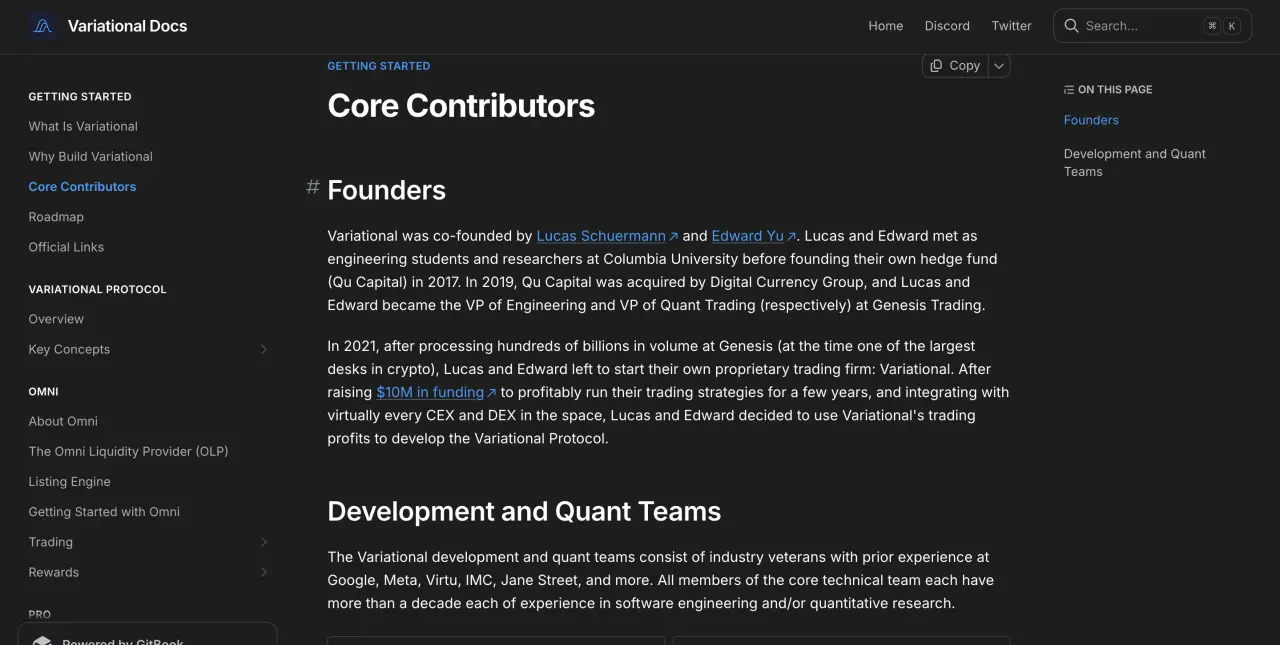
Variational was co-founded by Lucas Schuermann and Edward Yu. CEO Lucas graduated from Columbia University and was previously responsible for trading systems engineering architecture; Edward Yu has a Chinese background and was originally a quantitative analyst. The two met while studying and conducting research in the engineering department at Columbia University and co-founded the quantitative hedge fund Qu Capital in 2017.

In 2019, Qu Capital was acquired by Digital Currency Group. Subsequently, both joined Genesis Trading: Lucas served as Vice President of Engineering, and Edward Yu served as Vice President of Quantitative Trading.

According to the whitepaper, before leaving Genesis in 2021, their team had processed trading volumes in the hundreds of billions of dollars. After leaving, they founded their proprietary trading firm, Variational, and secured $10 million in funding.

In the following years, the team operated proprietary trading strategies while integrating with mainstream CEX and DEX trading interfaces. Later, based on their own trading business and system experience, they began developing and operating the Variational Protocol.

Additionally, Variational's development and quantitative team members also hail from technology and quantitative institutions such as Google, Meta, Virtu Financial, IMC Trading, and Jane Street. The whitepaper states that core technical team members generally possess over a decade of experience in software engineering or quantitative research.

What are its product features? How does it differ from Hyperliquid?

Judging from the trading interface, there isn't a significant difference between Variational and Hyperliquid. The platform currently lists approximately 450 trading pairs, mainly covering cryptocurrency and TradFi assets, offering users leverage up to 50x. The TradFi section is currently in Beta testing. According to official disclosures, the TradFi market will list over 100 trading pairs.
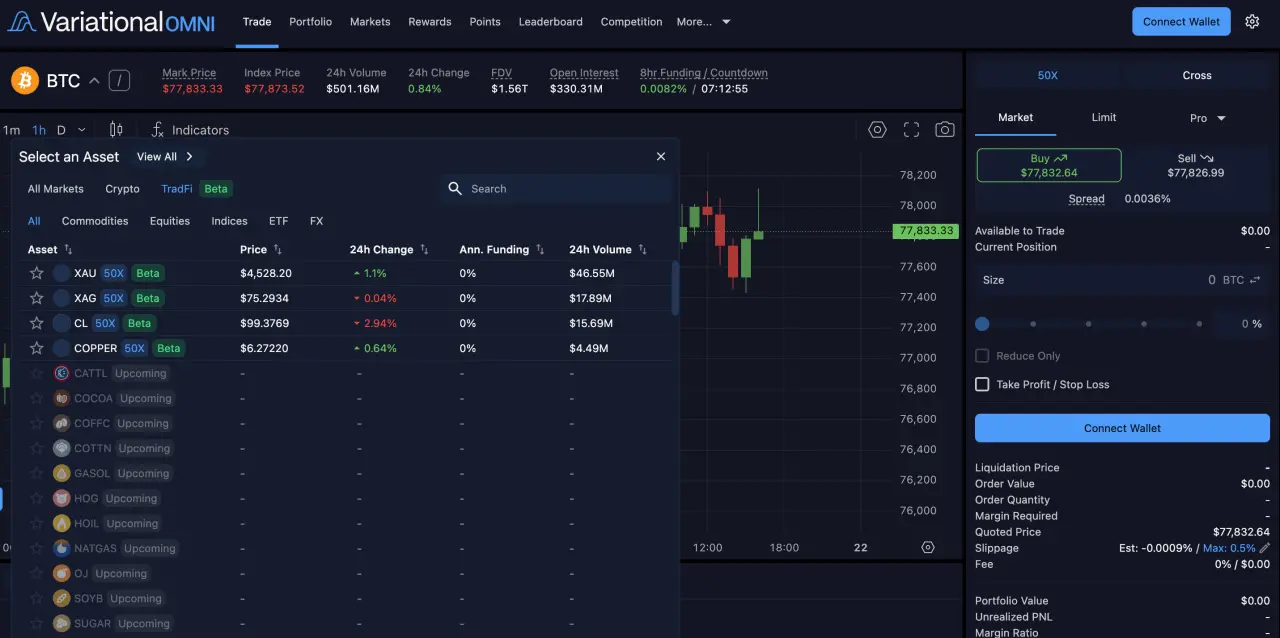
However, in its press release, Variational emphasizes a distinctly different positioning from Hyperliquid.

Variational describes its model as more akin to a brokerage rather than another exchange in the style of Hyperliquid. Its target users are not limited to crypto-native traders; it aims to make the on-chain derivatives trading experience closer to traditional markets through zero-fee trading and liquidity aggregation.

Currently operating on Arbitrum, Variational employs a dual-product-line model. The Omni version primarily targets retail users, positioned as a perpetual contracts trading product aggregating liquidity from multiple sources, while the Pro version caters to institutional over-the-counter derivatives trading.

The most significant difference from Hyperliquid lies in order matching and liquidity mechanisms. Hyperliquid relies on its self-built L1 chain and a public central limit order book (CLOB), with market makers or the HLP treasury within the protocol competing to provide quotes, and traders paying maker/taker fees. In contrast, Variational uses an RFQ (Request for Quote) model, with a single liquidity provider as the counterparty. It does not rely on on-chain internal market making but instead aggregates external liquidity in real-time from sources like CEXs, DEXs, OTC channels, and traditional financial market makers, managing risk through hedging.

The rationale for choosing this differentiated path, according to Variational CEO Lucas, is that on-chain liquidity still lags far behind traditional trading venues like the CME, and order book models face a "cold start" problem. Aggregating liquidity from external sources avoids the need to rebuild liquidity from scratch on-chain.

What is the current stage? What participation opportunities are available?

Variational is currently still in the Pre-TGE stage; the $VAR token has not been issued. The project initially planned a TGE in Q1 2025, which has since been postponed. No new definitive TGE date has been officially announced.

In December 2025, Variational launched the Omni Points points system. The official statement indicates that 50% of the $VAR supply will be allocated for community incentives, distributed gradually through mechanisms like Points rather than a one-time airdrop.

Regarding points, 3 million points have been retroactively distributed to early users. Subsequently, points are distributed every Friday based on the previous week's trading snapshot. The points program is scheduled to conclude by Q3 2026 at the latest.

The main current participation opportunity is to engage in perpetual contracts trading on the Omni platform. Trading volume is the core factor for earning points, with additional point bonuses available for holding positions over time and referring others.


Questions liées

QWhat is the total funding amount raised by the decentralized derivatives platform Variational, and who led its Series A round?

AVariational has raised a total of $61.8 million. Its Series A round of $50 million was led by Dragonfly.

QWhat are the key differences between Variational and its competitor Hyperliquid in terms of their operational models?

AThe key difference lies in their order matching and liquidity mechanisms. Hyperliquid relies on its own L1 blockchain with a public Central Limit Order Book (CLOB). Variational uses an RFQ (Request for Quote) model, acting as a single liquidity provider counterparty that aggregates external liquidity from CEXs, DEXs, OTC channels, and TradFi market makers, then manages risk through hedging.

QWhat is the professional background of Variational's founding team prior to starting the protocol?

ACo-founders Lucas Schuermann and Edward Yu met at Columbia University. They co-founded the quantitative hedge fund Qu Capital in 2017, which was later acquired by Digital Currency Group. They then joined Genesis Trading, where Lucas served as VP of Engineering and Edward Yu as VP of Quantitative Trading, before leaving in 2021 to found Variational.

QWhat is the current stage of Variational's token ($VAR) launch, and how is the project engaging its community?

AVariational is currently in the Pre-TGE stage, and the $VAR token has not been launched yet. The previously planned TGE for Q1 2025 has been postponed with no new official date announced. The project is engaging its community through an 'Omni Points' loyalty program launched in December 2025, with 50% of the $VAR supply designated for community incentives distributed via points and other mechanisms over time.

QOn which blockchain does Variational primarily operate, and what are its two main product lines?

AVariational primarily operates on the Arbitrum blockchain. It follows a dual-product line model: the 'Omni' version targets retail users as a perpetual contracts trading product aggregating liquidity from multiple sources, while the 'Pro' version is designed for institutional over-the-counter (OTC) derivatives trading.

Lectures associées

GSR Research estime que la crise d'identité d'Ethereum s'aggrave

Selon une analyse de GSR Research rédigée par Carlos Guzman, Ethereum traverse une période de crise stratégique et identitaire profonde. Cette crise est marquée par un turnover important au sein de la Fondation Ethereum (EF), avec neuf départs de contributeurs seniors en 2026, dont cinq rien qu'en mai. Ces départs suivent l'introduction du cadre CROPS (résistance à la censure, open source, confidentialité, sécurité), perçu par une partie de la communauté comme un désengagement envers la croissance et l'adoption du réseau. Ce changement amplifie un débat sur le rôle de l'EF : doit-elle rester une institution de recherche étroite ou prendre un rôle plus actif pour défendre la position marchande d'Ethereum ? La controverse survient dans un contexte de faible performance : le cours de l'ETH a chuté d'environ 30% depuis début 2024 et son ratio face au BTC a atteint un plus bas depuis mi-2025, tandis que des réseaux comme Solana gagnent du terrain. En réponse, Vitalik Buterin a réaffirmé une vision où l'EF doit rester un "petit navire" focalisé sur le cadre CROPS, vendre moins d'ETH et servir de "nœud" à vocation définie, et non comme le centre de tout l'écosystème. Sa stratégie technique repose sur trois piliers : des logiciels exempts de bugs via la vérification formelle assistée par IA, un "consensus de chaîne disponible" unique, et la minimisation des intermédiaires. L'avantage fondamental d'Ethereum reste sa neutralité crédible, un attrait pour les bâtisseurs et institutions. Cependant, GSR souligne que cet argument a ses limites face à la nécessité pour les utilisateurs d'avoir des transactions abordables et une expérience pratique. La conclusion de l'analyse est que la fenêtre pour exécuter cette vision n'est pas illimitée. La question centrale est de savoir si une EF plus réduite et ciblée peut préserver ce qui différencie profondément Ethereum, tandis que le reste de l'écosystème construit les moteurs de croissance autour d'elle.

bitcoinistIl y a 37 mins

GSR Research estime que la crise d'identité d'Ethereum s'aggrave

bitcoinistIl y a 37 mins

De la piscine minière à Mars : Pourquoi Wang Chun se retrouvera-t-il aux commandes d’un vaisseau SpaceX ?

Auteur : Winnie, CryptoPulse L'annonce par SpaceX que Wang Chun, cofondateur du pool minier F2Pool, commanderait la première mission commerciale habitée vers Mars a suscité l'étonnement. Mais cette nomination reflète les liens croissants entre l'industrie crypto et l'exploration spatiale, ainsi que l'évolution des infrastructures mondiales vers l'énergie, la puissance de calcul et les technologies de pointe. Wang Chun est l'une des figures pionnières de l'écosystème Bitcoin, ayant contribué à bâtir des infrastructures décentralisées via F2Pool. Son profil d'ingénieur et de visionnaire à long terme correspond à la culture de SpaceX, qui valorise les bâtisseurs de civilisation plutôt que les acteurs purement financiers. Aujourd'hui, l'industrie crypto et SpaceX partagent une vision commune : elles représentent des infrastructures de nouvelle génération, fondées sur un capital à risque et une perspective à long terme. Alors que SpaceX réduit les coûts d'accès à l'espace, une économie interplanétaire émergente pourrait naturellement intégrer les cryptomonnaies comme système de valeur transfrontalier et décentralisé. Cet événement symbolise également un changement historique : l'exploration spatiale passe d'une domination étatique à une ère commerciale, portée par des entreprises privées, des capitaux technologiques globaux et de nouveaux idéalistes. La participation de Wang Chun rappelle que l'objectif de SpaceX doit rester la colonisation de Mars, et non seulement la rentabilité à court terme. En somme, le parcours de Wang Chun, du minage de Bitcoin aux voyages interplanétaires, illustre la convergence future entre les crypto-économies, l'IA, l'énergie et l'expansion spatiale – une préfiguration de l'évolution de la civilisation technologique.

marsbitIl y a 6 h

De la piscine minière à Mars : Pourquoi Wang Chun se retrouvera-t-il aux commandes d’un vaisseau SpaceX ?

marsbitIl y a 6 h

Top Cryptos Under $0.05 Offering 1,000%+ Upside Potential if Adoption Targets Are Reached

Alors que les investisseurs recherchent la prochaine vague de croissance explosive dans les crypto-monnaies, les actifs à bas prix (< 0,05 $) suscitent un regain d’intérêt en raison de leur potentiel de gains exponentiels en cas d’adoption. Trois projets se distinguent particulièrement. **Ozak AI (OZ)** est un projet d'intelligence artificielle en phase de prévente (actuellement à 0,014 $), ayant déjà connu une hausse de 1 300%. Il développe une plateforme de veille de marché alimentée par l'IA, fonctionnant sur une infrastructure physique décentralisée (DePIN). Le jeton $OZ sert à l'accès aux analyses, au jalonnement et à la gouvernance. Les analystes envisagent une forte hausse si les objectifs d'adoption post-cotation sont atteints. **Kaspa (KAS)** est une blockchain proof-of-work basée sur une architecture blockDAG, permettant une confirmation parallèle des blocs pour une grande rapidité. Bien établie mais toujours à un prix modeste, elle pourrait être revalorisée en cas d'adoption accrue dans les paiements et les applications évolutives. **VeChain (VET)**, un actif établi à quelques centimes, se concentre sur la gestion de la chaîne d'approvisionnement et la vérification de données pour les entreprises. Son approche orientée vers les partenariats réels en fait un candidat pour une revalorisation significative si l'usage de la blockchain d'entreprise s'étend. Ces jetons à bas prix offrent un attrait psychologique et mathématique, permettant d'acquérir un grand nombre d'unités avec un petit capital. Cependant, ils comportent des risques élevés liés à l'exécution du projet et aux conditions du marché. Ozak AI se distingue par son utilité centrée sur l'IA et son élan précoce, tandis que Kaspa et VeChain représentent des projets fondamentalement solides qui pourraient bénéficier de nouveaux cycles d'adoption.

TheNewsCryptoIl y a 6 h

Top Cryptos Under $0.05 Offering 1,000%+ Upside Potential if Adoption Targets Are Reached

TheNewsCryptoIl y a 6 h

Trading

Spot
Futures
活动图片