Starting from 9.9 RMB, Three Major Carriers Enter the Token Business. Will Using AI Be Like Paying a Phone Bill in the Future?

marsbitPublié le 2026-05-19Dernière mise à jour le 2026-05-19

Résumé

China's three major telecom operators—China Telecom, China Mobile, and China Unicom—have officially entered the AI token business, launching low-cost token packages for individuals and businesses. China Telecom introduced six trial commercial token plans. For individuals and families, prices start at 9.9 yuan/month for 10 million tokens. For developers and SMEs, plans range from 39.9 yuan/month for 15 million tokens to 299.9 yuan/month for 150 million tokens. Shanghai Mobile launched a token service offering 400,000 tokens for 1 yuan, payable via phone bill. It also started an "AI Hui Shen Huo" upgrade plan for smart home products. China Unicom's cloud division released personal and team token plans. Personal plans start at 15 yuan/month for 6 million tokens, while team plans begin at 198 yuan/month (approximately 200 million tokens). Local branches in Sichuan and Shanghai have also rolled out their own token packages and AI strategies. This move marks a shift for operators, repackaging AI model usage (tokens) into familiar, subscription-based services like data plans. By leveraging their vast user base, billing systems, and distribution channels, they aim to make AI access as simple and widespread as paying a phone bill, potentially establishing tokens as a new fundamental utility.

ZHIDONGSHE, May 18 — In recent days, China Telecom, China Mobile, and China Unicom have successively launched Token packages and related AI services, selling large model call volume to users such as individuals, families, developers, and small and medium-sized enterprises.

This marks the first formal entry of the three major carriers into the Token business, which was previously dominated by large model manufacturers, internet giants, and cloud service providers.

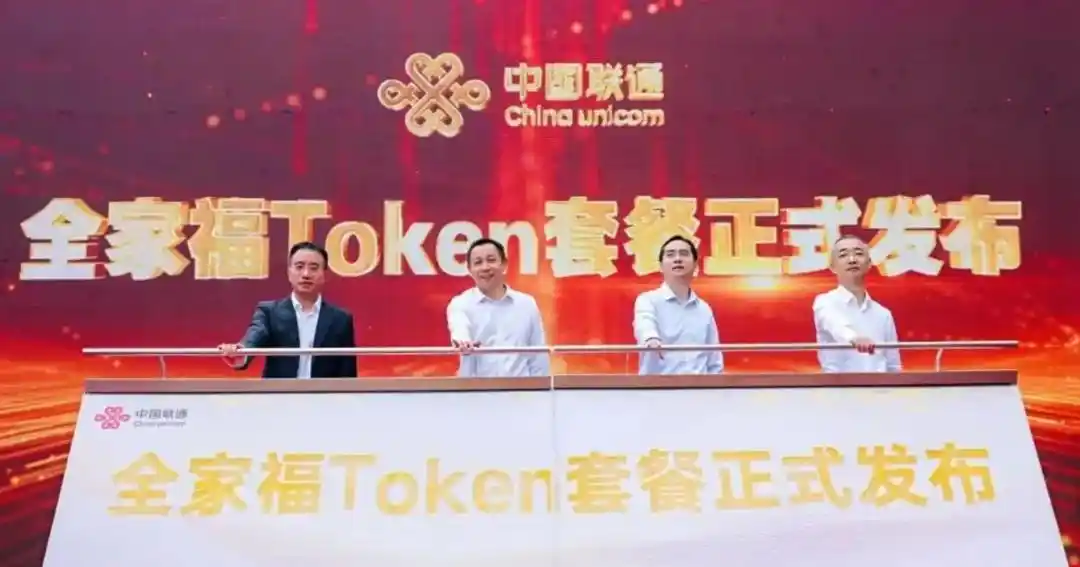
Yesterday, China Telecom launched a series of trial commercial Token packages. Personal and family customers can obtain 10 million Tokens for as low as 9.9 RMB/month; on the same day, Shanghai Mobile launched a Token general service, where 1 RMB can buy 400,000 Tokens, supporting payment via phone bill; Unicom Cloud recently collaborated with Unicom Yuanjing to launch Token Plan Personal Edition and Team Edition dual-track products. China Unicom's Sichuan and Shanghai branches also released local Token packages and AI strategy upgrades.
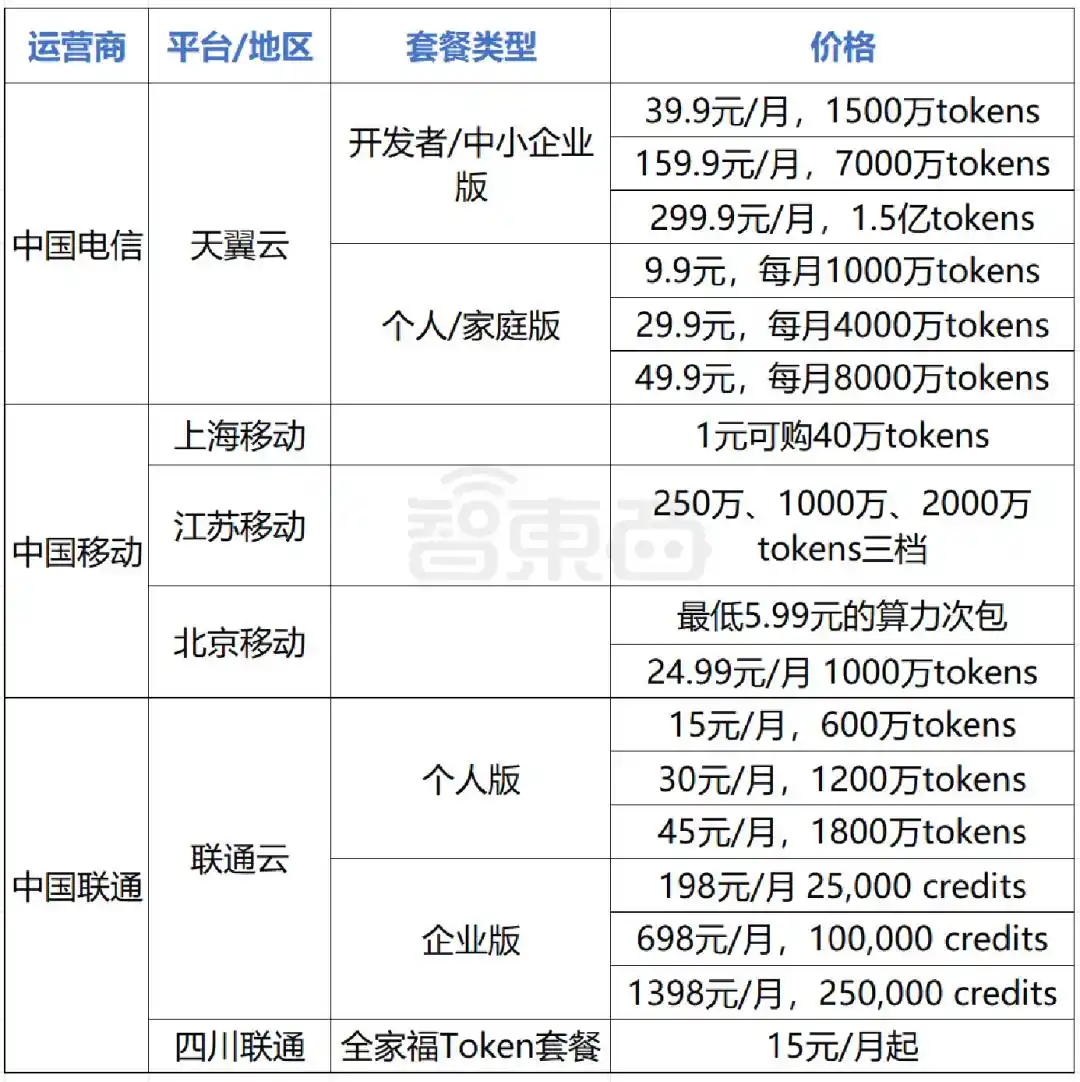
Comparison of Token Packages from the Three Major Carriers (Chart by ZHIDONGSHE)

The Token packages from the three major carriers have lowered the price threshold to tens of RMB or even single-digit RMB. China Telecom and China Mobile adopt tiered sales for individuals and enterprise teams, while China Mobile and China Unicom introduce special policies for different provinces.

It can be seen that all three major carriers are packaging large model call volume from a backend cloud platform capability into a basic service similar to data packages or broadband packages. In the past, data traffic was one of the core businesses for carriers. Now, in the AI era, the three major carriers launching Token packages are, to some extent, attempting to get a share in the Token consumption track, and may even become new primary operators leveraging their massive customer base.

01. China Telecom Launches Six-Tier Token Packages, Starting from 9.9 RMB/Month

Yesterday, China Telecom launched a series of trial commercial Token packages, offering six tiers of Token Plans for developers and SME customers, as well as personal and family customers, along with uplink speed boost packages for broadband and security protection packages.

For developers and SME customers, China Telecom provides an integrated service of "Token + Connectivity + Security", introducing three tiers of Token Plans: Basic, Professional, and Premium, with monthly fees of 39.9 RMB, 159.9 RMB, and 299.9 RMB, corresponding to 15 million Tokens, 70 million Tokens, and 150 million Tokens per month, respectively. This package integrates China Telecom's Xingchen Large Model and GLM-5 and other mainstream domestic large models, suitable for scenarios like AI programming and creation, code development and debugging, and intelligent agent setup and operation.

For personal and family customers, China Telecom launched three tiers of Token Plans: Light, Standard, and Premium, with monthly fees of 9.9 RMB, 29.9 RMB, and 49.9 RMB, corresponding to 10 million Tokens, 40 million Tokens, and 80 million Tokens per month, respectively. This package integrates China Telecom's Xingchen Large Model and DeepSeekV3.2 and other ecosystem large models, suitable for scenarios like daily office assistance, learning and creation, and copywriting.
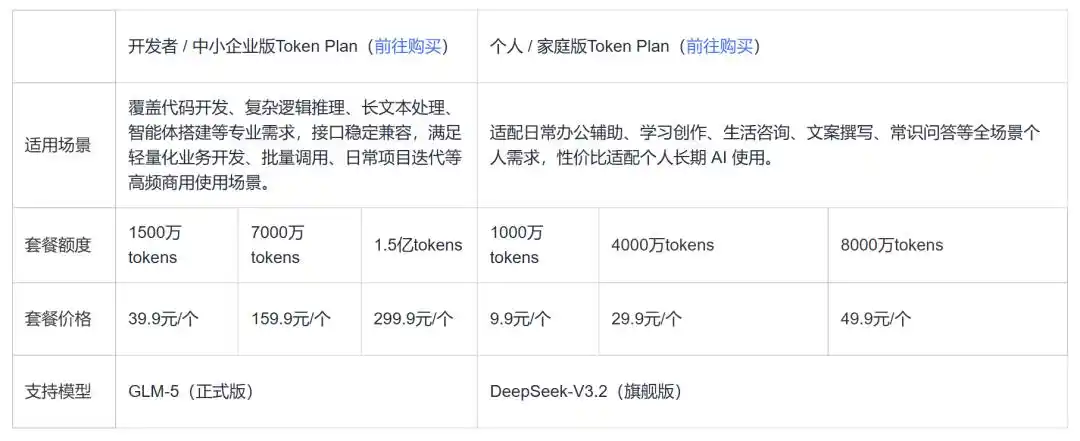
China Telecom Launches 6-Tier Token Plan (Image Source: Tianyi Cloud)

Users can subscribe through channels like the Tianyi Cloud official website and the China Telecom App. Customers who already have local hardware terminals (e.g., Mac Mini) can set their own API keys for applications like China Telecom's TeleClaw, third-party OpenClaw, and Hermes; customers without local hardware terminals can directly use them by purchasing Tianyi AI Cloud Computers with built-in intelligent agents like TeleClaw, OpenClaw, and Hermes.

Additionally, China Telecom will launch Tianyi Token Coins and Token Benefits for Token ecosystem partners. Customers can use points to exchange Token volume packages and AI applications. China Telecom will also collaborate with more AI ecosystem application partners to operate Token benefits.

02. Shanghai Mobile Launches Token General Service, 1 RMB Buys 400,000 Tokens

According to a report from the Shanghai Municipal Commission of Economy and Informatization, on May 17, China Mobile Shanghai Company launched a Token general service at the World Telecommunication Day press conference and jointly launched the co-branded WorkBuddy Intelligent Agent Workbench with Tencent. 1 RMB can buy 400,000 Tokens, supporting phone bill payment and multi-model universality.

Shanghai Mobile also simultaneously launched the "AI Hui Shen Huo" upgrade plan, introducing products like Super Portable Wi-Fi, Dual Vivid Jingcai Audio-Visual, AI Smart Viewing, and Love Home Lingxi Screen for citizens, accelerating the entry of embodied intelligence and Token inclusive services into home scenarios.
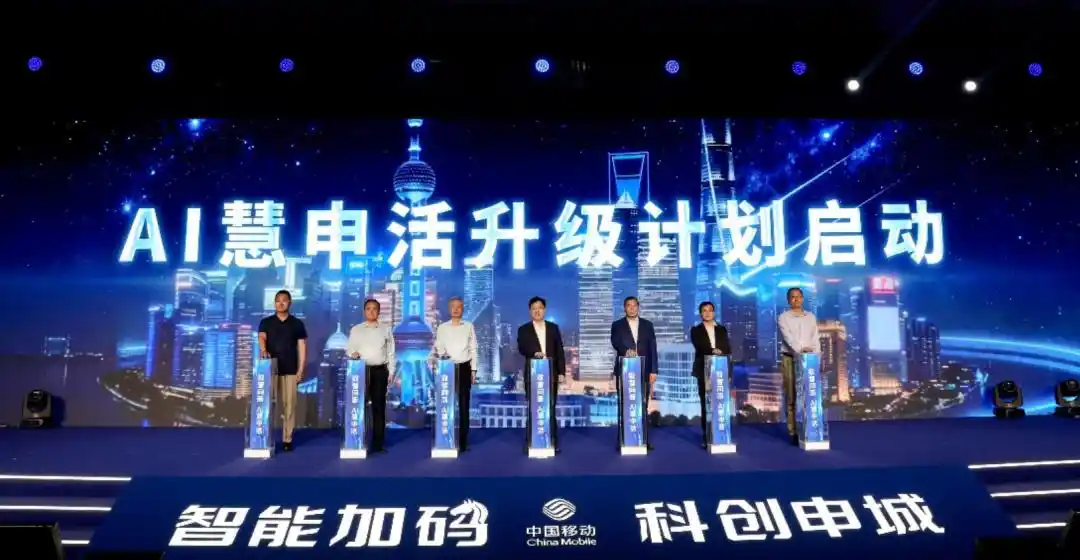
Shanghai Mobile Launches "AI Hui Shen Huo" Upgrade Plan (Image Source: Shanghai Securities News)

Previously, some local branches of China Mobile had conducted pilot AI Token packages. Jiangsu Mobile launched three packages of 2.5 million, 10 million, and 20 million Tokens, each valid for 1 month; Beijing Mobile launched a 5.99 RMB computing power sub-package and a 24.99 RMB/10 million Token monthly package for cloud computer users. Overall, China Mobile is accelerating the launch of AI computing power services through pilot projects by local branches and the group's Token operation ecosystem.

03. China Unicom Advances with Cloud Products and Local Packages, Personal Edition Starting from 15 RMB/Month

Recently, Unicom Cloud, in collaboration with Unicom Yuanjing, officially launched the Token Plan Personal Edition and Team Edition. This Token Plan relies on the Yuanjing MaaS platform, self-developed intelligent agent toolkit, and AI-selected Unicom Cloud computing power, covering scenarios from personal light office work, content creation, and student learning to enterprise R&D, government and enterprise office work, and industry digitization.

The Token Plan is divided into Personal Edition and Team Edition, with a total of 6 tiers. The Personal Edition targets users like independent creators, professionals, students, and self-media bloggers, offering three packages: Lite, Pro, and Max, priced at 15 RMB/month (including 6 million tokens), 30 RMB/month (including 12 million tokens), and 45 RMB/month (including 18 million tokens) respectively.

The Team Edition targets enterprise R&D teams, government and enterprise office teams, and industry solution teams, offering three packages: Team Lite, Team Pro, and Team Max, priced at 198 RMB/month (including 25,000 credits), 698 RMB/month (including 100,000 credits), and 1398 RMB/month (including 250,000 credits) respectively.

The Credits consumed per instance are dynamically determined by factors such as model type, token usage (input/output/cache), thinking mode, and tool calls. Taking DeepSeek-V4-Pro as an example: 25,000 credits are approximately 200 million tokens; 100,000 credits are approximately 800 million tokens; 250,000 credits are approximately 2 billion tokens.
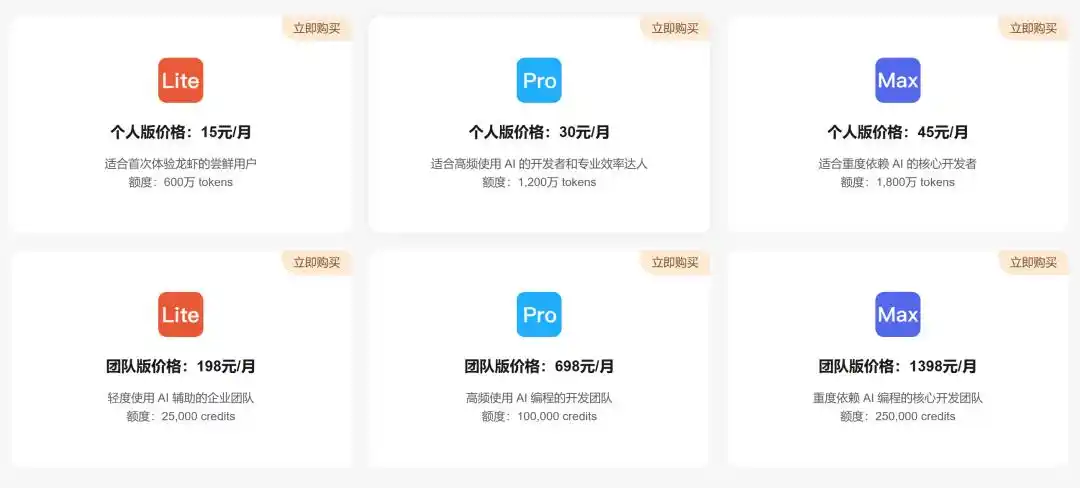
Unicom Cloud Launches Personal and Team Edition Token Plans (Image Source: Unicom Cloud)

In terms of models, the Personal Edition supports DeepSeek V4-Flash and MiniMax-M2.5, while the Team Edition unlocks DeepSeek V4 and provides models such as DeepSeek V4-Flash, DeepSeek V4-Pro, and MiniMax-M2.5.

Additionally, Unicom's self-developed office assistant UniClaw can handle tasks like file processing, document generation, data analysis, deep research, and multimodal content processing, and supports local private deployment.

Besides the unified products from Unicom Cloud, local branches of China Unicom are also simultaneously promoting the landing of Token packages. Yesterday, China Unicom Sichuan Branch released the "Family Token Package", with a fixed monthly fee starting as low as 15 RMB. Combined with Unicom Cloud Desktop and the WorkBuddy intelligent agent application, it allows users to process files and generate reports in the cloud without complex technical deployment.
Sichuan Unicom Releases Family Token Package

On May 16, China Unicom Shanghai Branch comprehensively upgraded the "UniAI·Zhi Lian Shen Cheng" artificial intelligence strategy, building a "National Chip, National Model, National Cloud" security foundation. Simultaneously, relying on ten-thousand-card domestic computing power and self-developed scheduling platforms, it launched three types of computing power services, released multiple Token products and integrated packages, and initiated the "Computing Power Inclusive Season".

04. Conclusion: Carriers Collectively Launch Token Packages, AI Computing Power Enters the Mass Market

The consecutive launch of Token packages by the three major carriers signifies, to some extent, that AI computing power is gradually transforming into a basic service for the masses. Compared to the traditional API calling model, carriers' advantages lie in user accounts, phone bill payment, broadband and mobile network access, and service channels targeting families and SMEs.

As Tokens are packaged into monthly packages, instance packages, benefit packages, and integrated packages, ordinary users no longer need to understand model platforms and API calls to use AI. For carriers, Tokens may also become a new category of basic billing unit following voice calls, data traffic, and broadband.

This article is from the WeChat public account "Zhixidongshe" (ID: zhidxcom), author: Yang Jingli, editor: Li Shuiqing

Questions liées

QWhat are the price ranges and token allowances for China Telecom's token plans?

AChina Telecom offers six trial commercial token plans. For developers and SMEs, the Basic, Professional, and Premium plans cost 39.9, 159.9, and 299.9 yuan per month, providing 15 million, 70 million, and 150 million tokens respectively. For individual and family users, the Lite, Enjoy, and Premium plans cost 9.9, 29.9, and 49.9 yuan per month, offering 10 million, 40 million, and 80 million tokens respectively.

QHow is Shanghai Mobile promoting AI token services?

AShanghai Mobile has launched a token service where 1 yuan can purchase 400,000 tokens, and this supports payment via phone bill. They have also partnered with Tencent to launch a co-branded WorkBuddy smart agent workbench. Furthermore, they initiated the 'AI for a Better Shanghai Life' upgrade plan, introducing products like Super Portable Wi-Fi and AI Smart Viewing to bring embodied intelligence and token services into household scenarios.

QWhat are the main differences between China Unicom's 'Personal Edition' and 'Team Edition' token plans?

AChina Unicom's 'Personal Edition' is aimed at individual users like creators and students, with three tiers: Lite (15 yuan/month, 6 million tokens), Pro (30 yuan/month, 12 million tokens), and Max (45 yuan/month, 18 million tokens). The 'Team Edition' targets business teams, with tiers offering Credits: Team Lite (198 yuan/month, 25,000 credits), Team Pro (698 yuan/month, 100,000 credits), and Team Max (1398 yuan/month, 250,000 credits). Credits dynamically translate to tokens based on model usage; for example, 25,000 credits roughly equals 200 million tokens for the DeepSeek-V4-Pro model.

QWhat strategic advantage do telecom operators have in the AI token market?

ATelecom operators like China Telecom, China Mobile, and China Unicom possess significant strategic advantages for the AI token market. These include their massive existing customer bases, established billing and payment systems (like phone bill integration), extensive service channels for households and SMEs, and their core infrastructure in broadband and mobile networks. This allows them to package AI token usage as simple, accessible monthly plans, similar to data or voice packages, lowering the technical barrier for mainstream adoption.

QWhat does the article suggest about the future of AI compute power consumption?

AThe article suggests that the entry of major telecom operators into the token business signals a shift where AI compute power is becoming a mainstream, consumer-facing utility service. By packaging tokens into monthly bundles, pay-per-use packs, and integrated service plans, operators are making AI model usage as straightforward as paying for mobile data or a phone plan. This trend indicates that tokens could evolve into a new fundamental billing unit for operators, alongside traditional services like voice, data, and broadband.

Lectures associées

L'amende de Futu est-elle une bonne nouvelle pour Hyperliquid ?

L'article analyse comment les pénalités infligées par les autorités chinoises à des courtiers comme Futu pour leurs activités transfrontalières illégales pourraient profiter à Hyperliquid, une plateforme de trading décentralisée. Alors que les canaux d'investissement transfrontaliers traditionnels se ferment, les capitaux pourraient se tourner vers des alternatives comme Hyperliquid, comme le suggère la hausse de son token HYPE suite à l'annonce des sanctions. Hyperliquid, une petite équipe basée à Singapour, génère des revenus mensuels importants en permettant des transactions de produits dérivés sans KYC, sans limites de position et sans surveillance du marché comme le font les bourses traditionnelles (CME, ICE). Ces dernières le critiquent, notamment pour ses contrats sur le pétrole qui fonctionnent en week-end quand elles sont fermées, brisant ainsi leur "monopole temporel". L'article souligne le succès récent des contrats perpétuels Pre-IPO sur Hyperliquid (via Trade.xyz), comme ceux pour Cerebras et SpaceX, qui ont démontré une découverte de prix très précise par rapport aux marchés traditionnels. La force perçue de Hyperliquid réside dans son modèle "sans visage" : ses contrats synthétiques (comme SPCX pour SpaceX) ne sont adossés à aucun actif physique réel, ce qui les rend difficiles à cibler par des actions en justice ou réglementaires, contrairement à des concurrents plus traditionnels comme PreStocks ou Ondo. Cependant, l'article note aussi les risques : l'absence de KYC pose des problèmes de sécurité nationale potentiels, et la décentralisation du protocole, bien que théoriquement robuste, repose sur un nombre limité de validateurs identifiables. La pression réglementaire, illustrée par la visite de son co-fondateur à Washington, reste une menace réelle. En définitive, l'avantage principal de Hyperliquid pourrait être sa capacité à opérer en continu, offrant un accès là où les marchés traditionnels sont fermés.

marsbitIl y a 10 mins

L'amende de Futu est-elle une bonne nouvelle pour Hyperliquid ?

marsbitIl y a 10 mins

Le premier rapport de Mythos est sorti : des milliards d'appareils exposés dans le monde, 10 000 vulnérabilités critiques découvertes en 30 jours

Premier rapport de Mythos dévoilé : des milliards d'appareils vulnérables dans le monde, 10 000 failles critiques découvertes en 30 jours. Le programme « Glasswing » d'Anthropic, utilisant le modèle d'IA avancé Claude Mythos Preview, a publié ses résultats après un mois d'opération. En collaboration avec une cinquantaine d'acteurs majeurs de l'informatique et des infrastructures critiques, il a identifié plus de 10 000 vulnérabilités logicielles de haut niveau. Parmi les réalisations notables : la découverte de 2 000 failles (dont 400 critiques) chez Cloudflare, la correction de 271 vulnérabilités dans Firefox 150, et même la détection d'un bogue vieux de 27 ans dans OpenBSD. Le modèle a également démontré des capacités offensives en construisant des chaînes d'exploitation complètes. De manière plus concrète, il a permis d'intercepter une tentative de fraude de 1,5 million de dollars dans une banque partenaire. L'analyse de plus de 1 000 projets open source essentiels a révélé 23 019 failles, dont 6 202 considérées comme critiques ou graves par l'IA. Une vérification humaine indépendante a confirmé un taux de vrais positifs de 90,6%, validant 1 094 vulnérabilités sérieuses. Un exemple frappant est la découverte d'une faille logicielle majeure dans la bibliothèque cryptographique wolfSSL, utilisée par des milliards d'appareils IoT. Cette efficacité sans précédent a créé un nouveau défi : la capacité humaine à corriger les failles ne suit plus le rythme de leur découverte. Des mainteneurs de logiciels libres ont demandé à ralentir les signalements. En réponse, Anthropic propose des outils comme Claude Security pour générer automatiquement des correctifs et a ouvert certains de ses frameworks d'analyse. Anthropic reste prudent quant à une publication générale de Mythos, en raison des risques de mauvaise utilisation par des acteurs malveillants. La société préconise l'accélération des cycles de correction, les mises à jour forcées et le renforcement des mesures de sécurité de base. L'objectif final est de rendre le code mondial bien plus robuste, réduisant considérablement les cyberattaques.

marsbitIl y a 1 h

Le premier rapport de Mythos est sorti : des milliards d'appareils exposés dans le monde, 10 000 vulnérabilités critiques découvertes en 30 jours

marsbitIl y a 1 h

Vitalik Buterin défend sa vision à long terme face aux inquiétudes sur le prix du token

Vitalik Buterin, co-fondateur d'Ethereum, a répondu aux préoccupations concernant le rôle de la Fondation Ethereum, soulignant que son objectif principal n'est pas la valorisation du token ETH mais la poursuite de sa vision à long terme. Il a affirmé que la Fondation resterait concentrée sur ses objectifs fondamentaux : décentralisation du protocole, sécurité informatique, recherche et résistance à la censure, plutôt que de concurrencer les blockchains à haut débit. Ces déclarations interviennent alors que le prix de l'ETH avoisine les 2 094 $, en baisse de plus de 50% par rapport à son record d'août 2025, et après des départs notables de la Fondation et des ventes d'ETH par d'importants investisseurs. Buterin a comparé les réserves de tokens, notant que la Fondation Ethereum ne détient qu'environ 0,16% de l'offre totale d'ETH, un pourcentage bien inférieur à celui d'autres fondations. Face aux critiques, notamment concernant l'impact de la mise à jour Dencun sur les revenus du réseau, Buterin a insisté sur la priorité accordée à la "longévité". Il a précisé que la Fondation utiliserait ses ressources pour soutenir la recherche, ce qui devrait réduire les ventes futures d'ETH. Bien que la Fondation ait retiré 21 270 ETH d'un protocole de staking en mai, cela ne signifie pas nécessairement qu'ils seront vendus.

TheNewsCryptoIl y a 3 h

Vitalik Buterin défend sa vision à long terme face aux inquiétudes sur le prix du token

TheNewsCryptoIl y a 3 h

Trading

Spot
Futures

Articles tendance

Comment acheter BILL

Bienvenue sur HTX.com ! Nous vous permettons d'acheter Billions Network (BILL) de manière simple et pratique. Suivez notre guide étape par étape pour commencer votre parcours crypto.Étape 1 : Création de votre compte HTXUtilisez votre adresse e-mail ou votre numéro de téléphone pour ouvrir un compte sur HTX gratuitement. L'inscription se fait en toute simplicité et débloque toutes les fonctionnalités.Créer mon compteÉtape 2 : Choix du mode de paiement (rubrique Acheter des cryptosCarte de crédit/débit : utilisez votre carte Visa ou Mastercard pour acheter instantanément Billions Network (BILL).Solde :utilisez les fonds du solde de votre compte HTX pour trader en toute simplicité.Prestataire tiers :pour accroître la commodité d'utilisation, nous avons ajouté des modes de paiement populaires tels que Google Pay et Apple Pay.P2P :tradez directement avec d'autres utilisateurs sur HTX.OTC (de gré à gré) : nous offrons des services personnalisés et des taux de change compétitifs aux traders.Étape 3 : stockage de vos Billions Network (BILL)Après avoir acheté vos Billions Network (BILL), stockez-les sur votre compte HTX. Vous pouvez également les envoyer ailleurs via un transfert sur la blockchain ou les utiliser pour trader d'autres cryptos.Étape 4 : tradez des Billions Network (BILL)Tradez facilement Billions Network (BILL) sur le marché Spot de HTX. Il vous suffit d'accéder à votre compte, de sélectionner la paire de trading, d'exécuter vos trades et de les suivre en temps réel. Nous offrons une expérience conviviale aux débutants comme aux traders chevronnés.

83 vues totalesPublié le 2026.05.07Mis à jour le 2026.05.12

Comment acheter BILL

Discussions

Bienvenue dans la Communauté HTX. Ici, vous pouvez vous tenir informé(e) des derniers développements de la plateforme et accéder à des analyses de marché professionnelles. Les opinions des utilisateurs sur le prix de BILL (BILL) sont présentées ci-dessous.

活动图片