The Mag7 Myth Shatters: 9 Consecutive Drops, Amazon Follows Microsoft into Bear Market

marsbitPublié le 2026-02-14Dernière mise à jour le 2026-02-14

Résumé

Amazon's stock has experienced a nine-day losing streak, its longest in nearly two decades, officially entering a bear market after falling more than 23% from its recent high. It becomes the second member of the "Magnificent Seven" (Mag7) to do so, following Microsoft, which entered a bear market in late January and is down 27.8%. Meta is also nearing bear market territory, down 19.6% from its peak, as investor confidence is shaken by aggressive AI spending plans. The four major cloud hyperscalers—Amazon, Microsoft, Meta, and Alphabet—are projected to spend a combined $650 billion on capital expenditures in AI by 2026, with Amazon leading at $200 billion. This massive spending is raising significant concerns among investors about returns on investment and its impact on free cash flow. For Amazon, this level of expenditure could push its free cash flow into negative territory this year, potentially forcing it to raise more capital from debt markets. Analysts note a rotation within the Mag7, with investors moving away from companies like Microsoft and Nvidia to favor others like Alphabet, whose vertically integrated tech infrastructure helps alleviate some spending concerns. The next key catalyst for AI-related stocks is expected to be Nvidia's earnings report on February 25th, which will indicate whether the AI boom is sustaining.

Author: Zhao Ying, Bao Yilong, Wall Street Insights

Amazon's stock has fallen for nine consecutive days, marking its longest losing streak in nearly 20 years.

After entering a technical bear market on Thursday, becoming the second Mag7 company to fall into a bear market, Amazon's stock continued to decline on Friday.

Investors are strongly resisting the aggressive AI spending plans of tech giants, leading to significant declines in these star stocks.

On Friday, Amazon's stock closed at $198.79, down more than 23% from its recent high, officially crossing the bear market threshold the previous day, Thursday.

Among the four major hyperscale cloud service providers, Amazon has the highest planned capital expenditure for 2026, reaching $200 billion.

Amazon, Microsoft, Meta, and Alphabet are expected to collectively spend $650 billion on capital expenditures in the AI field by 2026.

Meta could be the next Mag7 member to fall into a bear market. As of Friday's close, it was down 19.6% from last year's high, just 0.4% away from the bear market threshold of a 20% decline. Although Meta's Q4 revenue and profits exceeded Wall Street expectations, increased AI spending and margin pressures have dampened investor confidence.

Microsoft was the first Mag7 member to enter a bear market. The company's stock fell into a bear market on January 29, after the Azure cloud business growth reported the previous day fell short of investor expectations. As of Friday's close, Microsoft's stock was down 27.8% from its recent high.
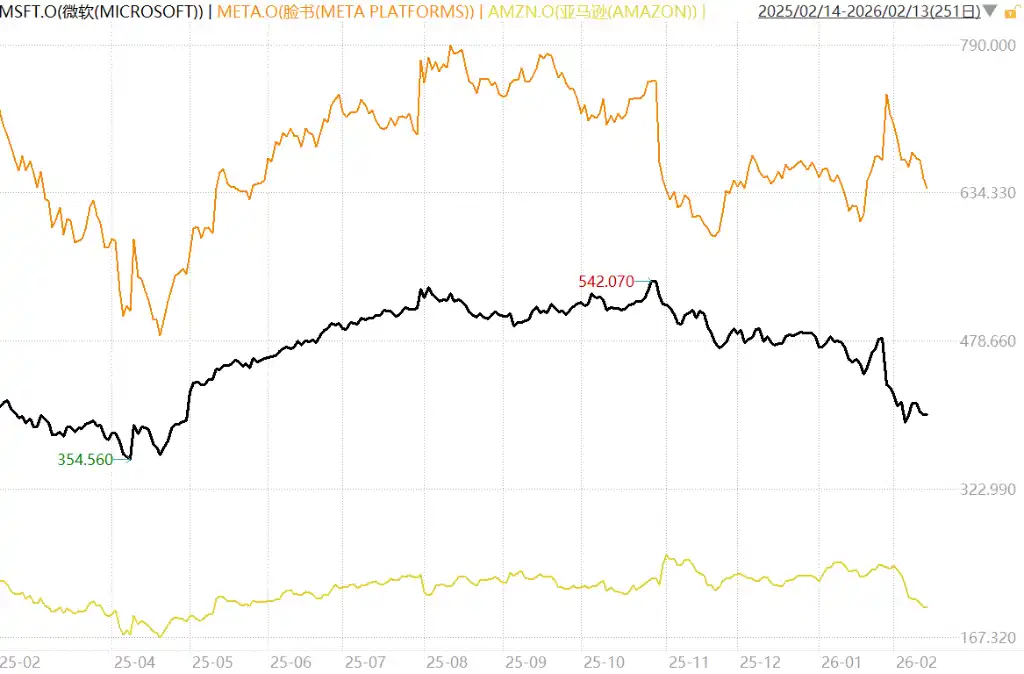
(Chart of Amazon, Microsoft, and Meta's performance over the past year)

Investors Rotate Within Mag7, Free Cash Flow Pressure Highlights

Mike Treacy, Vice President of Risk at Apex Fintech Solutions, stated that the recent sell-off highlights the growing divergence among Mag7 members.

Since last fall, investors have shifted away from OpenAI-related deals involving Microsoft, NVIDIA, and Oracle, favoring the Alphabet and Broadcom ecosystems instead.

Treacy pointed out that Alphabet's vertically integrated technology stack has somewhat offset concerns about excessive spending, shielding the stock from the worst of the tech sell-off. Alphabet's stock closed Thursday down 9.2% from its recent high.

Treacy noted that Google's self-sufficiency should command a premium relative to other companies that may be adversely affected by a single link in the industry chain.

Amazon, Microsoft, and Meta's stocks have been hit harder because investors lack confidence that these companies' AI spending will yield sufficient returns on investment.

For Amazon, the increased level of expenditure could lead to negative free cash flow this year, meaning the company may need to start raising more funds in the debt market.

Treacy believes that the next major catalyst for AI trades will be NVIDIA's earnings report on February 25. This report will show whether the AI boom is cooling down or if NVIDIA has successfully captured the tens of billions of dollars its largest clients are investing into the field.

Related reading: Trading Moment: AI Panic Escalates Ahead of CPI, Bitcoin Grinds Bottom, May Struggle to Repeat "Spring Festival Rally"


Questions liées

QWhat is the main reason for the recent decline in Mag7 stocks, particularly Amazon and Microsoft?

AInvestors are strongly resisting the aggressive AI spending plans of tech giants, leading to significant sell-offs in these star stocks.

QWhich Mag7 company was the first to enter a bear market, and when did it happen?

AMicrosoft was the first Mag7 member to enter a bear market, with its stock falling into bear territory on January 29.

QHow much is Amazon's planned capital expenditure for 2026, and what is the total AI-related capital expenditure expected from the four major cloud service providers?

AAmazon plans a capital expenditure of $200 billion for 2026. The four major cloud service providers (Amazon, Microsoft, Meta, and Alphabet) are expected to spend a total of $650 billion in AI-related capital expenditures by 2026.

QWhich Mag7 company is at risk of being the next to fall into a bear market, and how close is it to the 20% decline threshold?

AMeta is at risk of being the next Mag7 member to fall into a bear market. As of Friday's close, it was down 19.6% from last year's high, just 0.4% away from the bear market threshold of a 20% decline.

QWhat potential financial pressure does Amazon face due to its increased capital expenditure in AI?

AThe increase in capital expenditure levels could lead Amazon's free cash flow to turn negative this year, meaning the company may need to raise more capital by entering the debt market.

Lectures associées

Après trois trimestres consécutifs de baisse, le marché des cryptomonnaies pourra-t-il connaître une fenêtre de stabilisation au troisième trimestre ?

Le marché des cryptomonnaies a enregistré son pire trimestre depuis 2022, avec une capitalisation totale chutant de 12,6% à 2 100 milliards de dollars. Tous les indicateurs clés (volume des échanges, valeur des stablecoins) montrent une sortie nette de capitaux. Le Bitcoin a perdu 14,2% et l'Ethereum 25,4% sur le trimestre, rompant sa corrélation antérieure avec les actions technologiques. Les ETF spot américains sur le Bitcoin ont subi des rachats massifs, avec une sortie nette de 4,67 milliards de dollars au Q2, indiquant une pression de vente continue. Le resserrement de la politique de la Fed et les ventes d'entreprises comme Strategy ont accentué la déleveragisation du secteur. L'attention du marché se porte désormais presque exclusivement sur la réunion de la Fed fin juillet. Une position accommodante pourrait stabiliser le Bitcoin entre 68 000 et 84 000 dollars, tandis qu'un ton hawkish pourrait le faire osciller autour de 50 000-56 000 dollars. Parallèlement, la progression du *CLARITY Act*, une loi cruciale pour la clarté réglementaire, est au point mort au Sénat, réduisant les chances d'adoption en 2026 et maintenant une prime de risque élevée sur l'ensemble du secteur. Malgré ce contexte difficile, quelques secteurs résistent : les marchés de prédiction ont vu leur volume nominal augmenter de 48,7% et les biens collectionnables tokenisés ont progressé d'environ 143%. La tokenisation d'actifs du monde réel (RWA) continue également sa croissance régulière, portée par des fondamentaux indépendants du cycle crypto. Les bases d'un effondrement extrême semblent absentes, mais le marché est désormais guidé par les politiques monétaires, les prix et les attentes de taux, plutôt que par le simple récit haussier. La fin des sorties massives des ETF et le retour des achats des détenteurs à long terme pourraient indiquer une phase de stabilisation potentielle.

marsbitIl y a 22 h

Après trois trimestres consécutifs de baisse, le marché des cryptomonnaies pourra-t-il connaître une fenêtre de stabilisation au troisième trimestre ?

marsbitIl y a 22 h

The SpaceX Trade, Unlocked: SPCXON Débarque sur WEEX

En juin 2026, SpaceX a réalisé la plus grande introduction en bourse de l'histoire, mais l'accès à l'action a été limité pour de nombreux investisseurs en raison de restrictions régionales et de frictions liées aux courtiers. La plateforme WEEX propose désormais une solution via SPCXON/USDT, un instrument tokenisé sur le marché au comptant qui permet d'obtenir une exposition au cours de SpaceX en utilisant l'USDT, sans nécessiter de compte de courtage américain. SPCXON est un produit tokenisé construit sur l'infrastructure d'Ondo, conçu pour refléter l'économie de la détention d'actions SpaceX pour les traders éligibles en dehors des États-Unis, avec des dividendes réinvestis. Le cas d'investissement repose sur la croissance des revenus de Starlink et les progrès de Starship, malgré un valorisation déjà élevée et des risques liés à un flottant public réduit et à des déblocages d'actions internes à venir. Il est important de noter que SPCXON offre une exposition, et non la propriété directe d'actions ou de droits de vote. Son prix peut évoluer avec une prime ou une décote par rapport à la valeur liquidative. WEEX propose également d'autres produits tokenisés comme MSTRON et MUON dans un compte unifié, permettant une rotation entre crypto-monnaies et actions traditionnelles sans transfert de fonds. La plateforme souligne ainsi comment les barrières entre la finance traditionnelle et les actifs numériques s'estompent.

TheNewsCryptoIl y a 23 h

The SpaceX Trade, Unlocked: SPCXON Débarque sur WEEX

TheNewsCryptoIl y a 23 h

BIT Trading Moment : Le BTC reste sous la pression de l'EMA 200 hebdomadaire, un rejet pourrait relancer la baisse, les actions de stockage et de semi-conducteurs qui ont bondi cette nuit ont baissé en séance de nuit

**Résumé des marchés : Bitcoin sous pression, actions technologiques en réajustement** Le marché crypto poursuit son rebond, avec Bitcoin évoluant autour de 66 000 $. Il fait face à une résistance clé vers 68 000 $, niveau correspondant au coût moyen des investisseurs sur cinq mois. Les traders surveillent les moyennes mobiles clés (200 MA à ~63 333 $ et 200 EMA à ~68 328 $ en hebdomadaire). Une rupture au-dessus de 68 000 $ ouvrirait la voie à une hausse, tandis qu'un échec pourrait entraîner un retest des 63 000 $. L'analyse suggère que la dynamique actuelle ressemble à un rebond estival à faible liquidité plutôt qu'au début d'un véritable marché haussier. Sur le marché actions américain, après une forte séance mardi portée par les semi-conducteurs et les titres du stockage (Micron, AMD, Intel...), les contrats à terme indiquent une ouverture en baisse. Les secteurs ayant récemment bondi, comme les semi-conducteurs et le stockage, reculent en séance de nuit. Certaines valeurs se démarquent néanmoins, comme Super Micro Computer (SMCI), en hausse après des résultats et des perspectives robustes liées à la demande de serveurs IA. Des vents contraires persistent : les prix du pétrole (Brent >91$) et les rendements des obligations d'État américaines grimpent, ravivant les craintes inflationnistes. En Asie, les marchés ont suivi le rebond technologique américain, mais de manière hésitante. La tension reste forte sur le yen japonais, qui atteint son plus bas niveau depuis des décennies. **Points clés à surveiller :** * **Crypto :** Niveaux techniques de Bitcoin (68k$/63k$), flux des ETF spot. * **Actions :** Saison des résultats (Tesla, Alphabet, Intel...), activité d'AMD sur l'IA. * **Économie :** Données américaines sur l'emploi, décision de la BCE, tensions géopolitiques et prix de l'énergie.

marsbitIl y a 23 h

BIT Trading Moment : Le BTC reste sous la pression de l'EMA 200 hebdomadaire, un rejet pourrait relancer la baisse, les actions de stockage et de semi-conducteurs qui ont bondi cette nuit ont baissé en séance de nuit

marsbitIl y a 23 h

Gate Research Institute : La vague de « Wall Streetisation » des produits financiers cryptographiques, concurrence ou fusion ?

Le titre de l'article est : "Gate Institute : La vague de 'Wall Street-isation' des produits financiers cryptos, est-ce une compétition ou une fusion ?" Résumé en français (environ 1400 caractères) : Il y a dix-sept ans, Bitcoin fut créé avec une vision décentralisée et anti-establishment financier. Aujourd'hui, paradoxalement, son adoption massive passe souvent par des ETF émis par des géants comme BlackRock. Cet article analyse cette "Wall Street-isation" apparente des actifs cryptos : les institutions traditionnelles s'emparent-elles du pouvoir d'émission, de tarification, de garde et de distribution ? La réalité est plus nuancée. C'est une convergence à double sens. D'un côté, les plateformes cryptos comme Gate.io étendent leurs services aux actions traditionnelles (états-uniennes, hongkongaises, sud-coréennes), aux CFD et aux produits tokenisés, offrant un compte unifié. De l'autre, des courtiers traditionnels comme Robinhood intègrent les cryptomonnaies et explorent la tokenisation d'actions sur blockchain. Cette fusion vise à créer le "super-compte" financier de demain, où actions, cryptos, ETF et obligations tokenisées (RWA) coexistent dans une même interface, comblant les faiblesses de chaque écosystème. Les RWA, notamment les obligations d'État tokenisées, agissent comme une couche intermédiaire unificatrice. En conclusion, Wall Street n'a pas conquis la crypto, et la crypto n'a pas contourné Wall Street. Ils construisent ensemble une nouvelle forme de marché des capitaux, plus efficace et mondial, où l'idéal décentralisé persiste dans les protocoles, tandis qu'une expérience utilisateur unifiée émerge à l'interface.

marsbitIl y a 23 h

Gate Research Institute : La vague de « Wall Streetisation » des produits financiers cryptographiques, concurrence ou fusion ?

marsbitIl y a 23 h

Trading

Spot
活动图片




