High-Frequency Trading, $100K Annual Income: The Most 'Boring' Profit Myth on Polymarket

marsbitPublié le 2026-02-11Dernière mise à jour le 2026-02-11

Résumé

A user known as planktonXD (0x4ffe49ba2a4cae123536a8af4fda48faeb609f71) has generated over $106,000 in profit on Polymarket within a year by executing more than 61,000 predictions—averaging around 170 trades per day. This high-frequency, automated strategy focuses on exploiting small, certain opportunities rather than betting on high-risk, high-reward outcomes. The approach is characterized by market-making and micro-arbitrage: placing orders on both sides of the order book to capture spreads or profiting from mispriced options in low-liquidity markets. The largest single win was only $2,527, illustrating a disciplined, risk-managed method that avoids large drawdowns. The bot operates across diverse categories—sports, weather, crypto prices, politics—constantly scanning for pricing inefficiencies. Notable examples include buying heavily undervalued options in niche markets, such as esports matches or extreme crypto price movements, where probability is mispriced due to emotional trading or thin order books. For instance, a $16 bet on SOL falling to $130 (priced at 0.7¢, implying <1% chance) returned $1,574 during a volatile period. Key takeaways: The strategy highlights the power of compounding small gains, the necessity of automation and API tools, and the superiority of high-probability opportunities over high-risk bets. In prediction markets, the most advanced approach isn’t forecasting—it’s managing probability and liquidity.

Original Author: Ma He, Foresight News

Another miracle has emerged on Polymarket.

Through extensive monitoring and frenzied betting, an address has netted $100,000 in just one year by compounding small profits.

The address we are reviewing, planktonXD (0x4ffe49ba2a4cae123536a8af4fda48faeb609f71), is an extremely typical high-frequency quantitative trader. From February 2025 to the present, in just one year, it has generated a net profit of $106,000 through over 61,000 predictions.
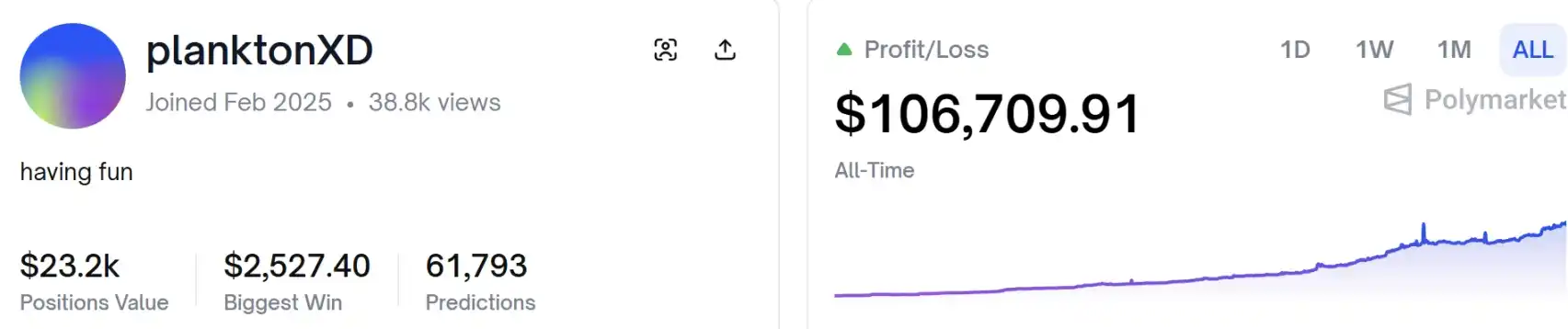
In prediction markets, most people are gambling on "black swans" or chasing big news, but planktonXD takes a completely different path: extreme certainty and terrifying execution frequency.

Looking at planktonXD's historical trading data, the most astonishing aspect is its 61,000 predictions. From February 2025 to February 2026, it averages about 170 transactions per day.

This frequency far exceeds the limits of manual human operation, confirming that this player uses an automated trading script (Bot). It is not "predicting" outcomes but "harvesting" price differences.

A very interesting phenomenon is that planktonXD's "Biggest Win" is only $2,527.4. Compared to its total profit of $100,000, this single largest gain appears very "small" (only about 2% of the total profit).

Some retail players always hope to make a big score, betting all their chips on a confident judgment.

Winning is good, of course, but losing makes it hard to get back to the table.

Even if every ALL-IN could win, just one loss would mean a big defeat.

Reviewing its trading history, it never goes all-in on a single extreme event, nor does it bet on high odds. Its profit curve shows a perfect 45-degree smooth rise with almost no significant drawdowns. This indicates it employs a market-making strategy: placing orders on both sides of the order book to earn the bid-ask spread, or performing micro-arbitrage using price fluctuations between different markets.
It does not always hold positions long-term (Buy and Hold) but frequently enters and exits the market. This "light position, fast turnover" approach greatly reduces single-point risk. Even if an unexpected event occurs in a prediction market (like a sudden election result change), its impact on the total capital pool is minimal.

This quantitative robot does not specialize in trading vertical sectors like weather but places bets across multiple sectors: sports, weather, coin prices, politics, etc. It monitors thousands of prediction markets on the platform 24/7, looking for moments of pricing inefficiency.

VALORANT Challengers is a classic实战 case study for this trader.

You can think of it as the "minor league" or "regional league" of the esports circle. Fuego and LYON are professional teams in the Latin American region. Because such matches have a small audience and extremely high information asymmetry, they become a "套利天堂" (arbitrage paradise) for quantitative robots.

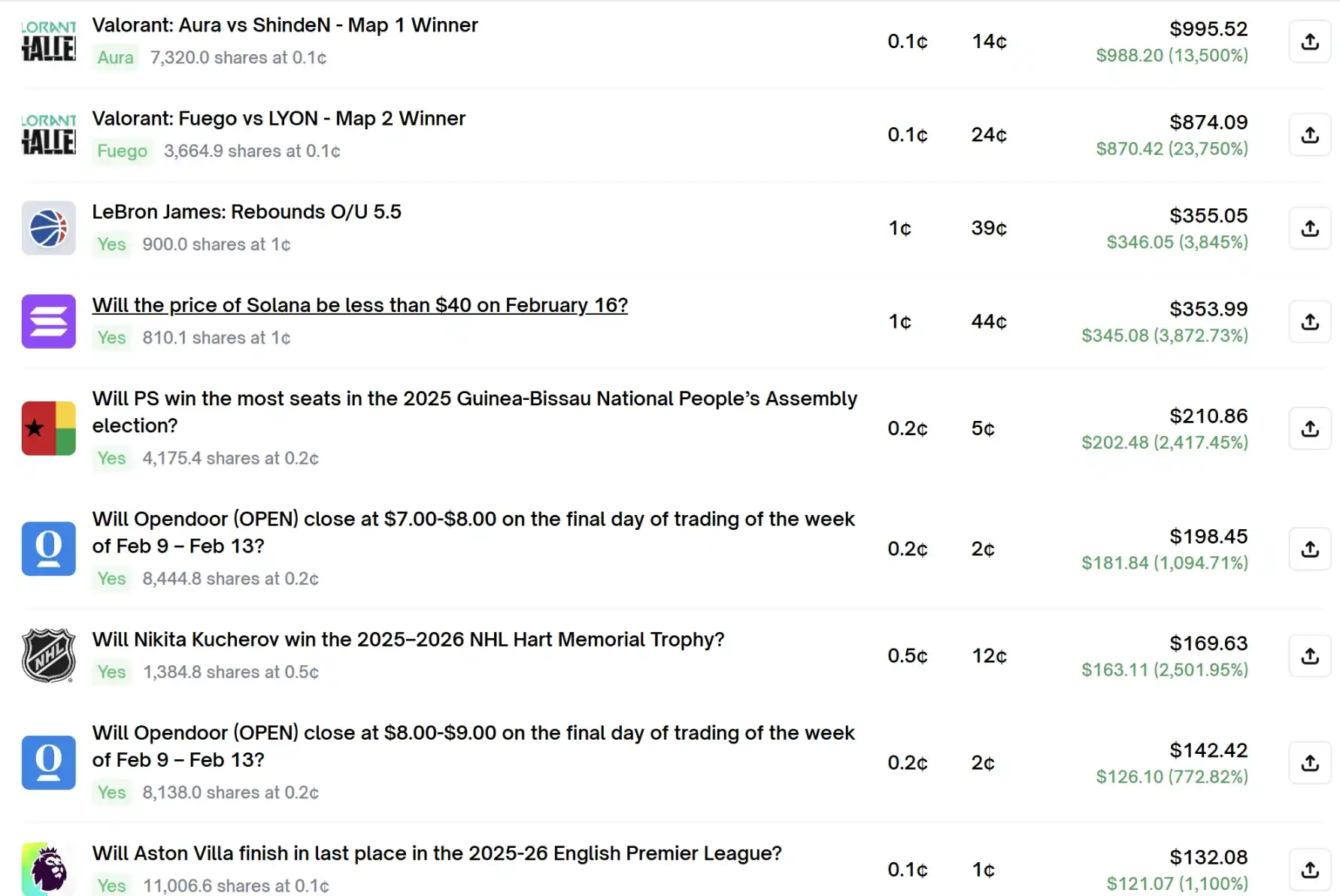
It bought 3,664.9 shares of Fuego winning at a unit price of $0.001, and this trade ultimately yielded a return of $874.09, with a staggering return rate of 23,750%!

This is a typical "small position, big odds" play. In long-tail markets with extremely poor liquidity or where the public is extremely bearish on a certain option (like the round results of esports matches), it uses a Bot to monitor options that are mispriced to near "zero." It doesn't need to predict who will win; it only needs to know that Fuego's probability of winning is definitely not 0.1%. This is essentially harvesting the market's "extreme sentiment" and "lack of liquidity."

When it comes to sentiment, coin prices embody it most vividly.
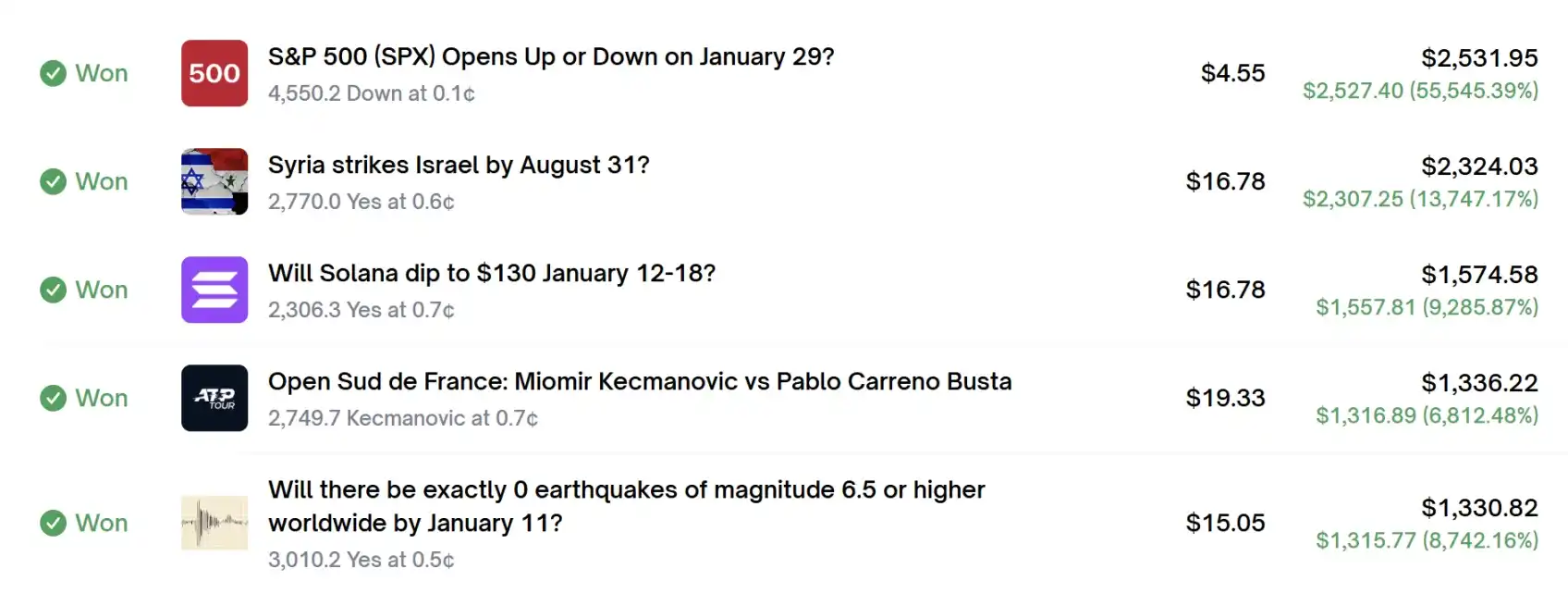
Will the SOL price drop to $130 between January 12-18?

It invested about $16 at $0.007 (the market believed the probability of success was less than 1%) and ultimately took away $1,574, with an amazing return rate of 9,285%.

Why did this "almost impossible" prediction allow it to make big money at that time?

During periods of剧烈波动 (sharp volatility) in the cryptocurrency market, mainstream predictions tend to be bullish or sideways. planktonXD would捕捉 (capture) those "extremely bearish" options priced at $0.001 - $0.01 around the clock. These options are like worthless paper to ordinary people, but they are extremely cheap insurance to quant traders. As long as the market experiences a deep wick or sudden bad news, these "worthless papers" can instantly surge thousands of times. Additionally, in specific price ranges (e.g., SOL < $40), because the current price is far from the predicted price, the order book is often very thin. planktonXD uses automated scripts to place orders in these "no-man's land," eating up the cheap shares抛出的 (thrown out) due to panic or misoperation, essentially acting as a probability搬运工 (mover).

planktonXD's SOL strategy shows that on Polymarket, buying the "impossible" does not mean it believes it will happen, but because the "probability of it happening" is underestimated by the market. It uses a few dollars to buy out the market's one-in-ten-thousand possibility of panic. This is a typical "antifragile" trade.

planktonXD's success offers three core启示 (insights) for ordinary retail users:

The power of compound interest should not be underestimated. Earning 0.5% daily through high-frequency trading yields much more stable returns after a year than betting on a 10x coin. Technology is the killer skill. In the Crypto era, quantitative tools and API capabilities are standard for top players. Finally, certainty is greater than odds. In prediction markets,寻找 (finding) those small profit opportunities with extremely high probability (e.g., 90%+ certainty) is easier to survive than gambling on 50/50 major events.

After all, the highest level of play in prediction markets is not predicting the future, but managing probability and liquidity.


Questions liées

QWhat is the key strategy used by the address planktonXD to earn over $100,000 on Polymarket in a year?

AThe key strategy is high-frequency automated trading (using a bot) that focuses on small, certain profits through market making and micro-arbitrage, rather than betting on high-risk, high-reward events. It executed over 61,000 predictions in a year, averaging about 170 trades per day.

QHow does planktonXD achieve such a smooth profit curve with minimal drawdowns?

AIt achieves this by using a market maker strategy: placing orders on both sides of the order book to capture the bid-ask spread, and engaging in micro-arbitrage across different markets. This 'light position, fast turnover' approach minimizes single-point risk and avoids large bets on volatile outcomes.

QWhat type of markets does planktonXD typically target for its trades?

AIt targets multiple sectors including sports, weather, cryptocurrency prices, and politics. It monitors thousands of prediction markets 24/7 to identify mispriced opportunities, especially in illiquid or emotionally driven markets where extreme mispricing occurs.

QCan you give an example of a high-return trade made by planktonXD and explain why it was successful?

AOne example is buying 3,664.9 shares of Fuego winning a VALORANT Challengers match at 0.1¢ each, which resulted in an 874.09 USD profit with a 23,750% return. The success came from exploiting extreme mispricing in a low-liquidity, information-asymmetric market where the probability of Fuego winning was significantly higher than the market price reflected.

QWhat are the three key lessons for retail traders from planktonXD's success on Polymarket?

A1. The power of compounding: small daily gains through high-frequency trading can yield more stable returns than betting on high-risk events. 2. Technology is essential: automated tools and API capabilities are crucial for top performers. 3. Certainty over odds: seeking high-probability, small-profit opportunities is more sustainable than gambling on 50/50 outcomes.

Lectures associées

Après trois trimestres consécutifs de baisse, le marché des cryptomonnaies pourra-t-il connaître une fenêtre de stabilisation au troisième trimestre ?

Le marché des cryptomonnaies a enregistré son pire trimestre depuis 2022, avec une capitalisation totale chutant de 12,6% à 2 100 milliards de dollars. Tous les indicateurs clés (volume des échanges, valeur des stablecoins) montrent une sortie nette de capitaux. Le Bitcoin a perdu 14,2% et l'Ethereum 25,4% sur le trimestre, rompant sa corrélation antérieure avec les actions technologiques. Les ETF spot américains sur le Bitcoin ont subi des rachats massifs, avec une sortie nette de 4,67 milliards de dollars au Q2, indiquant une pression de vente continue. Le resserrement de la politique de la Fed et les ventes d'entreprises comme Strategy ont accentué la déleveragisation du secteur. L'attention du marché se porte désormais presque exclusivement sur la réunion de la Fed fin juillet. Une position accommodante pourrait stabiliser le Bitcoin entre 68 000 et 84 000 dollars, tandis qu'un ton hawkish pourrait le faire osciller autour de 50 000-56 000 dollars. Parallèlement, la progression du *CLARITY Act*, une loi cruciale pour la clarté réglementaire, est au point mort au Sénat, réduisant les chances d'adoption en 2026 et maintenant une prime de risque élevée sur l'ensemble du secteur. Malgré ce contexte difficile, quelques secteurs résistent : les marchés de prédiction ont vu leur volume nominal augmenter de 48,7% et les biens collectionnables tokenisés ont progressé d'environ 143%. La tokenisation d'actifs du monde réel (RWA) continue également sa croissance régulière, portée par des fondamentaux indépendants du cycle crypto. Les bases d'un effondrement extrême semblent absentes, mais le marché est désormais guidé par les politiques monétaires, les prix et les attentes de taux, plutôt que par le simple récit haussier. La fin des sorties massives des ETF et le retour des achats des détenteurs à long terme pourraient indiquer une phase de stabilisation potentielle.

marsbitHier 08:42

Après trois trimestres consécutifs de baisse, le marché des cryptomonnaies pourra-t-il connaître une fenêtre de stabilisation au troisième trimestre ?

marsbitHier 08:42

The SpaceX Trade, Unlocked: SPCXON Débarque sur WEEX

En juin 2026, SpaceX a réalisé la plus grande introduction en bourse de l'histoire, mais l'accès à l'action a été limité pour de nombreux investisseurs en raison de restrictions régionales et de frictions liées aux courtiers. La plateforme WEEX propose désormais une solution via SPCXON/USDT, un instrument tokenisé sur le marché au comptant qui permet d'obtenir une exposition au cours de SpaceX en utilisant l'USDT, sans nécessiter de compte de courtage américain. SPCXON est un produit tokenisé construit sur l'infrastructure d'Ondo, conçu pour refléter l'économie de la détention d'actions SpaceX pour les traders éligibles en dehors des États-Unis, avec des dividendes réinvestis. Le cas d'investissement repose sur la croissance des revenus de Starlink et les progrès de Starship, malgré un valorisation déjà élevée et des risques liés à un flottant public réduit et à des déblocages d'actions internes à venir. Il est important de noter que SPCXON offre une exposition, et non la propriété directe d'actions ou de droits de vote. Son prix peut évoluer avec une prime ou une décote par rapport à la valeur liquidative. WEEX propose également d'autres produits tokenisés comme MSTRON et MUON dans un compte unifié, permettant une rotation entre crypto-monnaies et actions traditionnelles sans transfert de fonds. La plateforme souligne ainsi comment les barrières entre la finance traditionnelle et les actifs numériques s'estompent.

TheNewsCryptoHier 08:34

The SpaceX Trade, Unlocked: SPCXON Débarque sur WEEX

TheNewsCryptoHier 08:34

BIT Trading Moment : Le BTC reste sous la pression de l'EMA 200 hebdomadaire, un rejet pourrait relancer la baisse, les actions de stockage et de semi-conducteurs qui ont bondi cette nuit ont baissé en séance de nuit

**Résumé des marchés : Bitcoin sous pression, actions technologiques en réajustement** Le marché crypto poursuit son rebond, avec Bitcoin évoluant autour de 66 000 $. Il fait face à une résistance clé vers 68 000 $, niveau correspondant au coût moyen des investisseurs sur cinq mois. Les traders surveillent les moyennes mobiles clés (200 MA à ~63 333 $ et 200 EMA à ~68 328 $ en hebdomadaire). Une rupture au-dessus de 68 000 $ ouvrirait la voie à une hausse, tandis qu'un échec pourrait entraîner un retest des 63 000 $. L'analyse suggère que la dynamique actuelle ressemble à un rebond estival à faible liquidité plutôt qu'au début d'un véritable marché haussier. Sur le marché actions américain, après une forte séance mardi portée par les semi-conducteurs et les titres du stockage (Micron, AMD, Intel...), les contrats à terme indiquent une ouverture en baisse. Les secteurs ayant récemment bondi, comme les semi-conducteurs et le stockage, reculent en séance de nuit. Certaines valeurs se démarquent néanmoins, comme Super Micro Computer (SMCI), en hausse après des résultats et des perspectives robustes liées à la demande de serveurs IA. Des vents contraires persistent : les prix du pétrole (Brent >91$) et les rendements des obligations d'État américaines grimpent, ravivant les craintes inflationnistes. En Asie, les marchés ont suivi le rebond technologique américain, mais de manière hésitante. La tension reste forte sur le yen japonais, qui atteint son plus bas niveau depuis des décennies. **Points clés à surveiller :** * **Crypto :** Niveaux techniques de Bitcoin (68k$/63k$), flux des ETF spot. * **Actions :** Saison des résultats (Tesla, Alphabet, Intel...), activité d'AMD sur l'IA. * **Économie :** Données américaines sur l'emploi, décision de la BCE, tensions géopolitiques et prix de l'énergie.

marsbitHier 08:34

BIT Trading Moment : Le BTC reste sous la pression de l'EMA 200 hebdomadaire, un rejet pourrait relancer la baisse, les actions de stockage et de semi-conducteurs qui ont bondi cette nuit ont baissé en séance de nuit

marsbitHier 08:34

Gate Research Institute : La vague de « Wall Streetisation » des produits financiers cryptographiques, concurrence ou fusion ?

Le titre de l'article est : "Gate Institute : La vague de 'Wall Street-isation' des produits financiers cryptos, est-ce une compétition ou une fusion ?" Résumé en français (environ 1400 caractères) : Il y a dix-sept ans, Bitcoin fut créé avec une vision décentralisée et anti-establishment financier. Aujourd'hui, paradoxalement, son adoption massive passe souvent par des ETF émis par des géants comme BlackRock. Cet article analyse cette "Wall Street-isation" apparente des actifs cryptos : les institutions traditionnelles s'emparent-elles du pouvoir d'émission, de tarification, de garde et de distribution ? La réalité est plus nuancée. C'est une convergence à double sens. D'un côté, les plateformes cryptos comme Gate.io étendent leurs services aux actions traditionnelles (états-uniennes, hongkongaises, sud-coréennes), aux CFD et aux produits tokenisés, offrant un compte unifié. De l'autre, des courtiers traditionnels comme Robinhood intègrent les cryptomonnaies et explorent la tokenisation d'actions sur blockchain. Cette fusion vise à créer le "super-compte" financier de demain, où actions, cryptos, ETF et obligations tokenisées (RWA) coexistent dans une même interface, comblant les faiblesses de chaque écosystème. Les RWA, notamment les obligations d'État tokenisées, agissent comme une couche intermédiaire unificatrice. En conclusion, Wall Street n'a pas conquis la crypto, et la crypto n'a pas contourné Wall Street. Ils construisent ensemble une nouvelle forme de marché des capitaux, plus efficace et mondial, où l'idéal décentralisé persiste dans les protocoles, tandis qu'une expérience utilisateur unifiée émerge à l'interface.

marsbitHier 08:09

Gate Research Institute : La vague de « Wall Streetisation » des produits financiers cryptographiques, concurrence ou fusion ?

marsbitHier 08:09

Trading

Spot
活动图片




