The Hidden Market Makers Behind the Gold Surge: This Crypto Firm Earning Billions Annually Has Amassed 140 Tons of Gold

marsbitPublié le 2026-01-28Dernière mise à jour le 2026-01-28

Résumé

The article reveals that Tether, the issuer of the USDT stablecoin, has accumulated approximately 140 tons of physical gold, valued at around $23 billion, making it one of the largest private holders of gold globally—surpassing many national reserves. Tether’s CEO, Paolo Ardoino, announced ambitions to become one of the world’s top “gold central banks.” The company has been aggressively purchasing gold since 2025, acquiring over 70 tons last year alone, significantly influencing gold's price surge. Tether’s gold is stored in a secure Swiss vault, and the firm is expanding its influence by hiring seasoned metal market executives, investing in gold mining royalties, and launching a gold-backed stablecoin, XAU₮, which dominates the tokenized gold market. The company’s aggressive accumulation is backed by substantial profits—$15 billion in net income in 2025—driven primarily by interest from its vast holdings of U.S. Treasuries and strategic Bitcoin investments. Tether is expanding its reach with a new federally regulated stablecoin, USAT, targeting the U.S. market. Its growing influence in both traditional finance and crypto has positioned it as a major, albeit controversial, force in global markets.

Author: Nancy, PANews

Gold is going crazy. In less than a month since the start of the year, various funds have been frantically buying, pushing gold prices to repeatedly hit new historical highs.

Amid this precious metal狂欢盛宴, an "invisible big player" has unexpectedly come into view: stablecoin giant Tether has quietly accumulated 140 tons of gold reserves.

Holding 140 Tons of Gold, Aiming to Become the World's Largest Gold Central Bank

Tether, which 'has mines at home,' is becoming a major player in the gold market.

"We will soon become one of the world's largest 'gold central banks,' so to speak." Tether CEO Paolo Ardoino recently stated unabashedly in an interview with Bloomberg.

This is not just talk. To date, Tether has accumulated approximately 140 tons of physical gold, worth about $23 billion at current prices. Typically, Tether purchases directly from Swiss refineries and top global financial institutions, with large metal orders often taking months to deliver. Upon arrival, the gold is stored in a nuclear bunker built during the Cold War in Switzerland, protected by multiple layers of heavy steel doors, and Switzerland boasts one of the world's top confidentiality systems.

In terms of scale, Tether has become the largest known holder of physical gold outside the banking systems and nations, ranking among the top 30 global gold holders, with holdings exceeding those of countries like Greece, Qatar, and Australia.

Although Tether began布局 gold assets many years ago, its large-scale entry真正 occurred in 2025. Last year alone, Tether purchased over 70 tons of gold, becoming one of the top three buyers of gold globally this year. Its procurement scale not only surpassed that of almost all single central banks except the Polish central bank but also exceeded that of many large gold ETFs.

It can be said that Tether is also a significant driver behind this year's rise in gold prices.
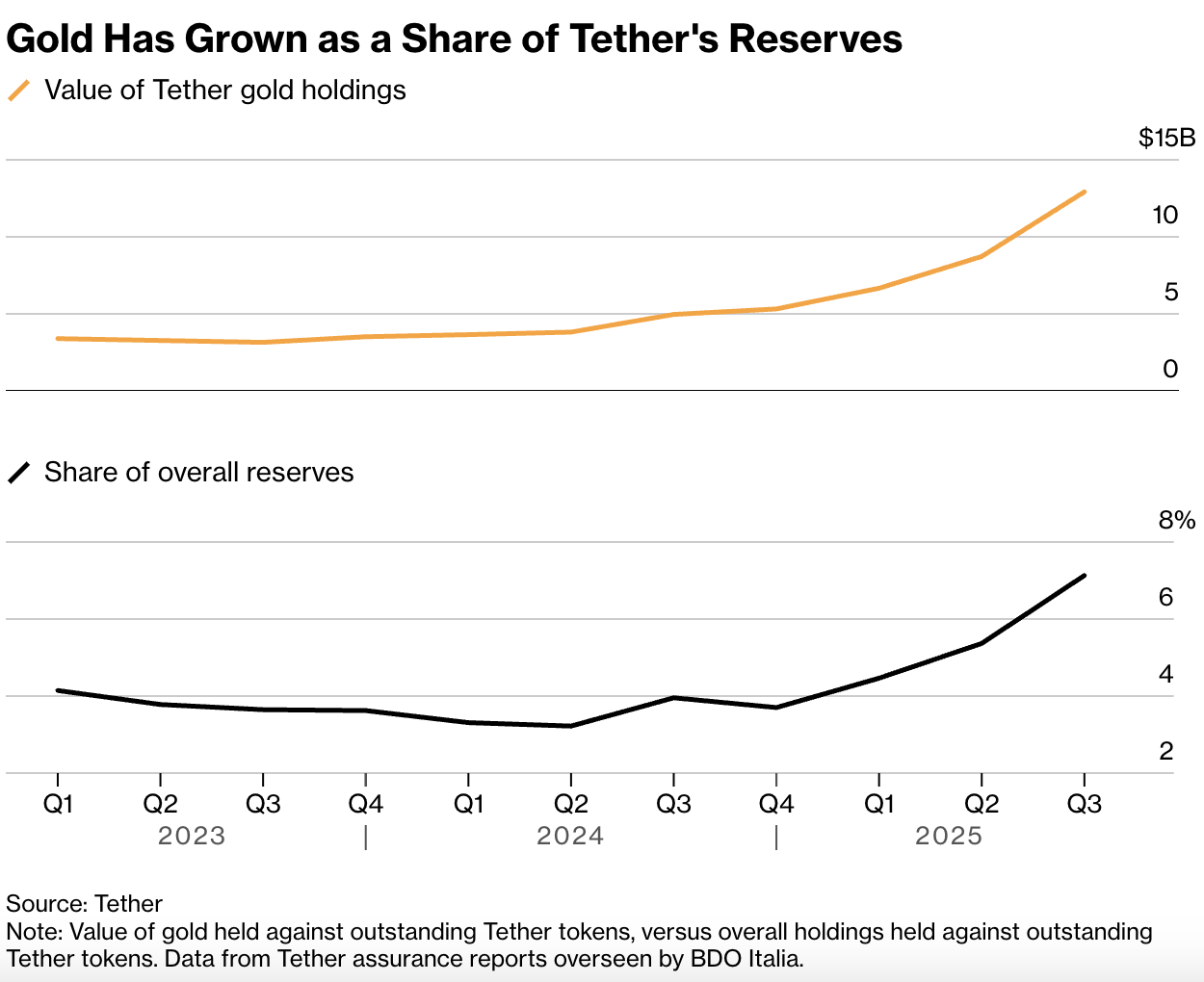
According to Ardoino, Tether's current gold procurement rate is about 1 to 2 tons per week, and it plans to maintain this pace in the coming months, "maybe slowing down, but we will assess gold demand quarterly."

But Tether's ambitions go beyond just hoarding gold. In the Bloomberg interview, Ardoino stated that Tether is evaluating the market and potential trading strategies, planning to actively trade its gold reserves to capture arbitrage opportunities. Simultaneously, the company is working on building "the world's best gold trading floor," aiming to establish stable, long-term channels for gold acquisition and compete with large banks like JPMorgan Chase and HSBC that dominate the global precious metals market.

To this end, Tether last year prominently brought on two heavyweight trading veterans: former HSBC global head of metals trading Vincent Domien, and former head of precious metals procurement for Europe, the Middle East, and Africa, Mathew O’Neill, specifically负责 expanding its gold business landscape. (Related reading: Tether's Gold Empire: The Ambition and Cracks of a 'Borderless Central Bank')

Upstream in the industry chain, Tether has also begun using its financial muscle to secure positions. Tether has successively invested in several Canadian mid-tier gold mining royalty companies, including Elemental Royalty, Metalla Royalty & Streaming, Versamet Royalties, and Gold Royalty, locking in future production capacity and revenue sharing through equity investments.

At the financial product level, Tether launched the gold-pegged stablecoin Tether Gold (XAU₮) as early as 2020. As of the end of last year, this token was backed by 16.2 tons of physical gold. Not long ago, Tether also introduced a new unit of account for XAU₮ called Scudo, where 1 Scudo represents one-thousandth of a troy ounce of gold, aiming to make gold a more usable form of payment.

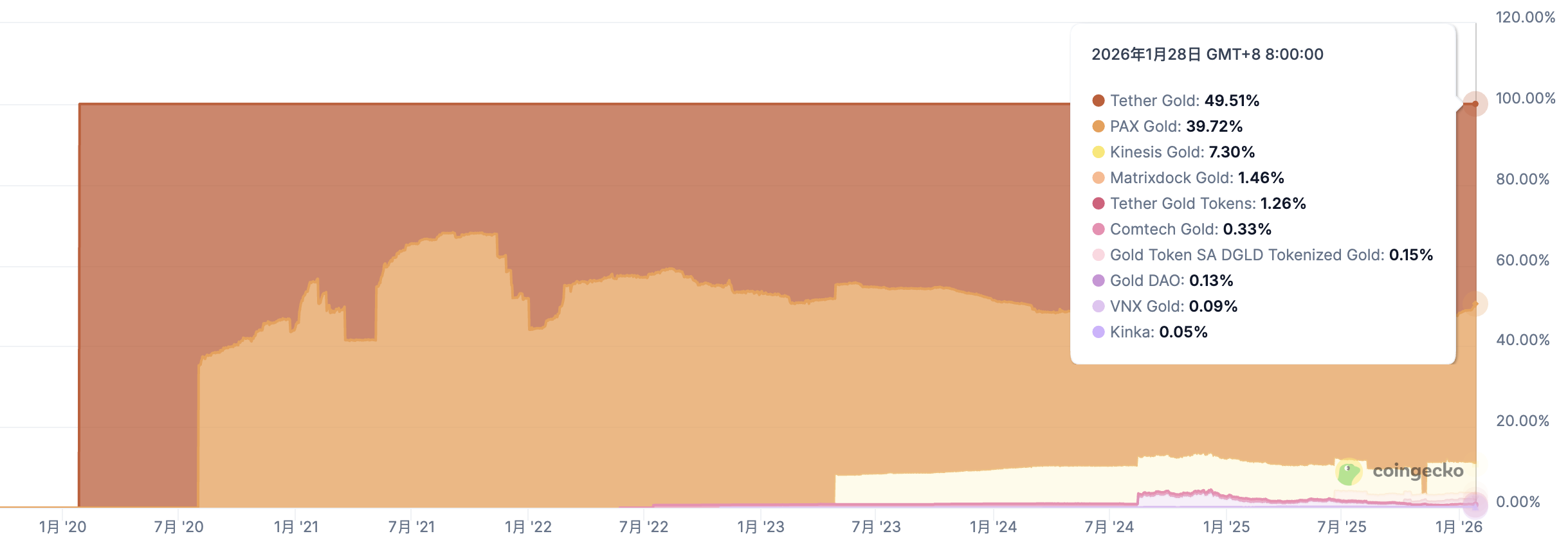
CoinGecko data shows that as of January 28, the circulating market value of XAU₮ had reached $2.7 billion, growing about 91.3% over the past year, capturing 49.5% of the tokenized gold track market share, firmly holding the top position.
From physical gold hoarding to industry chain布局, to financial product innovation, the large-scale investments by this gold enthusiast have even left traditional commodity圈 insiders baffled, with some形容 Tether as "the strangest company they have ever encountered."

But now, as gold prices continue to刷新历史 highs, Tether's bet is yielding惊人的 returns.

Earning $15 Billion Annually, Building a Capital Arsenal

The confidence behind Tether's疯狂囤积 gold comes from a high-speed运转的 "money printing machine."

According to a Fortune report, Tether generated approximately $15 billion in net profit in 2025, a significant increase from the previous year's $13 billion. This百亿 profit is supported by a global workforce of only about 200 people. Roughly calculated, the per capita profit is as high as $75 million, an efficiency level that leaves traditional financial giants in the dust.

The core of this profitability comes from the capital pool沉淀 by its stablecoin business.

Today, the US dollar stablecoin USDT issued by Tether is the most widely used stablecoin globally, with over 500 million users. CoinGecko data shows that as of January 28, 2026, the circulation of USDT issued by Tether was接近 $1870 billion, firmly holding the top spot in the stablecoin赛道. Trading activity is同样领先; Artemis Analytics data shows that in 2025, total stablecoin transaction volume grew 72% to $33 trillion, with USDT contributing $13.3 trillion, accounting for over 33%.

Building on this, Tether is further expanding the scale of its capital沉淀 through合规化.

On January 27, Tether officially launched USAT, a stablecoin regulated by the U.S. federal government. It is issued by Anchorage Digital Bank, the first federally regulated stablecoin issuer in the U.S., with Cantor Fitzgerald serving as the designated reserve custodian and preferred primary dealer, and former White House advisor Bo Hines appointed as CEO. This is seen as a key step for Tether's full-scale entry into the U.S. domestic market.

Simultaneously, leveraging its investments in content platforms like Rumble, Tether is attempting to integrate USAT business into the traffic ecosystem, thereby quickly reaching 100 million U.S. users, with a target of a $1 trillion market cap within five years. If progress is smooth, USAT could become the first真正意义上的 competitor to USDC in the U.S. market.

After obtaining an almost zero-cost liability side, Tether easily套取 interest rate differentials by allocating high-liquidity, low-risk assets.

Among these, U.S. Treasury interest is the core source of Tether's收益. In a high-interest rate cycle, U.S. Treasury interest directly amplifies Tether's profitability. Currently, Tether holds approximately $1350 billion in U.S. Treasury bonds, exceeding the holdings of sovereign nations like South Korea and making it the 17th largest holder of U.S. Treasury bonds globally.

Additionally, Tether is also a super player in Bitcoin. Since 2023, Tether has allocated up to 15% of its monthly net profit to定期 Bitcoin. Its current holdings exceed 96,000 BTC, making it one of the largest institutional holders of Bitcoin globally, with an average cost of about $51,000, far below the current market price.围绕 the Bitcoin ecosystem, Tether has also built its own mining farms, invested in mining companies, and布局 DAT (Crypto Treasury), continuously expanding its industry influence, and has一度 been the subject of overseas conspiracy theories about being a "BTC隐形操盘手." (Related reading: Caught in BTC隐形操盘手 Conspiracy Theories? Unveiling the Full Picture of Tether's Bitcoin Strategy)

Furthermore, to leverage more potential收益, Tether has开启了大撒币 mode over the past few years, extending its investment触角 to areas such as satellite communications, AI data centers, agriculture, telecommunications, and media.

Thus, an arbitrage machine spanning traditional finance and the crypto world has gradually taken shape, continuously supplying Tether with capital ammunition, becoming the chips for its large-scale bets.


Questions liées

QHow much gold has Tether accumulated and what is its current value?

ATether has accumulated approximately 140 tons of physical gold, with a current value of about $23 billion.

QWhat is Tether's goal regarding its gold reserves, as stated by its CEO?

ATether's CEO, Paolo Ardoino, stated that the company aims to become one of the world's largest 'gold central banks'.

QWhat was Tether's net profit in 2025 and what is the primary source of this profitability?

ATether's net profit in 2025 was approximately $15 billion, primarily sourced from the interest on U.S. Treasury bonds held from its stablecoin business.

QWhat is the name of the gold-backed stablecoin issued by Tether and what is its market position?

ATether's gold-backed stablecoin is called Tether Gold (XAU₮), and it holds a 49.5% market share in the tokenized gold sector, ranking first.

QHow does Tether store its physical gold reserves and where are they located?

ATether stores its physical gold in a nuclear bunker from the Cold War era in Switzerland, which has multiple layers of heavy steel doors and top-tier confidentiality systems.

Lectures associées

Après trois trimestres consécutifs de baisse, le marché des cryptomonnaies pourra-t-il connaître une fenêtre de stabilisation au troisième trimestre ?

Le marché des cryptomonnaies a enregistré son pire trimestre depuis 2022, avec une capitalisation totale chutant de 12,6% à 2 100 milliards de dollars. Tous les indicateurs clés (volume des échanges, valeur des stablecoins) montrent une sortie nette de capitaux. Le Bitcoin a perdu 14,2% et l'Ethereum 25,4% sur le trimestre, rompant sa corrélation antérieure avec les actions technologiques. Les ETF spot américains sur le Bitcoin ont subi des rachats massifs, avec une sortie nette de 4,67 milliards de dollars au Q2, indiquant une pression de vente continue. Le resserrement de la politique de la Fed et les ventes d'entreprises comme Strategy ont accentué la déleveragisation du secteur. L'attention du marché se porte désormais presque exclusivement sur la réunion de la Fed fin juillet. Une position accommodante pourrait stabiliser le Bitcoin entre 68 000 et 84 000 dollars, tandis qu'un ton hawkish pourrait le faire osciller autour de 50 000-56 000 dollars. Parallèlement, la progression du *CLARITY Act*, une loi cruciale pour la clarté réglementaire, est au point mort au Sénat, réduisant les chances d'adoption en 2026 et maintenant une prime de risque élevée sur l'ensemble du secteur. Malgré ce contexte difficile, quelques secteurs résistent : les marchés de prédiction ont vu leur volume nominal augmenter de 48,7% et les biens collectionnables tokenisés ont progressé d'environ 143%. La tokenisation d'actifs du monde réel (RWA) continue également sa croissance régulière, portée par des fondamentaux indépendants du cycle crypto. Les bases d'un effondrement extrême semblent absentes, mais le marché est désormais guidé par les politiques monétaires, les prix et les attentes de taux, plutôt que par le simple récit haussier. La fin des sorties massives des ETF et le retour des achats des détenteurs à long terme pourraient indiquer une phase de stabilisation potentielle.

marsbitHier 08:42

Après trois trimestres consécutifs de baisse, le marché des cryptomonnaies pourra-t-il connaître une fenêtre de stabilisation au troisième trimestre ?

marsbitHier 08:42

The SpaceX Trade, Unlocked: SPCXON Débarque sur WEEX

En juin 2026, SpaceX a réalisé la plus grande introduction en bourse de l'histoire, mais l'accès à l'action a été limité pour de nombreux investisseurs en raison de restrictions régionales et de frictions liées aux courtiers. La plateforme WEEX propose désormais une solution via SPCXON/USDT, un instrument tokenisé sur le marché au comptant qui permet d'obtenir une exposition au cours de SpaceX en utilisant l'USDT, sans nécessiter de compte de courtage américain. SPCXON est un produit tokenisé construit sur l'infrastructure d'Ondo, conçu pour refléter l'économie de la détention d'actions SpaceX pour les traders éligibles en dehors des États-Unis, avec des dividendes réinvestis. Le cas d'investissement repose sur la croissance des revenus de Starlink et les progrès de Starship, malgré un valorisation déjà élevée et des risques liés à un flottant public réduit et à des déblocages d'actions internes à venir. Il est important de noter que SPCXON offre une exposition, et non la propriété directe d'actions ou de droits de vote. Son prix peut évoluer avec une prime ou une décote par rapport à la valeur liquidative. WEEX propose également d'autres produits tokenisés comme MSTRON et MUON dans un compte unifié, permettant une rotation entre crypto-monnaies et actions traditionnelles sans transfert de fonds. La plateforme souligne ainsi comment les barrières entre la finance traditionnelle et les actifs numériques s'estompent.

TheNewsCryptoHier 08:34

The SpaceX Trade, Unlocked: SPCXON Débarque sur WEEX

TheNewsCryptoHier 08:34

BIT Trading Moment : Le BTC reste sous la pression de l'EMA 200 hebdomadaire, un rejet pourrait relancer la baisse, les actions de stockage et de semi-conducteurs qui ont bondi cette nuit ont baissé en séance de nuit

**Résumé des marchés : Bitcoin sous pression, actions technologiques en réajustement** Le marché crypto poursuit son rebond, avec Bitcoin évoluant autour de 66 000 $. Il fait face à une résistance clé vers 68 000 $, niveau correspondant au coût moyen des investisseurs sur cinq mois. Les traders surveillent les moyennes mobiles clés (200 MA à ~63 333 $ et 200 EMA à ~68 328 $ en hebdomadaire). Une rupture au-dessus de 68 000 $ ouvrirait la voie à une hausse, tandis qu'un échec pourrait entraîner un retest des 63 000 $. L'analyse suggère que la dynamique actuelle ressemble à un rebond estival à faible liquidité plutôt qu'au début d'un véritable marché haussier. Sur le marché actions américain, après une forte séance mardi portée par les semi-conducteurs et les titres du stockage (Micron, AMD, Intel...), les contrats à terme indiquent une ouverture en baisse. Les secteurs ayant récemment bondi, comme les semi-conducteurs et le stockage, reculent en séance de nuit. Certaines valeurs se démarquent néanmoins, comme Super Micro Computer (SMCI), en hausse après des résultats et des perspectives robustes liées à la demande de serveurs IA. Des vents contraires persistent : les prix du pétrole (Brent >91$) et les rendements des obligations d'État américaines grimpent, ravivant les craintes inflationnistes. En Asie, les marchés ont suivi le rebond technologique américain, mais de manière hésitante. La tension reste forte sur le yen japonais, qui atteint son plus bas niveau depuis des décennies. **Points clés à surveiller :** * **Crypto :** Niveaux techniques de Bitcoin (68k$/63k$), flux des ETF spot. * **Actions :** Saison des résultats (Tesla, Alphabet, Intel...), activité d'AMD sur l'IA. * **Économie :** Données américaines sur l'emploi, décision de la BCE, tensions géopolitiques et prix de l'énergie.

marsbitHier 08:34

BIT Trading Moment : Le BTC reste sous la pression de l'EMA 200 hebdomadaire, un rejet pourrait relancer la baisse, les actions de stockage et de semi-conducteurs qui ont bondi cette nuit ont baissé en séance de nuit

marsbitHier 08:34

Gate Research Institute : La vague de « Wall Streetisation » des produits financiers cryptographiques, concurrence ou fusion ?

Le titre de l'article est : "Gate Institute : La vague de 'Wall Street-isation' des produits financiers cryptos, est-ce une compétition ou une fusion ?" Résumé en français (environ 1400 caractères) : Il y a dix-sept ans, Bitcoin fut créé avec une vision décentralisée et anti-establishment financier. Aujourd'hui, paradoxalement, son adoption massive passe souvent par des ETF émis par des géants comme BlackRock. Cet article analyse cette "Wall Street-isation" apparente des actifs cryptos : les institutions traditionnelles s'emparent-elles du pouvoir d'émission, de tarification, de garde et de distribution ? La réalité est plus nuancée. C'est une convergence à double sens. D'un côté, les plateformes cryptos comme Gate.io étendent leurs services aux actions traditionnelles (états-uniennes, hongkongaises, sud-coréennes), aux CFD et aux produits tokenisés, offrant un compte unifié. De l'autre, des courtiers traditionnels comme Robinhood intègrent les cryptomonnaies et explorent la tokenisation d'actions sur blockchain. Cette fusion vise à créer le "super-compte" financier de demain, où actions, cryptos, ETF et obligations tokenisées (RWA) coexistent dans une même interface, comblant les faiblesses de chaque écosystème. Les RWA, notamment les obligations d'État tokenisées, agissent comme une couche intermédiaire unificatrice. En conclusion, Wall Street n'a pas conquis la crypto, et la crypto n'a pas contourné Wall Street. Ils construisent ensemble une nouvelle forme de marché des capitaux, plus efficace et mondial, où l'idéal décentralisé persiste dans les protocoles, tandis qu'une expérience utilisateur unifiée émerge à l'interface.

marsbitHier 08:09

Gate Research Institute : La vague de « Wall Streetisation » des produits financiers cryptographiques, concurrence ou fusion ?

marsbitHier 08:09

Trading

Spot
活动图片




