Memecoins vs. Altcoins: Market Cap Ratio Signals Potential Reversal

bitcoinistPublié le 2025-09-15Dernière mise à jour le 2025-09-15

Résumé

Memecoins have been under heavy selling pressure since December 2024, with many declaring the sector as good as dead. Prices...

Trusted Editorial content, reviewed by leading industry experts and seasoned editors. Ad Disclosure

Memecoins have been under heavy selling pressure since December 2024, with many declaring the sector as good as dead. Prices collapsed across the board, liquidity dried up, and retail enthusiasm that once fueled massive rallies seemed to vanish. For months, memecoins have trended lower, underperforming most of the broader crypto market and leaving investors skeptical about their long-term survival.

Yet, despite the gloom, some analysts argue that dismissing memecoins entirely may be premature. As the market prepares for a new phase driven by shifting liquidity flows, institutional positioning, and macroeconomic catalysts, speculation could once again find fertile ground in this volatile sector. Top analyst Darkfost has gone as far as to suggest that the time to take a fresh look at memecoins may have arrived. According to him, data shows that the market is entering an area where memecoin dominance has historically regained strength, often sparking sharp rebounds.

While risks remain high—memecoins are still among the most speculative assets in crypto—the potential for explosive gains continues to attract attention.

Memecoin Dominance Signals Possible Rebound

Darkfost highlights the importance of monitoring the Memecoin Dominance in Altcoin Markets chart, which compares the market capitalization of key memecoins against that of established altcoins. This ratio offers valuable insight into whether memecoins are gaining or losing influence relative to the broader altcoin sector.

Since the massive rush that peaked at the end of 2024, memecoins have been in a prolonged decline, steadily losing both valuation and investor interest. The frenzy that once drove parabolic gains gave way to exhaustion, with most of the sector retracing sharply.
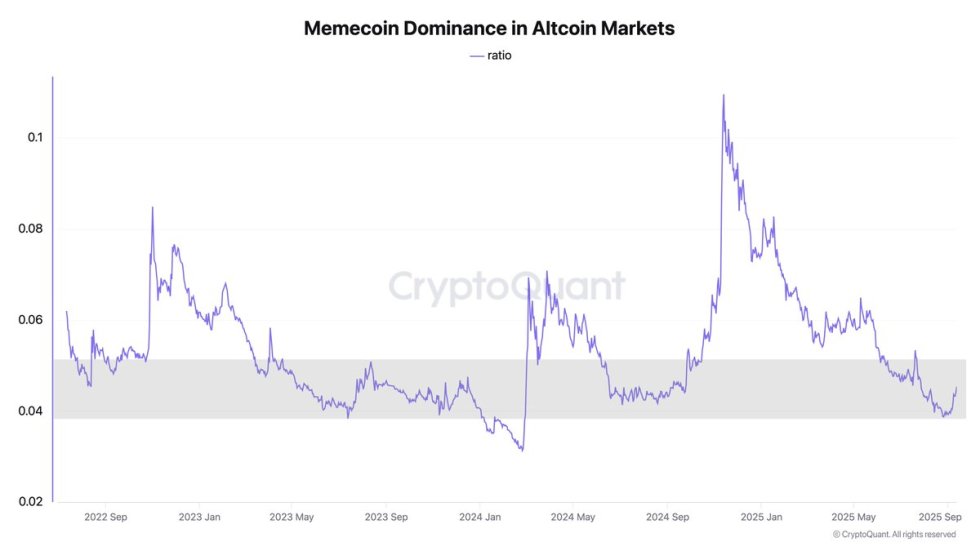
Memecoin Dominance in Altcoin Markets | Source: Darkfost

Investors in memecoins understand the unique challenge of this asset class. Unlike Bitcoin or Ethereum, memecoins often lack fundamental backing, making them highly speculative. As a result, timing entries and, more importantly, exiting positions quickly to secure profits are essential strategies. Hesitation can easily turn short-term gains into significant losses.

Despite this, Darkfost observes that the memecoin dominance chart is signaling a potential turning point. The ratio has entered an area where memecoins have historically regained strength, marking the beginning of sharp rebounds. Early signs of reaction suggest that market sentiment may be shifting, with speculative capital slowly re-entering the space.

If the trend persists, the conditions could align for a renewed memecoin mania. While it may not replicate the extreme fervor of late 2024, a resurgence in speculative appetite could drive significant rallies. For traders watching closely, the data implies that memecoins may once again become a hot narrative in the crypto cycle, though managing risk remains paramount.

Market Cap Growth Analysis

The chart of the Memecoin Market Cap (Daily) shows how the sector remains highly volatile, reflecting speculative behavior that defines this corner of the crypto market. After rebounding strongly from the July lows near $64B, the market surged to a local peak above $88B in early September. However, that momentum quickly faded, with the cap now retracing toward $75B, down nearly 5% in the latest session.
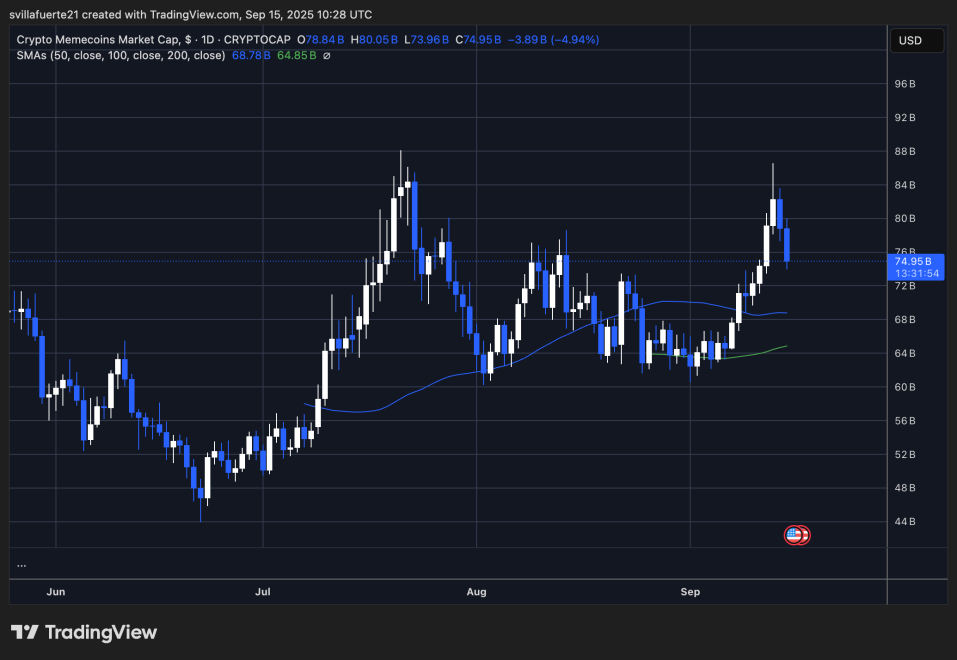
Crypto Memecoin Market Cap | Source: MEME.C chart on TradingView

The 50-day moving average at $68.7B has acted as a strong dynamic support throughout this recovery, showing that buyers continue to step in when valuations approach this level. Meanwhile, the sector’s ability to push above $80B and briefly test the $88B resistance highlights that speculative capital is still present, even if profit-taking remains aggressive.

For now, memecoins are consolidating after a sharp upswing, and the market appears to be searching for balance. If capitalization holds above the $72–74B range, a renewed attempt to reclaim $80B could follow, reigniting bullish sentiment. On the other hand, a breakdown below the 50-day average would suggest fading momentum and open the door for a deeper retracement. Ultimately, memecoins remain sensitive to liquidity flows and broader risk sentiment, making timing critical.

Featured image from Dall-E, chart from TradingView

Editorial Process for bitcoinist is centered on delivering thoroughly researched, accurate, and unbiased content. We uphold strict sourcing standards, and each page undergoes diligent review by our team of top technology experts and seasoned editors. This process ensures the integrity, relevance, and value of our content for our readers.

Sebastian's journey into the world of crypto began four years ago, driven by a fascination with the potential of blockchain technology to revolutionize financial systems. His initial exploration focused on understanding the intricacies of various crypto projects, particularly those focused on building innovative financial solutions. Through countless hours of research and learning, Sebastian developed a deep understanding of the underlying technologies, market dynamics, and potential applications of cryptocurrencies. As his knowledge grew, Sebastian felt compelled to share his insights with others. He began actively contributing to online discussions on platforms like X and LinkedIn, focusing on fintech and crypto-related content. His goal was to expose valuable trends and insights to a wider audience, fostering a deeper understanding of the rapidly evolving crypto landscape. Sebastian's contributions quickly gained recognition, and he became a trusted voice in the online crypto community. To further enhance his expertise, Sebastian pursued a UC Berkeley Fintech: Frameworks, Applications, and Strategies certification. This rigorous program equipped him with valuable skills and knowledge regarding Financial Technology, bridging the gap between traditional finance (TradFi) and decentralized finance (DeFi). The certification deepened his understanding of the broader financial landscape and its intersection with blockchain technology. Sebastian's passion for finance and writing is evident in his work. He enjoys delving into financial research, analyzing market trends, and exploring the latest developments in the crypto space. In his spare time, Sebastian can often be found immersed in charts, studying 10-K forms, or engaging in thought-provoking discussions about the future of finance. Sebastian's journey as a crypto analyst and investor has been marked by a relentless pursuit of knowledge and a dedication to sharing his insights. His ability to navigate the complex world of crypto, combined with his passion for financial research and communication, makes him a valuable asset to the industry. As the crypto landscape continues to evolve, Sebastian remains at the forefront, providing valuable insights and contributing to the growth of this revolutionary technology.

Lectures associées

Une entrée potentielle de milliers de milliards pour les fonds de pension ? L'ETF de réinvestissement des dividendes en Bitcoin de Franklin Templeton intègre un plafond de vente

Le géant de l'investissement Franklin Templeton a déposé une demande pour lancer deux ETF innovants qui intègrent discrètement le Bitcoin dans des portefeuilles actions traditionnels, ciblant principalement les conseillers financiers. Le mécanisme central de ces fonds, basé sur le principe de l'investissement par défaut et de l'inertie comportementale, utilise les dividendes des actions (95% du portefeuille initial) pour acheter automatiquement du Bitcoin, avec une allocation cible de 5%. Cependant, leur conception impose des règles de rééquilibrage trimestrielles qui obligent à vendre une partie du Bitcoin si son poids dépasse 5% (pour le ramener à 4,5%), et plafonne l'exposition maximale à 20%. Cela signifie qu'en période de hausse du Bitcoin, ces fonds deviendraient des vendeurs nets, créant potentiellement une pression à la vente programmée et un « plafond » de prix. L'analyse montre que les flux d'achats annuels générés par les dividendes seraient minimes (environ 1% ou 0,5% de l'actif par an) par rapport au marché quotidien du Bitcoin. Les fonds utilisent également une structure offshore aux îles Caïmans pour des raisons de conformité et permettent aux conseillers de contourner les restrictions internes sur les crypto-actifs. Pour que ce modèle débloque des capitaux retraite significatifs, ces ETF devraient devenir une option par défaut dans les plans 401(k), un processus qui dépend de la clarification réglementaire par le Département du Travail américain. L'essence de la stratégie est de s'appuyer sur l'inaction des investisseurs plutôt que de les convaincre d'acheter du Bitcoin volontairement.

marsbitIl y a 23 mins

Une entrée potentielle de milliers de milliards pour les fonds de pension ? L'ETF de réinvestissement des dividendes en Bitcoin de Franklin Templeton intègre un plafond de vente

marsbitIl y a 23 mins

Pourquoi les projets de crypto aiment-ils autant changer de nom ?

Dans le secteur traditionnel, la fidélité à la marque est un atout crucial, mais dans la cryptographie, plus de 16 % des projets changent de nom. Cette tendance s'explique par plusieurs raisons principales. Premièrement, la fidélité des utilisateurs est faible. La plupart des participants sont des investisseurs ou des chasseurs d'airdrop, motivés par les gains potentiels plutôt que par l'attachement à la marque. Un nom associé à des échecs, des piratages ou une baisse des prix devient un handicap. Deuxièmement, le changement de nom est une stratégie marketing. Il peut s'agir d'un réalignement stratégique (comme Matic devenant Polygon) ou d'une tentative de suivre les tendances (IA, RWA). Parfois, il sert à échapper à une mauvaise réputation après un incident. Troisièmement, le changement de nom s'accompagne souvent d'un échange de jetons, créant un espace gris. Cela peut réinitialiser les graphiques historiques et les prix, offrant aux équipes et aux market makers une opportunité de manipuler le marché. Une refonte de la tokenomics peut aussi diluer la valeur des jetons détenus par les utilisateurs. En conclusion, le vrai problème n'est pas le changement de nom en soi, mais la volonté d'effacer l'histoire. Lorsqu'un projet change de nom, il faut se demander : quelles sont ses nouvelles capacités réelles ? La tokenomics a-t-elle changé ? Que cherche-t-il à faire oublier ? Un changement justifié par des avancées concrètes peut être positif, mais s'il ne sert qu'à masquer des problèmes ou à relancer un schéma spéculatif, il représente un risque.

marsbitIl y a 50 mins

Pourquoi les projets de crypto aiment-ils autant changer de nom ?

marsbitIl y a 50 mins

Trading

Spot
Futures
活动图片