US Federal Regulators To Review State-Level Stablecoin Frameworks Under GENIUS Act

bitcoinistPublié le 2025-08-20Dernière mise à jour le 2025-08-20

Résumé

US federal regulators are set to review state regulations of stablecoins to “even out” rules across jurisdictions under the new...

Trusted Editorial content, reviewed by leading industry experts and seasoned editors. Ad Disclosure

US federal regulators are set to review state regulations of stablecoins to “even out” rules across jurisdictions under the new federal regulatory framework for the sector, the Guiding and Establishing National Innovation for U.S. Stablecoins (GENIUS) Act.

State-Level Stablecoin Rules To Face Federal Review

A federal committee led by the US Treasury Secretary is expected to start evaluating state-level regulatory regimes to determine whether they are similar to the federal regulatory framework under the GENIUS Act.

Following last month’s enactment of the landmark crypto legislation, the Stablecoin Certification Review, comprised of the US Treasury Secretary and the chairmen of the Federal Reserve and the Federal Deposit Insurance Corporation, is in charge of reviewing state-by-state rules and “establish broad-based principles for determining whether a State-level regulatory regime is substantially similar to the Federal regulatory framework under this Act.”
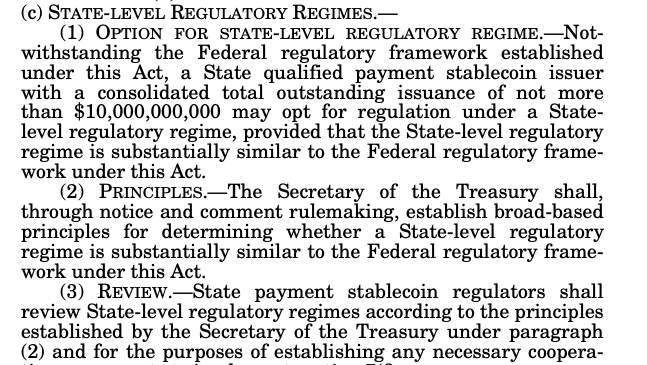
stablecoin

Excerpt from the GENIUS Act. Source: congress.gov

The requirement aims to level out regulatory approaches between states to make compliance by stablecoin issuers more seamless across jurisdictions, as issuers face a different set of rules and policies depending on each jurisdiction, with some states having a stricter approach to the industry while others have a more welcoming strategy.

Gavin Meyers, a financial services regulatory partner at Pierson Ferdinand LLP, told Bloomberg Law that “It creates a potential for less of a mosaic of state-by-state regulation, which kind of plagues other aspects of the financial industry,” asserting that “eliminating that barrier is a highly beneficial aspect of the committee.”

“There will be some wiggle room in states that have been more favorable to crypto generally, like Wyoming,” Meyers affirmed. Notably, Wyoming has passed over 45 pieces of crypto-related legislation since 2016, including a bill in 2023 that authorized a state commission to issue stablecoins pegged to the US dollar.

Moreover, it launched Frontier (FRNT), the US’s first state-issued stablecoin, on seven blockchains, including Ethereum, Solana, and Avalanche, on August 19. Nonetheless, “due to lingering regulatory hurdles, the token is not yet available to the public,” noted crypto journalist Eleanor Terrett on X.

The Importance Of Clear Frameworks

According to the Bloomberg Law report, the federal Committee is ready to “even out the state-by-state approach, curtailing stricter regulatory regimes or building upon permissive state frameworks.”

Rosemary Spaziani, a partner at Gibson Dunn & Crutcher LLP, told the news media outlet that “If 40 states all sign on to what the federal government does, those are going to be pretty simple rubber stamps—they’re going to adopt a model act and incorporate it into their laws,” while “the ones that deviate are probably going to be a bit of a bottleneck.”

Additionally, the companies hoping to enter the stablecoin sector will likely welcome federal oversight to avoid potential compliance issues. Meyers noted that “If you are licensed by whichever state that qualifies under the ‘GENIUS Act,’ that certification is good across the country.”

Recently, leading banking associations sent a joint letter to the US Senate Banking Committee calling for amendments to the GENIUS Act. The associations asked the lawmakers to address multiple “loopholes” in the landmark legislation, arguing that a clear regulatory framework is crucial for the digital assets market.

Among the recommendations, they urged the Committee to strengthen the prohibition on interest payments related to payment stablecoins and to repeal a section of the GENIUS Act that allows uninsured, out-of-state-chartered financial institutions to operate without the host states’ approval, which could complicate regulation.

stablecoin, btc, btcusdt

Bitcoin's performance in the one-week chart. Source: BTCUSDT on TradingView
Featured Image from Unsplash.com, Chart from TradingView.com
Editorial Process for bitcoinist is centered on delivering thoroughly researched, accurate, and unbiased content. We uphold strict sourcing standards, and each page undergoes diligent review by our team of top technology experts and seasoned editors. This process ensures the integrity, relevance, and value of our content for our readers.

Rubmar is a crypto enthusiast who likes learning and improving constantly. She enjoys reporting on the latest news and developments in the crypto industry. Rubmar also enjoys scrapbooking, crafting, simulation games, and watching football.

Lectures associées

B20, la nouvelle porte d'émission de jetons sur Base, vise à accueillir quels types d'actifs ?

Base a retardé le lancement de son principal standard de jetons, B20, suite à des interruptions de production de blocs sur son réseau principal fin juin. Le B20, élément clé de la mise à niveau Beryl, fonctionne comme une version native des jetons ERC-20 sur Base. Contrairement aux contrats ERC-20 traditionnels, il est implémenté via une précompilation Rust pour une vitesse et une efficacité accrues, tout en restant compatible avec l'écosystème ERC-20 existant. Conçu pour les émetteurs d'actifs numériques, notamment les stablecoins et les actifs réels tokenisés (RWA), le B20 intègre des outils de contrôle renforcés. Il permet une gestion granulaire des permissions (frappe, destruction, gel), la mise en place de listes blanches et noires pour restreindre les transferts, et inclut des fonctionnalités comme les mémos (pour lier les transactions à des données hors chaîne) et l'autorisation par signature (ERC-2612 permit). Ces fonctionnalités répondent aux besoins de conformité et de traçabilité des actifs réglementés. En résumé, le B20 vise à offrir une infrastructure de tokenisation standardisée, plus rapide et moins coûteuse, tout en donnant aux émetteurs la capacité de définir des règles de gouvernance et de conformité adaptées à leurs actifs. Son succès dépendra de sa capacité à attirer les émetteurs institutionnels en quête de stabilité, de contrôle et d'intégration transparente.

Foresight NewsIl y a 13 mins

B20, la nouvelle porte d'émission de jetons sur Base, vise à accueillir quels types d'actifs ?

Foresight NewsIl y a 13 mins

MicroStrategy dévoile son scénario de sauvetage, 12,5 milliards de dollars de ventes de crypto : la compétition et le calcul derrière

L'ancienne stratégie de MicroStrategy, qui consistait à émettre des actions pour acheter du Bitcoin sans jamais vendre, a atteint ses limites. Face à une perte latente de 13 milliards de dollars sur ses 847 363 Bitcoins et à l'effondrement du cours de ses actions privilégiées perpétuelles (STRC), la société a présenté un nouveau « Cadre de capital de crédit numérique » pour restaurer la confiance et la liquidité. Ce cadre repose sur cinq piliers : 1) Une réserve de trésorerie de 2,55 milliards de dollars pour les dépenses obligatoires ; 2) Une augmentation du dividende des STRC à 12% pour soutenir leur prix ; 3) Un rachat potentiel de 1 milliard de dollars d'actions privilégiées ; 4) Un rachat potentiel de 1 milliard de dollars d'actions ordinaires ; 5) La possibilité de vendre jusqu'à 1,25 milliard de dollars de Bitcoin pour renforcer la liquidité. L'objectif est de réparer l'ancrage de crédit, de faire remonter la valorisation boursière au-dessus de la valeur des actifs Bitcoin détenus, et de rouvrir les canaux de financement. Cependant, cette évolution stratégique, bien que défensive et rationnelle, implique un coût : la rupture du récit de « détention pure » qui avait jusque-là soutenu la prime de valorisation de MicroStrategy. Le marché surveillera désormais étroitement la mise en œuvre des rachats d'actions et toute vente effective de Bitcoin, qui pourrait influencer la psychologie du marché plus large.

marsbitIl y a 18 mins

MicroStrategy dévoile son scénario de sauvetage, 12,5 milliards de dollars de ventes de crypto : la compétition et le calcul derrière

marsbitIl y a 18 mins

Trading

Spot
活动图片