Crypto Donations Keep Flowing For Trump’s Super PAC – Details

bitcoinistPublié le 2025-08-02Dernière mise à jour le 2025-08-02

Résumé

MAGA Inc., the flagship super PAC backing US President Donald Trump, has amassed a staggering $200 million in donations, with...

Trusted Editorial content, reviewed by leading industry experts and seasoned editors. Ad Disclosure

MAGA Inc., the flagship super PAC backing US President Donald Trump, has amassed a staggering $200 million in donations, with a substantial portion coming from the crypto industry. High-profile figures like Elon Musk and the Winklevoss twins have contributed millions, underscoring the growing alignment between industry power players and Trump’s political machine. As the 2026 midterm elections approach, MAGA Inc. holds an unprecedented war chest, positioning itself as a dominant force in upcoming political battles.

However, there’s growing skepticism within the crypto community about whether these funds will actually benefit pro-crypto candidates in the midterms. MAGA Inc.’s previous iteration was known for holding back significant resources during the midterm cycles, choosing instead to focus on a major push for the 2024 presidential election. This strategy raises questions about the super PAC’s intentions and whether the industry’s financial support will translate into meaningful legislative advocacy.

With regulatory clarity and friendly policies high on the industry’s priority list, many are watching closely to see if MAGA Inc.’s financial muscle will align with pro-innovation agendas in Washington. For now, the donations signal strong political engagement from crypto giants, but the real impact remains uncertain.

Crypto Industry Aligns With Trump’s Vision For US Crypto Dominance

Several major crypto firms have emerged as key contributors to MAGA Inc., signaling a deepening alliance between the President and the digital asset industry. Companies like BTC Inc, BitGo Inc, and Gemini Trust Company—the latter owned by the Winklevoss twins—have all made substantial donations to the super PAC, further solidifying Trump’s position as a pro-crypto President.

Trump has been increasingly vocal about his support for cryptocurrencies, positioning himself as a defender of innovation against what he perceives as overregulation from federal agencies. His statements about making the United States the “Crypto Capital of the World” have resonated within the industry, which continues to seek clearer regulatory frameworks and support for blockchain technology.

These high-profile donations are more than just financial gestures—they represent a coordinated effort by the crypto sector to align with policymakers who are willing to advocate for the industry’s growth. As regulatory clarity becomes a pressing issue, especially concerning token classification, stablecoins, and DeFi platforms, Trump’s stance is seen as a potential catalyst for positive legislative action.

The coming months will be pivotal. With regulatory uncertainty still clouding the US market, the crypto industry is betting that Trump’s political capital and the war chest of $200 million will translate into policy influence. While it remains to be seen how effectively these funds will be used to advance pro-crypto agendas, the donations from BTC Inc, BitGo, and Gemini mark a significant moment of political engagement, one that could shape the trajectory of crypto adoption and innovation in the US for years to come.

Total Crypto Market Cap Analysis

The total crypto market cap has recently faced a sharp correction after a strong bullish rally, dropping by 6.27% to $3.65 trillion. This pullback comes after the market briefly touched $3.93 trillion, a level close to previous highs set in late 2021. The chart shows that despite the recent decline, the market structure remains bullish, with higher highs and higher lows since the rebound from the $2.4 trillion region in April.
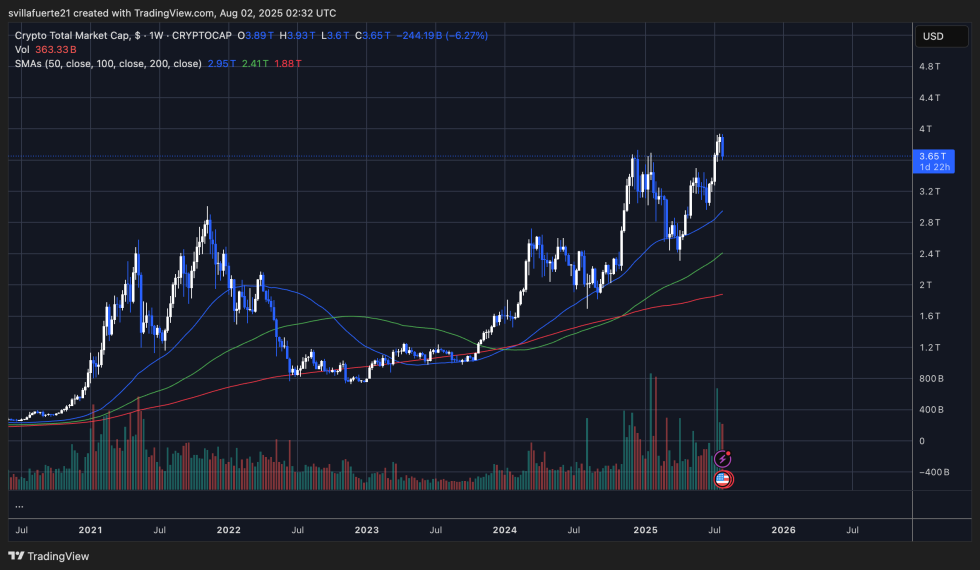
Total Crypto Market Cap flirts with $4T | Source: TOTAL chart on X

The 50-week moving average continues to trend upward, providing dynamic support around the $2.95 trillion level, while the 100-week and 200-week moving averages remain below at $2.41 trillion and $1.88 trillion, respectively. This alignment of moving averages confirms a long-term uptrend.

Related Reading: Ethereum Chain Dominates RWA Market With 83.69% Share

However, the market now faces a key test. Bulls must hold the $3.6 trillion support to prevent a deeper retracement towards the $3.2 trillion level. A failure to maintain this support could trigger a larger correction, while a successful defense may open the path for another push toward the elusive $4 trillion psychological barrier.

Featured image from Dall-E, chart from TradingView

Editorial Process for bitcoinist is centered on delivering thoroughly researched, accurate, and unbiased content. We uphold strict sourcing standards, and each page undergoes diligent review by our team of top technology experts and seasoned editors. This process ensures the integrity, relevance, and value of our content for our readers.

Sebastian's journey into the world of crypto began four years ago, driven by a fascination with the potential of blockchain technology to revolutionize financial systems. His initial exploration focused on understanding the intricacies of various crypto projects, particularly those focused on building innovative financial solutions. Through countless hours of research and learning, Sebastian developed a deep understanding of the underlying technologies, market dynamics, and potential applications of cryptocurrencies. As his knowledge grew, Sebastian felt compelled to share his insights with others. He began actively contributing to online discussions on platforms like X and LinkedIn, focusing on fintech and crypto-related content. His goal was to expose valuable trends and insights to a wider audience, fostering a deeper understanding of the rapidly evolving crypto landscape. Sebastian's contributions quickly gained recognition, and he became a trusted voice in the online crypto community. To further enhance his expertise, Sebastian pursued a UC Berkeley Fintech: Frameworks, Applications, and Strategies certification. This rigorous program equipped him with valuable skills and knowledge regarding Financial Technology, bridging the gap between traditional finance (TradFi) and decentralized finance (DeFi). The certification deepened his understanding of the broader financial landscape and its intersection with blockchain technology. Sebastian's passion for finance and writing is evident in his work. He enjoys delving into financial research, analyzing market trends, and exploring the latest developments in the crypto space. In his spare time, Sebastian can often be found immersed in charts, studying 10-K forms, or engaging in thought-provoking discussions about the future of finance. Sebastian's journey as a crypto analyst and investor has been marked by a relentless pursuit of knowledge and a dedication to sharing his insights. His ability to navigate the complex world of crypto, combined with his passion for financial research and communication, makes him a valuable asset to the industry. As the crypto landscape continues to evolve, Sebastian remains at the forefront, providing valuable insights and contributing to the growth of this revolutionary technology.

Lectures associées

« Ne peut être censuré » - La proposition Bitcoin visant à bloquer les Ordinals recueille moins de 1 % de soutien

La proposition controversée de soft fork Bitcoin, BIP-110, visant à limiter les données non financières comme les inscriptions Ordinals et Runes, n'a pas obtenu le soutien nécessaire des mineurs. À la date limite du 4 juillet, moins de 1% de la puissance de hachage du réseau (seulement 10 blocs sur 2016) avait signalé son soutien, bien loin du seuil de 55% requis pour l'activation. Les partisans du BIP-110, comme le développeur Luke Davis Jr., y voyaient un moyen de préserver la fonction première de Bitcoin en tant qu'argent numérique en empêchant les transactions de spam et les memecoins qui augmentent les coûts. Cependant, les critiques, dont BitMEX Research et Adam Back de Blockstream, ont vivement contesté la proposition. Ils ont averti qu'elle pourrait casser des portefeuilles existants, interdire des transactions légitimes impliquant plus de 1,7 million de BTC et aller à l'encontre du principe fondamental de Bitcoin : un réseau ouvert et non censurable. La faible adoption par les mineurs est considérée par certains, comme David Bailey de Bitcoin Conference, comme un signe positif ("bullish") pour l'avenir de Bitcoin. La dernière fenêtre d'activation par les utilisateurs est prévue en août, mais son succès semble très improbable compte tenu de l'opposition majoritaire exprimée. La communauté Bitcoin reste profondément divisée sur la question de la régulation des types de transactions autorisées sur son réseau.

ambcryptoIl y a 2 h

« Ne peut être censuré » - La proposition Bitcoin visant à bloquer les Ordinals recueille moins de 1 % de soutien

ambcryptoIl y a 2 h

Trading

Spot
活动图片