Charles Hoskinson, the founder of Cardano, unveiled a framework for blockchain governance in his latest broadcast, introducing what he refers to as a “Bill of Rights” for the Cardano ecosystem. This initiative, centered around 11 foundational blockchain tenants, aims to establish a constitutional foundation that will guide the development and governance of Cardano and potentially influence broader blockchain technologies.
Broadcasting live from Colorado on October 13, 2024, Hoskinson emphasized the collaborative efforts underpinning this initiative. “More than 50 workshops have already been held,” he stated. The process has seen participation from 1,400 individuals and the election of 63 delegates.
At the heart of Hoskinson’s announcement is a blog post titled “The 11 Blockchain Tenants Towards a Blockchain Bill of Rights.” He clarified that these tenants are not exclusive to Cardano but are intended as a universal framework applicable to various blockchain systems. “These tenants are meant to capture the natural durability of these systems and the rights of their users,” Hoskinson explained, drawing parallels to human rights enshrined in constitutional law.
The 11 Cardano Blockchain Tenants
Hoskinson provided an in-depth exploration of each of the 11 tenants, elucidating their significance and practical implications for Cardano:
- Transaction Censorship Resistance: “Transactions cannot be slowed down or censored and will be expediently served for their intended purpose,” Hoskinson stated. He likened this principle to the freedom of speech, emphasizing the importance of maintaining user autonomy within the system. “Transactions express the ways the users wish to engage with the system so users should be free and able to do so in a manner proportional to their intent; this excludes censorship but also mandates expediency and processing.”
- Predictable Transaction Costs: Hoskinson asserted that “the cost of a transaction should be predictable and cannot be unreasonable,” which is essential for user planning and system sustainability. He acknowledged the challenges in balancing resource allocation with user intent, especially in high-demand scenarios. Mechanisms like tiered pricing and intent-based ledgers are being explored to address these issues.
- Fair Recognition And Compensation: Addressing the equitable treatment of contributors, Hoskinson noted, “Every user’s inputs and contributions to the system will be recognized, recorded, processed, and assessed fairly.” This tenant seeks to ensure that both maintenance and development efforts are adequately rewarded, preventing incentives failures within the ecosystem. He also highlighted the need to fairly compensate various roles, from stake pool operators to governance participants.
- Data And Value Portability: Reflecting principles similar to the European Union’s General Data Protection Regulation (GDPR), Hoskinson emphasized the importance of user consent in data handling. “The value and data users contribute or create will not be locked or processed without their consent,” he stated. He advocates for user control over personal assets and information.
- Resource Efficiency: “No resources will be unnecessarily spent,” Hoskinson explained, highlighting the necessity of minimizing resource utilization through efficient protocol design. This tenant aims to prevent systemic bloat and ensure the long-term viability of the blockchain. Examples include protocol optimizations that reduce transaction sizes without compromising security.
- Safe Preservation Of Value And Information: Hoskinson discussed the dual aspects of this tenant: preserving the integrity of information against threats like quantum attacks and ensuring value stability through mechanisms like stablecoins. “The system will safely preserve the value and information stored within it,” he stated, emphasizing both data integrity and asset stability as critical components.
- Minimization Of Unnecessary Resource Expenditure: This tenant focuses on resource optimization, ensuring that Cardano operates efficiently without wasting resources. Hoskinson highlighted the transition from Plutus V1 to V2 as an example, where transaction sizes were significantly reduced, enhancing overall system efficiency.
- Fair And Representative Governance: “The system will treat users fairly and will evolve accordingly to their collective will, aiming at its long-term sustainability and viability,” Hoskinson declared. This tenant emphasizes the importance of inclusive governance, where all stakeholders have a voice in the system’s evolution. The upcoming Constitutional Convention in Buenos Aires aims to formalize these governance principles.
- User Privacy Preservation: Emphasizing data privacy, Hoskinson stated, “Users’ privacy, both in terms of their actions and their data, should be preserved.” Drawing parallels to GDPR, he advocated for minimal disclosure and selective, contextual data sharing. This tenant addresses the balance between transparency and privacy, ensuring users retain control over their personal information.
- Compliance with Local Laws and Regulations: “The system will offer users ways to engage that do not require them to break local laws and regulations,” Hoskinson explained. This tenant acknowledges the global nature of Cardano and the necessity for users to remain compliant with their respective jurisdictions.
- Transparency, Predictability, and Verifiability: The final tenant mandates that “the system’s operation should be transparent, predictable, verifiable, interpretable, and without asymmetries.” Hoskinson emphasized the importance of open-source protocols and public verifiability to ensure trust and accountability within the ecosystem.
The Way Forward
Hoskinson detailed the ongoing efforts to formalize these tenants through decentralized governance. “You have to have decentralized governance before you go down that road because only through decentralized governance can you make a decision for everyone everywhere, that’s the point of Voltaire,” he remarked. The upcoming Constitutional Convention in Buenos Aires, Argentina, scheduled for December 2024, will bring together delegates from 50 countries to finalize and approve the constitutional text based on these tenants.
The founder underscored the significance of this initiative beyond Cardano, suggesting that other blockchain communities could adopt similar frameworks to balance technical innovation with ethical governance. “These tenants are being actively debated by the Cardano community […] they will act as beacons in the far horizon that will pull Cardano and other blockchain communities to where they intend to travel to,” Hoskinson stated.
Hoskinson concluded the video by highlighting the importance of preserving the system’s integrity over short-term gains. “We should never sacrifice the integrity of the system for the sake of short-term gain or short-term progress on some arbitrary metric like token price or adoption,” he asserted.
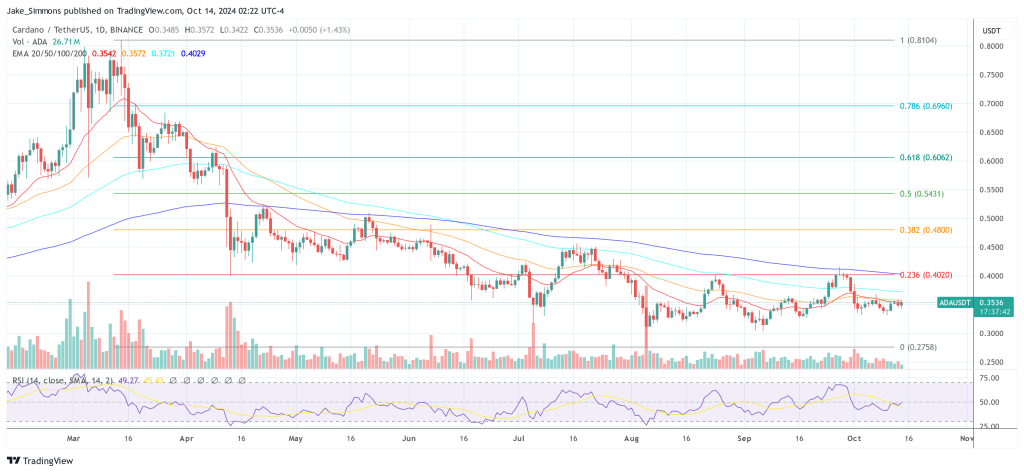
At press time, ADA traded at $0.3536.

Related Posts