Bitcoin is still quite stable after the happenings on major exchanges, showing resilience in volatile times.
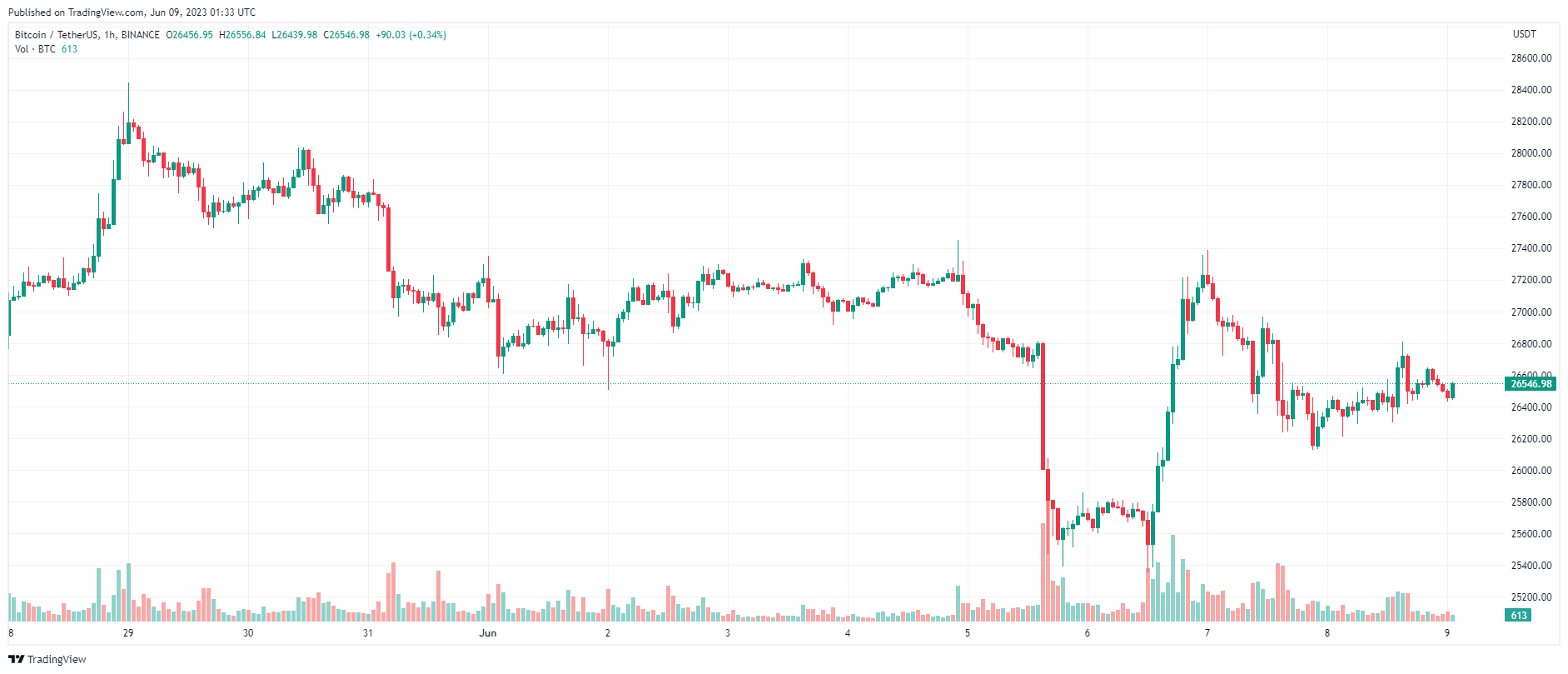
BTC Price Chart – 1 hour | Source: TradingView
US stocks rallied on Thursday (June 8), as investors awaited important inflation data next week as well as the latest policy announcement from the US Federal Reserve (Fed).
Ending the session, the Dow Jones increased 168.59 points (equivalent to 0.5%) to 33,833.61 points; The S&P 500 gained 0.62% to 4,293.93 points, its highest close so far in 2023, and the Nasdaq Composite added 1.02% to 13,238.52 points.
Amazon stock pushed tech stocks higher after optimistic comments from analysts. Shares of the e-commerce giant jumped 2.5% and helped the Technology Select Sector SPDR Fund fund certificate increase more than 1%.
The S&P 500 bounced off the decline but remained close to the key 4,300 mark. The index also hit its highest level since August 2022 this week, up 2.7% month-to-date and 11.8% year-to-date.
Small-cap stocks have shown strength in recent weeks. The Russell 2000 index jumped 7.5% in June and is up nearly 7% since the start of the year, suggesting the economy is more resilient to the tech boom. However, the index fell 0.4% on Thursday.
Investors seem to be in a holding position as they await the upcoming Fed policy meeting on June 13-14. Economic signs suggest inflation is easing, even if it remains above the central bank's 2% target.
New data released on Thursday showed initial jobless claims in the United States rose to 261,000 for the week ended June 3, compared with expectations of 235,000. The spike pushed first-time jobless claims to the highest level since October 2021. The increase also raised hopes that the Fed will pause its rate-raising campaign at its meeting next week.
The tightening labor market is seen as an obstacle in the US central bank's quest to slow inflation. Data indicating that the labor market is starting to weaken suggests that the FOMC's measures to contain inflation are bearing fruit.
According to the CME FedWatch tool, the market is forecasting a 72 percent chance that the Fed will not raise rates at its next meeting.
Meanwhile, gold prices rose on Thursday (June 8), after data showed a spike in weekly jobless claims in the US, bolstering expectations that the US Federal Reserve (Fed) ) will pause the rate hike cycle.
At the end of the session, the spot gold contract increased 1.3% to 1,965.1 USD/oz. Gold futures added 1.1% to $1,980.3 an ounce.
Oil prices eased some of the decline after falling more than 3 USD / barrel on Thursday (June 8), after the White House denied that the US and Iran may be moving to an agreement on oil exports.
Ending the session, the Brent oil contract fell 1.29% to $ 75.96 / barrel, after falling to 3 USD / barrel. WTI oil contract lost 1.24 USD (equivalent to 1.71%) to 71.29 USD/barrel.
Recent developments around Binance and Coinbase have had a notable impact on the Bitcoin (BTC) price, leading to a correction. Recent chart analysis by CryptoQuant shows that BTC sell-off volume is mainly influenced by day traders and some long-term holders.
The Exchange Inflow Spent Output Age Bands indicator shows that, on June 4, there was a slight increase in BTC inflows between 0 and 1 day, with over 14,000 BTC being put on exchanges.
However, June 5 saw a spike in inflows from long-term holders over a period of 3 to 6 months. This sudden increase has seen over 3,000 BTC sent to the exchange, indicating that this group of long-term holders is conducting an unusual sell-off.
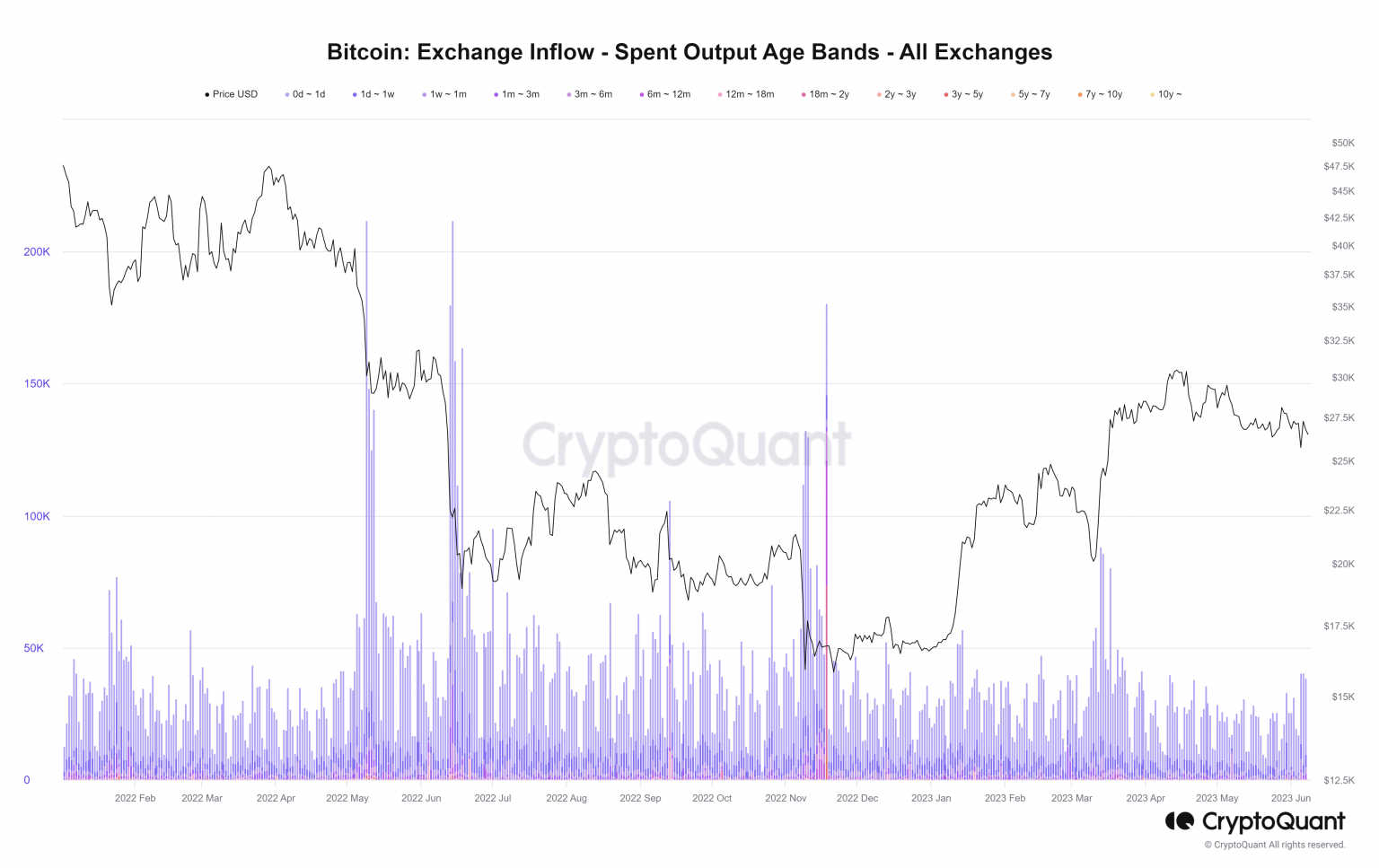
Source: CryptoQuant
On the other hand, the 6 and 12 month holders seem relatively calm in their sales. But June 7 saw a move of over 1,000 BTC, the highest level since March. These observations suggest that short-term holders are the main driver behind recent BTC price movements, while long-term holders still tend to hold their coins.
Furthermore, the Exchange Inflow – Spent Output Value Bands Indicator shows the volume of Bitcoin mainly sold by traders holding between 1 and 10,000 BTC over the past 13 months.
As U.S. regulatory pressure mounts on major crypto exchanges Binance and Coinbase, the market has seen extreme volatility. Despite these tumultuous movements, recent data from Glassnode's chart revealed that Bitcoin's actual loss (realized loss) recorded on-chain only touched $112 million.
This is a lot smaller than -3.05 billion dollars (-96.5%) in the largest capitulation event on record. These findings suggest that market participants remain confident in resilience in the face of these regulatory challenges.
On the daily timeframe chart, Bitcoin's price movement shows a notable trend that started on June 4. During this time period, Bitcoin experienced strong fluctuations. However, it has managed to maintain its support range, which hovers around $25,000 to $26,000.
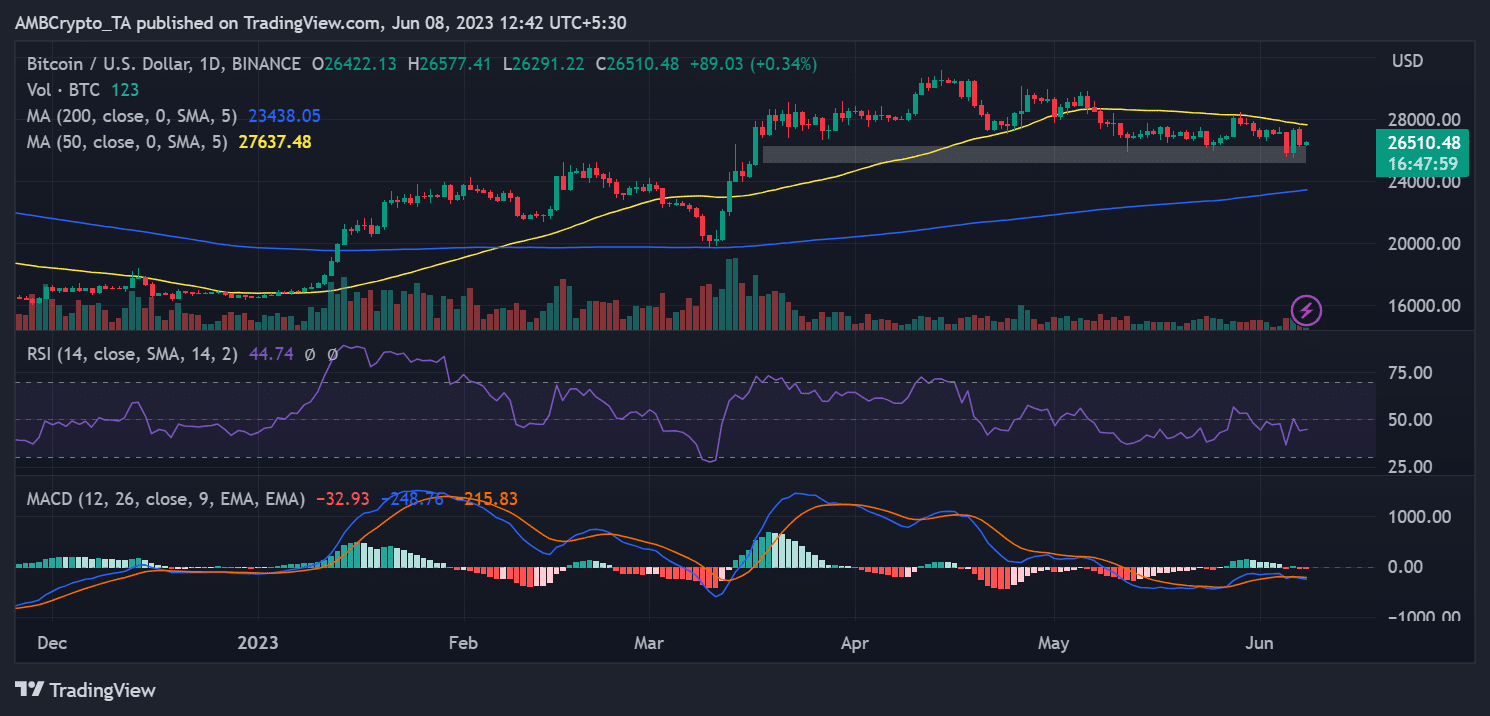
Source: TradingView
The Altcoin market is mostly flat as BTC continues to trade around $26,500.
Most of the large-cap Altcoin in the top 20 have shown little volatility on the day, with fluctuations of no more than 1%.
In the top 100, Terra Classic (LUNC) and ImmutableX (IMX) were the projects that increased the most when recording 5% and 3.5% profits, respectively.
In contrast, Sui (SUI) and Lido DAO (LDO) are the biggest Altcoin of the past 24 hours, evaporating more than 5% on the day.
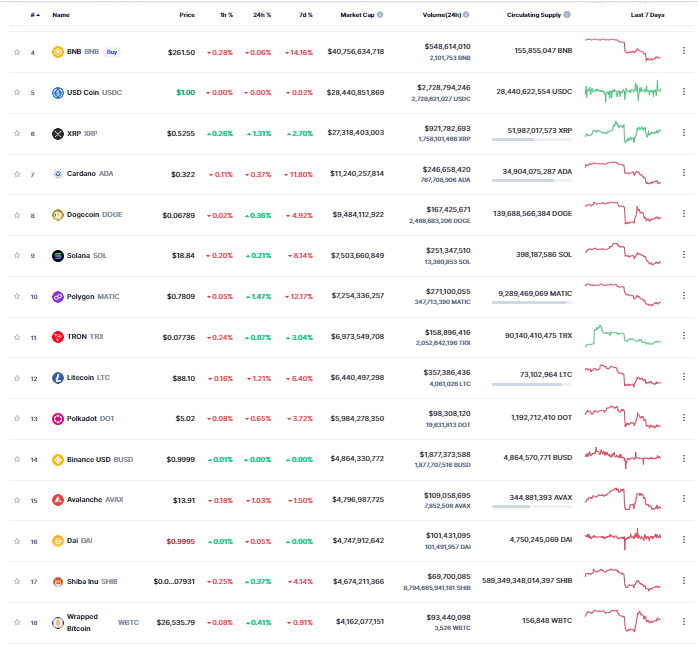
Source: Coinmarketcap
Ethereum (ETH) continues to fluctuate near the $1,850 area. The 2nd largest asset by market capitalization is mimicking the price action of BTC, with relatively little movement over the past 24 hours and is currently trading around $1,847, up slightly by 0.5%.
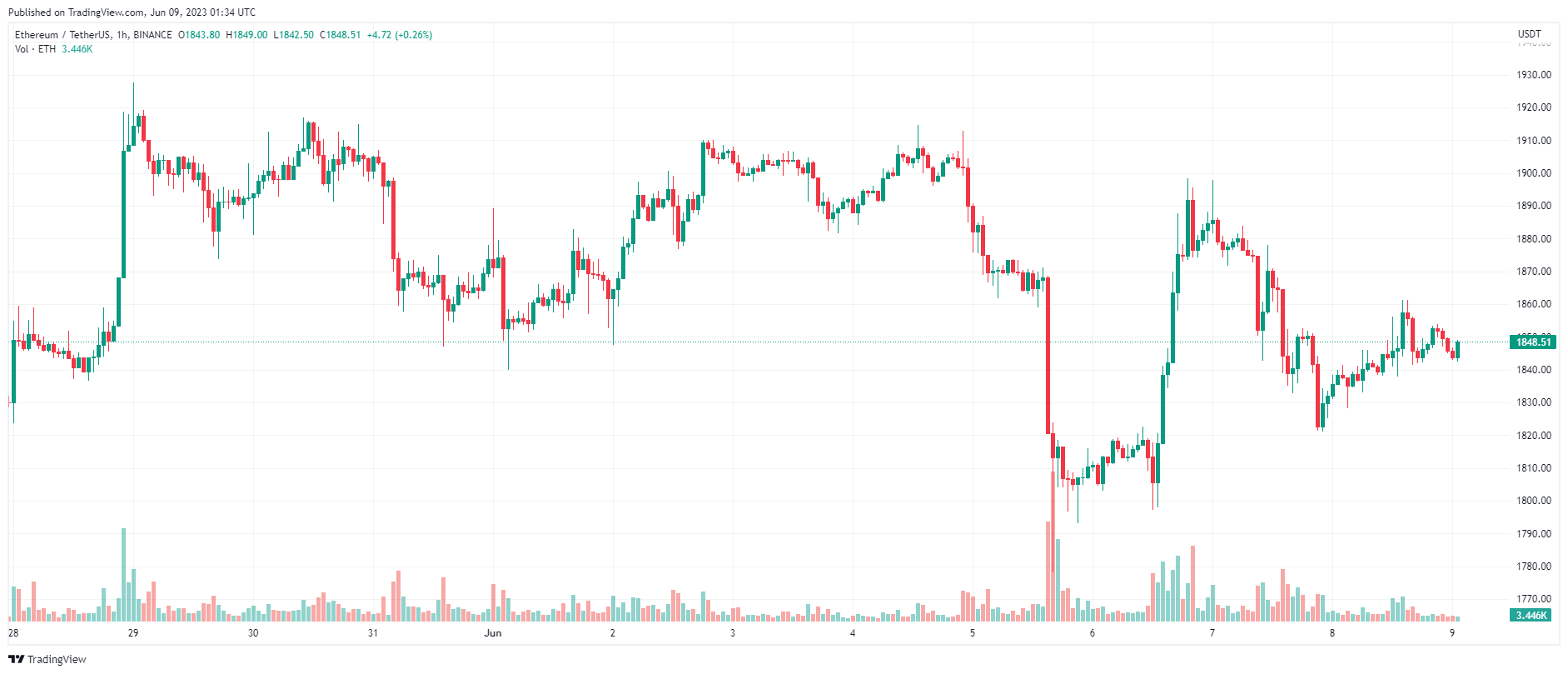
ETH price chart – 1 hour | Source: TradingView
The column “Coin Price today” will be updated at 9:00 daily with general market news, readers are welcome to follow.