Wormhole强行抬价横插一脚,LayerZero收购Stargate还能推进吗?

Odaily星球日报Published on 2025-08-21Last updated on 2025-08-21

原创 | Odaily 星球日报(@OdailyChina

作者|Azuma(@azuma_eth

已进入正式投票流程的“LayerZero 收购 Stargate”提案突然生变。

8 月 21 日,LayerZero 的直接竞争对手 Wormhole 基金会于 X 公开宣布,LdayerZero 对 Stargate 提出的约 1.1 亿美元收购报价低估了 Stargate 的协议资产及增长,因此 Wormhole 计划提交更高报价,并请求暂停当前 Snapshot 投票 5 个工作日,以便完善竞标流程,保障 STG 持有者利益。

背景提要:LayerZero 发起收购

关于 LayerZero 对 Stargate 的收购提案,可追溯至 8 月 11 日 —— 参考阅读《LayerZero 提议收购 Stargate:代币双双暴涨 20%+,但这一群体却强烈反对》。

当日凌晨,LayerZero 基金会在 Stargate 的治理论坛内发布了一则草案,提议以 1.1 亿美元的总价格对 Stargate 进行收购。

具体而言,LayerZero 基金会提议按照发文时每 STG 0.1675 美元(实际上略高于当时的市场价格)和每 ZRO 1.94 美元的价格,将所有流通中的 STG(包括处于质押/投票状态的 STG)以 1 STG : 0.08634 ZRO 的比例兑换为 ZRO。收购完成后,Stargate 将更深入地融入 LayerZero 生态系统,Stargate DAO 将解散,Stargate 未来产生的所有超额收入将通过回购计划用于减少 ZRO 的流通供应。
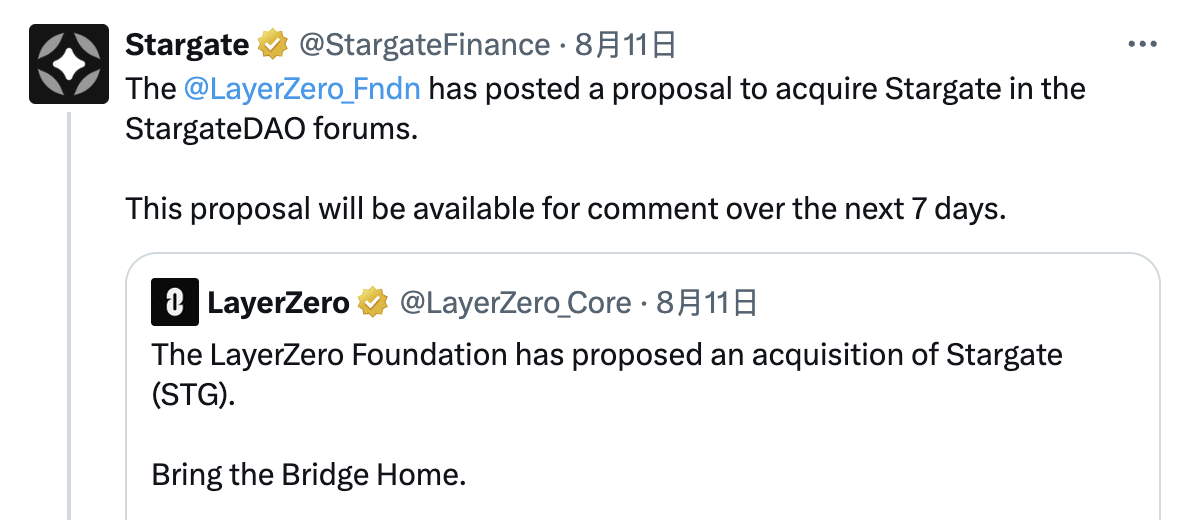
提案公布后,LayerZero 和 Stargate 的官推频频互动,双方大谈“合作共赢”,受此影响当日 ZRO 和 STG 也双双暴涨,但细看 Stargate 的治理论坛讨论内容,绝大多数 Stargate 均对该收购提案持反对态度,认为 LayerZero 的报价过于低估

前期进展:投票启动,大户碾压

8 月 18 日,该提案正式在 Snapshot 上启动投票,STG 持有者将共同决定是否接受该收购要约。相较于最初的提案,LayerZero 并未提高收购报价,而是宣称将向 veSTG 的持有者(即直接投票的用户)分享 Stargate 接下来六个月内总收入 50% 的分成。

投票启动后,不但快速突破了最低票数要求,支持率更是一度上冲至 97% 以上(根据规则,结束时超过 70% 即通过)。LayerZero 联合创始人 Bryan Pellegrino 在参与 CounterParty 的播客时甚至还骄傲地大谈:“这是 Stargate 历史上参与票数最多的投票。”

如此一边倒的票型并不令人意外,虽然许多 Stargate 社区成员对报价持反对态度,但 LayerZero 和 Stargate 作为完全绑定的后端协议与前端产品,两家项目本就很难作为两个独立实体看待,甚至于 Stargate 基金会一半的董事会成员都由 LayerZero 方面出任……再结合 LayerZero 和 Stargate 的互动话术来看,不难想象双边的利益相关方本就控制着足够的票权,说白了这就是一场“注定会通过,但需要有个过场”的投票

Wormhole 的阳谋:即便抢不动,也得恶心你一下

可能就连 LayerZero 和 Stargate 双方都没想到,Wormhole 会在如此关键的时刻横插一脚。

截至发文,有别于 LayerZero 提出收购后双方频频互动的“和谐景象”,在 Wormhole 提出有意收购后,Stargate 官方推特没有发布任何一条相关动态,而 LayerZero 方面也仅有联合创始人 Bryan 疑似回应了一句:“这不可能发生。”

截至发文,Wormhole 方面尚未提出正式报价,而原因也让人哭笑不得 —— Wormhole 声称需要更多时间对 Stargate 的估值进行尽调,因为他们不像 LayerZero 那样熟悉 Stargate,熟悉到占了后者半数的基金会董事席位……
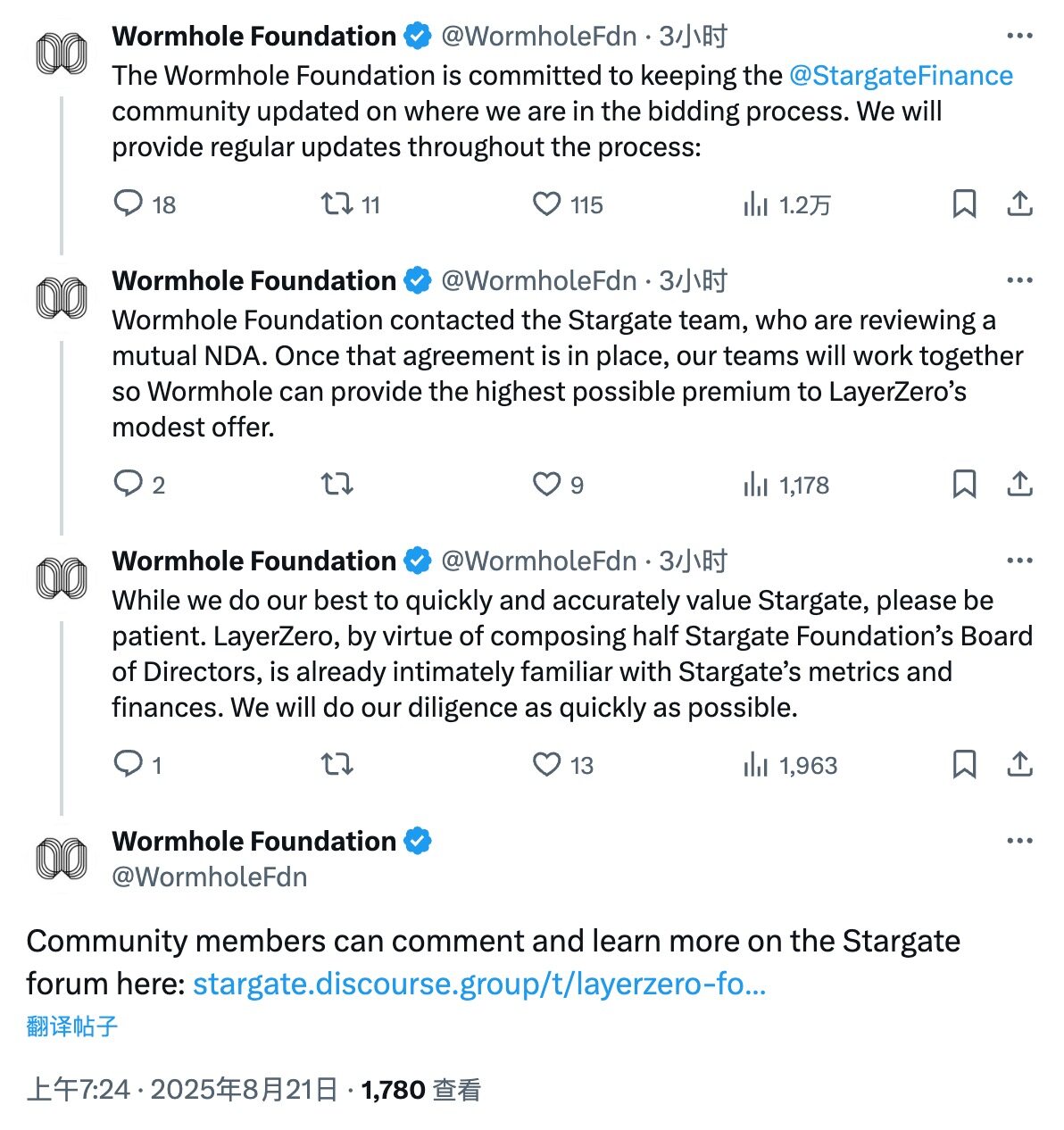
综合目前的情况看来,该起事件后续的发展无非以下四种情况,而无论哪种情况,Wormhole 都会乐见其成。

  • 第一种情况是 Stargate 方面暂停投票,继而进入 Wormhole 和 LayerZero 的竞价,最终假设 Wormhole 获胜。如此一来,Wormhole 将直接夺走最大竞争对手的核心产品,从而抢占更多的市场份额。
  • 第二种情况则是假设 LayerZero 竞价获胜,或是 LayerZero 单方面提高报价并推进提案,如此一来 LayerZero 将支付给多资金给予 STG 持币用户,Wormhole 一分钱不出也能看着对手消耗更多。
  • 第三种情况则是 Stargate 方面以流程已启动为由无视 Wormhole 的报价,提案将以原状况继续推进(目前支持率仍超),如此一来假设 LayerZero 完成了收购,利益上错失更高报价的 STG 必然会因此而恼怒,Wormhole 很乐于看到 LayerZero 方面的社区分裂。
  • 第四种情况也是 Stargate 强行推进投票,假设提案最终以 Stargate 社区反对而失败(目前支持率仍超 88%,失败可能性极低),Wormhole 阻挠计划成功。

综合来看,我个人会更倾向第二种和第三种剧本,毕竟 Stargate 作为 LayerZero 的核心产品,后者绝对不愿意承担损失该产品的后果。

Fluid 首席运行官 DMH 很精炼地概括了当下的状况:“显然 Stargate 和 LayerZero 在提案之前就已经达成一致;Wormhole 很生气,LayerZero 竟然用一袋米买了新加坡;因此 Wormhole 选择抬价,试图扰乱 LayerZero 的收购计划;但 Stargate 最终一定会被 LayerZero 吸收,这一点市场都心知肚明,所以不会有出现任何戏剧情况。”

Wormhole 可能在报价之前也已知道最终的结果早就注定,但动动嘴皮子就能让最大的竞争对手极度恶心,且自己毫无损失,这波简直是顶级阳谋。

Related Reads

Altcoin: The ETF Boom Explodes – XRP, SOL, LTC, HBAR, DOGE, LINK, and the Emergence of New Opportunities

While the spotlight has been on Solana (SOL) ETFs, which have attracted approximately $682 million in inflows, XRP ETFs have quietly surpassed them with $874 million, despite launching later. Simultaneously, a new wave of altcoin ETFs for LTC, HBAR, DOGE, and LINK has entered the market, each recording modest but stable inflows since their debut. Seven separate Solana ETFs have generated $618.62 million in net inflows, holding $915.08 million in assets under management, representing about 1.15% of Solana's market cap. In contrast, four XRP ETFs have attracted $874.28 million, with Canary's XRPC leading at $357 million. The newly launched altcoin ETFs for LINK, HBAR, LTC, and DOGE have collectively seen $133.46 million in net inflows. Grayscale's GLNK attracted $40.90 million, Canary's LTCC (Litecoin) drew $7.67 million, and its HBR (HBAR) ETF recorded $82.04 million. Two DOGE ETFs brought in $2.85 million. This expansion signals a new market phase of diverse choices and intense competition. However, these new altcoin ETFs remain far behind the established Bitcoin and Ethereum ETFs in terms of total capital. Amid this ETF boom, Bitcoin Hyper (HYPER) is emerging as a potential altcoin outside the traditional ETF scope. It's a Bitcoin Layer-2 project built on the Solana Virtual Machine (SVM), combining Solana's speed with Bitcoin's security. Having raised nearly $29 million in its presale, it offers a fixed supply of 21 billion tokens and 40% staking APY, positioning itself to unlock Bitcoin's potential in DeFi.

bitcoinistHace 13 min(s)

Altcoin: The ETF Boom Explodes – XRP, SOL, LTC, HBAR, DOGE, LINK, and the Emergence of New Opportunities

bitcoinistHace 13 min(s)

Polymarket Revival: The Mainstreaming of Crypto Prediction Markets and Future Prospects

Polymarket, a crypto-based prediction market platform, has made a significant comeback in 2025 by re-entering the U.S. market through regulatory-compliant means, including the acquisition of regulated trading and清算 entities. This resurgence is further supported by institutional capital investment and integration with mainstream platforms like the MetaMask wallet, allowing users to trade directly without leaving their wallets. Mainstream financial data platforms have also begun displaying prediction market data, increasing market visibility. Once viewed primarily as a gambling or speculative platform, Polymarket is increasingly recognized as a mechanism for information pricing in financial markets. Widespread participation from both retail and institutional users has made its probability assessments of future events more representative and liquid. Prediction market data is now being incorporated by traditional financial media and data platforms, highlighting its growing potential. However, challenges remain. Prediction markets are not always accurate, with studies showing limited predictive reliability in certain contexts. Questions about platform neutrality and business models have emerged, such as the employment of internal market makers, which could undermine trust. Information asymmetry and insider risks are inherent, potentially disadvantaging ordinary users when some participants access information early. Regulatory, tax, and disclosure requirements also present ongoing uncertainties. The revival and transformation of Polymarket signify a broader shift of prediction markets from niche experiments toward mainstream financial infrastructure. By converting public expectations into tradable probabilities, these markets may complement traditional analysis and polling, providing real-time, decentralized signals in areas like macroeconomics, policy, technology, and geopolitics. As traditional financial institutions invest in compliance and structured products, DeFi is evolving beyond an alternative asset pool to resemble traditional financial infrastructure. Prediction market applications are expanding beyond crypto to potentially include stocks, macroeconomic indicators, sports events, and tech product launches, tightening the link between crypto and the real world. If platforms like Polymarket continue on a path of compliance, stable operation, and integration with mainstream financial services, they could become next-generation market infrastructures—event-driven financial tools alongside stocks, bonds, and options. Key factors for development include platform neutrality, prediction accuracy, regulatory environment, participant diversity, and the maturity of related financial products. In summary, Polymarket’s comeback represents a move of prediction markets from the fringe into the core of financial systems, reflecting deeper changes in how information is priced and how financial infrastructure is rebuilt. This shift brings not only new trading methods but also potential changes in how investors perceive and engage with future events and asset valuation.

cointelegraph_中文Hace 50 min(s)

Polymarket Revival: The Mainstreaming of Crypto Prediction Markets and Future Prospects

cointelegraph_中文Hace 50 min(s)

Trading

Spot
Futures
活动图片