Ether Machine Boss Snubs Bitcoin, Backs Ethereum As Superior Bet

bitcoinistPublished on 2025-07-24Last updated on 2025-07-24

Abstract

According to Andrew Keys, co‑founder and chairman of the Ether Machine, Bitcoin feels like yesterday’s tool. He told CNBC’s Squawk...

Trusted Editorial content, reviewed by leading industry experts and seasoned editors. Ad Disclosure

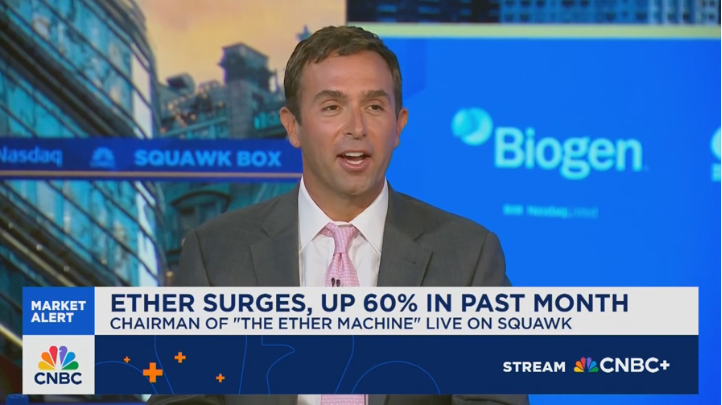
According to Andrew Keys, co‑founder and chairman of the Ether Machine, Bitcoin feels like yesterday’s tool.

He told CNBC’s Squawk show on July 21 that he’d “rather have an iPhone than a landline.”

Keys went on to say he owns zero Bitcoin, staking his entire belief on Ethereum. That move puts him in a small group of crypto backers who champion Ethereum without holding any Bitcoin.

Ethereum Firm Backs GENIUS Act

Based on reports, Keys says the GENIUS Act will be a game‑plan for growth. That law, approved on July 18, clears the way for US‑based stablecoin issuers by setting guardrails for audits, reserves and licensing.

More than 50% of all stablecoins now run on Ethereum’s smart‑contract network. If stablecoin volumes hit the predicted trillions, that share would drive big fee gains for validators and dApps alike.
Smart‑Contract Network Attracts Institutional Flows

According to Keys, institutional players will flock to Ethereum for settlements and real‑world tokenization. He compared Ethereum’s stablecoin grip to Google’s search dominance, noting Google has about 90% of all searches.

Banks and funds, he said, will find it easier to handle cash‑like tokens on a network built for programmable money. That view echoes strategist Tom Lee of FundStrat, who recently said Ether could jump to $15,000 by year‑end. Lee, however, still holds Bitcoin as well as Ethereum.

Ethereum is currently trading at $3,668. Chart: TradingView

SPAC Listing Raises Big Money

Based on filings, the Ether Machine has teamed up with SPAC firm Dynamix Corporation to list under the ticker ETHM on Nasdaq.

Keys is putting in $645 million of his own funds as an anchor investment. The combined company aims to raise $1.5 billion to back a treasury of ETH, staking operations and DeFi strategies. Investors like 10T Holdings, Pantera Capital and Electric Capital have already signed on.

Competition From Layer‑2s And Other Chains

According to on‑chain data, some activity is shifting to Layer‑2 networks such as Arbitrum and Optimism. Rival blockchains like Solana and Avalanche also host parts of the stablecoin market and NFT trades. That trend could spread transaction fees away from Ethereum mainnet, curbing some of its expected gains.

Based on market chatter, some analysts worry about a cliff in SPAC deal flow. Closing the ETHM merger depends on shareholder redemptions and SEC review.

There’s also regulatory risk over staking services, which the SEC may see as unregistered securities. Gas‑fee spikes during periods of heavy use could deter new users, too.

Featured image from Unsplash, chart from TradingView

Editorial Process for bitcoinist is centered on delivering thoroughly researched, accurate, and unbiased content. We uphold strict sourcing standards, and each page undergoes diligent review by our team of top technology experts and seasoned editors. This process ensures the integrity, relevance, and value of our content for our readers.

Christian, a journalist and editor with leadership roles in Philippine and Canadian media, is fueled by his love for writing and cryptocurrency. Off-screen, he's a cook and cinephile who's constantly intrigued by the size of the universe.

Related Reads

Stablecoins at a Crossroads: Clear Regulations Drive Adoption, Systemic Risks Remain

Stablecoins are at a critical juncture, with regulatory clarity driving their rapid evolution from crypto trading tools to mainstream payment and settlement infrastructure. The U.S. GENIUS Act and the EU’s MiCA framework have established federal and regional standards for issuance, reserves, and auditing, accelerating their adoption. Market capitalization has surpassed $300 billion, with USD-pegged stablecoins dominating, though euro and other fiat-backed alternatives are growing. Use cases are expanding significantly, with enterprises adopting stablecoins for cross-border payments, payroll, and treasury management due to their 24/7 availability and low transaction costs. They are increasingly integrated into traditional finance as settlement and custody solutions. However, systemic risks remain. USD-pegged stablecoins face potential de-pegging risks, insufficient reserve transparency, and high centralization, which could trigger liquidity crises. Large holdings of sovereign bonds or fixed-income assets may also impact bond markets and monetary policy. The IMF has warned about financial stability risks and dollarization concerns. For stablecoins to mature into reliable, compliant, and interoperable digital infrastructure—rather than just survive—they require transparent issuance mechanisms, robust regulatory coordination, and effective systemic risk controls.

cointelegraph_中文2m ago

Stablecoins at a Crossroads: Clear Regulations Drive Adoption, Systemic Risks Remain

cointelegraph_中文2m ago

Cryptocurrency Exchange Bybit to Promote the Stablecoin USDC. What Are the Plans

Cryptocurrency exchange Bybit and Circle, the issuer of the USDC stablecoin, have announced a strategic partnership. Bybit will promote the use of USDC among its users. As one of the largest exchanges, Bybit plans to enhance USDC liquidity on spot and derivatives markets and further integrate the stablecoin into its ecosystem, including its Bybit Earn, Bybit Pay, and other services. The partnership includes joint campaigns to increase the efficiency of USDC usage on the platform. Bybit is the second-largest exchange by trading volume after Binance, with over $2.5 billion traded in the last 24 hours. It is notably popular in Russia, where it attracted 28% of its traffic in October. USDC is the second-largest stablecoin by market capitalization at $78 billion, behind Tether's USDT at $185 billion. The trading volume gap is significant, with USDT at $76 billion and USDC at $5 billion over the past day. The collaboration will also explore deeper integration for cross-chain liquidity and institutional-grade financial solutions. The partnership will expand to fiat solutions, leveraging Circle's infrastructure and partner network with Bybit's global reach to simplify deposits and withdrawals in key markets. Bybit emphasized that this partnership aligns with its commitment to regulatory compliance, noting its recent virtual asset license in the UAE and expanded presence in the EU, Turkey, and other jurisdictions.

RBK-crypto19m ago

Cryptocurrency Exchange Bybit to Promote the Stablecoin USDC. What Are the Plans

RBK-crypto19m ago

Trading

Spot
Futures
活动图片