ZORA Plunges 95%, Coinbase Finally Admits Creator Coins Failed

Foresight NewsPublicado a 2026-07-14Actualizado a 2026-07-14

Resumen

On July 13th, Coinbase CEO Brian Armstrong publicly declared the failure of Base network's year-long "content coins" strategy. Initially launched in 2025 via the Zora platform and integrated into Coinbase's wallet as a core feature, the model aimed to turn every social media post into a tradeable token. Each post or creator account would generate 1 billion ERC-20 tokens, with creators receiving an initial allocation. The concept briefly propelled Base to become the largest L2 by new token issuance. However, the model proved unsustainable. These tokens, explicitly not granting ownership or revenue shares, primarily functioned as speculative assets dependent on new buyers. While activity surged in mid-2025—with millions of tokens minted and billions in trading volume—it failed to build lasting user engagement or value. High-profile token launches, including one by Base's official account, experienced extreme volatility, often crashing shortly after spikes. The supporting infrastructure token, ZORA, plummeted approximately 95% from its August 2025 peak, losing nearly $520 million in market capitalization. Armstrong acknowledged the misstep, stating "it didn't work" and that Base had shifted focus earlier in the year toward its core competencies of trading and stablecoin payments. This pivot follows internal criticism that the content coin experiment consumed excessive resources, harmed other Base projects, and ultimately resulted in significant financial losses for participati...


By: ChandlerZ, Foresight News


On July 13, Coinbase CEO Brian Armstrong publicly acknowledged on X that the content coins strategy, pursued for over a year on the Base network, had failed. Starting in 2025, Base aggressively promoted content coins through the Zora platform, embedding them as a core feature in its own wallet product. This initially propelled Base to become the L2 chain with the highest volume of new token issuance.
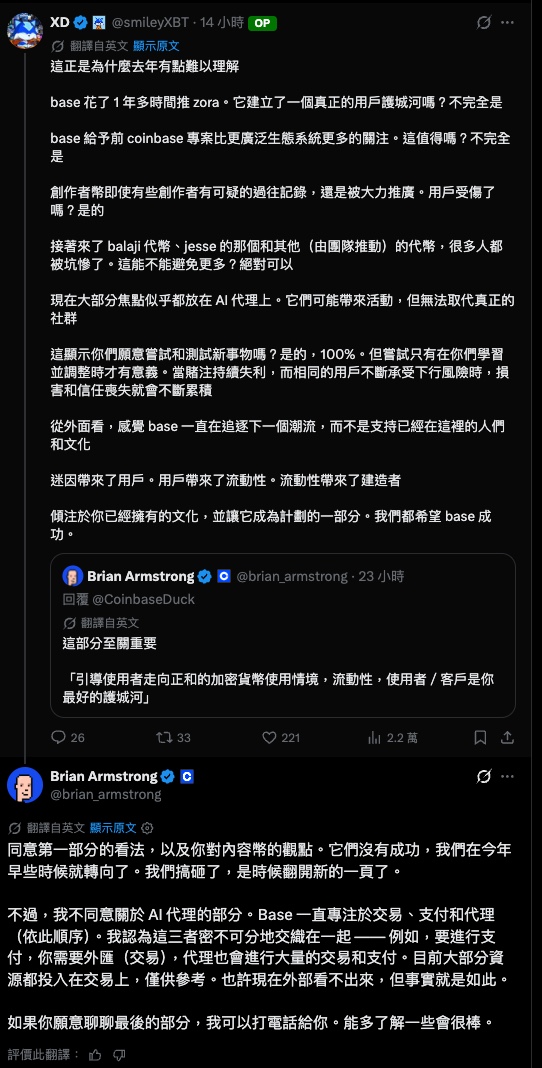


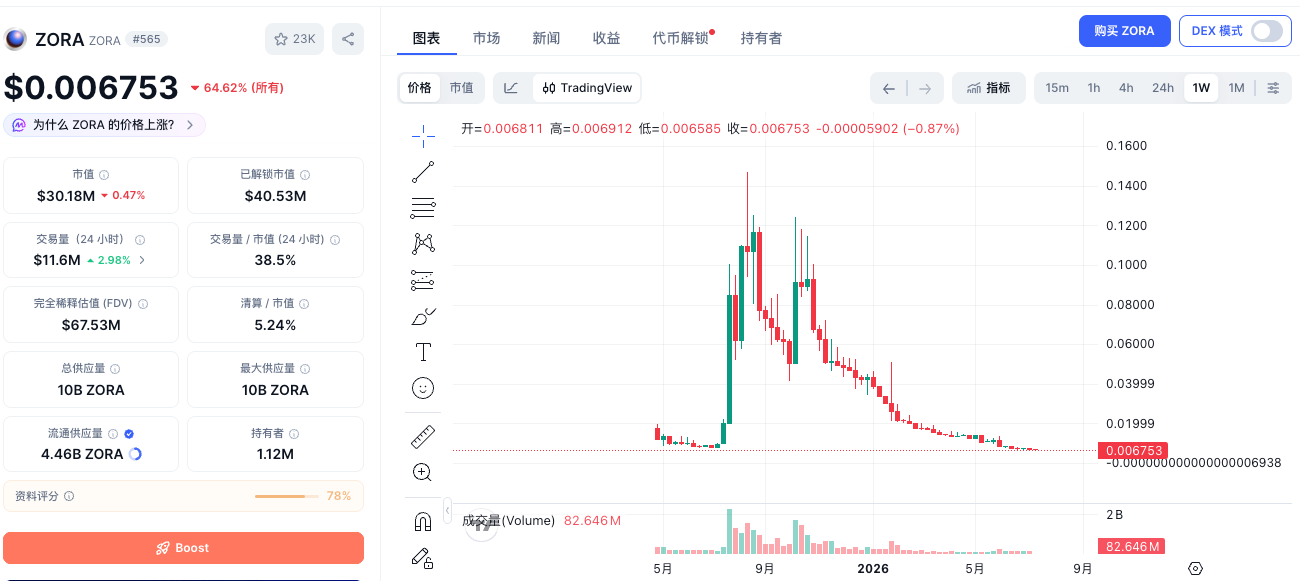
Brian Armstrong stated, "It didn't work, and we pivoted earlier this year. We messed up, time to move on." The ZORA token, which provided the core infrastructure for this experiment, has fallen approximately 95% from its all-time high last August, with its market capitalization shrinking from about $550 million to around $30 million.


From 'Every Post is a Coin' to 'We Messed Up'


Brian Armstrong's statement provides the clearest official characterization of failure for Base's roughly year-long creator token experiment. In July 2025, Coinbase rebranded Coinbase Wallet as the Base App, simultaneously adding social feeds, chat, payments, trading, and app discovery features. When Base opened the app to over 140 countries in December of the same year, it was still defined as an integrated product for social interaction, trading, and payments.


Base's creator economy was powered by underlying tools from the on-chain social platform Zora. A content coin corresponded to a specific post; when a user published an image, video, or text, the system would simultaneously create a freely tradable ERC-20 token. Each content coin had a fixed supply of 1 billion tokens, with the creator receiving 1% (10 million tokens) directly at launch. The token initially had no price; a market price formed on-chain as other users bought in, with subsequent buying and selling determining the market cap and holder profits or losses.



Buyers acquired a token associated with the post, which they could sell to the market at any time. The token did not include copyright to the post, nor did it represent equity in the creator, future revenue, or profit sharing. Zora's terms of service limited its use to entertainment, use, and consumption, requiring users to confirm their purchase was not for equity or profit-sharing purposes. Therefore, a buyer's profit primarily depended on whether later participants were willing to buy at a higher price.


Creator coins used an entire account as the subject, with each Zora account having only one. It also had a supply of 1 billion tokens, with 50% entering the open market and the other 50% vesting linearly to the creator over five years. Content coins published thereafter by that account would be linked to the creator coin. Zora hoped popular content would increase demand for the creator coin. Creators could sell their allocated tokens and also received a share from each transaction fee. Base claimed at the time that this structure could bypass ads, brand partnerships, and follower count thresholds, directly converting attention into trading revenue.


100,000 Tokens Launched in a Day, Trading Didn't Retain Users


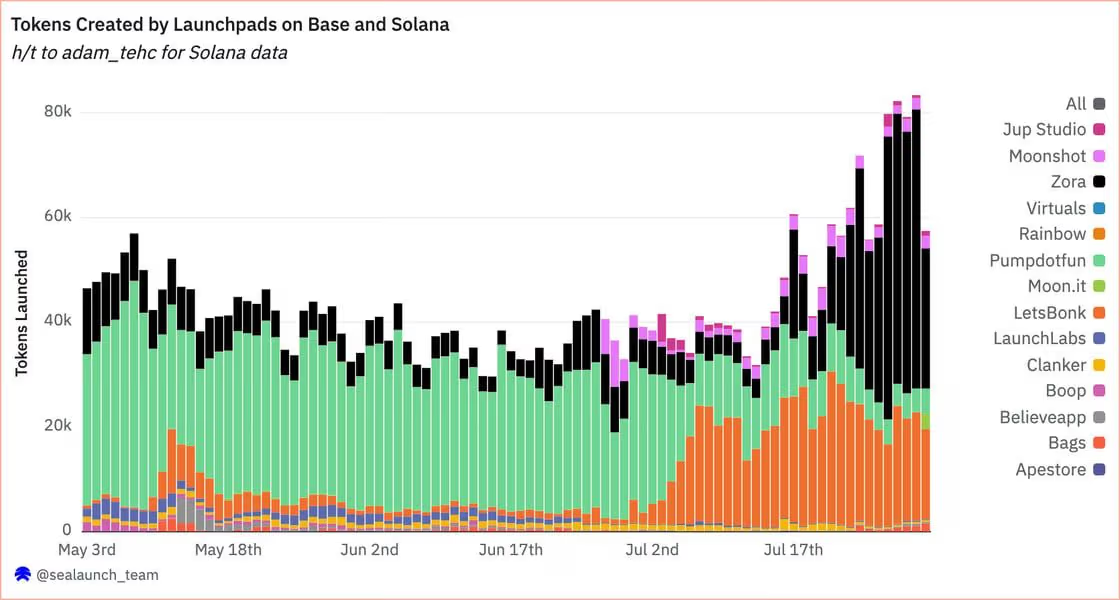
Low-cost token issuance quickly inflated Base's surface-level activity. In August 2025, following the relaunch of the Base App, Zora's activity reached an all-time high. Over 1.6 million creator coins were minted, with nearly 3 million unique traders and a total trading volume exceeding $470 million. The price of the ZORA token also rose nearly 5-fold within a month.


In April 2025, after the official Base account published the "Base is for everyone" content via Zora, the system automatically generated a token of the same name. The token surged briefly after launch before plummeting about 95% within hours. Base explained that the official account did not sell the token nor issue it as a formal project, but ordinary users found it difficult to distinguish between a content post, a token issuance, and official endorsement.


Creator Nick Shirley's token later provided a more direct case study. Shirley's investigative video garnered over 100 million views on social media, and Brian Armstrong had publicly promoted it. His creator coin's market cap once reached $15 million before rapidly retreating. Viral spread brought short-term buying pressure but failed to establish sustained demand for the token.


The collaboration between Base and Zora also sparked discontent among ecosystem developers. Some developers felt Base devoted excessive exposure and resources to Zora and creator coins, which neither created stable user moats nor crowded out display opportunities for other Base projects. The community member who questioned Brian Armstrong on July 13 also pointed out that many participants suffered losses as token prices fell.


Defending Content Coins in January, Retreating by February


Brian Armstrong was still defending the model as recently as January of this year. Responding to a former Coinbase engineer's critique of the zero-sum nature of content coins, he argued that buying content coins generated economic value and demand for creator coins. Roughly a month later, the Base App announced the discontinuation of Creator Rewards and removed the social feed powered by Farcaster, shifting the product focus toward tradable assets.


In March, Brian Armstrong admitted in a podcast for the first time that the SocialFi features of the Base App "didn't work that well." Base's subsequently released 2026 strategy placed trading and stablecoin payments at its core. Official disclosures stated that Base processed over $17 trillion in stablecoin transaction volume in 2025, covering 26 local currencies and 17 countries. These figures provided clearer commercial justification for pivoting toward financial infrastructure.


In the same thread, Armstrong rebutted another criticism. @smileyXBT suggested Base's heavy bet on AI agents was repeating the cycle of chasing hype. Armstrong responded that Base's roadmap had always prioritized trading, payments, and AI agents in that order, with most resources currently directed toward trading.


From Base's official coin minting in April 2025 to Armstrong's "we messed up" in July 2026—15 months in between. ZORA's market capitalization evaporated nearly $500 million. Throughout this process, Coinbase doubled down, embedding Zora into its wallet product, encouraging funds to establish creator token indices, and providing platform-level exposure for tokens from insiders.


Coinbase can relegate these 15 months to a concluded product experiment, but the losses in holders' accounts won't disappear with the strategic pivot.


Preguntas relacionadas

QWhat did Coinbase CEO Brian Armstrong publicly admit on July 13th regarding Base's content coin strategy?

AOn July 13th, Coinbase CEO Brian Armstrong publicly admitted that Base's content token (creator coin) strategy, which had been running for over a year, had failed. He stated, "didn't work, we turned away from it early this year. We fumbled, time to move on."

QWhat was the primary function of the creator/content coins on Base as provided by Zora, and what did they *not* represent?

ACreator/content coins on Base, powered by Zora, functioned primarily as tokens linked to a creator's account or a specific post (like a video or text). They were intended for entertainment, use, and consumption. Crucially, they did NOT represent ownership, equity, future revenue, profit share, or copyright of the creator's work or the specific post.

QAccording to the article, what was a major reason the creator coin experiment failed to create sustainable value?

AA major reason for the failure was the lack of sustainable demand. The model relied heavily on viral moments and speculative buying, where buyers' profits depended primarily on finding new buyers willing to pay a higher price (a zero-sum dynamic). Viral popularity generated short-term spikes but failed to build lasting economic utility or user retention for the tokens.

QHow did the failed experiment impact the ZORA token's value?

AThe ZORA token, which provided the core infrastructure for the creator coin experiment, suffered a massive decline. Its value dropped approximately 95% from its all-time high in August of the previous year, with its market capitalization shrinking from around $550 million to about $30 million.

QWhat is Base's new strategic focus after moving away from the creator coin and SocialFi approach?

AAfter pivoting away from the creator coin/SocialFi strategy, Base's new strategic focus for 2026 centers on core financial infrastructure: trading and stablecoin payments. The company highlighted its significant volume in stablecoin transactions as the business basis for this shift.

Lecturas Relacionadas

Must-Watch Events Next Week|CLARITY Act Could Face Senate Vote; SpaceX, Circle to Report Earnings (8.3-8.9)

**Summary: Key Events and Developments to Watch (August 3-9)** The upcoming week is marked by significant financial disclosures, key legislative deadlines, and notable product updates. **Major Financial Events:** Several companies are scheduled to release their Q2 2026 earnings. American Bitcoin (ABTC) will report on August 3, followed by SpaceX and Hut 8 Mining Corp. on August 4, and Circle on August 5. Notably, a significant portion of SpaceX shares (up to 12% of total shares) will be unlocked on August 6 following their earnings release. **Key Legislative Deadline:** The U.S. Senate faces an August 7 deadline to secure 60 votes for the CLARITY Act, a bipartisan bill aiming to establish a federal regulatory framework for cryptocurrencies. The Senate may hold a full vote on the bill during the week. **Economic Data:** The U.S. July Non-Farm Payrolls report will be released on August 7, providing crucial labor market data. **Technology & Product Updates:** * **Shutdowns:** DeFi portfolio tracker Zapper and wallet app Ctrl Wallet will cease operations on August 3. * **Upgrades:** LayerZero will deprecate its v1 relayers on August 3. XRP Ledger's new version 3.3.0, featuring five new functions, is expected next week. * **AI:** Elon Musk announced that the advanced Grok 4.6 AI model is set for release around August 7. * **Bitcoin:** The BIP-110 forced signaling for a potential Bitcoin network change is scheduled to begin around August 8. **Other Notable Events:** Chinese robotics firm Unitree Tech has set its preliminary price inquiry for its IPO for August 5. South Korean exchange Upbit will delist AQT and AERGO tokens on August 3.

marsbitHace 1 hora(s)

Must-Watch Events Next Week|CLARITY Act Could Face Senate Vote; SpaceX, Circle to Report Earnings (8.3-8.9)

marsbitHace 1 hora(s)

Stocks Are Plummeting More Sharply Than Cryptocurrencies. Where Has the Money Gone?

Stock Markets Plunge Deeper Than Cryptocurrencies: Where Did the Money Go? In late July, Seoul's Kospi index triggered circuit breakers for two consecutive days, plummeting over 40% from its June high. The collapse was led by heavyweight stocks like SK Hynix, whose record profits still disappointed investors, and devastating leveraged ETFs, with one major product losing over 83% of its value. This signaled a global, forced deleveraging targeting the most crowded trades. Interestingly, while stocks exhibited extreme volatility akin to crypto markets, Bitcoin rose nearly 15% in July after a prior steep drop. Analysis shows the money fleeing equities did not flow into Bitcoin. Instead, Bitcoin had already absorbed its sell-off in May-June, when U.S. spot Bitcoin ETFs saw historic outflows. The true safe-haven beneficiary was gold, whose price rose over 20% year-on-year, highlighting a decoupling between Bitcoin and gold as "digital gold." The sell-off was a targeted unwinding of leveraged positions in tech and semiconductors, accelerated by broker-dealer risk management and shifts in the AI narrative, including new competition from Chinese memory chipmakers. The retreat path was clear: from high-valuation tech stocks to cash and U.S. Treasuries, then to gold. For Bitcoin to attract sustained institutional inflows, conditions like eased global liquidity pressure, a "soft-landing" Fed rate cut, and U.S. regulatory clarity via legislation like the stalled CLARITY Act are needed. Currently, Bitcoin is not a safe haven but an already-cleared asset. Its low correlation with tech stocks, however, makes it a potential diversification play for institutional portfolios once the storm passes. The money isn't here yet, but the positioning is underway.

marsbitHace 1 hora(s)

Stocks Are Plummeting More Sharply Than Cryptocurrencies. Where Has the Money Gone?

marsbitHace 1 hora(s)

In Conversation with Ray Dalio: We Are Currently in an AI Bubble, with 1% of My Portfolio in Bitcoin

Ray Dalio, founder of Bridgewater Associates, warns in an interview that the current AI boom shows classic bubble characteristics, which could lead to significant economic downturns as seen in past cycles like 1929 or 2000. He explains that speculative enthusiasm, fueled by debt and overvaluation, often precedes a crash when rising rates or taxation force asset sales, causing widespread losses and recession. Dalio also outlines his "Big Cycle" theory, describing an approximate 80-year pattern where widening wealth gaps, massive government deficits, and shifting geopolitical power (like China's rise) create internal conflict and global instability. He emphasizes that we are in a late-cycle, transitional phase where traditional powers like the US and UK face decline. For personal wealth protection, Dalio advises diversification beyond cash into assets like stocks, bonds, real estate, and particularly gold, which he prefers over Bitcoin. While he holds about 1% of his portfolio in Bitcoin as a non-printable hard asset, he views gold as more secure from technological or governmental threats. Regarding AI's impact, Dalio believes it will disproportionately benefit capital owners, worsening inequality by replacing both physical and cognitive labor. He suggests that human intuition and emotional intelligence, combined with AI, will be key for future workers. On taxation, Dalio argues that wealth taxes are impractical and risk triggering asset sell-offs, reducing productive investment. He points to the UK as a cautionary example of debt, low productivity, and political strife. Geopolitically, Dalio foresees a more regionalized world, with the US showing weakness in prolonged conflicts like with Iran, akin to past imperial declines. The ideal outcome, he suggests, is coexisting powerful blocs (e.g., Americas, China-Asia Pacific) without major war.

marsbitHace 5 hora(s)

In Conversation with Ray Dalio: We Are Currently in an AI Bubble, with 1% of My Portfolio in Bitcoin

marsbitHace 5 hora(s)

Trading

Spot
活动图片




