ZK-Driven Bitcoin Privacy Solution Officially Launches on Starknet

marsbitPublicado a 2026-05-14Actualizado a 2026-05-14

Resumen

Starknet has launched strkBTC, a ZK-driven privacy solution for Bitcoin. It uses Starknet's zero-knowledge technology to shield transaction details and balances on the public ledger, addressing growing security concerns like targeted robberies and AI-powered wallet tracking. The system is designed to be compliance-ready, featuring view keys for authorized audits and third-party screening to prevent illicit funds. Future plans include confidential DeFi activities on Starknet, quantum-resistant cryptography, integration with BitVM for enhanced security, and a long-term goal of a trustless bridge via a Bitcoin OP_CAT soft fork. The initiative aims to make Bitcoin function as private digital cash while maintaining necessary accountability.

strkBTC officially launched on Starknet on May 12, leveraging Starknet's ZK technology to provide advanced shielding mechanisms while being fully compliant. This privacy solution addresses the growing demand for privacy protection and serves as a practical response to armed robberies and threats triggered by public ledger exposure of large Bitcoin holdings. As personal safety concerns for Bitcoin holders become increasingly severe, privacy protection is not just a technical innovation but potentially life-saving.

Damian Chen, Vice President of the Starknet Foundation, stated: "When criminals monitor public ledgers, use AI to track wallets, and attack others for cryptocurrency, privacy is no longer merely a noble ideal."

"Privacy is both a need and a right. We urgently need privacy solutions that can draw the curtains, meaning criminals can no longer peer through the window to plot against their targets."

Private Digital Cash, As It Was Meant to Be

Privacy pioneer and StarkWare CEO & Zcash co-founder Eli Ben-Sasson believes that strkBTC's momentum can transform into "private digital cash — as it was meant to be."

He stated that strkBTC represents a significant advancement of some of the ideals that drove the Zcash project. The strkBTC economy will allow users and institutions to hide balances, which is essential for protecting rights, ensuring security, and promoting adoption. In the future, users will also be able to participate in DeFi while maintaining full compliance and selective disclosure capabilities.

What Are strkBTC's Current Core Features?

  • Re-anonymization: A mechanism to bridge back to a new, unlinked Bitcoin address.
  • Compliance-Ready: Full auditability for tax and legal purposes through viewing key technology and integrated third-party asset screening to prevent prohibited or sanctioned assets from entering the privacy pool.

What Features Are Coming Soon?

  • Confidential DeFi: Shielded lending, trading, and yield generation on Starknet while preserving credible utility.

The Safety Mission: Privacy as Physical Security

Starknet has long been a leader in the privacy space, using the zero-knowledge STARK cryptography co-invented by Ben-Sasson.

STARK combines scalability with strong privacy guarantees, and strkBTC applies this technology to the most pressing issue facing Bitcoin holders today: Bitcoin-targeted crime.

This connection is no longer theoretical but actionable. In 2025, armed robberies and extortion cases targeting Bitcoin holders increased by 75%. The Starknet team has been closely monitoring this trend. According to recent estimates, AI-powered tools can now link public wallet addresses to real-world identities with up to 90% accuracy.

Chen pointed out that blockchain's default transparency has severe consequences in the absence of effective protection. For individuals, the risk is physical safety; for institutions, the issue is adoption. Many serious financial institutions cannot operate at scale when every balance, transfer, and treasury activity is publicly visible.

He added: "Bitcoin is the most sovereign money ever created, but it's also the least private money most people have ever used. For fifteen years, we've told ourselves the public ledger is a feature, but in 2026, it has become a map to our private lives."

"When people show up at someone's doorstep because they saw their wallet balance online, transparency is no longer a feature—it's exposure. That's why we built strkBTC, to address how the world has changed since 2008."

The situation in France has already become severe, with 41 cryptocurrency-related kidnapping cases recorded in the country this year. Recently, a French family was attacked after their crypto assets were identified through leaked datasets and public blockchain activity. The attackers weren't guessing; they knew precisely.

strkBTC is a direct response to the "$5 wrench attack"—where attackers use low-cost violence to force victims to hand over private keys or assets. It's for those who want to hold Bitcoin without broadcasting their entire financial life to anyone with an internet connection.

How strkBTC Works

At its core, strkBTC is a technical wrapper for Bitcoin designed to bring it into a shielded environment on Starknet, allowing users and institutions to protect balances and transaction history while retaining the ability to comply with audit, tax reporting, and legal requirements.

In practice, strkBTC allows the underlying value to enter "shielded mode," whereupon balances and transaction history are hidden from the public.

In stark contrast to older privacy protocols, it was not designed as an opaque black box but was built for regulatory disclosure under legitimate requirements. The system automatically generates viewing keys. When faced with a legitimate regulatory request, independent third-party compliance reviewers can use these keys to share limited and specific data with tax authorities, auditors, or other regulators. This compliant transaction model unlocks vast markets previously inaccessible to BTC due to compliance constraints. Simultaneously, ordinary users will have their own viewing keys, allowing them to unshield transactions for their own needs, while all information remains absolutely private to the public.

It is this compliance layer, guaranteed by designated third-party auditing entities, that activates many financial activities previously hindered by a lack of transactional confidentiality. These specifically include:

  • Private payroll: Paying employee salaries without exposing individual compensation or corporate cash flow movements.
  • Supplier payments: Making B2B transfers without revealing business relationships, pricing, or strategic trade flows.
  • Strategic capital deployment: Moving large positions without signaling intent to the market or attracting predatory observers.

The ultimate goal is to achieve superior usability: enabling Bitcoin to be used as private on-chain cash globally without forcing users into difficult choices between confidentiality and accountability.

A Collective Effort Toward Technical Sovereignty

The realization of strkBTC is the result of collaboration from a broad ecosystem of contributors, including Starknet core developers, alliance partners, wallet service providers, audit infrastructure providers, and liquidity providers dedicated to expanding Bitcoin's utility. Core project members like Eli Ben-Sasson and Chen emphasize that strkBTC, as a now fully operational technical wrapper, serves as an immediate bridge between Bitcoin and Layer2. Project leaders position it as a pragmatic and necessary tool. They know the world cannot wait for a "perfect" technical milestone, therefore prioritizing immediate utility that solves real-world pain points over theoretical purity.

Technical Roadmap

Looking ahead, strkBTC's technical development primarily includes the following directions:

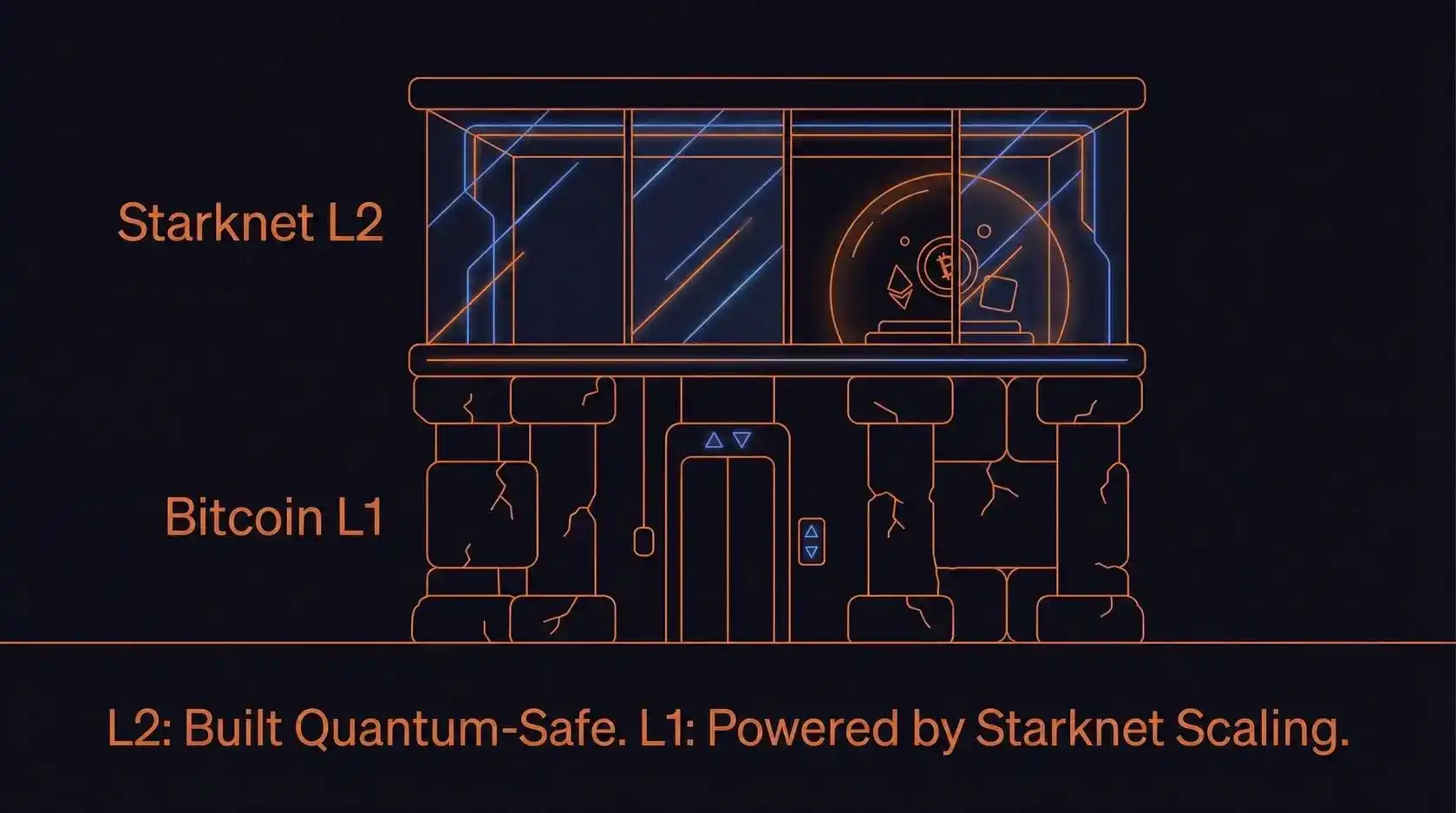
  • Quantum Resistance Research: StarkWare is developing quantum-resistant cryptography for strkBTC. StarkWare Chief Product Officer Avihu Levy recently presented research on making Bitcoin quantum-resistant.
  • BitVM Integration: The project is actively moving towards a 1-of-N security model via BitVM. This model ensures the system remains secure even if only one participant is honest, significantly reducing the required trust assumptions.
  • Ultimate Goal: The long-term vision is to establish a fully trustless bridge powered by an OP_CAT soft fork, enabling Bitcoin to natively verify Starknet proofs.

Original Link

Preguntas relacionadas

QWhat is the name of the new privacy solution for Bitcoin that launched on Starknet, and when did it launch?

AThe solution is called strkBTC, and it officially launched on Starknet on May 12.

QAccording to the article, what is the primary real-world problem that strkBTC aims to address for Bitcoin holders?

AIt primarily aims to address the increasing personal security threats, such as armed robberies and extortion, faced by Bitcoin holders whose wealth is exposed on the public blockchain ledger.

QWhat key feature ensures strkBTC's compliance with regulatory requirements like tax and legal audits?

AThe system generates viewing keys. These keys allow designated independent third-party compliance reviewers to share specific, limited data with authorities or auditors upon legitimate request, while keeping all information private from the general public.

QWhat are two of the future functionalities planned for strkBTC as mentioned in the article?

ATwo planned future functionalities are: 1) Confidential DeFi, enabling shielded lending, trading, and yield generation on Starknet, and 2) Integration with BitVM to move towards a more secure 1-of-N trust model.

QWho described strkBTC's potential as 'private digital cash the way it was always supposed to be' in the article?

AThis statement was made by Eli Ben-Sasson, a pioneer in privacy technology and the CEO of StarkWare and co-founder of Zcash.

Lecturas Relacionadas

A Nation Blocks Chips, a Giant Buys a Nuclear Power Plant: Why It's Time to Seriously Consider DeAI

**Title: Great Powers Blockade Chips, Giants Buy Nuclear Plants: Why It's Time to Seriously Consider DeAI** In May 2026, the US closed loopholes for Chinese firms to acquire advanced NVIDIA chips via overseas subsidiaries. That same month, Kenya halted a $1B geothermal data center project involving Microsoft, fearing its immense energy consumption. Meanwhile, Huawei announced mass production of its Ascend AI chip. These disparate events underscore a new reality: the competition for computing power ("compute") has escalated beyond the tech industry, becoming a geopolitical and infrastructural battleground. A new era of oligopoly is forming, with control over the AI stack—from GPU chips (NVIDIA) and cloud platforms (AWS, Azure, Google Cloud) to foundational models (OpenAI, Anthropic)—concentrating in a few Western "AI Octopus" corporations. This centralization creates systemic risks: pricing power and platform lock-in for users, infrastructure fragility, and a widening "compute divide" that threatens to marginalize nations without independent AI capacity. An "AI Iron Curtain" is deepening through export controls. In response, some nations like Saudi Arabia and the UAE are investing heavily to buy compute power, aiming to transition from oil to AI economies. The EU seeks to triple its compute capacity by 2030 to reduce dependency. However, the spending gap is vast, with four US tech giants alone planning ~$750B in AI capex for 2026. The race is increasingly constrained by energy, with AI tasks consuming up to 1000x more power than web searches, pushing firms to even acquire nuclear plants. This landscape is fueling interest in Decentralized AI (DeAI). It proposes a third way: using open protocols to coordinate a global network of idle GPUs, independent developers, and data centers, creating an AI infrastructure without a single controlling entity. Leveraging blockchain and cryptographic verification, DeAI aims to break market concentration, disperse energy demands, reduce geopolitical dependencies, and enhance transparency. While still nascent in performance and stability, DeAI's core promise is not immediate superiority but providing a crucial alternative architecture to resist monopoly, censorship, and centralized power. As specialized AI hardware costs fall and open-source models flourish, the window to build this foundation is open. The very existence of such competition serves as a vital check against the inevitable abuse of concentrated power.

marsbitHace 36 min(s)

A Nation Blocks Chips, a Giant Buys a Nuclear Power Plant: Why It's Time to Seriously Consider DeAI

marsbitHace 36 min(s)

Outpoll Review: A Prediction Market Platform Built for Active Traders

Outpoll Review: A Prediction Market Platform Built for Active Traders In recent years, prediction markets have grown from a niche sector to a mainstream arena, attracting billions in trading volume and institutional capital. However, the user experience and tools for traders have not kept pace. Outpoll, a new global prediction market platform, aims to fill this gap by providing enhanced trading infrastructure for active and professional traders. Built on standard prediction market principles, Outpoll allows users to trade on the outcome of specific events. It uses fully collateralized contracts with USDC settlement, charges a competitive 0.1% fee per trade, and provides clear settlement rules upfront to minimize disputes. A key focus for Outpoll is its professional-grade trading tools. The platform supports limit and market orders, as well as take-profit and stop-loss orders for open positions—features uncommon in prediction markets. For automated trading, Outpoll offers comprehensive REST and WebSocket APIs, enabling portfolio management, price arbitrage, and integration with existing tools. The platform also features a creator-led market model, where approved experts and community leaders can create and manage markets for niche topics under platform supervision. Its integrated interface combines news feeds directly with trading functions, allowing users to monitor events and manage positions seamlessly. Outpoll launched with a native Android app (available on Google Play) and plans an iOS version later this year. In summary, Outpoll distinguishes itself with trader-focused tools, practical APIs, transparent and collateralized markets, integrated news, and an expanding creator program. For active traders, its advanced order types and API access alone make it a platform worth watching. Outpoll is now globally accessible via outpoll.com and Google Play.

marsbitHace 45 min(s)

Outpoll Review: A Prediction Market Platform Built for Active Traders

marsbitHace 45 min(s)

Bitwise: Crypto Becomes a Contrarian Investment, Three Logics to Understand the Current Market

**Summary** Matt Hougan, Bitwise's CIO, analyzes the current crypto market through three key lenses, arguing it has shifted from a momentum-driven to a contrarian investment. **1) Crypto Becomes a Contrarian Play:** The market is weak, with major assets like Bitcoin and Ethereum down significantly. Capital has moved to hot sectors like AI, leaving crypto as an "unloved" asset class. This transforms crypto investing from trend-following to a test of patience and fundamental analysis. Investors now favor projects with solid fundamentals (e.g., Hyperliquid) over speculative ones. **2) Regulatory Overhang:** The uncertain fate of the U.S. CLARITY Act, a major crypto regulatory framework, is a key headwind. With its passage in 2024 seen as far from guaranteed (estimates range from 30-55%), institutional capital remains on the sidelines, choosing less risky alternatives like AI stocks. The market needs clarity—whether the bill passes or fails—more than any specific outcome to move decisively. **3) Capital Rotates to New Fundamentals:** This cycle differs from past bear markets where money fled to Bitcoin. Now, capital seeks smaller assets with strong use cases. While major cryptos fell in May 2024, tokens like Hyperliquid (+72%), Zcash (+50%), and XLM (+44%) rallied on their specific fundamentals. This rotation confirms the new contrarian, fundamentals-driven logic and signals the bear market may be in its later stages. **Conclusion:** Short-term pressure persists due to regulatory uncertainty and competition from AI narratives. Investing in crypto now requires a contrarian mindset—acting against the crowd and focusing on fundamental value. Patience and targeting high-quality projects based on their merits are essential for capturing long-term gains.

marsbitHace 1 hora(s)

Bitwise: Crypto Becomes a Contrarian Investment, Three Logics to Understand the Current Market

marsbitHace 1 hora(s)

ChatGPT Might Be Disappearing Soon

OpenAI announced at its "Intelligence at Work" event that its coding assistant, Codex, will be fully integrated into the ChatGPT app within weeks. This move marks a strategic shift from a conversational AI (Chat) towards a unified "agentic" platform capable of execution. Codex, originally launched to compete with Anthropic's Claude Code, has grown rapidly to 5 million weekly active users, with 20% being non-developers like analysts and designers. Its enterprise revenue now constitutes 40% of OpenAI's total. The integration is the first step in creating a super-app combining ChatGPT (interface), Codex (execution engine), and the Atlas browser (web access). OpenAI also unveiled new Codex features: specialized Agent plugins for six professional roles, an "Annotations" tool for direct document editing, and a "Sites" function to turn work into shareable web apps. Internally, this reflects a power shift; the Codex team now leads core product strategy. While the ChatGPT brand remains for its vast user base, the platform's future is focused on autonomous agents that perform tasks, not just chat. The article notes that competition with Claude Code pushed OpenAI's development, with Codex competing on cost-effectiveness and accessibility rather than raw coding quality. It concludes that the essence of "ChatGPT" is evolving from a chatbot into an AI agent platform, with the name potentially becoming a legacy symbol of its original function.

marsbitHace 1 hora(s)

ChatGPT Might Be Disappearing Soon

marsbitHace 1 hora(s)

Trading

Spot
Futuros

Artículos destacados

Cómo comprar ZK

¡Bienvenido a HTX.com! Hemos hecho que comprar ZKsync (ZK) sea simple y conveniente. Sigue nuestra guía paso a paso para iniciar tu viaje de criptos.Paso 1: crea tu cuenta HTXUtiliza tu correo electrónico o número de teléfono para registrarte y obtener una cuenta gratuita en HTX. Experimenta un proceso de registro sin complicaciones y desbloquea todas las funciones.Obtener mi cuentaPaso 2: ve a Comprar cripto y elige tu método de pagoTarjeta de crédito/débito: usa tu Visa o Mastercard para comprar ZKsync (ZK) al instante.Saldo: utiliza fondos del saldo de tu cuenta HTX para tradear sin problemas.Terceros: hemos agregado métodos de pago populares como Google Pay y Apple Pay para mejorar la comodidad.P2P: tradear directamente con otros usuarios en HTX.Over-the-Counter (OTC): ofrecemos servicios personalizados y tipos de cambio competitivos para los traders.Paso 3: guarda tu ZKsync (ZK)Después de comprar tu ZKsync (ZK), guárdalo en tu cuenta HTX. Alternativamente, puedes enviarlo a otro lugar mediante transferencia blockchain o utilizarlo para tradear otras criptomonedas.Paso 4: tradear ZKsync (ZK)Tradear fácilmente con ZKsync (ZK) en HTX's mercado spot. Simplemente accede a tu cuenta, selecciona tu par de trading, ejecuta tus trades y monitorea en tiempo real. Ofrecemos una experiencia fácil de usar tanto para principiantes como para traders experimentados.

528 Vistas totalesPublicado en 2024.12.13Actualizado en 2026.06.02

Cómo comprar ZK

Discusiones

Bienvenido a la comunidad de HTX. Aquí puedes mantenerte informado sobre los últimos desarrollos de la plataforma y acceder a análisis profesionales del mercado. A continuación se presentan las opiniones de los usuarios sobre el precio de ZK (ZK).

活动图片