ZetaChain 2.0 Launches With Anuma, Bringing Private Memory and AI Interoperability to Creators

TheNewsCryptoPublicado a 2026-01-27Actualizado a 2026-01-27

Resumen

ZetaChain has launched ZetaChain 2.0, introducing Anuma—a privacy-first AI interface and interoperability layer. Anuma brings private, user-owned memory and cross-AI model interoperability to creators, enabling applications to operate across multiple AI models and blockchains without lock-in. Built by core contributor Ankur Nandwani (co-creator of Basic Attention Token), the platform emphasizes user control, encrypted memory, and built-in monetization. ZetaChain 2.0 includes an AI Portal for unified model routing and a Private Memory Layer for secure, permissioned context retention. The release also features an SDK for developers to build privacy-preserving, multi-model AI apps with global payment support. A waitlist for Anuma is now open.

San Francisco, USA, January 27th, 2026, Chainwire

What Brave helped mainstream for private browsing, Anuma brings to AI with private, user-owned memory and AI Portal-based interoperability powered by ZetaChain 2.0.

ZetaChain today announced the beta launch and public waitlist for Anuma, a privacy-first AI interface built on ZetaChain 2.0. ZetaChain also introduced ZetaChain 2.0, a new AI interoperability layer designed to help developers build applications and agents that work across AI models, preserve private user context, and monetize globally without backend infrastructure.

ZetaChain Core Contributor Ankur Nandwani previously co-created Basic Attention Token (BAT), which powers the Brave browser ecosystem with over 100M monthly active users. Brave helped mainstream privacy-first browsing by blocking trackers and ads by default. Anuma applies that same “privacy and user control by default” approach to the next major consumer interface of AI where context and memory increasingly define user experience.

AI adoption is accelerating at internet scale: McKinsey notes that ChatGPT reached 100 million users in two months, and OpenAI has reported 800 million weekly active users by late 2025. Yet the ecosystem remains fragmented, with only 9% of consumers paying for more than one AI subscription across major assistants. This combination creates lock-in at the model layer and forces developers to repeatedly rebuild the same integration, routing, state, and billing infrastructure, while privacy and data are routinely shared across applications, agents, and model providers.

ZetaChain was built to address fragmentation in Web3 by enabling universal apps — applications that can natively access assets like BTC and execute across multiple blockchains through a single platform. In 2025, the ZetaChain network scaled to more than 11.5 million users and processed more than 225 million transactions. With ZetaChain 2.0, ZetaChain is extending this unification thesis to AI so applications can operate across both chains and models, with permissions and private context built in.

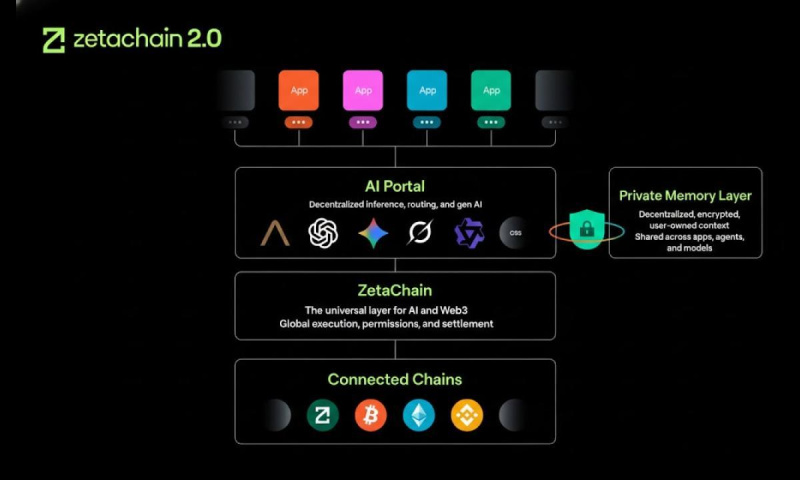
ZetaChain 2.0 is composed of two core components:

  • AI Portal: A unified routing and execution layer that allows applications to access multiple AI model providers without lock-in, with built-in support for availability, fallback, and cost-performance optimization.
  • Private Memory Layer: A protocol-level memory system designed to keep user context encrypted and permissioned, enabling persistent experiences across sessions while maintaining user control over what applications and agents can access.

Developer SDK and Platform

ZetaChain 2.0 is designed to scale as a developer platform. Alongside the protocol components, ZetaChain is releasing a developer SDK that packages private persistent memory, cross-model interoperability, and monetization primitives into a single toolkit. The goal is to make it straightforward to build privacy-first apps and agents that can maintain continuity across sessions, connect to multiple model providers, and support global monetization rails from onchain settlement to traditional payment processors without requiring teams to build bespoke infrastructure.
Anuma: First Consumer Showcase

Anuma is the first consumer AI interface built on ZetaChain 2.0. The product provides access to multiple leading AI models through a single experience, supports switching between models without losing context, and is designed so memory remains private and user-controlled. Users can request early access through the public waitlist.

“Brave and BAT proved that privacy-first defaults can win at consumer scale,” said Ankur Nandwani, Core Contributor at ZetaChain. “We’ve already unified the blockchain experience at scale, powering more than 225 million transactions. ZetaChain 2.0 extends that same approach to AI, enabling the next generation of apps and agents that run across models and chains with private, permissioned memory and global monetization by default.”

In 2023, ZetaChain announced a $27 million funding round with participation from Blockchain.com, Human Capital, VY Capital, Sky9 Capital, Jane Street Capital, VistaLabs, CMT Digital, Foundation Capital, Lingfeng Capital, GSR, and others.

About ZetaChain

ZetaChain is the universal layer for AI and Web3, letting developers build apps that run across chains and models, keep memory private, and monetize without infrastructure. With native connectivity across major blockchains and an AI interoperability stack powered by a Private Memory Layer, ZetaChain is building the foundation for the next generation of apps, agents, and experiences.

Users can follow ZetaChain on X (Twitter) and join the conversation on Discord and Telegram.

Contact

CMO
Jonathan Covey
ZetaChain
jonathan@zetachain.com

Preguntas relacionadas

QWhat is the core innovation that ZetaChain 2.0 introduces with the launch of Anuma?

AZetaChain 2.0 introduces an AI interoperability layer with two core components: the AI Portal, a unified routing and execution layer for accessing multiple AI models, and the Private Memory Layer, a protocol-level system that keeps user context encrypted and permissioned.

QWho is Ankur Nandwani and what is his previous significant contribution mentioned in the article?

AAnkur Nandwani is a Core Contributor at ZetaChain who previously co-created the Basic Attention Token (BAT), which powers the Brave browser ecosystem with over 100 million monthly active users.

QWhat problem in the current AI ecosystem does ZetaChain 2.0 aim to solve?

AZetaChain 2.0 aims to solve the fragmentation and lock-in in the AI ecosystem, where developers are forced to repeatedly rebuild integration, routing, state, and billing infrastructure, while user privacy and data are routinely shared across applications and model providers.

QWhat are the key features of the Anuma AI interface as the first consumer showcase on ZetaChain 2.0?

AAnuma provides access to multiple leading AI models through a single experience, supports switching between models without losing context, and is designed so that user memory remains private and user-controlled.

QHow did ZetaChain demonstrate its scalability in the Web3 space prior to this announcement?

AIn 2025, the ZetaChain network scaled to more than 11.5 million users and processed more than 225 million transactions, demonstrating its ability to unify the blockchain experience at scale.

Lecturas Relacionadas

Misjudged A-Shares: Resilience, Expectations, and Confidence

China's A-share market recently faced selling pressure, especially in tech sectors, initially triggered by a global tech sell-off that began in South Korea. However, the article argues this is a case of "mistaken injury" and highlights the market's underlying resilience. This resilience stems from three main pillars: **1) Tech Sector Fundamentals:** Unlike Korea's market dominated by a few memory chip stocks, China's tech sector is diversified across computing, communications, electronics, and semiconductors, supported by dual narratives of global AI supply chains and domestic substitution. Core areas like optical modules and fiber optics continue to show strong earnings growth. **2) "National Team" Support:** State-backed institutions and large corporations have made significant market purchases and announced buybacks, providing liquidity and signaling confidence. This is seen as a stabilizing policy signal, often associated with market bottoms. **3) Broader Market Pillars:** Other major sectors are showing endogenous recovery momentum. Consumer stocks benefit from stabilizing CPI and signs of sector recovery (e.g., liquor price hikes). Cyclical sectors like aluminum have high earnings, potential price increases due to tight supply, and low valuations. The financial sector offers stable dividends and low valuations. The conclusion is that the sell-off was driven by external contagion, not a collapse in fundamentals. With strong policy support and recovering momentum across key sectors, the A-share market possesses the toughness to regain stability.

marsbitHace 25 min(s)

Misjudged A-Shares: Resilience, Expectations, and Confidence

marsbitHace 25 min(s)

The Clarity Act's Journey Through Congress: The Thorny Path of Bipartisan Compromise in the U.S.

The U.S. Congress is struggling to advance the crypto market structure bill known as the Clarity Act, with bipartisan compromise proving difficult. Key hurdles include unresolved disputes over "yield" products and, more critically, the inclusion of strong ethics provisions for elected officials—a non-negotiable demand for many Democrats. While a compromise on yield was reached in May, securing only limited Democratic support in committee, the separate Senate Agriculture Committee version later passed with no Democratic votes due to the ethics impasse. As Republicans push for a full Senate vote in July, demands for ethics rules have expanded, and other contentious issues like developer protections and concerns from law enforcement and large banks further complicate negotiations. Despite consensus on the need for legislation, the path forward is unclear. Recent discussions between senators and White House officials aim to find acceptable ethics language. Some lawmakers question whether a compromise text can garner enough bipartisan support, with one Democrat stating the current proposal lacks the strong ethics provisions required for their vote. Potential short-term goals for the crypto community include symbolic Senate action before the August recess, a longer-term aim for passage by 2026, or establishing a detailed framework that addresses ethics and other compromises. The process remains arduous, relying on the traditional, vote-by-vote effort to build bipartisan support.

marsbitHace 44 min(s)

The Clarity Act's Journey Through Congress: The Thorny Path of Bipartisan Compromise in the U.S.

marsbitHace 44 min(s)

Are Kalshi and Polymarket Founders at Odds? This Business Rivalry Is More Brutal Than You Think

"The Rivalry Between Kalshi and Polymarket Founders Turns Bitter and Litigious" The intense feud between Tarek Mansour, CEO of Kalshi, and Shayne Coplan, founder of Polymarket, has escalated far beyond typical business competition into personal animosity and regulatory battles. Both lead billion-dollar prediction market platforms, but their approaches differ sharply. Kalshi positions itself as the compliant operator, securing U.S. regulatory approval before launching. In contrast, Polymarket initially operated offshore, allowing U.S. users to access its platform via VPN, which drew regulatory scrutiny. The conflict reached a peak in November 2024 when FBI agents raided Coplan's New York apartment. While Coplan publicly blamed political motives, his team privately suspected Kalshi was involved. According to sources, Kalshi's lawyers had previously reported Polymarket's operations to federal prosecutors, highlighting its accessibility to U.S. users despite a ban. This incident fueled mutual accusations and underhanded tactics, including social media smear campaigns and attempts to sabotage each other's major business deals. Their rivalry also played out in Washington, influencing regulatory debates. Kalshi actively lobbied against Polymarket's practices, framing them as illegal and unethical. Polymarket, after facing a CFTC fine and investigation, later acquired a licensed U.S. firm to launch a domestic app, regaining a foothold. Despite the hostility, both companies have seen massive growth, with combined trading volumes soaring. However, increased regulatory scrutiny, particularly around insider trading on Polymarket's platform, continues to pose challenges. The founders' deep-seated mutual disdain ensures their battle for market dominance remains as much a personal vendetta as a commercial one.

marsbitHace 53 min(s)

Are Kalshi and Polymarket Founders at Odds? This Business Rivalry Is More Brutal Than You Think

marsbitHace 53 min(s)

Trading

Spot
活动图片





