ZEC Co-Founder Responds to Orchard Vulnerability: No Signs of Theft, Orchard Pool to Be Sealed

Foresight NewsPublicado a 2026-06-15Actualizado a 2026-06-15

Resumen

ZEC Co-Founder Addresses Orchard Vulnerability: No Signs of Theft, Plans to Sunset Orchard Pool A security vulnerability was recently discovered in Zcash's Orchard shielded pool, raising key concerns. The primary questions are whether the flaw was exploited, if user funds are safe, whether users can verify the total ZEC supply, and if other similar vulnerabilities exist. Analysis suggests the vulnerability was likely not exploited prior to its discovery. It was found proactively by a researcher using specialized tools, not due to an active breach. The development team and mining pools acted quickly to contain the issue. Typical financially-motivated attacks would likely have left visible on-chain evidence, which has not been observed. User funds in Orchard are considered safe and should be recoverable, assuming no prior exploitation. If the flaw was never used, all legitimate funds can be withdrawn. The article outlines risks associated with moving funds to transparent addresses or other pools, but concludes that leaving assets in place is a reasonable option. Currently, users cannot independently verify that the total ZEC supply hasn't been inflated due to this bug. However, the planned Ironwood network upgrade is designed to resolve this. It will permanently close the Orchard pool to new deposits and internal transfers, allowing only withdrawals. This mechanism will cap total withdrawals at the amount of legitimately deposited funds, enabling anyone to cryptographically...


Authors: Zooko Wilcox, Jason McGee

Compiled by: Luffy, Foresight News


Recently, a security vulnerability was exposed in Zcash's Orchard module, raising two major concerns for the community: Is the total supply of ZEC tokens abnormal? Are user assets safe?


Current discussions intertwine several different topics, making it difficult for many to understand the actual impact of this vulnerability on ordinary users. This article will address these issues, explaining the underlying meanings one by one.


This Orchard vulnerability primarily raises four key questions:


  1. Has the vulnerability been exploited by hackers?
  2. Can users' legitimate assets stored in Orchard be withdrawn normally?
  3. Can users independently verify that the total supply of Zcash has not been artificially inflated?
  4. How can we confirm that the project does not contain other similar token forgery vulnerabilities?


Has the Vulnerability Been Exploited?


Currently, there is no definitive conclusion. Overall, the likelihood of the vulnerability being maliciously exploited previously is low, but we cannot rule it out with 100% certainty. There are three main reasons:


  • For many years, numerous top global cryptographers and security researchers have been reviewing the Zcash code, and this vulnerability remained undiscovered. This vulnerability was proactively found by Shielded Labs' Taylor Hornby during targeted investigations, not accidentally exposed. He leveraged AI-powered security detection technology and custom tools specifically designed to uncover this type of hidden flaw. Such vulnerabilities have a high technical barrier; it would be difficult for individuals not specialized in the Zcash codebase to find and exploit them.
  • Upon the vulnerability's exposure, the Zcash development team immediately collaborated with major mining pools to temporarily freeze the Orchard pool and push a fix, significantly narrowing the window of opportunity for attackers.
  • Most attacks in the cryptocurrency space aim for quick profits. Once a vulnerability is public, hackers typically cash out immediately. To profit from this vulnerability, a hacker would need to transfer the forged ZEC out of the Orchard pool and exchange it for other assets. Such operations generally leave traces. If the vulnerability had been exploited long ago, evidence should have emerged by now. Throughout industry history, hackers' modus operandi is typically "strike and disappear quickly," not deliberately hiding for months or even years.


Can Legitimate Assets in Orchard Be Withdrawn?


We believe they can be withdrawn normally, provided the vulnerability has never been exploited. If this assessment holds true, all legitimate assets users have deposited into Orchard can be successfully transferred out.
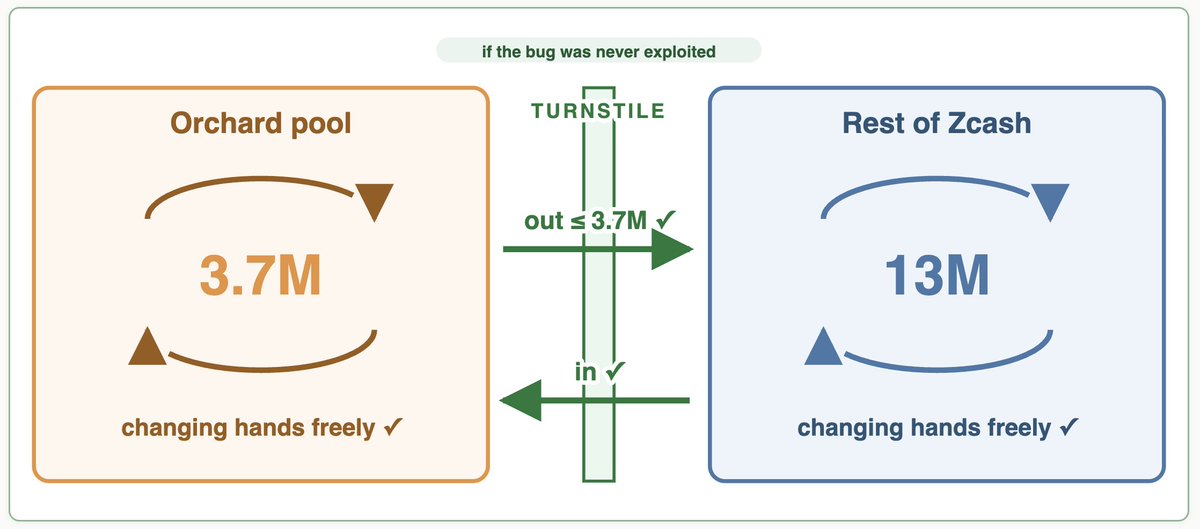


Conversely, if hackers have already used the vulnerability to create counterfeit tokens and transferred them into the pool, the existing withdrawal channels would cap the total withdrawal amount. The withdrawal limit would equal the total amount of legitimate tokens initially deposited. In this scenario, if counterfeit tokens are withdrawn first, some users' legitimate assets might not be fully recovered.
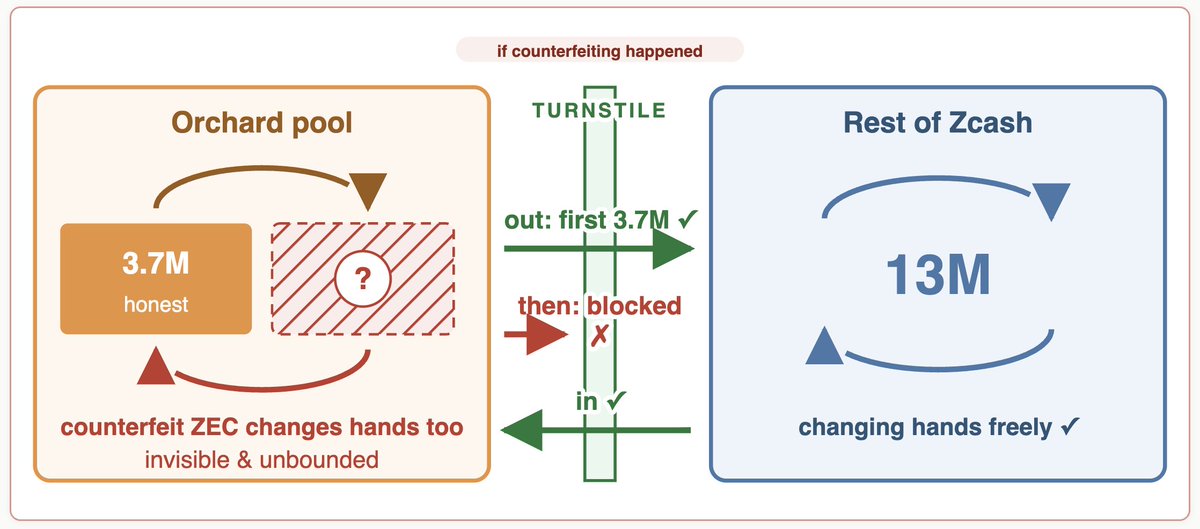


We consider the likelihood of this extreme scenario to be low. If users still have concerns, they can move their assets out of the Orchard pool. However, before doing so, it's important to understand the potential risks of different withdrawal methods:


  • Transferring to a transparent address (t-address): The transfer amount and time will be fully public, and the assets will become publicly associated with that address, completely losing privacy.
  • Transferring to the Sapling shielded pool: The transfer amount and time will still be recorded, but it won't link the assets to a specific address or transaction history, offering better privacy than transparent addresses. Note that Sapling relies on a trusted setup ceremony completed in 2018, which itself carries additional security considerations.
  • Wallets: Among mainstream self-custody wallets, currently only YWallet and Zkool support the Sapling pool.
  • Other wallets or custodial platforms: There may also be risks of operational errors, software faults, platform risk controls, and other unexpected issues.


Overall, these risks are manageable. Combined with the assessment that "the vulnerability was most likely not exploited," keeping assets in the original shielded wallet is a prudent choice. If users can ensure operational safety, withdrawing assets is also a viable option. Users should decide based on their individual circumstances.


Can Users Independently Verify That Zcash's Total Supply Has Not Been Inflated?


Currently, this is not possible. Due to the existence of this vulnerability, ordinary users cannot independently verify whether the total token supply within the shielded pools has been inflated.
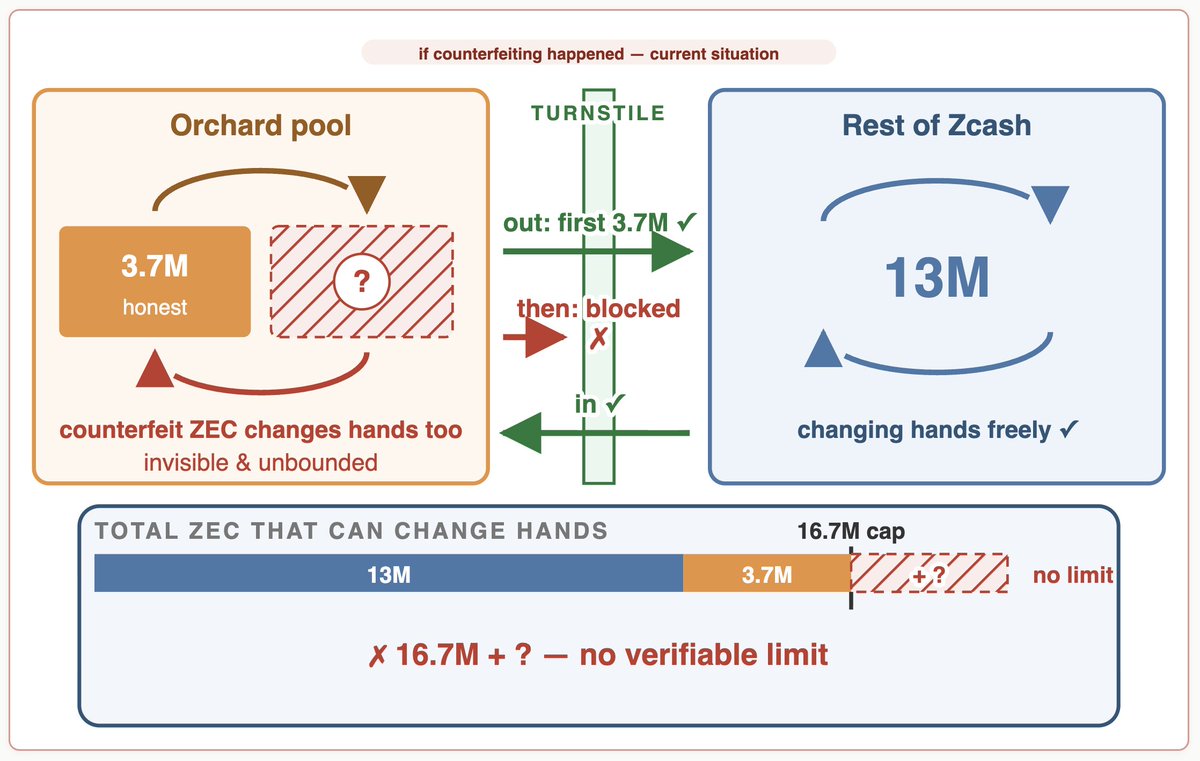


However, the planned Ironwood network upgrade will address this issue. The logic is as follows:
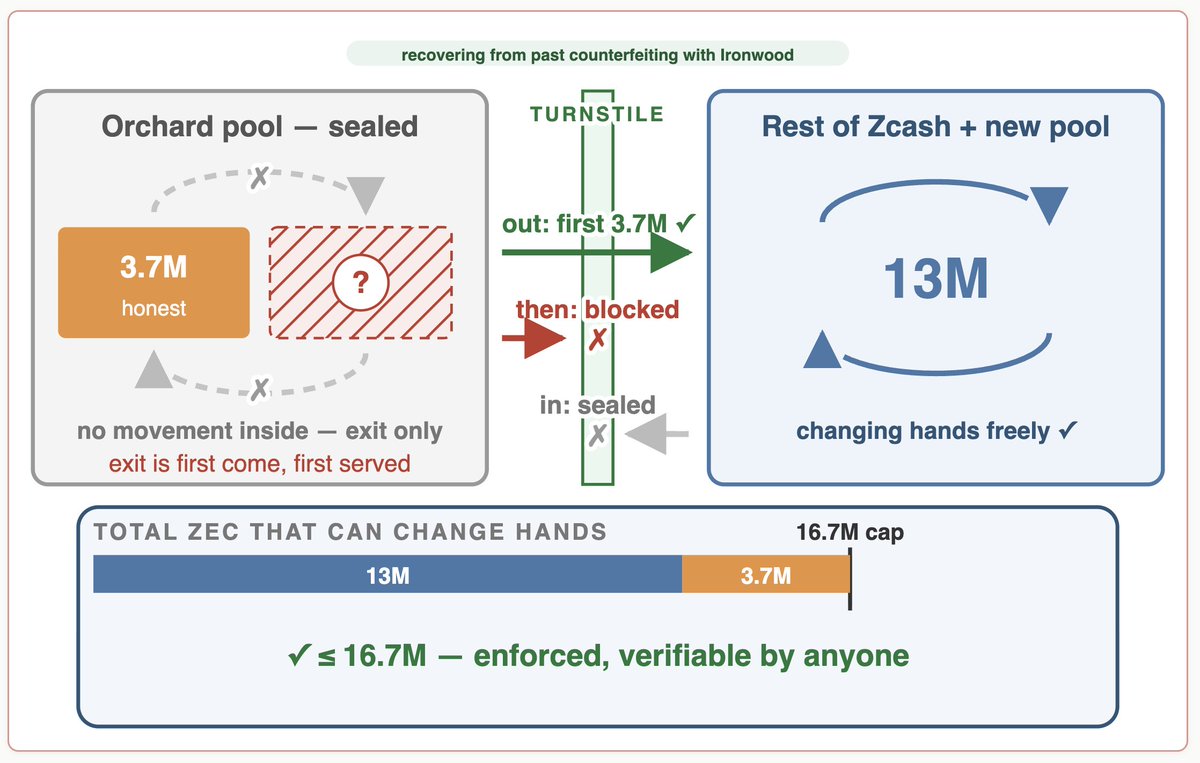


This upgrade will permanently close the Orchard pool, disallowing new asset deposits. Tokens within the pool will no longer be able to move internally; all assets can only be withdrawn through the original channels. The total withdrawal amount from these channels strictly equals the amount of legitimate tokens originally deposited, fundamentally preventing any excess outflow of tokens.


After the upgrade is complete, anyone running a node will be able to verify that the total token supply is compliant. Even if counterfeit tokens were created in the past, they will no longer be able to circulate within the Orchard pool, artificially inflating the total supply. Users won't need to speculate about the actions of hackers or other users; the protocol itself will guarantee that token over-issuance cannot occur.


This point is crucial. Zcash's long-term credibility is built on users' ability to independently verify the total token supply. The Ironwood upgrade will restore this capability to users.


How to Confirm the Project Has No Other Token Forgery Vulnerabilities?


At this stage, we cannot give an absolute answer, but we have reason to believe no similar vulnerabilities currently exist.


Shielded Labs, in collaboration with several teams, conducted a comprehensive review of the Zcash protocol, specifically searching for token forgery vulnerabilities. During this process, the team also utilized Anthropic's not-yet-publicly-released Mythos AI model for auxiliary detection. We will publish a follow-up article detailing the process and results of this review.


To date, the team has not discovered any new forgery vulnerabilities. This review assembled experienced technical personnel, professional security teams, and advanced AI analysis tools, which further strengthens our confidence that there are currently no undisclosed high-risk vulnerabilities of the same type.


Simultaneously, we are collaborating with partners like the Tachyon project to conduct additional inspections, further strengthening our security defenses. Related progress will also be announced later.


Summary


This Orchard vulnerability raises four core questions: whether the vulnerability was exploited, whether legitimate assets can be withdrawn, whether the total token supply can be verified, and whether other forgery vulnerabilities exist.


Based on the current investigation results, we assess that the likelihood of the vulnerability being exploited previously is low. Therefore, user assets are safe, and the total token supply currently remains normal. After repeated inspections by multiple independent teams, we are increasingly confident that the project currently has no other undiscovered forgery vulnerabilities.


However, one point is unavoidable: currently, users cannot independently verify the total token supply. The upcoming network upgrade will completely solve this problem. After the upgrade, the Orchard pool will be permanently closed, allowing users to independently verify the total token supply without needing to judge whether token forgery has ever occurred.

Preguntas relacionadas

QWhat are the four key questions raised by the Orchard security vulnerability?

AThe four key questions are: 1) Has the vulnerability been exploited? 2) Can legitimate user assets stored in Orchard be withdrawn normally? 3) Can users independently verify that the total Zcash supply has not been artificially increased? 4) How can we confirm there are no other similar token counterfeiting vulnerabilities in the project?

QWhat is the primary reason why the authors believe the Orchard vulnerability likely hasn't been exploited?

AThe authors believe exploitation is unlikely primarily because the vulnerability was discovered through proactive investigation by Shielded Labs using specialized AI detection tools, not due to a public exposure. They argue that exploiting it requires deep expertise and that typical cryptocurrency attackers would likely have cashed out already, leaving detectable traces, which haven't been observed.

QHow does the planned Ironwood network upgrade aim to restore users' ability to verify the Zcash supply?

AThe Ironwood upgrade will permanently close the Orchard pool, preventing new deposits and internal transfers. All assets can only be withdrawn via the original channels, whose total withdrawal amount is strictly capped at the amount of legitimate tokens originally deposited. This prevents any excess tokens from leaving the pool, allowing anyone running a node to verify the total supply compliance.

QWhat risks do users face if they choose to transfer their assets out of the Orchard pool?

ATransferring to a transparent address (t-address) reveals the amount, timing, and links the assets to that address, losing all privacy. Transferring to the Sapling pool offers better privacy but relies on a 2018 trusted setup ceremony, which introduces its own security considerations. Additionally, users may face risks from operational errors, software bugs, or platform restrictions when using wallets or custodial services.

QWhat measures have been taken to search for other potential token counterfeiting vulnerabilities in Zcash?

AShielded Labs, in collaboration with other teams, conducted a comprehensive audit of the Zcash protocol specifically for token counterfeiting vulnerabilities. They utilized advanced tools including an unreleased AI model from Anthropic called Mythos. So far, no new such vulnerabilities have been found, increasing confidence that no other high-risk, undisclosed vulnerabilities of this type exist.

Lecturas Relacionadas

Xpeng and NIO Compete on Computing Power, Li Auto Shifts Architecture

On June 15, 2026, Li Auto unveiled details of its self-developed chip, Mahe M100, for its new L9 Livis model. CTO Xie Yan stated the goal was not just a faster chip, but a fundamentally different one, targeting the chip architecture itself. While competitors like NIO, Xpeng, and Huawei highlight TOPS (computing power) figures for their self-developed chips, Li Auto’s Mahe M100 focuses on redesigning the underlying architecture. It employs a "dynamic data flow architecture" to address memory bandwidth bottlenecks in large model inference, claiming up to 3x the effective computing power of Nvidia's Thor U for its specific workloads and a 40% reduction in latency. The chip's design was peer-reviewed and accepted at ISCA 2026. However, this performance is highly optimized for Li Auto's own VLA2.1 algorithm, meaning it may not generalize as well to other tasks. Li Auto aims to achieve full-stack in-house development with Mahe M100, covering chip, compiler, OS, AI algorithms, and domain controller—a level of vertical integration few competitors match. Beyond the chip, CEO Li Xiang introduced a new strategic narrative: the "embodied intelligent vehicle," defined as an integration of an EV, a professional driver, an AI computer, and a life assistant. This shifts competition from features like large screens to systemic AI capabilities. A key commitment was that Li Auto's Mahe VLA autonomous driving model will match Tesla's FSD V14 by Q4 2026, with specific OTA milestones set for July, September, and December. Financially, Li Auto faces pressure with declining revenue and vehicle gross margins since Q4 2025, while maintaining high R&D investment (approx. ¥12B in 2026, 50% AI-related). Its 2026 sales target is 550,000 vehicles, up from 406,000 in 2025. The new L9 Livis garnered over 10,000 pre-orders in two weeks. The effectiveness of these strategic moves—new products, OTAs, and the novel chip architecture—will begin to show in Q3 2026 financial results, with the year-end FSD V14 benchmark being the ultimate test.

marsbitHace 36 min(s)

Xpeng and NIO Compete on Computing Power, Li Auto Shifts Architecture

marsbitHace 36 min(s)

The Year of AI Applications: Saying 'Yes' While Ignoring Risks? A Comprehensive Open Source Log of Software Development's Journey

The Year of AI Applications: Blindly Saying "Yes" While Ignoring Risks? A Software Development Log Goes Fully Open Source. AI-generated code harbors risks hidden within seemingly correct programs, potentially leading to data leaks or asset loss. The open-source project "Narwhal AI Code Risks," from Peking University's Narwhal-Lab, compiles real-world cases, early warning signs, and typical risk pathways. Its goal is to help developers identify potential hazards early and avoid repeating past mistakes. In 2026, code is generated faster than ever but deployed with less scrutiny. The danger often lies not in glaring errors, but in code that appears normal—syntactically correct, passing all checks—yet introduces subtle but critical flaws like non-existent dependencies, excessive permissions, or exposed databases. A stark example is the Moonwell cbETH oracle incident. A configuration file error, where a cryptocurrency price was set to ~$1.12 instead of ~$2,200, slipped through 28 checks and a pull request signed by both AI (Claude, Copilot) and human developers. This "semantic deviation" resulted in a loss of $1.78 million. The risk is that AI can produce functionally valid code that is semantically wrong for the business context. As AI moves beyond simple code completion to modifying configurations, installing dependencies, and operating via autonomous agents, it traverses longer, less traceable paths within software engineering, blurring traditional boundaries and oversight points. The Narwhal AI Code Risks project structures information into three layers: `/cases` for documented real-world incidents, `/inferred` for early warning signals, and `/scenarios` for clear, generalized risk patterns not yet tied to specific events. This aims to create a lasting, public record to prevent collective amnesia about past AI-coding pitfalls. Risks are categorized into seven areas: Software Supply Chain (e.g., recommending fake packages), Code-Level Vulnerabilities (e.g., reintroducing path traversal bugs), Cloud & Infrastructure Misconfiguration (e.g., overly permissive settings), Agent Risks (from autonomous tool execution), Vertical Domain Risks (e.g., in finance, healthcare), Intellectual Property & Compliance issues, and Human Factors (like over-reliance on AI output). The project's core value is transforming isolated incidents into reusable knowledge—a foundational resource for developers to spot similar issues, for security researchers to build upon, for toolmakers to create detection rules, and for the community to contribute new findings. As AI integration accelerates, this open-source "logbook" serves as a crucial navigational aid, charting past errors to help future projects steer clear of the same traps.

marsbitHace 36 min(s)

The Year of AI Applications: Saying 'Yes' While Ignoring Risks? A Comprehensive Open Source Log of Software Development's Journey

marsbitHace 36 min(s)

The Foundation of SpaceX's Trillion-Dollar Valuation: Who is Dividing Up Musk's Annual Tens of Billions in Capital Expenditure?

SpaceX's trillion-dollar valuation is built on its three core businesses: Starlink (profitable, 60% of revenue), rockets (driving down launch costs), and AI (a major investment area). This creates a financial cycle: Starlink funds rocket development, which enables low-cost launches for AI hardware, generating future revenue. This cycle fuels annual capital expenditures of tens of billions, flowing to a vast supply chain. Suppliers are categorized by their replaceability. The first group includes irreplaceable players like NVIDIA (GPU/CUDA ecosystem), Eutelsat (critical radio spectrum), Filtronic (specialized amplifiers), Materion (strategic beryllium), and STMicroelectronics (antenna chips). The second group consists of hard-to-replace suppliers due to high switching costs, such as Honeywell (flight control), Carpenter Technology (specialty alloys), Hexcel (carbon fiber), Broadcom (data exchange), and Linde (industrial gases). The third group comprises high-volume, cost-critical suppliers for mass-produced items like Starlink terminals. Key names include Wistron NeWeb (primary manufacturer) and several A-share companies like Shenzhen Sunway (connectors), Pies New Materials (forgings), Western Superconducting (alloys), and Yingliu (castings). Other niche players include Trimble (timing), Astronics (power distribution), and CTS (thermal management). The article argues that investing in these suppliers, rather than SpaceX stock directly, offers an alternative opportunity. The rationale is threefold: procurement is just beginning to scale, SpaceX's IPO brings new transparency to its supply chain, and the situation mirrors early stages of past "super terminal" ecosystems like Apple or Tesla. While risks exist (commodity cycles, geopolitical factors, technology shifts), the core thesis is that SpaceX's massive, ongoing procurement will translate into reliable revenue for its key suppliers, regardless of its own stock price volatility.

marsbitHace 1 hora(s)

The Foundation of SpaceX's Trillion-Dollar Valuation: Who is Dividing Up Musk's Annual Tens of Billions in Capital Expenditure?

marsbitHace 1 hora(s)

SpaceX's Trillion-Dollar Valuation Base: Who's Sharing in Musk's Annual Tens of Billions in Capital Expenditure?

**Title: The Foundation of SpaceX's Trillion-Dollar Valuation: Who Benefits from Musk's Annual $100 Billion Capital Expenditure?** This article argues that investors seeking to benefit from SpaceX's growth might find greater opportunities in its supply chain rather than directly investing in the company itself, drawing parallels to historical successes with Apple, Tesla, and NVIDIA suppliers. **SpaceX's Business Model & Cash Flow:** SpaceX generates revenue from three main areas: 1. **Starlink:** Its profitable core, earning $11.3B in 2023 (60% of revenue), funding other ventures. 2. **Rockets (Falcon/Starship):** Requires $3B+ in annual R&D but achieves the world's lowest launch costs. 3. **AI:** Currently unprofitable (-$6B+ in 2023), investing heavily in ground-based supercomputers (220,000 GPUs) and future orbital data centers. The cycle is: Starlink profits → fund cheaper rockets → low-cost launches deploy AI hardware → AI compute rentals generate future revenue. This cycle drives annual procurement spending of tens of billions of dollars. **The Supply Chain Beneficiaries:** Suppliers are categorized by their replaceability: **1. Nearly Irreplaceable (High Barriers to Entry):** * **NVIDIA:** Powers the Colossus supercomputer; its CUDA ecosystem creates immense switching costs. * **Eutelsat (SATS):** Controls critical radio spectrum for satellite communications; holds a ~3% stake in SpaceX. * **Filtronic (FTC):** Supplies millimeter-wave signal amplifiers for Starlink satellites; SpaceX constitutes 83% of its revenue. * **Materion (MTRN):** Global leader in beryllium production, a strategic material used in Starship structures. * **STMicroelectronics (STM):** Supplies phased-array antenna chips for Starlink satellites. **2. Replaceable, but Switching Cost is Prohibitively High:** * **Honeywell (HON):** Provides flight control and inertial navigation systems with decades of certification. * **Carpenter Technology (CRS):** Manufactures ultra-pure specialty steel alloys for Raptor engines. * **Hexcel (HXL):** Supplies custom carbon fiber composites developed over a decade with SpaceX. * **Broadcom (AVGO):** Manages high-speed data switching. * **Linde Group:** Supplies industrial gases (liquid oxygen/nitrogen) from facilities built near SpaceX launch sites. **3. High-Volume, Cost-Critical Manufacturing:** Focuses on mass-producing components like Starlink user terminals (target: 30 million units). * **Key Players:** Wistron NeWeb (6285, primary terminal manufacturer), several Chinese A-share companies (e.g., Sunway Communication, PAX New Materials, Western Metal Materials, Yingliu Co.), and smaller US firms like Trimble (TRMB, timing systems). **Why Now?** Three factors make the supply chain opportunity timely: 1. **Volume Ramp-Up:** SpaceX plans 100 launches in 2026, aims for 30 million Starlink terminals, and will deploy AI data centers, meaning procurement will accelerate. 2. **Increased Transparency:** The IPO provides public financial data, allowing investors to track supplier order growth. 3. **Historical Precedent:** The current phase is likened to Tesla's early mass-production stage (circa 2018), suggesting a long growth runway for suppliers. **Conclusion:** The article posits that while investing in SpaceX stock is betting on Elon Musk's ambitious vision at a high valuation, investing in its established suppliers is a bet on the tangible, recurring revenue from its massive procurement budget, which is largely decoupled from day-to-day stock price volatility.

链捕手Hace 1 hora(s)

SpaceX's Trillion-Dollar Valuation Base: Who's Sharing in Musk's Annual Tens of Billions in Capital Expenditure?

链捕手Hace 1 hora(s)

Trading

Spot
Futuros

Artículos destacados

Cómo comprar ZEC

¡Bienvenido a HTX.com! Hemos hecho que comprar Zcash (ZEC) sea simple y conveniente. Sigue nuestra guía paso a paso para iniciar tu viaje de criptos.Paso 1: crea tu cuenta HTXUtiliza tu correo electrónico o número de teléfono para registrarte y obtener una cuenta gratuita en HTX. Experimenta un proceso de registro sin complicaciones y desbloquea todas las funciones.Obtener mi cuentaPaso 2: ve a Comprar cripto y elige tu método de pagoTarjeta de crédito/débito: usa tu Visa o Mastercard para comprar Zcash (ZEC) al instante.Saldo: utiliza fondos del saldo de tu cuenta HTX para tradear sin problemas.Terceros: hemos agregado métodos de pago populares como Google Pay y Apple Pay para mejorar la comodidad.P2P: tradear directamente con otros usuarios en HTX.Over-the-Counter (OTC): ofrecemos servicios personalizados y tipos de cambio competitivos para los traders.Paso 3: guarda tu Zcash (ZEC)Después de comprar tu Zcash (ZEC), guárdalo en tu cuenta HTX. Alternativamente, puedes enviarlo a otro lugar mediante transferencia blockchain o utilizarlo para tradear otras criptomonedas.Paso 4: tradear Zcash (ZEC)Tradear fácilmente con Zcash (ZEC) en HTX's mercado spot. Simplemente accede a tu cuenta, selecciona tu par de trading, ejecuta tus trades y monitorea en tiempo real. Ofrecemos una experiencia fácil de usar tanto para principiantes como para traders experimentados.

355 Vistas totalesPublicado en 2024.12.12Actualizado en 2026.06.02

Cómo comprar ZEC

Discusiones

Bienvenido a la comunidad de HTX. Aquí puedes mantenerte informado sobre los últimos desarrollos de la plataforma y acceder a análisis profesionales del mercado. A continuación se presentan las opiniones de los usuarios sobre el precio de ZEC (ZEC).

活动图片