Zcash: Why ZEC must break THIS price level or risk a 20% crash

ambcryptoPublicado a 2026-04-06Actualizado a 2026-04-06

Resumen

Zcash (ZEC) is currently up 3.25% with a significant 32% surge in trading volume to $267 million. However, technical analysis indicates a potential 20% price decline if it fails to break above a key descending trendline resistance. A failure to close above $260 could lead to a drop toward $200. The Average Directional Index (ADX) at 17.95 signals weak momentum. Derivatives data shows traders are bearish, with $7.91 million in short positions targeting key liquidation levels. Despite the bearish outlook, ZEC's long-term utility in privacy and DeFi remains a positive factor.

At press time, Zcash [ZEC] was up 3.25% over the past 24 hours. In addition to the price jump, ZEC has also recorded strong participation from traders and investors, as reflected in the trading volume, which surged over 32% to $267 million.

However, its past performance and current price action indicate that there is a risk of a possible downturn.

ZEC price action signals possible 20% fall

On the daily chart, ZEC appears mildly bearish, and the current level can be considered a make-or-break point, as it has a strong history of price reversals.
Source: TradingView

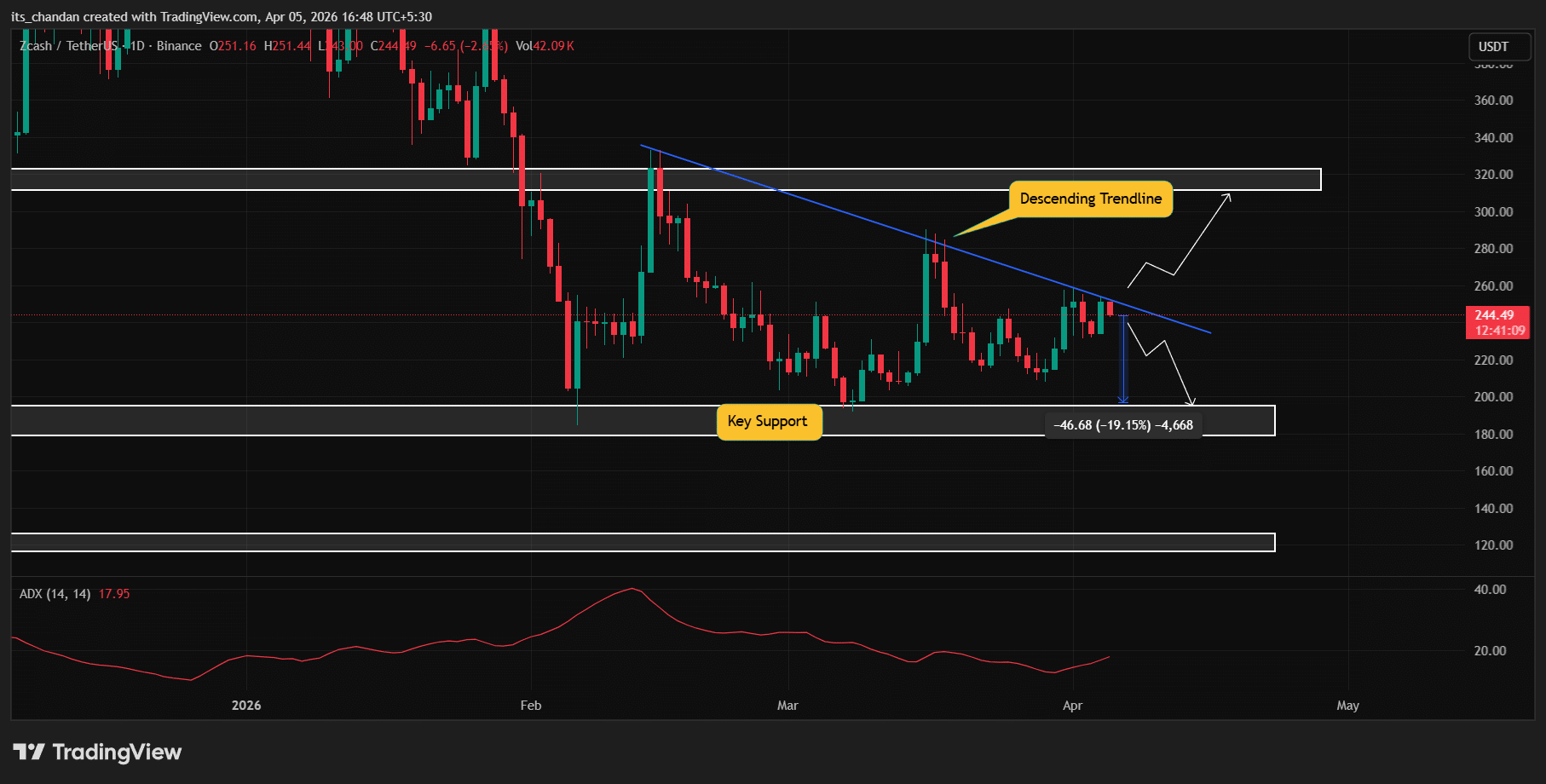
The chart shows that in February 2026, ZEC attempted a potential rebound but failed, and since then it has been in a downtrend, facing resistance from a descending trendline. In the past, whenever the ZEC price reached this resistance level, it recorded a sharp decline, which now appears likely to repeat.

Based on the current price action, if ZEC fails to breach its prolonged descending trendline, there is a high possibility that it could repeat its history with a potential decline. It may see a price dip of over 20%, reaching the $200 level.

However, this bearish thesis could be invalidated if ZEC breaks out of the trendline and closes a daily candle above the $260 level. Besides the price action, the technical indicator Average Directional Index (ADX) has fallen to 17.95, below the key threshold of 25, indicating weak momentum in the asset.

Looking at the current price action, a crypto analyst shared a post on X, noting that the $173 to $199.55 zone is a key level for ZEC. If the price fails to hold this zone, it could see a sharp decline, as the next major demand area lies between $54.18 and $79.91.

In addition, the expert noted that the bullish sentiment for ZEC remains intact due to its strong privacy-focused utility, low transaction costs, and growing relevance in decentralized finance and privacy-preserving payments.

ZEC investor sentiment turns bearish

Data from the derivatives platform CoinGlass shows that traders are following the trend, as they appear to be betting on further downside.

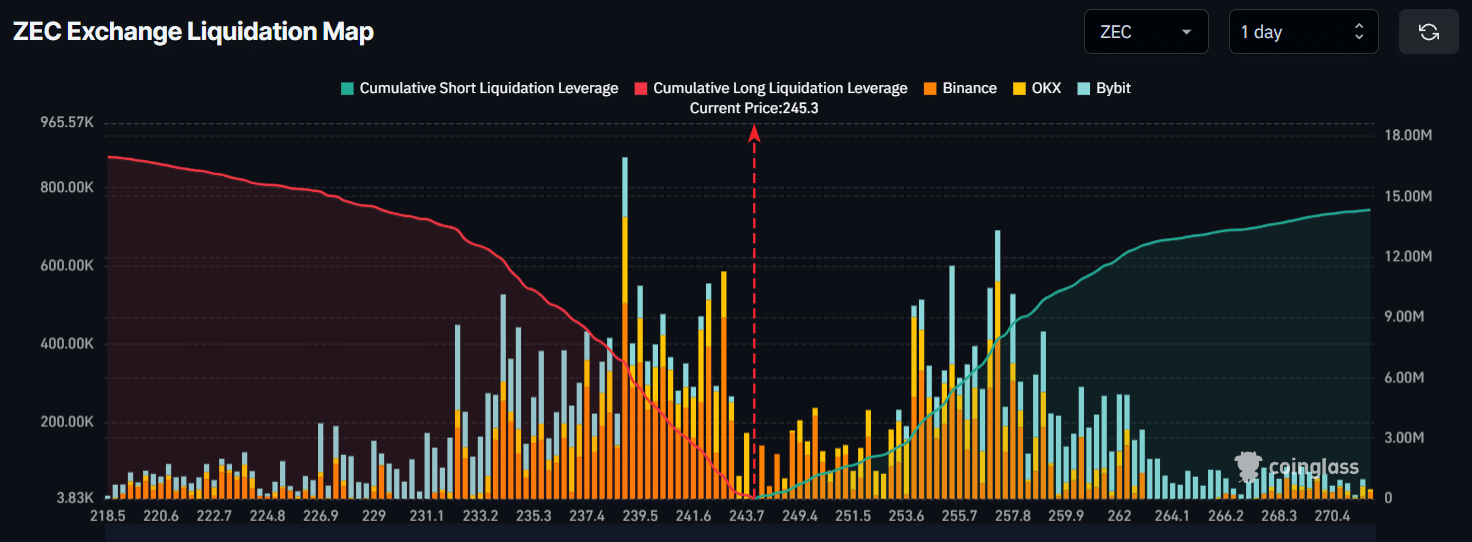
According to the latest data, $238.9 on the lower side and $257.2 on the upper side are major liquidation levels. At these levels, traders have built $5.91 million worth of long leveraged positions and $7.91 million worth of short positions. This suggests that traders are potentially expecting the ZEC price to decline.
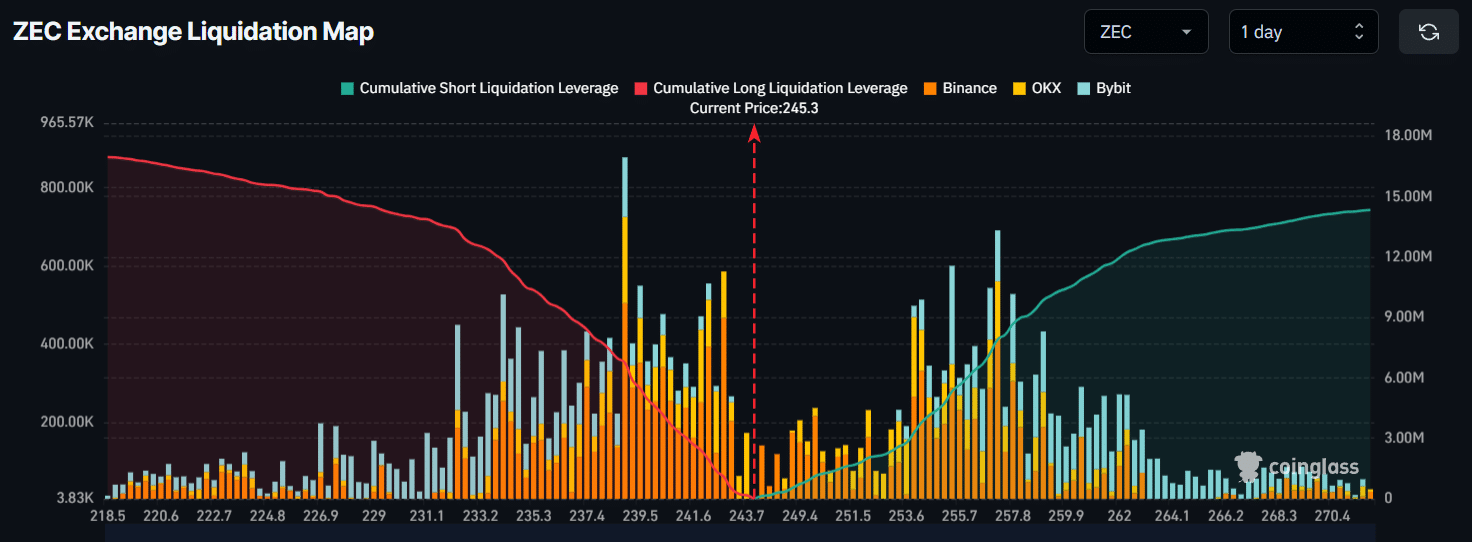
Source: CoinGlass

Meanwhile, some long‐term holders appear to be following the same trend, offloading part of their holdings. On the 5th of April 2026, ZEC’s spot inflow/outflow metric showed $1.02 million worth of ZEC moving into exchanges, suggesting potential preparation for a sell-off.
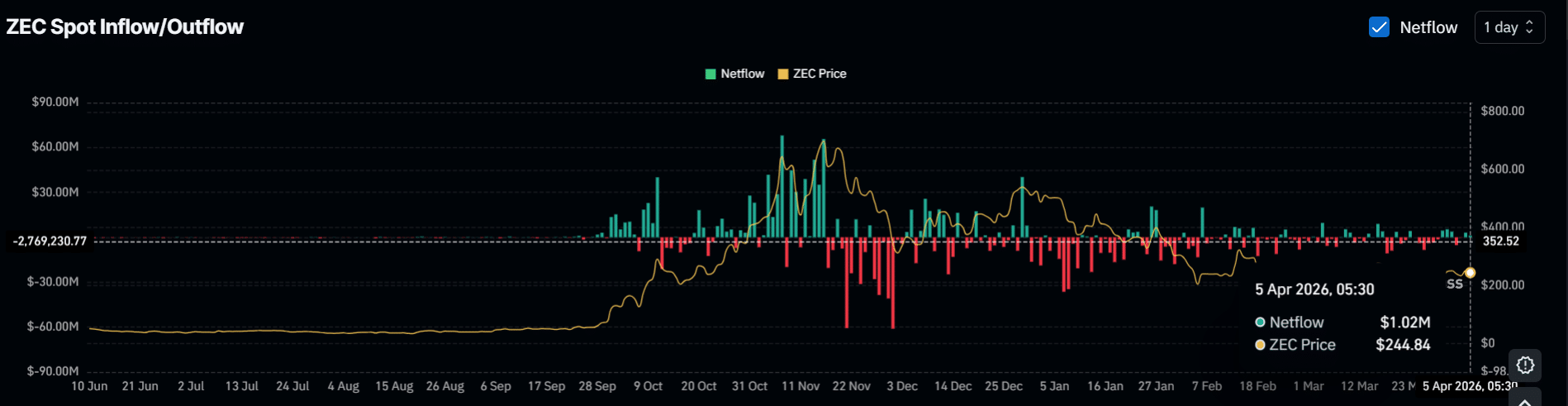
Source: CoinGlass

Final Summary

  • Zcash prices climbed, but price action suggests ZEC is at risk of a 20% drop if it fails to breach the descending trendline.
  • A derivative tool reveals that both investors and traders have a bearish outlook, as they appear to be offloading their holdings and betting on short positions.


Criptos en tendencia

Preguntas relacionadas

QAccording to the article, what is the key price level that ZEC must break to avoid a potential 20% crash?

AZEC must break out of its prolonged descending trendline and close a daily candle above the $260 level to avoid the potential 20% crash.

QWhat does the Average Directional Index (ADX) value of 17.95 indicate about ZEC's momentum?

AAn ADX value of 17.95, which is below the key threshold of 25, indicates weak momentum in the ZEC asset.

QWhat are the major liquidation levels for ZEC mentioned in the derivatives data from CoinGlass?

AThe major liquidation levels are $238.9 on the lower side and $257.2 on the upper side.

QWhat evidence suggests that long-term ZEC holders might be preparing to sell their holdings?

AOn April 5th, 2026, ZEC's spot inflow/outflow metric showed $1.02 million worth of ZEC moving into exchanges, suggesting potential preparation for a sell-off by long-term holders.

QDespite the bearish technical outlook, what fundamental factors does the analyst cite for maintaining a bullish sentiment on ZEC?

AThe analyst cites ZEC's strong privacy-focused utility, low transaction costs, and growing relevance in decentralized finance and privacy-preserving payments as reasons for the intact bullish sentiment.

Lecturas Relacionadas

Wall Street Morning News: V-shaped Rebound at Month-end, but Nasdaq Suffers Worst July in 12 Years; Funds Accelerate Concentration Towards Cloud Giants

Despite a V-shaped rebound at the end of July, the Nasdaq posted its worst July since 2004, while the S&P 500 had its worst July since 2014. Markets were jolted by geopolitical shifts, as President Trump canceled a planned strike on Iran, leading WTI crude to plunge over 8%. This, alongside OPEC+ announcing a supply increase, reversed crude's sharp July gains. Treasury yields surged, with the 10-year yield rising over 30 basis points in July—its largest July increase since 2005. In a rare move, the US and Japan jointly intervened to weaken the USD/JPY, aiming to prevent potential Japanese sales of US Treasuries. While the tech sector faced deleveraging pressure throughout July, cloud giants staged a massive rally on strong earnings. Microsoft, Amazon, and Google collectively added nearly $1.5 trillion in market value last week. Amazon soared over 15% on accelerating AWS growth, Microsoft extended historic gains, Google fully recovered post-earnings losses, and Meta ended an 11-day losing streak. In contrast, Apple tumbled over 7% on supply chain and guidance concerns, ceding its "world's most valuable company" title to Nvidia. The memory and storage sector corrected sharply. Gold edged up 0.91% in July, with analysts viewing the ~30% pullback from January highs as a potential basing period, supported by long-term central bank demand. Key events to watch this week include earnings from Palantir, AMD, SpaceX (its first post-IPO report), and memory giants like Western Digital. The US July non-farm payrolls report on Friday will be critical for gauging the Fed's policy path. SpaceX also faces a significant lock-up expiration, testing market liquidity.

marsbitHace 37 min(s)

Wall Street Morning News: V-shaped Rebound at Month-end, but Nasdaq Suffers Worst July in 12 Years; Funds Accelerate Concentration Towards Cloud Giants

marsbitHace 37 min(s)

Rubin Ultra Makes Major Cuts, Even Nvidia Can't Handle Memory Price Hikes?

NVIDIA's Rubin Ultra, the top-tier variant of the newly announced Rubin AI accelerators, has reportedly seen significant specification downgrades, according to an industry report from SemiAnalysis. Initially designed with four compute dies (4-die), the Rubin Ultra is now said to be reduced to a 2-die design. Key changes highlighted in the report include: * **No increase in peak theoretical compute performance**, remaining at 35 PFLOPs like the standard Rubin. * **Severe reduction in memory capacity** to 192GB using 8-Hi HBM stacks, which is less than the standard Rubin's 288GB using 12-Hi stacks. * **Negligible memory bandwidth improvement** of only 1 TB/s. * **Slightly higher chip-level power consumption**. * The **primary upgrade is a massive increase in scale-up interconnect capacity**, supporting connections for up to 576 GPUs via NVLink, compared to 72 for the standard Rubin. The report suggests the redesign is primarily a cost-optimization move driven by the sharp rise in HBM (High-Bandwidth Memory) prices. By reducing the expensive HBM content and shifting investment towards enhanced system-scale networking, NVIDIA aims to maintain the platform's value for large-scale AI training clusters while managing soaring material costs. The news reportedly triggered a sell-off in South Korean memory stocks, with SK Hynix and Samsung shares falling around 8%, as markets grew concerned that NVIDIA—a major HBM buyer—might be reducing its reliance on high-capacity memory, potentially capping future pricing power for memory makers.

Odaily星球日报Hace 57 min(s)

Rubin Ultra Makes Major Cuts, Even Nvidia Can't Handle Memory Price Hikes?

Odaily星球日报Hace 57 min(s)

Can Generative Models Finally Be Trained End-to-End? The Core Is a For Loop

This article introduces a novel training paradigm for generative models called Explorative Modeling (XM), which enables true end-to-end training. Traditionally, powerful generative models like autoregressive and diffusion models are not trained end-to-end. They are trained to predict a single small step but require iterative multi-step sampling for inference. This "exposure bias" leads to error accumulation and limits performance. The core challenge XM addresses is "mode blurring." In generative tasks, a single input (e.g., "generate a dog") corresponds to many valid outputs (multiple modes). Standard training objectives like reconstruction loss force the model to average these modes, producing unrealistic, blurry outputs. To avoid this, existing models break generation into many small, almost deterministic steps, sacrificing end-to-end training. XM tackles this by restructuring the training loop itself. Its key insight is to amplify "generative expressivity." For each training input, instead of generating one sample, the model generates K candidate outputs. Only the candidate closest to the real data is used for computing the loss and updating the model via backpropagation. This simple "best-of-K" mechanism is implemented as a short for-loop. By exploring multiple possibilities, the model learns to distribute its guesses across different modes rather than collapsing to their uninformative average. The paper demonstrates that "exploration" acts as a new, powerful scaling axis. Gains from XM increase with model size, data scale, and compute. Experiments show improvements in FID scores for image generation and significant efficiency gains, sometimes outperforming larger models without exploration. When pushed to the limit, XM enables fully single-step, end-to-end generative models. In robotics tasks, an "Explorative Policy" matched the performance of a 100-step Diffusion Policy with a single forward pass, drastically improving inference speed. While the best-of-K concept is not entirely new, the authors' contribution lies in formally understanding it as a direct method to boost generative expressivity without fragmenting the generation process. This work suggests that as models scale, enhancing exploration during training may become crucial for overcoming fundamental performance bottlenecks.

marsbitHace 1 hora(s)

Can Generative Models Finally Be Trained End-to-End? The Core Is a For Loop

marsbitHace 1 hora(s)

Trading

Spot

Artículos destacados

Cómo comprar ZEC

¡Bienvenido a HTX.com! Hemos hecho que comprar Zcash (ZEC) sea simple y conveniente. Sigue nuestra guía paso a paso para iniciar tu viaje de criptos.Paso 1: crea tu cuenta HTXUtiliza tu correo electrónico o número de teléfono para registrarte y obtener una cuenta gratuita en HTX. Experimenta un proceso de registro sin complicaciones y desbloquea todas las funciones.Obtener mi cuentaPaso 2: ve a Comprar cripto y elige tu método de pagoTarjeta de crédito/débito: usa tu Visa o Mastercard para comprar Zcash (ZEC) al instante.Saldo: utiliza fondos del saldo de tu cuenta HTX para tradear sin problemas.Terceros: hemos agregado métodos de pago populares como Google Pay y Apple Pay para mejorar la comodidad.P2P: tradear directamente con otros usuarios en HTX.Over-the-Counter (OTC): ofrecemos servicios personalizados y tipos de cambio competitivos para los traders.Paso 3: guarda tu Zcash (ZEC)Después de comprar tu Zcash (ZEC), guárdalo en tu cuenta HTX. Alternativamente, puedes enviarlo a otro lugar mediante transferencia blockchain o utilizarlo para tradear otras criptomonedas.Paso 4: tradear Zcash (ZEC)Tradear fácilmente con Zcash (ZEC) en HTX's mercado spot. Simplemente accede a tu cuenta, selecciona tu par de trading, ejecuta tus trades y monitorea en tiempo real. Ofrecemos una experiencia fácil de usar tanto para principiantes como para traders experimentados.

443 Vistas totalesPublicado en 2024.12.12Actualizado en 2026.06.02

Cómo comprar ZEC

Discusiones

Bienvenido a la comunidad de HTX. Aquí puedes mantenerte informado sobre los últimos desarrollos de la plataforma y acceder a análisis profesionales del mercado. A continuación se presentan las opiniones de los usuarios sobre el precio de ZEC (ZEC).

活动图片