ZCash reclaims $400, but here’s why the recovery could be short-lived

ambcryptoPublicado a 2026-07-03Actualizado a 2026-07-03

Resumen

ZCash (ZEC) has seen a 5.28% price increase, reclaiming the $400 level amid a broader, albeit cautious, crypto market recovery at the start of July. However, analysis suggests this rebound may be short-lived. Despite a whale opening an $8.1 million long position, the lack of significant growth in Open Interest indicates weak speculative interest. The price structure remains bearish, with key resistance at the $480-$540 zone. Failure to overcome this supply area, coupled with a potential loss of the local $360-$380 support, could see ZEC retreat toward $300, especially if Bitcoin's own recovery falters.

The crypto market has started July off on a positive note. Though June forced sizeable losses across the market, a positive start to the new month has given many altcoins a new lease of life.

Bitcoin [BTC] has gained 6.26% from the low of $57,800 made on July 1, and the altcoin market cap, including Ethereum, has expanded by 4.05%.
Source: Axel Adler Jr. on X

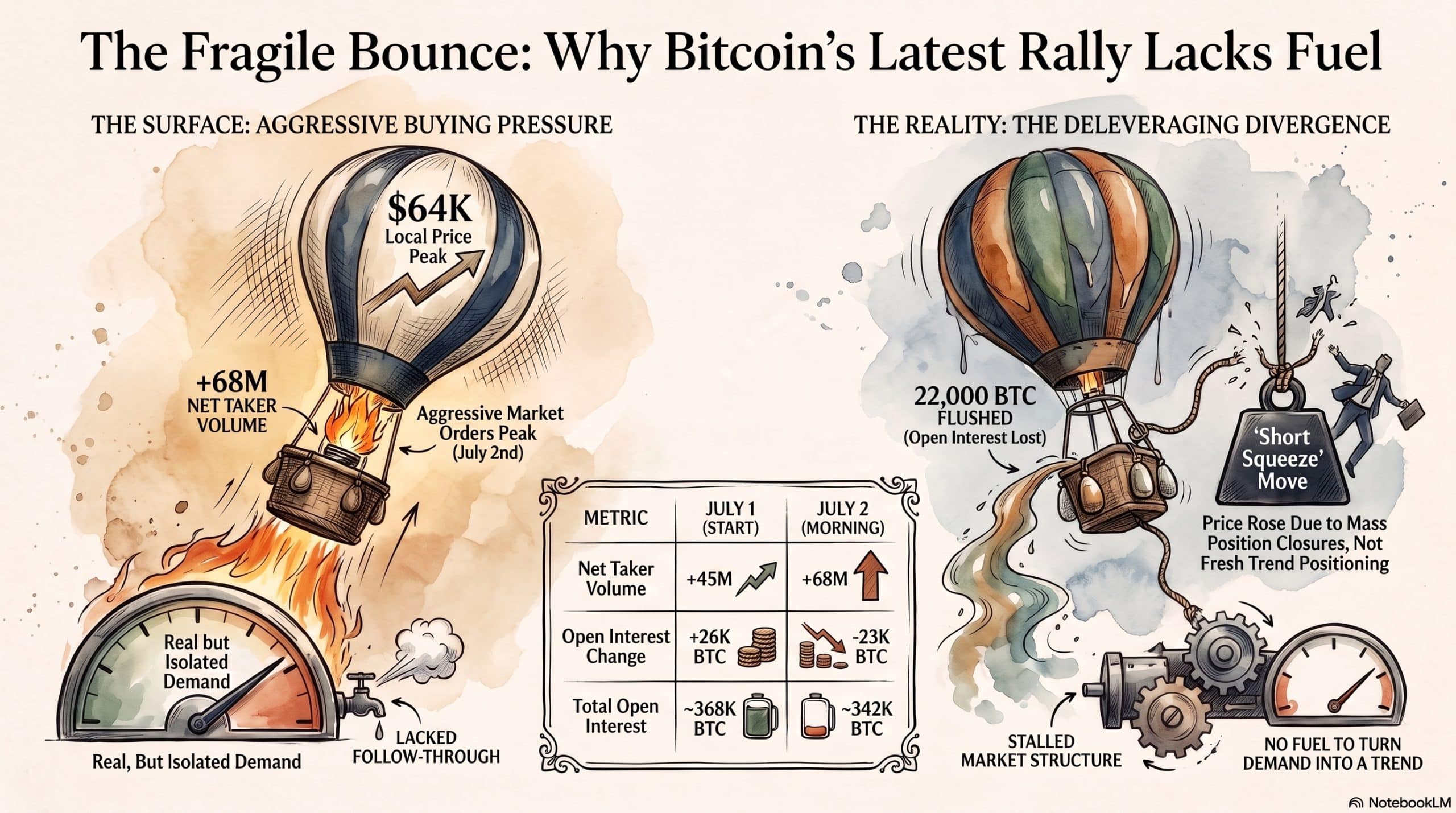
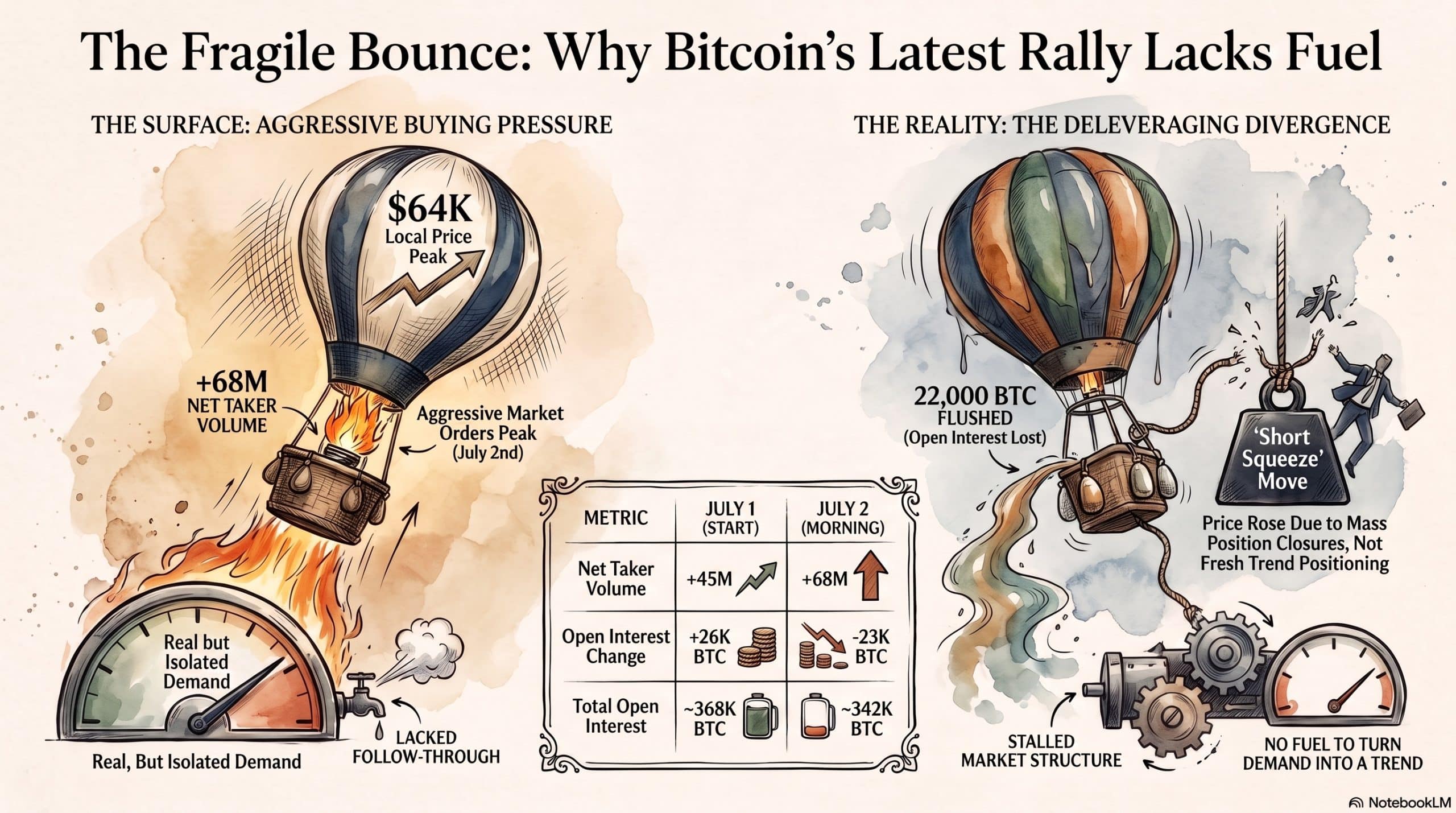
In a post on X, crypto analyst Axel Adler Jr. explained that the Bitcoin Open Interest fell by 23k BTC, though net taker buy volume was $68 million. The lack of growth in OI, despite aggressive buying in the perpetual markets, suggested a lack of fuel to sustain the upward move.

A lack of bullish follow-through can negatively impact altcoins, including ZCash [ZEC]. The token was up 5.28% in 24 hours, but its OI has grown by only 1.33%, indicative of a lack of speculative interest.

AMBCrypto reported that a ZEC whale had opened a $8.1 million long position, but that the price structure remained bearish. Here’s what ZEC bulls need to see before they can bet on a sustained uptrend.

The former range above $500 is pivotal for revival
Source: ZEC/USDT on TradingView

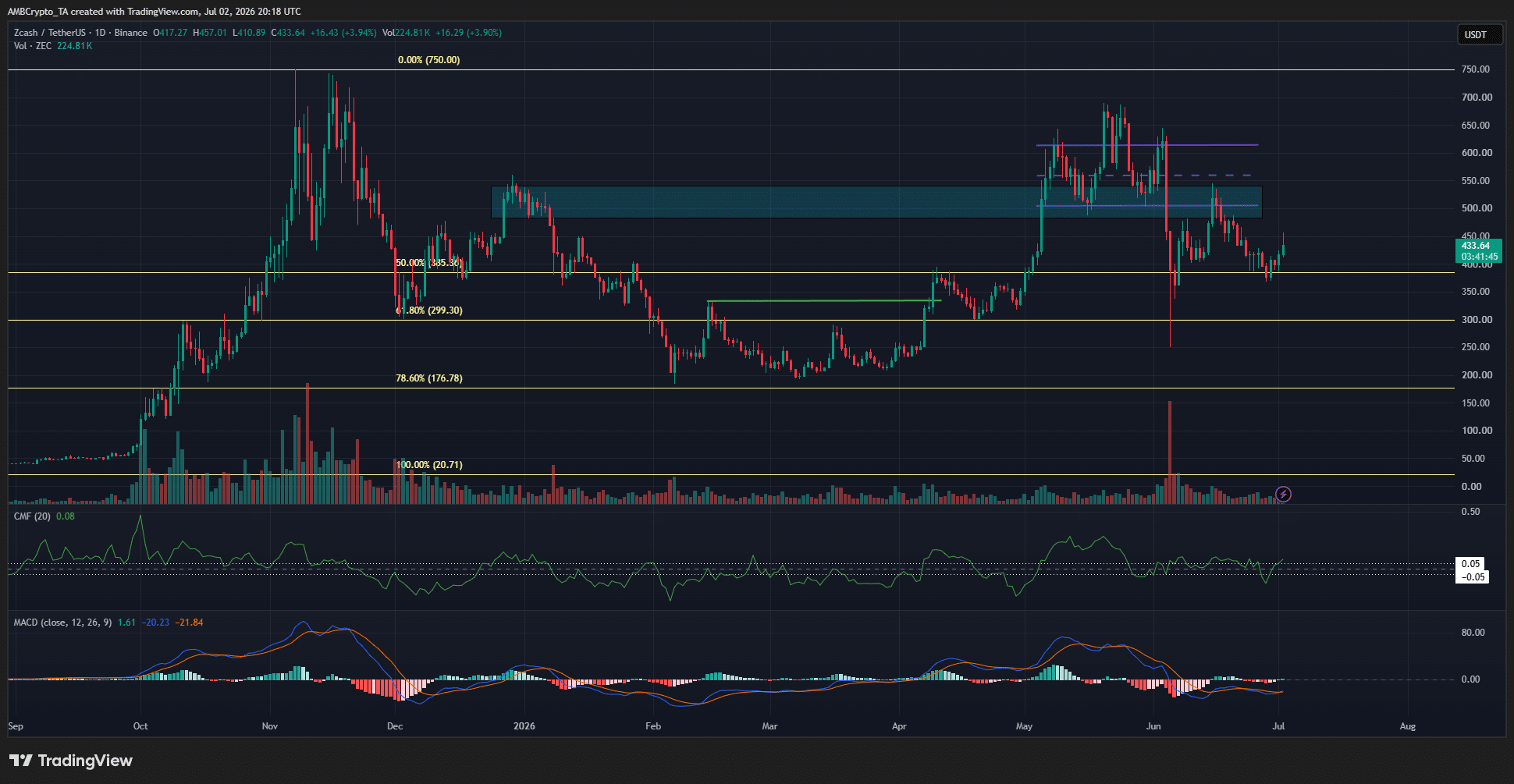
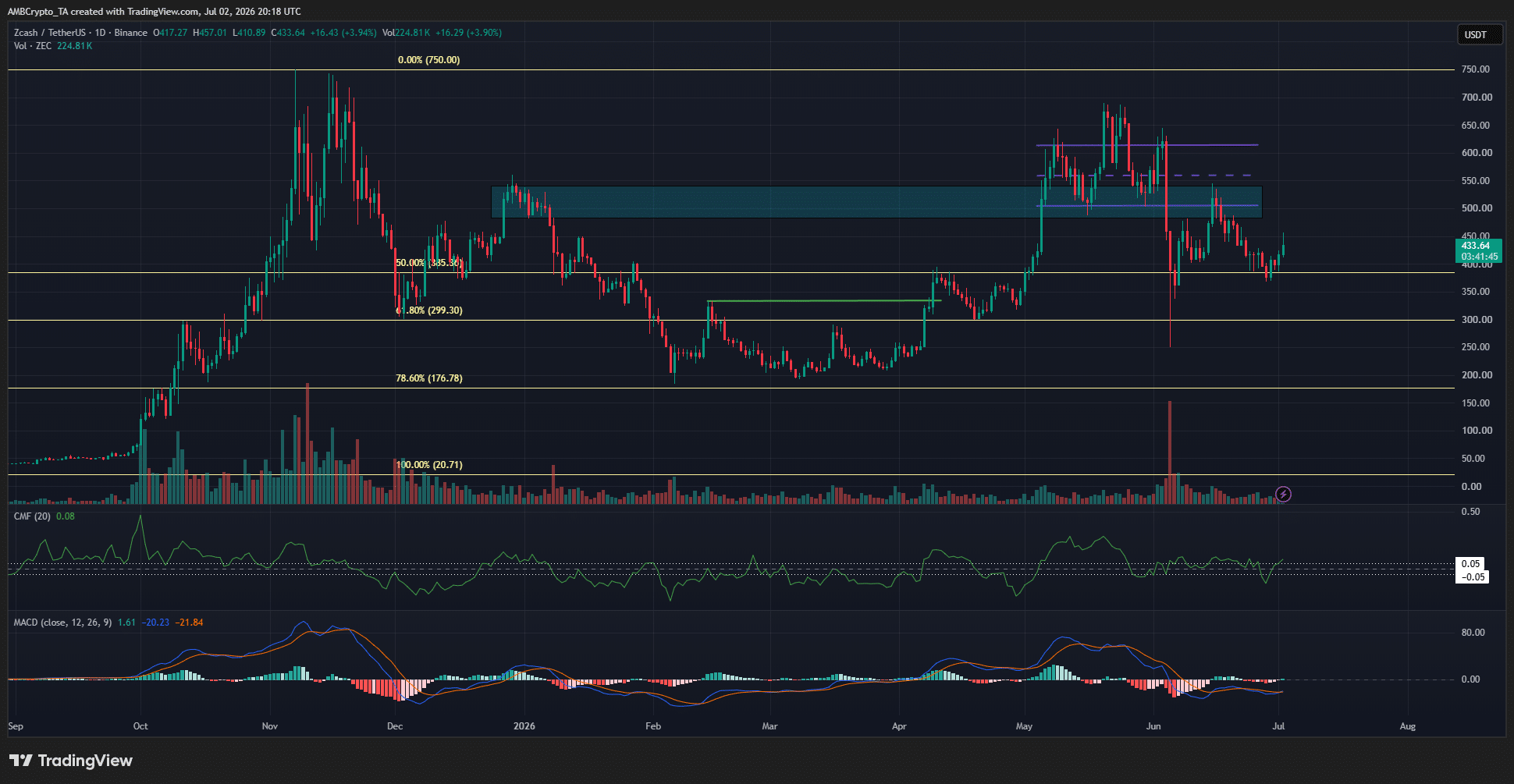
The 1-day chart showed a bearish internal market structure. The $486.61 low made in mid-May fell below the local range’s low, but the buyers were not able to defend this demand zone for long.

The subsequent waves of selling forced a price drop below $400 on two occasions in the weeks since this bearish breakdown.

At the time of writing, the CMF was at +0.08 to show significant buying pressure. The recovery from $176 earlier this year was part of a longer-term uptrend, but as things stand, the $480-$540 supply zone must be overcome to revive the idea of a bullish recovery.

If, instead, ZEC falls below the $360-$380 local support zone once again, swing traders and investors can expect the move to continue toward the next support level at $300.


Final Summary

  • The $360-$380 local support zone and $480-$540 resistance zone were the key battlegrounds ZEC swing traders must watch.
  • If the short-term Bitcoin bounce fails to gain traction, a momentum reversal could hurt ZEC and push it back below $400.

Preguntas relacionadas

QAccording to the article, why might ZCash's recovery be short-lived?

AThe recovery might be short-lived due to a lack of growth in Bitcoin's Open Interest (OI) despite buying, suggesting insufficient fuel for a sustained upward move, and ZCash's own OI growth of only 1.33%, indicating a lack of speculative interest.

QWhat are the key price zones for ZEC (ZCash) according to the technical analysis in the article?

AThe key zones are the local support zone at $360-$380 and the crucial supply/resistance zone at $480-$540. The price must overcome the $480-$540 zone to revive a bullish recovery idea.

QWhat potential downside target is mentioned if ZEC breaks below its $360-$380 support?

AIf ZEC falls below the $360-$380 local support zone, the move could continue toward the next support level at $300.

QWhat did the article report about a ZEC whale's activity?

AThe article reported that a ZEC whale had opened an $8.1 million long position.

QWhat broader market condition could negatively impact ZEC and other altcoins?

AA lack of bullish follow-through in Bitcoin's price movement could negatively impact altcoins like ZEC. If Bitcoin's short-term bounce fails to gain traction, a momentum reversal could hurt ZEC.

Lecturas Relacionadas

Perspective: Value Investing in U.S. Stocks Is Not the Same as Fundamental Investing

The article challenges the notion that value investing in US stocks is equivalent to fundamental investing. It uses the astronomical analogy of Henrietta Leavitt separating a star's apparent brightness from its intrinsic luminosity to illustrate a key investment framework: an observed valuation multiple (like brightness) conflates two things—the actual quality of a business and the premium the market is willing to pay for its future (its "distance" or duration). The author argues that the popular narrative of "fundamentals are dead"—fueled by momentum and concentration in mega-cap tech—is flawed. While recognizing factors like winner-take-all dynamics and AI scale advantages, the piece warns against confusing broad thematic truths (e.g., "AI is big") with justified valuations for specific companies. It introduces a 2x2 matrix categorizing stocks based on whether they *looked* cheap/expensive at a point in time versus whether they *were* actually cheap/expensive in hindsight (e.g., expensive-looking Meta in 2022 was actually cheap). The core formula presented is: Forward Return ≈ Fundamental Growth × Change in Valuation Multiple. Over short periods, multiple changes drive returns, making markets seem narrative-driven. Over the long term, fundamental growth dominates. The article concludes that markets may be becoming *less* efficient due to complex, long-duration business models, narrative cycles, and private market dynamics, creating more opportunities for investors who can disentangle real quality from market sentiment.

marsbitHace 23 min(s)

Perspective: Value Investing in U.S. Stocks Is Not the Same as Fundamental Investing

marsbitHace 23 min(s)

Wallet Connection Prompts Are a Sign of a Fake AML Check Website

Fake anti-money laundering (AML) verification sites are stealing from cryptocurrency investors. These websites trick users into connecting their wallets and signing transactions, which is unnecessary for a basic wallet check, as discovered by Malwarebytes. Legitimate wallet verification only requires a public address to analyze transaction history for links to hacks, thefts, or sanctioned entities. The fraudulent sites, some copying brands like AMLBot, mimic this process. After a user initiates a scan, they are prompted to connect their wallet, shown fake progress bars, and sometimes asked to pay a small "fee." Eventually, a false "clean, low risk" verdict is given to download a report. Connecting a wallet reveals the public address and assets, allowing scammers to craft targeted transactions for the victim to approve, which can drain funds. Malwarebytes warns that any AML checker requesting wallet connection instead of just a public address is a major red flag. The report details that the same malicious template is repackaged under different names. It also mentions a $500 scam kit advertised on cybercrime forums that creates fake token presales, scans visitor wallets for valuable assets, and attempts to steal secret recovery phrases by offering a bonus. The article advises users who connected only a wallet to revoke the site's permissions. Those who signed suspicious transactions should check activity and move funds to a new wallet if compromised. Anyone who entered a recovery phrase or private key should assume the wallet is breached.

cryptonews.ruHace 23 min(s)

Wallet Connection Prompts Are a Sign of a Fake AML Check Website

cryptonews.ruHace 23 min(s)

Trading

Spot
活动图片