This article first appeared in The Energy Mag. You can read the original article here. The Energy Mag (formerly The Miner Mag) publishes news, data, and analysis focused on the intersection of energy, computing, and markets.
According to The Energy Mag's analysis as of Monday, the Bitmain Antminer Z15 Pro mining Zcash yields approximately $727.30 in gross revenue per megawatt-hour of electricity. This is roughly 3.3 times the industry's average revenue yield for High-Performance Computing (HPC), estimated at $222.73 per MWh.
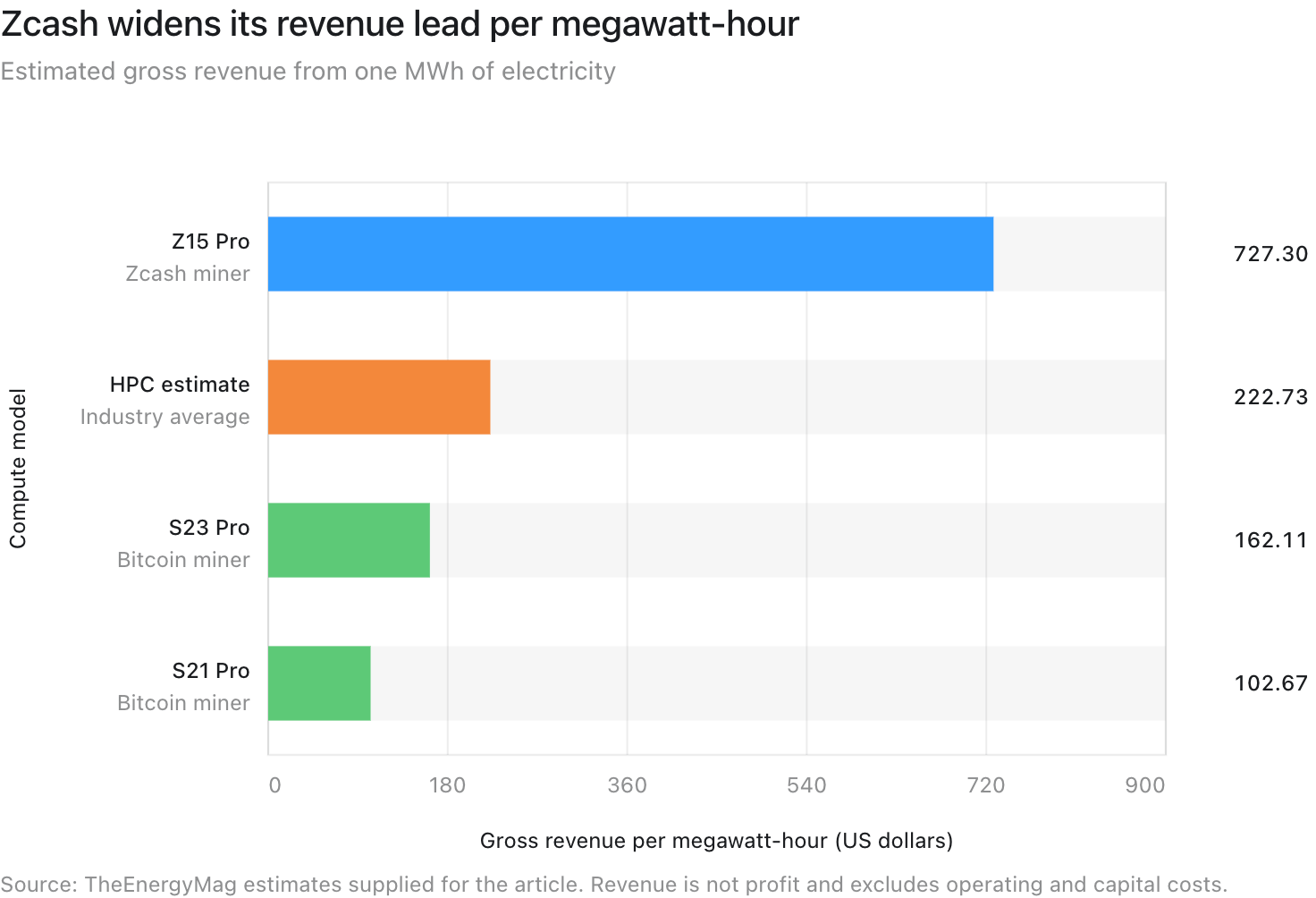
In a similar review by The Energy Mag published at the end of June, the Z15 Pro's revenue yield was estimated at $373 per MWh, compared to approximately $223 for HPC, $133 for the S23 Pro, and $84 for the S21 Pro. Zcash mining's advantage over the HPC benchmark at that time was about $150 per MWh. Since then, it has increased to over $500.
The gap between the Z15 Pro and the S23 Pro has more than doubled—from $240 to approximately $565 per MWh. The Z15 Pro's revenue is estimated to have grown by about 95%, while the S23 Pro's revenue increased by about 22%, and the HPC figure remained virtually unchanged.
This divergence reflects Zcash's superior performance. Over seven days, ZEC surged by approximately 70% and traded around $890 over the past week, surpassing the more sustainable market highs achieved after its launch in 2016.
This record comes with a caveat. Major price databases record anomalous trades from its launch week, ranging from about $3,200 to nearly $6,000, as Zcash's official all-time high. These prices were logged when only a negligible number of coins had been mined and available liquidity was extremely limited. Based on subsequent, more liquid trading history, the rise to around $890 represents a de facto all-time high, exceeding the peak levels reached during the 2017-2018 cryptocurrency cycle.
Bitcoin also rose more than 20% last week, breaking out of its roughly $62,000 to $67,000 range and climbing above $77,000 on Friday. This led to increased Bitcoin mining revenue, although the growth was significantly less than the growth in Zcash's economic activity.
The broader cryptocurrency rally began after the U.S. Treasury Department moved to expand purchases of long-term government bonds, leading to lower yields and a weaker dollar. Investors shifted focus to alternative assets, including gold and Bitcoin, amid concerns about inflation, federal debt, and the outlook for the U.S. currency.
Regulatory developments provided additional momentum. President Donald Trump used a White House cryptocurrency conference to pressure Congress to pass the Clarity Act, while regulators outlined further steps that could ease rules for companies handling digital assets.
The initial surge then accelerated into a "short squeeze." According to data from Coinglass, cited by the Associated Press, over $4 billion in cryptocurrency short positions were liquidated by Friday. Closing these positions required traders to buy back digital assets, intensifying upward pressure.
The next test will come from U.S. economic data and Federal Reserve actions. July personal consumption expenditures data, revised second-quarter GDP figures, and durable goods orders data are scheduled for Wednesday. Weekly jobless claims data will be released on Thursday.
On Friday, Fed Chairman Kevin Warsh will speak at the Jackson Hole symposium. A "hawkish" signal on inflation could lead to rising Treasury yields and a stronger dollar, partially reversing the liquidity-driven cryptocurrency rally. A more dovish stance could support further demand for risk and alternative assets.
end-content