Zcash Flaw Sparks Monero Audit Interest as Privacy Coin Debate Heats Up

TheNewsCryptoPublicado a 2026-06-06Actualizado a 2026-06-06

Resumen

A significant security flaw in Zcash's Orchard privacy pool was disclosed by non-profit developer Shielded Labs, causing ZEC's price to drop 38% in 24 hours before a modest recovery. The vulnerability, discovered on May 29th by security researcher Taylor Hornby using Anthropic's Opus 4.8 AI model, could have allowed an attacker to create an unlimited supply of counterfeit ZEC tokens undetected. This event has intensified the privacy coin debate. In response, Hornby announced plans to audit Monero (XMR), a leading privacy-focused cryptocurrency that, unlike Zcash, defaults to hiding all transaction data. Hornby expressed confidence in finding vulnerabilities in such privacy coins. The disclosure has cast fresh security scrutiny on the sector.

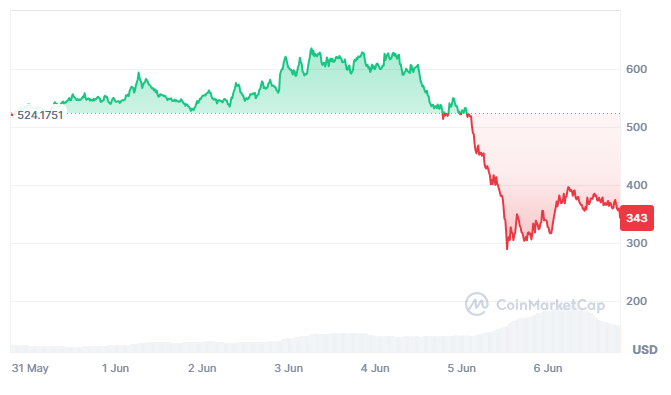
After non-profit developer Shielded Labs revealed a serious weakness in the blockchain’s Orchard privacy pool, which could have jeopardized the integrity of the token supply, Zcash (ZEC) fell 38% in 24 hours, speeding up the drop. Recent trading for ZEC has been around $361, with a low of $290, and the price has made some modest recovery of around 8% in the last 24 hours as per data from CMC.
Fresh Security Scrutiny

On Thursday night, Shielded Labs released a comprehensive disclosure about X, exposing a security hole that, if used, might have enabled an attacker to secretly produce an infinite supply of fake ZEC tokens. Imagine someone sneaking into the Federal Reserve’s dollar printing machine and making off with a bunch of additional cash; the only difference is that not even the Fed would know it happened.

The flaw was found on May 29th by Taylor Hornby, a security expert hired by Shielded Labs in April 2026 to find protocol weaknesses before bad guys could. The Orchard circuit is the cryptographic scheme supporting Zcash’s most sophisticated privacy pool; Hornby performed a focused evaluation of it using Anthropic’s newly published Opus 4.8 AI model.

One of the tokens that security researcher Taylor Hornby plans to audit next is privacy coin Monero. Hornby utilized Anthropic’s Opus 4.8 AI model to discover a serious flaw in Zcash. Hornby said, “Absolutely!” when asked on X whether he could find vulnerabilities in private coins like Monero. Adding that, Monero will be put up to my list of things to audit.

Unlike Zcash, which gives users the option to be either visible or shielded, Monero (XMR) defaults to hiding transaction data and is one of the biggest privacy-focused cryptocurrencies.

Highlighted Crypto News Today:

Worldcoin Falls Terribly as Arthur Hayes Dumps WLD

TagsAltcoinMoneroZcash

Preguntas relacionadas

QWhat was the key event that triggered the drop in Zcash's price and sparked interest in auditing Monero?

AThe key event was the disclosure by Shielded Labs of a serious security flaw in Zcash's Orchard privacy pool, which could have allowed an attacker to secretly create an unlimited supply of fake ZEC tokens.

QWho discovered the critical vulnerability in Zcash's Orchard circuit, and what tool did they use?

AThe vulnerability was discovered by security expert Taylor Hornby, who was hired by Shielded Labs. He found the flaw using Anthropic's newly published Opus 4.8 AI model.

QHow did the disclosure of the Zcash flaw specifically impact its price (ZEC) in the short term?

AFollowing the disclosure, Zcash (ZEC) fell 38% within 24 hours, reaching a low of around $290. It later saw a modest recovery of about 8% in the subsequent 24 hours.

QWhat is the fundamental difference between Monero's (XMR) and Zcash's (ZEC) approach to privacy, as mentioned in the article?

AThe fundamental difference is that Monero defaults to hiding all transaction data by design, whereas Zcash gives users an option to choose between transparent (visible) or shielded (private) transactions.

QWhat is the next project that security researcher Taylor Hornby plans to audit, and what was his confident response regarding finding vulnerabilities in it?

ATaylor Hornby plans to audit the privacy coin Monero next. When asked on X if he could find vulnerabilities in privacy coins like Monero, he responded, 'Absolutely!'

Lecturas Relacionadas

Bitcoin Mining Farms Are Becoming AI Factories

Bitcoin mines are transforming into AI factories. This shift is driven by the convergence of three key assets from the previous crypto cycle: infrastructure, talent, and capital. Crypto mining companies like Crusoe, CoreWeave, and Bitdeer are repurposing their core competency—securing power, land, and grid connections in remote locations—to build data centers for AI clients. These firms are signing multi-billion dollar, long-term contracts with companies like Anthropic, AWS, and Microsoft, as AI's demand for reliable, high-capacity compute surpasses the profitability of Bitcoin mining. Simultaneously, crypto entrepreneurs and engineers are applying their skills to new AI ventures. Examples include OpenSea's co-founder launching OpenRouter (an AI model aggregator), and former Coinbase engineers building Fal.ai (a generative media infrastructure platform). Their experience in building scalable, global software networks translates effectively to the AI space. Furthermore, capital accumulated during the crypto boom is now fueling AI. Figures like Jed McCaleb (co-founder of Ripple) funded Voltage Park, a large-scale GPU cloud provider. Notably, some crypto investments, like FTX's early bets on Anthropic and Cursor, have generated astronomical paper returns, demonstrating how high-risk crypto capital flowed into AI before it became mainstream. The transition is not just about repurposing hardware, but about redirecting critical resources—power infrastructure, distributed systems expertise, and venture funding—to the next technological frontier: artificial intelligence.

链捕手Hace 53 min(s)

Bitcoin Mining Farms Are Becoming AI Factories

链捕手Hace 53 min(s)

Morpho Launches Fixed-Rate Product Midnight: Lenders and Borrowers Set Their Own Rates, Ending the Era of Interest Rate Models

Morpho Launches Fixed-Rate Product Midnight: Lenders and Borrowers Set Their Own Rates, Ending the Era of Algorithmic Interest Models On-chain lending has grown to $60 billion but remains minuscule compared to traditional finance's $200 trillion annual credit volume. Morpho identifies the lack of fixed rates and maturity dates as key bottlenecks. Institutions need predictability, not the passive floating rates set by algorithmic models. Midnight allows lenders and borrowers to directly quote rates, set terms, and become price makers, not takers. Fixed-rate lending is now viable due to cheaper, faster blockchains and the entry of institutions demanding control and certainty over returns, costs, and duration. Morpho Blue previously gave users control over risk; Midnight adds control over interest rates. Past attempts at on-chain fixed-rate lending failed primarily because they were built on top of floating-rate pools (creating unpredictability) or lacked sufficient active participants. Midnight avoids these pitfalls as a standalone primitive with fixed rates at its core, built upon Morpho Blue's existing large and active user base. Midnight offers distinct value: institutions gain predictable term structures and full control; fintech companies can offer tailored fixed-rate products; lenders/borrowers achieve predictability and efficiency; and curators can now differentiate by configuring both risk and interest rates. Morpho Midnight is not a replacement for Morpho Blue. The Morpho network will now feature two complementary market structures: floating-rate/open-term (Blue) for flexibility and fixed-rate/fixed-term (Midnight) for predictability. Liquidity can flow between them. The launch will be gradual, prioritizing security. Initially, it will support direct lending on Base network with one trading pair (cbBTC/USDC) and limited maturity dates. Advanced features like auto-rollovers will be introduced later.

marsbitHace 53 min(s)

Morpho Launches Fixed-Rate Product Midnight: Lenders and Borrowers Set Their Own Rates, Ending the Era of Interest Rate Models

marsbitHace 53 min(s)

Trading

Spot
活动图片