Zcash explodes 23% – But a bigger move may be coming

ambcryptoPublicado a 2026-04-09Actualizado a 2026-04-09

Resumen

Zcash (ZEC) surged 23% to $329, with trading volume spiking 152% to $810 million, indicating strong demand. Capital is moving off exchanges, with wrapped ZEC supply rising to 284,680, primarily on Solana and BSC, signaling a shift toward cross-chain utility and liquidity. The rally is supported by growing institutional narrative around financial privacy and quantum resistance, as well as the Tachyon upgrade which emphasizes spending utility. Price action broke key resistance at $275, targeting higher levels like $376, though failure to hold gains could see a pullback to $240. Social engagement and sentiment remain high, but long-term sustainability depends on continued adoption rather than speculative attention.

Zcash’s [ZEC] move starts with price, yet the drivers extend beyond a simple rally.

ZEC’s price rose to $329, gaining 23% in 24 hours as volume jumped 152% to $810 million, which signaled strong demand entering quickly. However, this demand did not stay on exchanges, as capital began moving across chains.

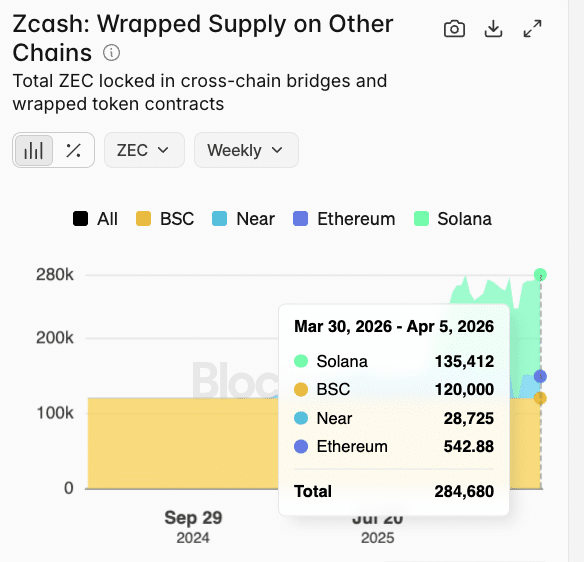
Wrapped supply rose to about 284,680 ZEC, led by Solana [SOL] at 135,412 and BSC at 120,000, while smaller flows reached Near Protocol. This shift shows users seek liquidity, utility, and access beyond a single network, which supports broader adoption rather than isolated trading.
Source: X

At the same time, narrative momentum builds, as institutional focus on privacy and fiat hedging draws attention. This creates a dual effect, where utility supports price, yet attention amplifies volatility.

In turn, sustainability depends on whether cross-chain usage continues or fades with sentiment.

Zcash momentum builds as price reclaims key levels

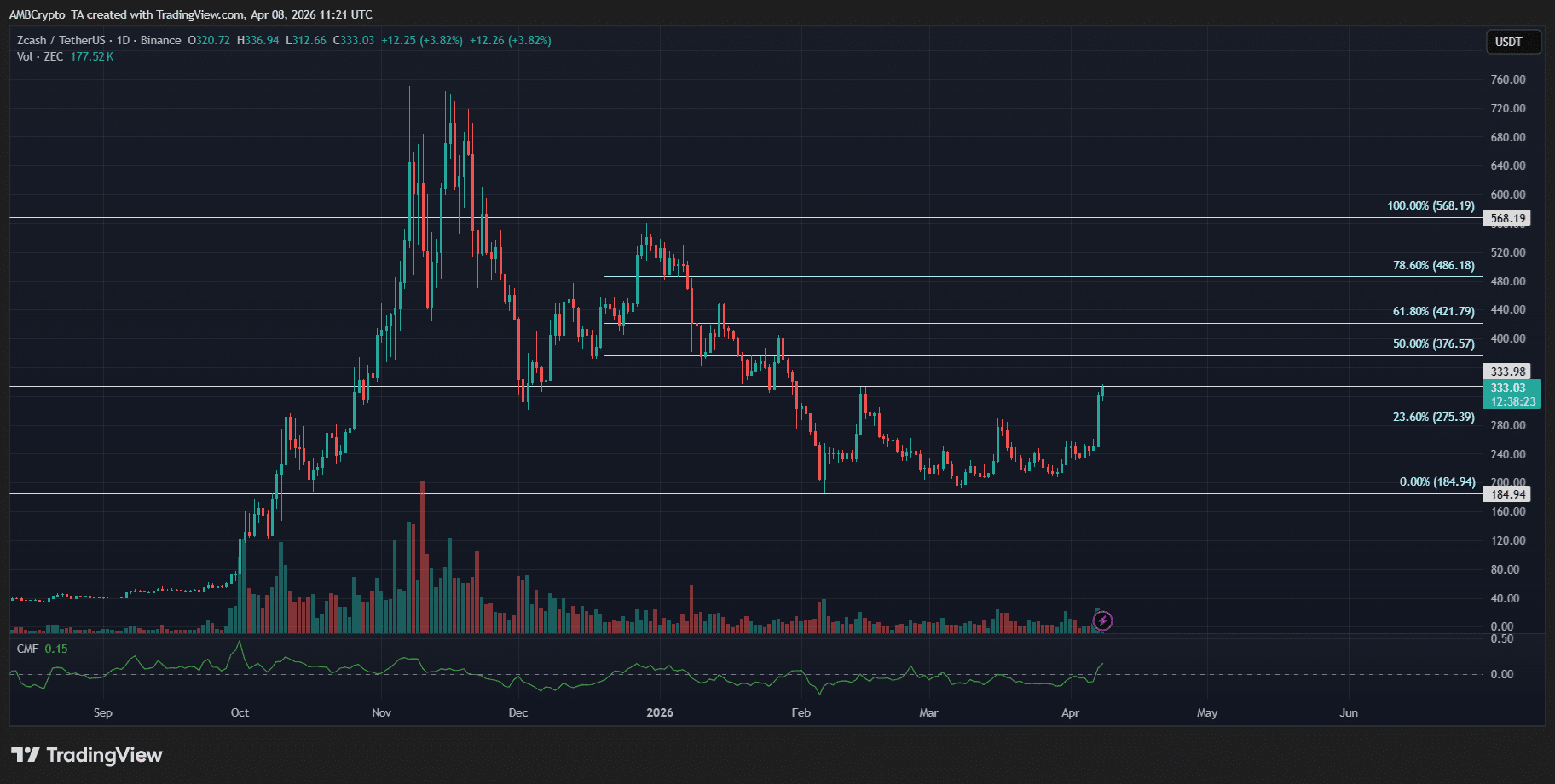
Zcash’s price action strengthened as momentum aligned with rising activity. First, ZEC rebounded from the $184 base and broke above $275, reclaiming the 23.6% level and signaling a trend reversal.

As price pushed toward $333 resistance, buyers showed intent to challenge some higher zones.
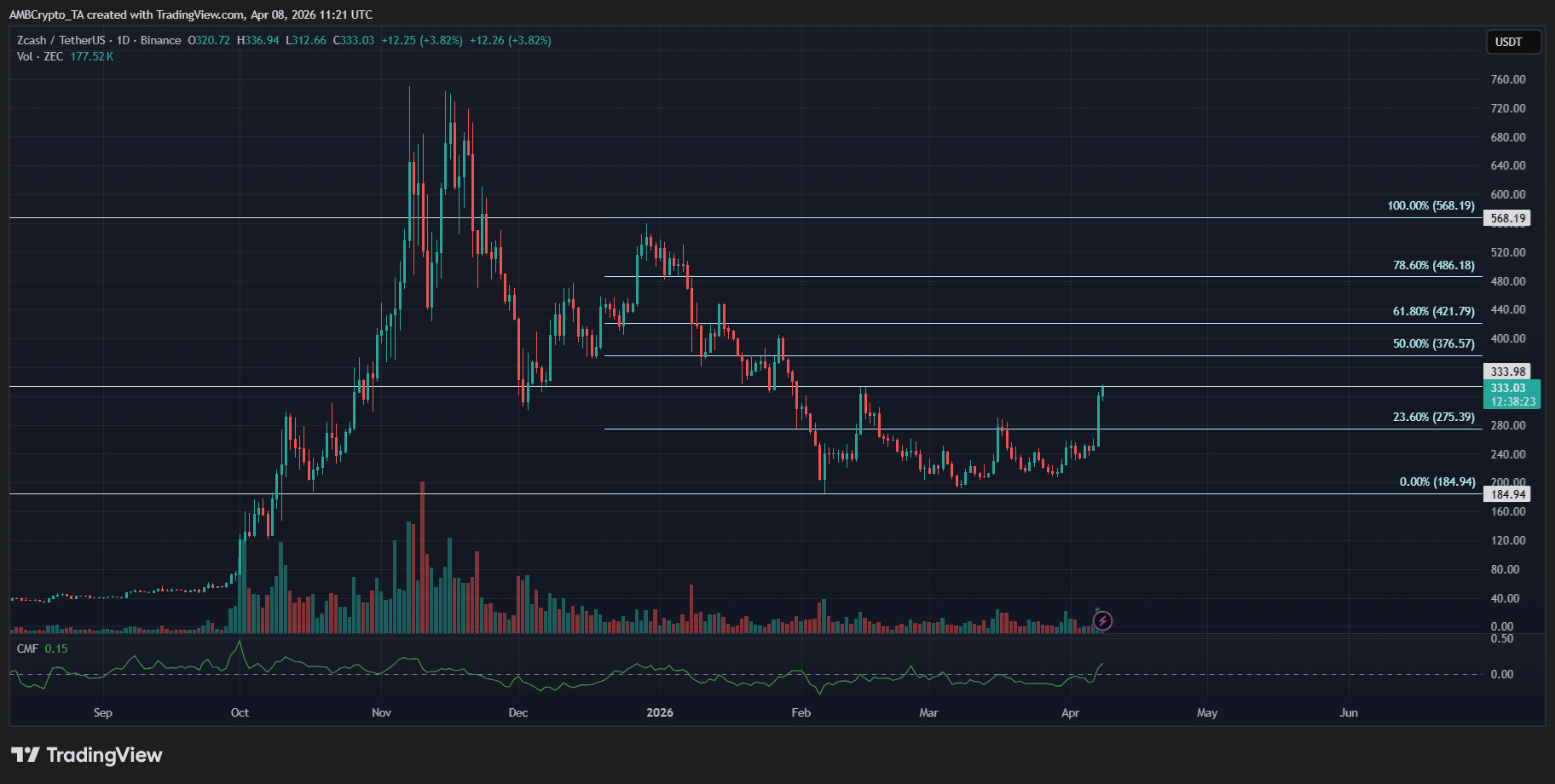
Source: ZECUSDT on TradingView

Above this, the $376 level marked the mid-range pivot, where a breakout would confirm continuation. Further up, $421 and $486 acted as supply zones, reflecting prior rejection areas where sellers may re-enter.

However, failure to hold above $275 could expose downside toward $240 and back to $184 support, weakening the structure. Meanwhile, CMF remains positive near 0.15, showing inflows.

In turn, momentum holds, yet key levels will decide if expansion continues or stalls.
Zcash gains as narrative and utility align

Zcash’s move begins with rising attention, yet it quickly feeds into price.

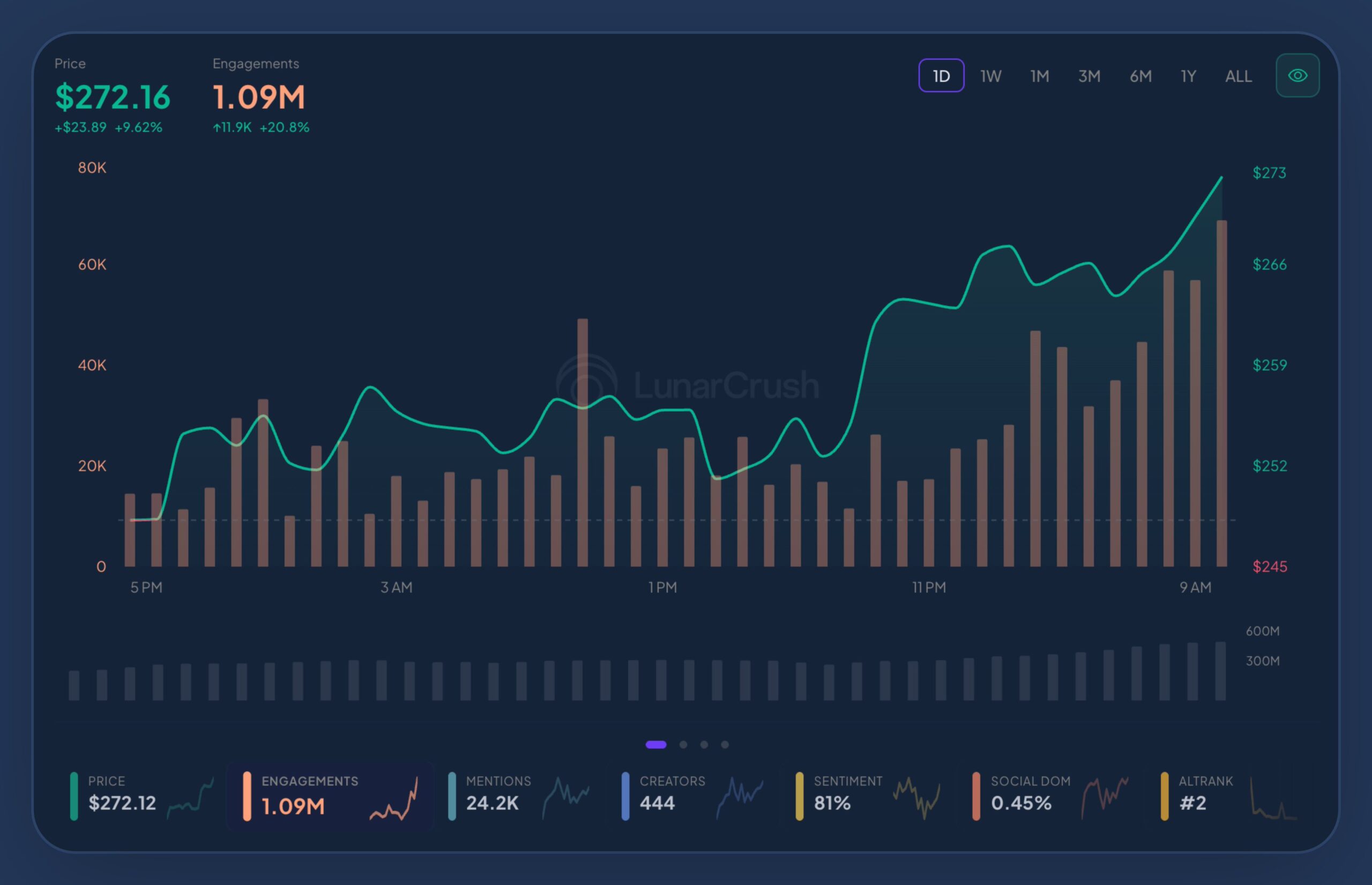
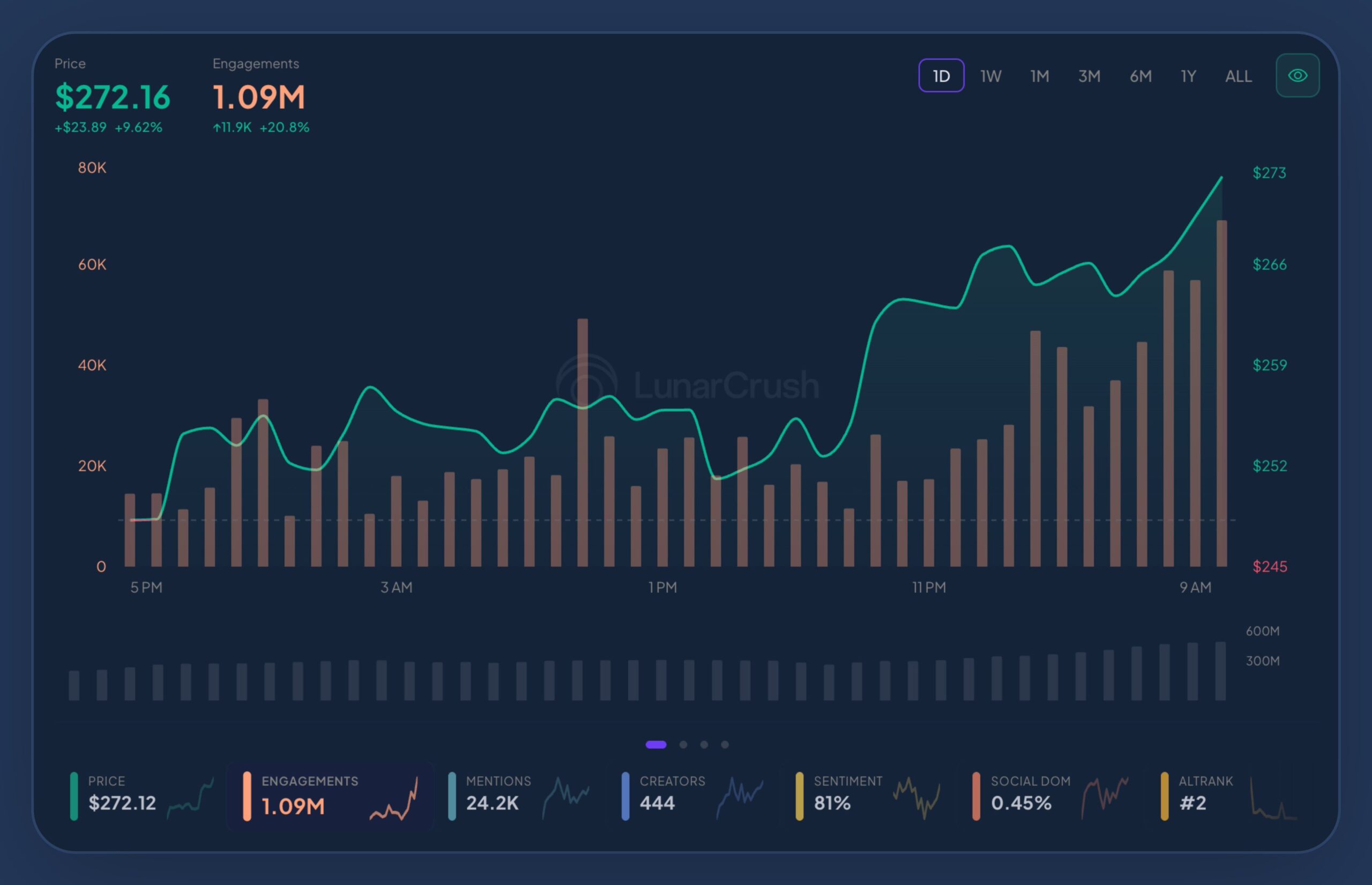
As ZEC’s price surged, engagements climbed to 1.09 million, up 20.8%, showing demand building in real time. As mentions reached 24,200 and sentiment stayed high at 81%, the narrative began to drive participation.

Source: LunarCrush

This attention does not emerge randomly. Foundry’s report on financial privacy introduces institutional validation, while quantum concerns revive Zcash’s relevance as a privacy-focused hedge.

At the same time, the Tachyon upgrade adds a usage angle, shifting the story from holding to spending. This creates tension, where narrative fuels price, yet sustainability depends on real adoption. In turn, the market now tests whether attention converts into lasting demand.


Final Summary

  • Zcash’s rally reflects cross-chain demand and narrative strength, as 284,680 wrapped supply and rising volume confirm active capital rotation beyond exchanges.
  • ZEC holds momentum above $275 with inflows and sentiment support, yet sustainability depends on real adoption rather than attention-driven volatility.

Preguntas relacionadas

QWhat was the percentage increase in Zcash's price and the volume surge mentioned in the article?

AZcash's price rose 23% in 24 hours, and its trading volume jumped 152% to $810 million.

QWhich blockchain networks saw the largest inflows of wrapped ZEC supply according to the article?

ASolana led with 135,412 wrapped ZEC, followed by BSC with 120,000 wrapped ZEC.

QWhat key price level did ZEC reclaim that signaled a trend reversal?

AZEC broke above $275, reclaiming the 23.6% level, which signaled a trend reversal.

QWhat two factors does the article suggest are creating a dual effect on Zcash's price movement?

AUtility supports the price, while attention amplifies volatility.

QWhat does the article state as the ultimate factor for the sustainability of Zcash's momentum beyond attention-driven volatility?

ASustainability depends on real adoption rather than attention-driven volatility.

Lecturas Relacionadas

$292 Million KelpDAO Cross-Chain Bridge Hack: Who Should Foot the Bill?

On April 18, 2026, an attacker stole 116,500 rsETH (worth ~$292M) from KelpDAO’s cross-chain bridge in 46 minutes—the largest DeFi exploit of 2026. The stolen assets were deposited into Aave V3 as collateral, causing $177–200M in bad debt and triggering a cascade of losses across nine DeFi protocols. Aave’s TVL dropped by ~$6B overnight. This legal analysis argues that KelpDAO and LayerZero Labs share concurrent liability, with fault apportioned 60%/40%. KelpDAO negligently configured its bridge with a 1-of-1 decentralized verifier network (DVN)—a single point of failure—despite LayerZero’s explicit recommendation of a 2-of-3 setup. LayerZero, which operated the compromised DVN, failed to secure its RPC infrastructure against a known poisoning attack vector. Both protocols’ terms of service cap liability at $200 (KelpDAO) or $50 (LayerZero), but these limits are likely unenforceable due to unconscionability, gross negligence exceptions, and potential securities law invalidation (if rsETH is deemed a security under the Howey test). Aave’s governance also faces fiduciary duty claims for raising rsETH’s loan-to-value ratio to 93%—far above competitors’ 72–75%—without adequately assessing bridge risks, amplifying the systemic fallout. Practical recovery targets include LayerZero Labs (a registered Canadian entity), KelpDAO’s founders, auditors, and identifiable Aave governance delegates. The incident underscores escalating legal risks for DeFi protocols, infrastructure providers, and governance participants.

marsbitHace 34 min(s)

$292 Million KelpDAO Cross-Chain Bridge Hack: Who Should Foot the Bill?

marsbitHace 34 min(s)

Insider Trading in War: 5 People Involved, the Highest Earner Was Arrested

On April 24, the U.S. Department of Justice arrested U.S. Army Special Forces Staff Sergeant Gannon Ken Van Dyke for insider trading related to the capture of Venezuelan President Nicolás Maduro on January 3. Van Dyke allegedly profited over $400,000 by placing bets on a prediction market, Polymarket, using insider knowledge of the covert operation. According to the indictment, Van Dyke registered an account (0x31a5) on December 26 and made a series of bets predicting Maduro’s capture and U.S. military involvement in Venezuela. He withdrew most of his funds on the day of the operation and attempted to obscure his tracks by transferring assets through crypto and brokerage accounts. This case marks the first time the DOJ has prosecuted insider trading on Polymarket. PolyBeats had previously identified five suspicious accounts, including Van Dyke’s—the highest earner—in January. The other accounts, with profits ranging from $34,000 to $145,000, remain under unofficial scrutiny but have not been charged. Their lower profits, indirect access to information, and unclear legal boundaries may complicate prosecution. Polymarket has since strengthened its market integrity rules, explicitly prohibiting trading based on confidential or insider information. Van Dyke’s arrest, nearly four months after his trades, signals increased regulatory attention and the persistent traceability of blockchain-based transactions.

marsbitHace 36 min(s)

Insider Trading in War: 5 People Involved, the Highest Earner Was Arrested

marsbitHace 36 min(s)

Bitwise: Bullish on Bitcoin's Performance in the Second Half of the Year, AI and Regulation Will Spark a New Altcoin Season

Bitwise CIO Matt Hougan and Research Lead Ryan Rasmussen express strong bullish sentiment on Bitcoin's long-term prospects, suggesting that its $1 million price target may be too conservative. They argue Bitcoin serves a dual role: as digital gold and a potential global settlement asset, especially amid declining trust in traditional monetary systems. Despite a weak Q1 2026 where nearly all crypto assets and prices saw double-digit declines, the analysts remain optimistic due to strong forward-looking catalysts, including institutional adoption via Bitcoin ETFs from major firms like Morgan Stanley and Goldman Sachs. Geopolitical instability, such as Iran’s mention of using Bitcoin for international payments, increases the value of Bitcoin’s “out-of-the-money call option” as a non-political, global settlement currency. This enhances its appeal beyond a mere store of value. . Additionally, Hougan highlights that a clearer regulatory token framework under current SEC leadership, combined with AI efficiency gains and high-performance blockchains, could fuel a new “altseason” by late 2026. This may lead to a wave of legitimate, value-capturing token projects, unlike the earlier ICO boom. . Bitwise also announced an Avalanche ETF, citing its unique architecture and rapid growth in real-world asset (RWA) tokenization, which has surged 10x to nearly $30 billion in two years. The firm believes Layer 1 blockchains are still early in their growth cycle, with significant potential ahead.

marsbitHace 1 hora(s)

Bitwise: Bullish on Bitcoin's Performance in the Second Half of the Year, AI and Regulation Will Spark a New Altcoin Season

marsbitHace 1 hora(s)

Trading

Spot
Futuros

Artículos destacados

Cómo comprar MOVE

¡Bienvenido a HTX.com! Hemos hecho que comprar Movement (MOVE) sea simple y conveniente. Sigue nuestra guía paso a paso para iniciar tu viaje de criptos.Paso 1: crea tu cuenta HTXUtiliza tu correo electrónico o número de teléfono para registrarte y obtener una cuenta gratuita en HTX. Experimenta un proceso de registro sin complicaciones y desbloquea todas las funciones.Obtener mi cuentaPaso 2: ve a Comprar cripto y elige tu método de pagoTarjeta de crédito/débito: usa tu Visa o Mastercard para comprar Movement (MOVE) al instante.Saldo: utiliza fondos del saldo de tu cuenta HTX para tradear sin problemas.Terceros: hemos agregado métodos de pago populares como Google Pay y Apple Pay para mejorar la comodidad.P2P: tradear directamente con otros usuarios en HTX.Over-the-Counter (OTC): ofrecemos servicios personalizados y tipos de cambio competitivos para los traders.Paso 3: guarda tu Movement (MOVE)Después de comprar tu Movement (MOVE), guárdalo en tu cuenta HTX. Alternativamente, puedes enviarlo a otro lugar mediante transferencia blockchain o utilizarlo para tradear otras criptomonedas.Paso 4: tradear Movement (MOVE)Tradear fácilmente con Movement (MOVE) en HTX's mercado spot. Simplemente accede a tu cuenta, selecciona tu par de trading, ejecuta tus trades y monitorea en tiempo real. Ofrecemos una experiencia fácil de usar tanto para principiantes como para traders experimentados.

222 Vistas totalesPublicado en 2024.12.13Actualizado en 2025.03.21

Cómo comprar MOVE

Discusiones

Bienvenido a la comunidad de HTX. Aquí puedes mantenerte informado sobre los últimos desarrollos de la plataforma y acceder a análisis profesionales del mercado. A continuación se presentan las opiniones de los usuarios sobre el precio de MOVE (MOVE).

活动图片