Zama Public Sale Too Complicated? A Guide to Understanding Sealed-Bid Dutch Auctions

Odaily星球日报Publicado a 2025-12-09Actualizado a 2025-12-09

Resumen

Zama, a fully homomorphic encryption (FHE) network that has raised $130 million, is conducting a sealed-bid Dutch auction for 10% of its ZAMA token supply. The auction, running from January 12–15, uses FHE to keep bids confidential, ensuring fairness with no front-running, bots, or gas wars. Participants convert stablecoins into encrypted assets before bidding. The clearing price is determined by accumulating demand from highest to lowest bids; those who bid above it get full allocation with refunds, those at the price get pro-rata shares, and those below are refunded. All purchased tokens are fully unlocked at claim. Zama’s mainnet is expected by year-end. The article also highlights ongoing guild tasks for community engagement before the token generation event.

Original | Odaily Planet Daily (@OdailyChina)

Author | Asher (@Asher_ 0210)
On December 1, Zama, a fully homomorphic encryption network that has raised a total of $130 million, announced on X that it will sell 10% of the total ZAMA token supply through a sealed-bid Dutch auction, using fully homomorphic encryption (FHE) to keep bids confidential. Additionally, the Zama mainnet is expected to launch before the end of the year.

Zama is arguably one of the most discussed projects in the community for its upcoming TGE. Below, Odaily Planet Daily will break down the Zama project, the sealed-bid Dutch auction, and the final interaction opportunities before the token generation event.

Project Overview

Zama is a company specializing in fully homomorphic encryption (FHE) technology, one of the most cutting-edge innovations in the field of privacy computing. Simply put, it allows computations to be performed directly on encrypted data without decryption. Zama's mission is to build efficient and user-friendly FHE tools to promote the widespread adoption of this technology in Web3 and beyond. Zama's core team was co-founded by Rand Hindi and Pascal Paillier:

  • Rand Hindi learned to program at age 10, created a social website that went viral in France at 14, holds a PhD in Computer Science and Bioinformatics from University College London, and previously founded and sold the AI voice platform Snips;
  • Pascal Paillier is a top expert in fully homomorphic encryption with 25 years of research experience, holding 25 patents and publishing dozens of papers. He has won the Asiacrypt Best Paper Award and is a core member of IACR.

To date, Zama has completed two funding rounds, raising a total of $130 million. In March 2024, Zama announced a $73 million Series A round co-led by Multicoin Capital and Protocol Labs; in June 2025, Zama announced a $57 million Series B round led by Blockchange Ventures and Pantera Capital. (For more details, read: The Next Blockchain Giant: Why ZAMA Raised $130 Million)

Sealed-Bid Dutch Auction Token Public Sale to Begin on January 12

Public Sale Details

Auction Method: Sealed-bid Dutch auction;

Auction Time: January 12 to 15, with claims starting January 20;

Public Sale Share: 10% of the total token supply, with 8% sold via auction and 2% sold at a fixed price post-auction (capped at $10,000 per person);

Lock-up: Zama tokens purchased in the auction will be fully unlocked;

Auction Pre-registration Link: https://www.zama.org/auction.
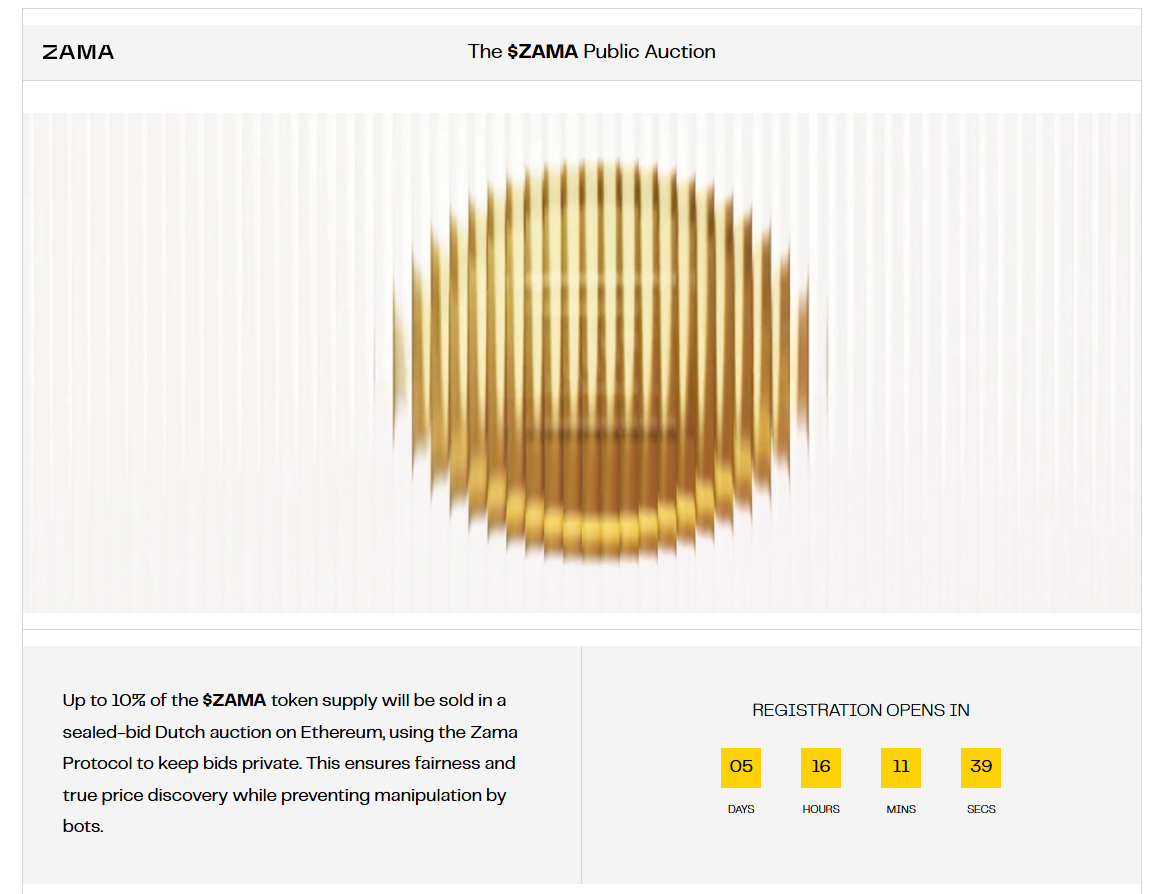
Zama Public Sale to start on January 12

What is a Sealed-Bid Dutch Auction?

Zama will sell 10% of the total ZAMA token supply through a sealed-bid Dutch auction on Ethereum, using fully homomorphic encryption (FHE) to maintain bid confidentiality. Key highlights include fair distribution, no front-running, no bots, and no gas wars. Specifically, the sealed-bid Dutch auction consists of 4 stages:

  • Stage 1: Shield stablecoins. Prepare funds by converting personal USDC, USDT, DAI, and other stablecoins on the Ethereum network into ERC-7984 confidential assets (a conversion website will be provided by the official at the public sale launch). The balances and transfer amounts of these tokens will be encrypted.
  • Stage 2: Place your bids. This is the bidding stage, running from January 12 to January 15. Users can submit any number of bids. Bid prices are public, but quantities are confidential. The starting price is $0.005 (corresponding to a $55 million FDV). Unlike a public Dutch auction where the price decreases over time, the sealed-bid Dutch auction allows users to bid at any price throughout the bidding period.
  • Stage 3: Clearing price and allocation. This is the settlement stage, running from January 16 to January 19. The smart contract uses FHE calculations to accumulate demand from the highest to the lowest price to determine the clearing price. Therefore, users will fall into three scenarios: 1. If the bid is higher than the clearing price, they receive their full allocation, and any overpayment is refunded; 2. If the bid equals the clearing price: if the quantity exceeds the remaining supply at that price, they receive a proportional share of tokens, with the remainder refunded; 3. If the bid is lower than the clearing price: they receive no tokens and get a full refund.
  • Stage 4: Claim your tokens. This is the token claim stage, starting January 20. Users can claim their ZAMA tokens (fully unlocked) and any refunds.

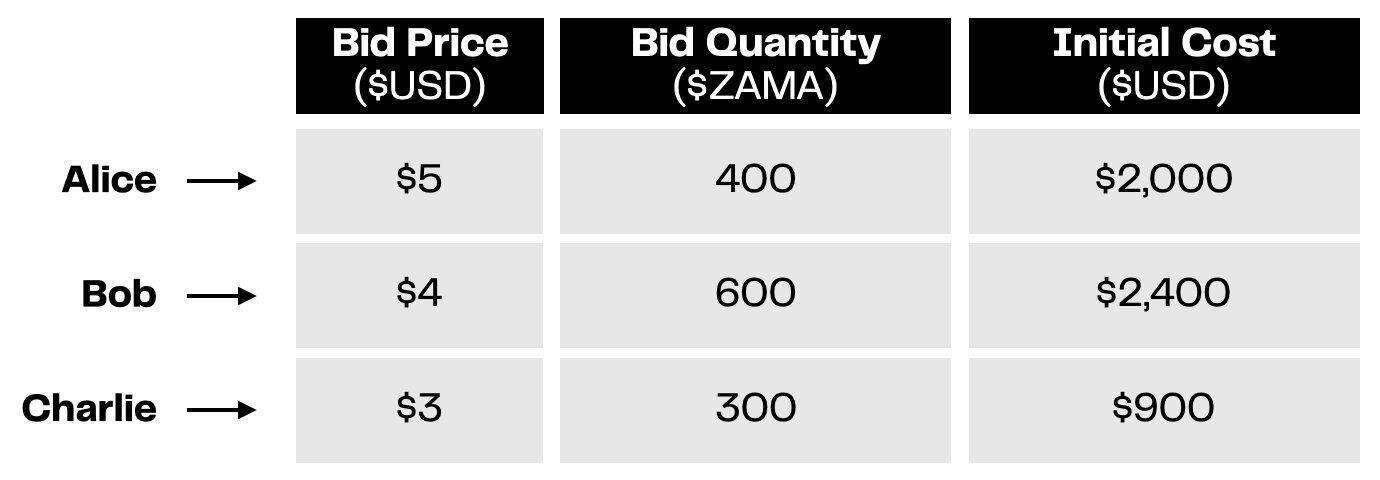
To make it easier to understand, Odaily Planet Daily provides an example. Assume 1000 ZAMA tokens are sold via a sealed-bid Dutch auction, with three participants: Alice, Bob, and Charlie.

First, during the bidding stage, their bids are as follows:

  • Alice bids for 400 tokens at $5 each, paying a total of $2000;
  • Bob bids for 600 tokens at $4 each, paying a total of $2400;
  • Charlie bids for 300 tokens at $3 each, paying a total of $900.
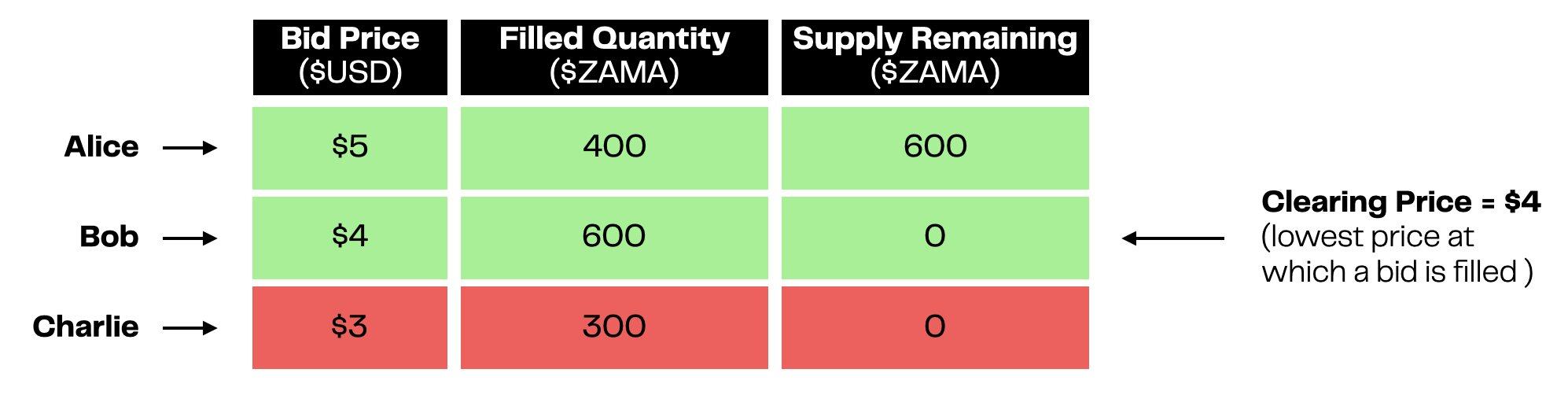
Next, after the bidding period ends, the auction smart contract allocates tokens to each participant in order from the highest to the lowest bid:

  • Alice has the highest bid and receives her 400 tokens. 600 tokens remain to be allocated.
  • Bob is the second highest bidder and receives the remaining 600 tokens. The remaining supply is now 0. Thus, the final clearing price is Bob's bid price of $4 per token.
  • Charlie's bid is below the final clearing price, so he receives no allocation.
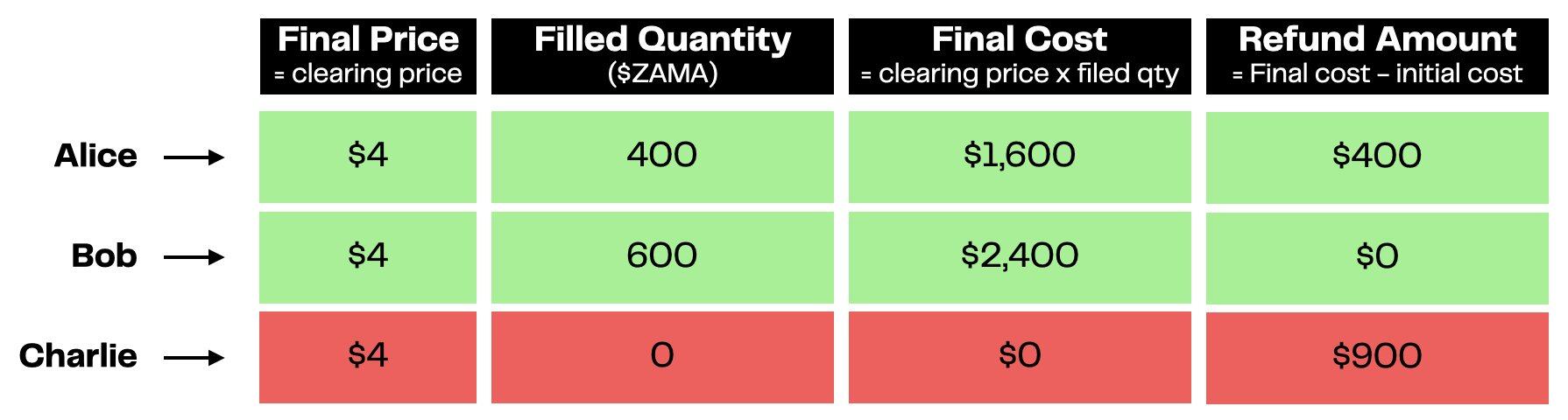
Finally, during the claim and refund stage:

  • Alice receives 400 ZAMA tokens and a $400 refund;
  • Bob receives 600 ZAMA tokens, with no refund;
  • Charlie receives no ZAMA tokens but gets a full refund of his $900.
Final Interaction Opportunities Before TGE

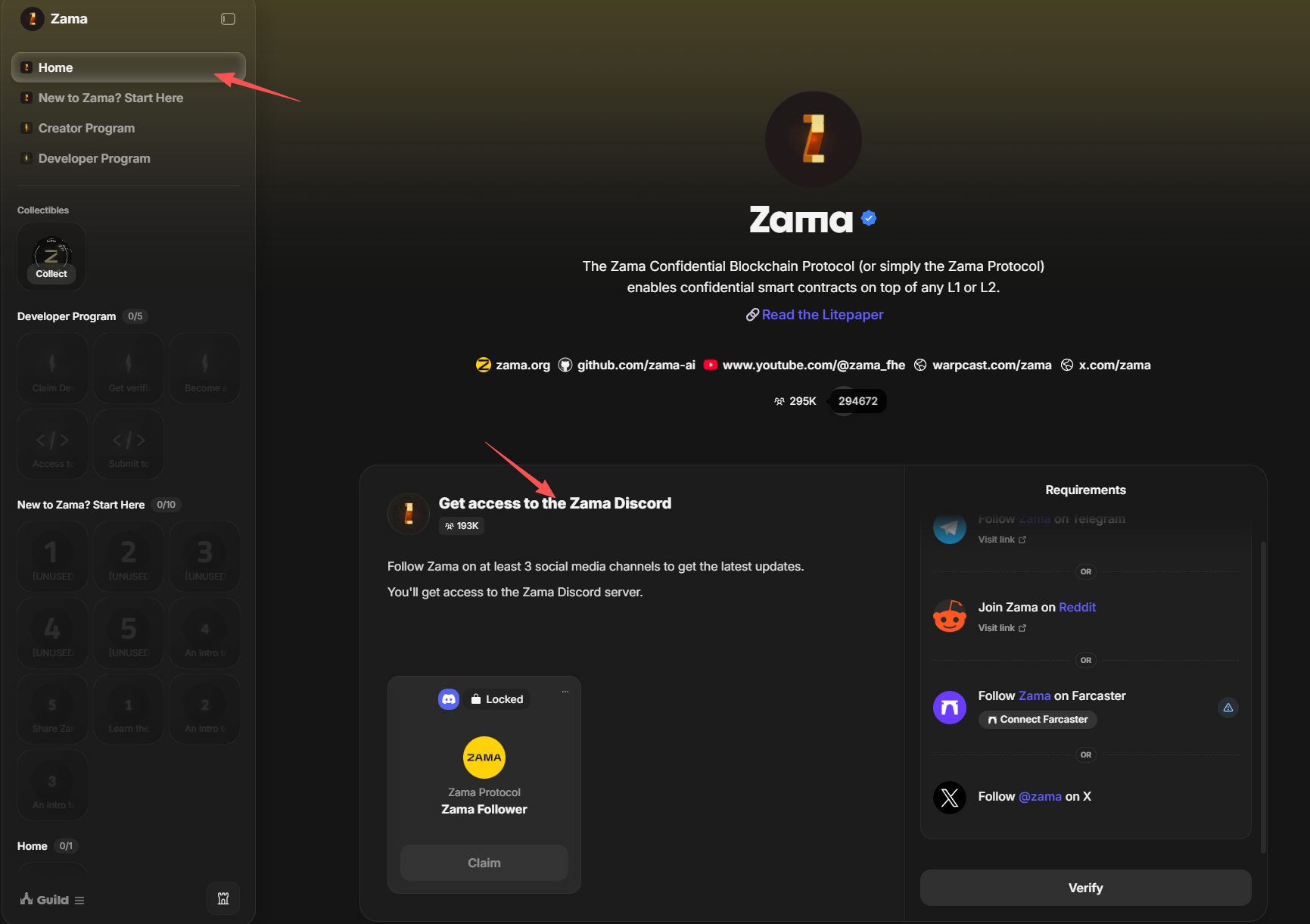
Currently, you can still participate in Zama's guild tasks (Link: https://guild.xyz/zama/home), which include:

Basic Task: Get access to the Zama Discord. Join three of the four official communities to complete this task, and also join the official Discord channel to get a role.
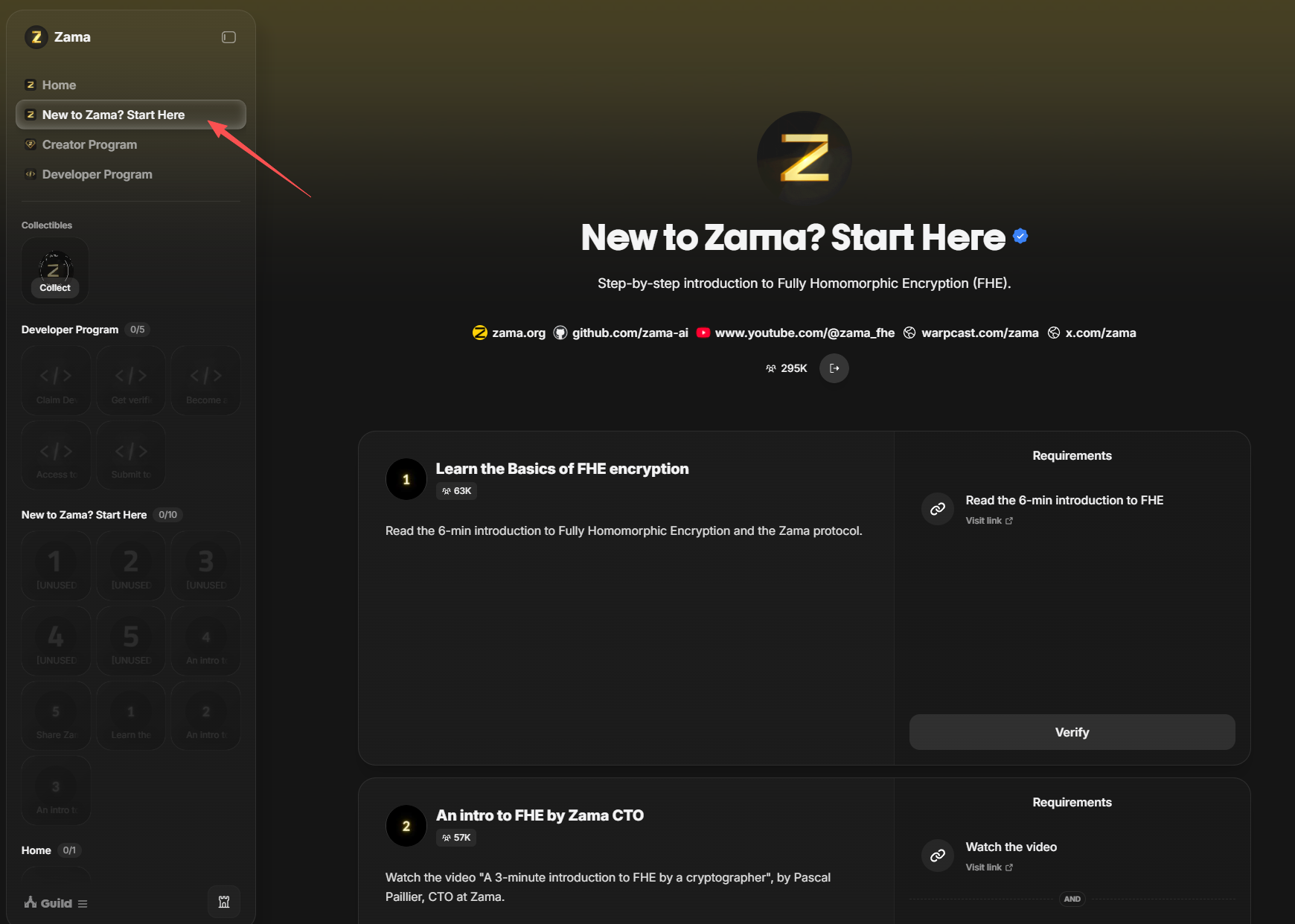
New to Zama? Task: Includes five subtasks, easy to complete by following the prompts.
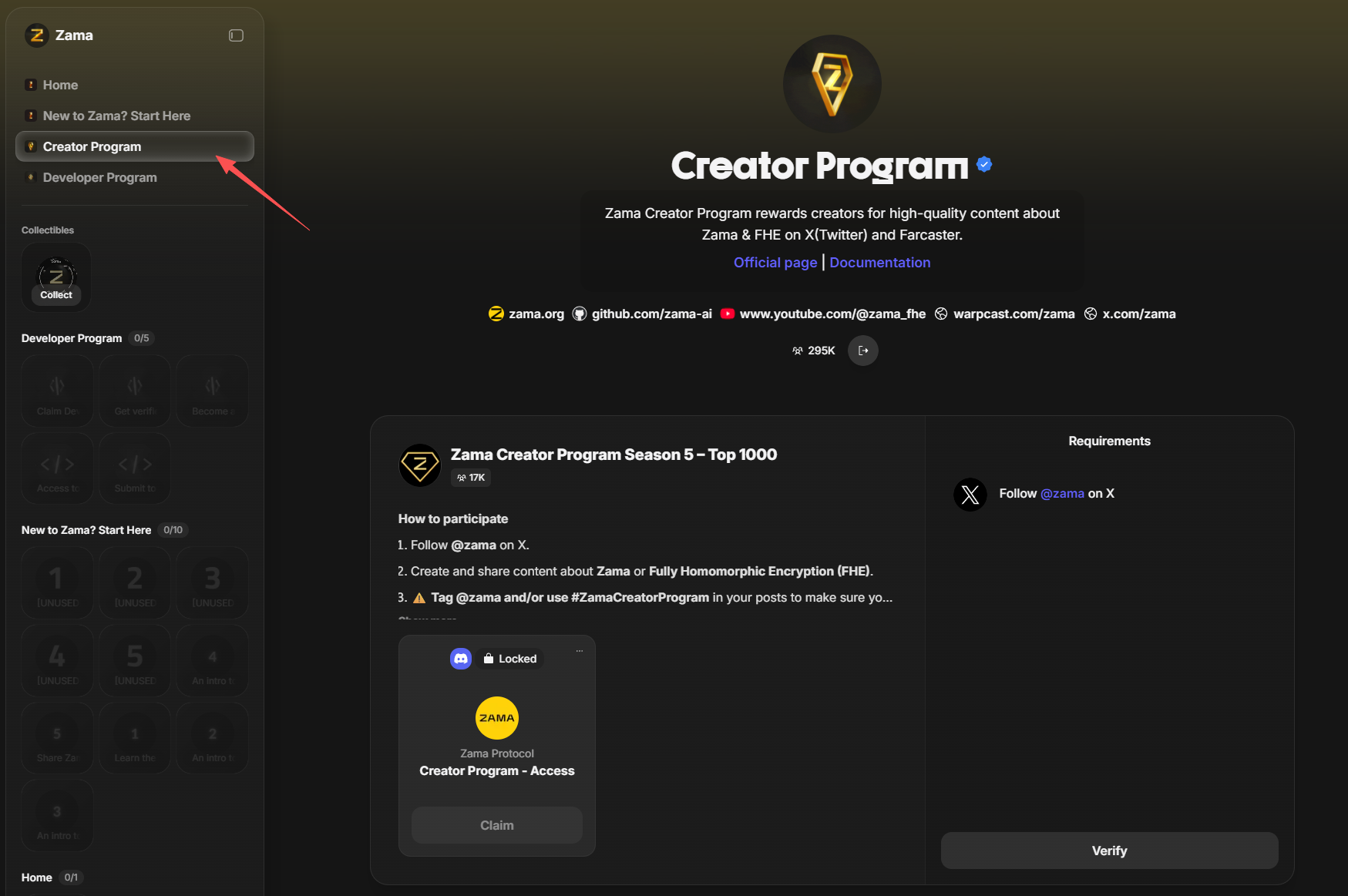
Creator Program Task: Includes two subtasks. The first subtask has funding requirements, and the second is the creator program.
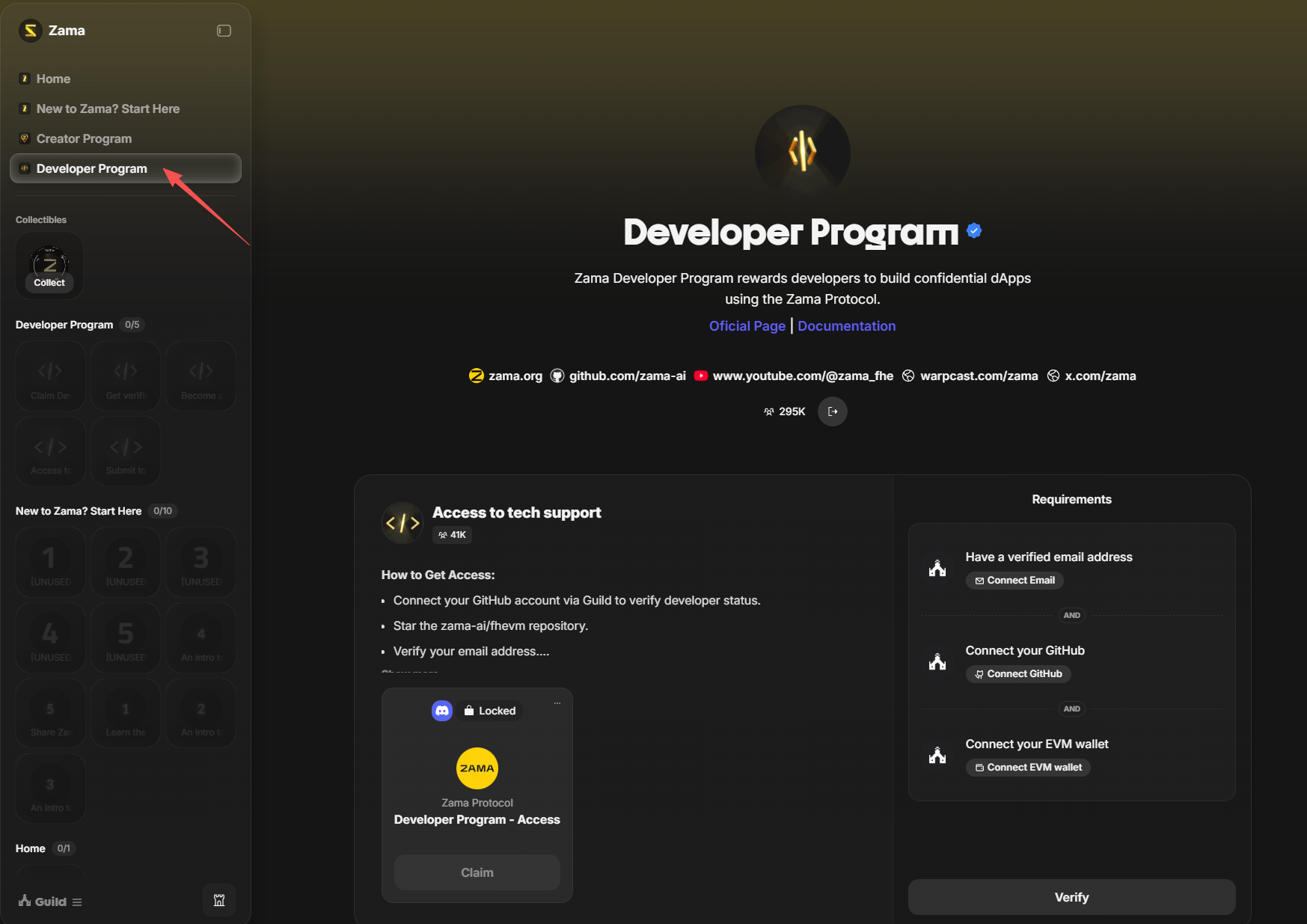
Developer Program Task: High task requirements, proceed based on your situation.
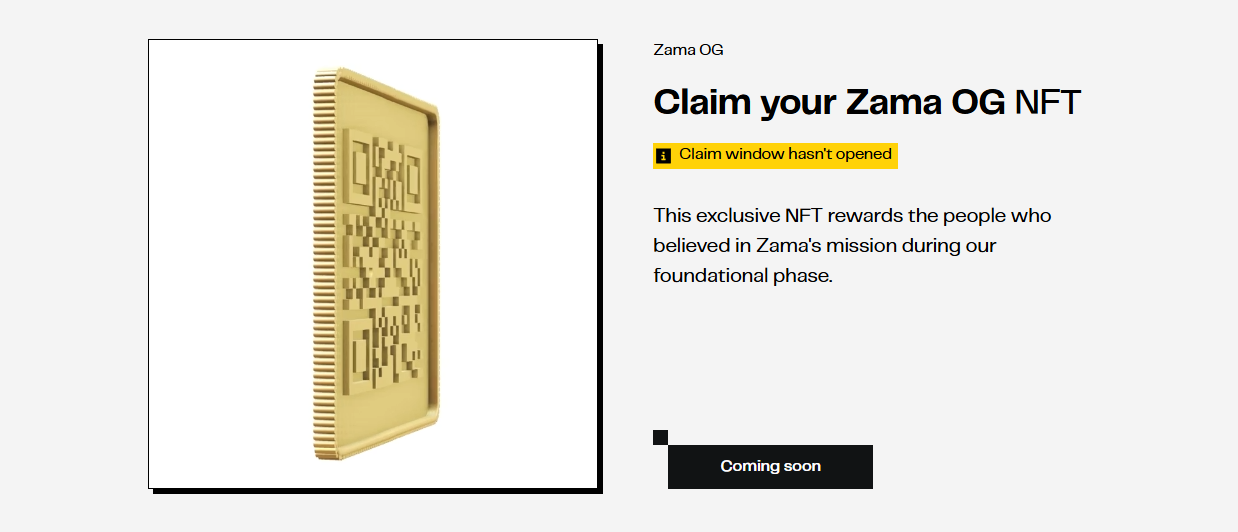
Additionally, the OG NFT minting page will open soon. Early participants should check if they are eligible when it opens (Link: https://www.zama.org/nft/og).
Criptos en tendencia

Preguntas relacionadas

QWhat is the auction method used by Zama for their token sale?

AZama is using a Sealed-Bid Dutch Auction for their token sale.

QWhat is the total percentage of the ZAMA token supply being sold in the public sale?

A10% of the total ZAMA token supply is being sold, with 8% through the auction and 2% at a fixed price after the auction.

QWhat is the key technological feature used to ensure bid confidentiality in Zama's auction?

AThe auction uses Fully Homomorphic Encryption (FHE) to keep the bids confidential.

QWhat happens to a bidder who places a bid price higher than the final clearing price?

AA bidder whose bid price is higher than the final clearing price will receive their full allocation of tokens and get a refund for any amount they overpaid.

QWhen does the token claim and refund phase for Zama's auction begin?

AThe token claim and refund phase begins on January 20th.

Lecturas Relacionadas

The person closest to the Federal Reserve commented on US non-farm payroll data!

The U.S. non-farm sector lost 23,000 jobs in July, indicating the labor market has not yet stabilized following four months of positive growth, although the unemployment rate edged down to 4.1%. Following the weak jobs data, Wall Street Journal reporter Nick Timiraos, known for his close ties to Federal Reserve policy, stated that interpreting the July employment report will be a complex task for the Fed. According to Timiraos, the new data showing the labor market is no longer improving could reduce the need for the Fed to raise interest rates next month. However, the most critical factor determining the direction of the interest rate decision will be inflation data. He noted that market focus will remain on inflation, especially as unemployment continues to fall, with rising or falling price pressures likely to shape the Fed's approach to interest rate policy. Therefore, moderate inflation data could strengthen the argument for the Fed to leave rates unchanged. Specifically, two consecutive months of moderate inflation could be interpreted as a sign that slowing price pressures are becoming a more pronounced trend, not a temporary fluctuation. Conversely, positive inflation data could force the Fed to reconsider its current inflation forecasts and increase the likelihood of a rate hike. Timiraos added that if inflation proves to be high, forecasts of reaching inflation targets without changing interest rates could be questioned by more Fed officials. In such a scenario, support for a rate hike among policymakers could increase.

cryptonews.ruHace 1 hora(s)

The person closest to the Federal Reserve commented on US non-farm payroll data!

cryptonews.ruHace 1 hora(s)

Trading

Spot

Artículos destacados

Cómo comprar SQQQ

¡Bienvenido a HTX.com! Hemos hecho que comprar ProShares UltraPro Short QQQ (SQQQ) sea simple y conveniente. Sigue nuestra guía paso a paso para iniciar tu viaje de criptos.Paso 1: crea tu cuenta HTXUtiliza tu correo electrónico o número de teléfono para registrarte y obtener una cuenta gratuita en HTX. Experimenta un proceso de registro sin complicaciones y desbloquea todas las funciones.Obtener mi cuentaPaso 2: ve a Comprar cripto y elige tu método de pagoTarjeta de crédito/débito: usa tu Visa o Mastercard para comprar ProShares UltraPro Short QQQ (SQQQ) al instante.Saldo: utiliza fondos del saldo de tu cuenta HTX para tradear sin problemas.Terceros: hemos agregado métodos de pago populares como Google Pay y Apple Pay para mejorar la comodidad.P2P: tradear directamente con otros usuarios en HTX.Over-the-Counter (OTC): ofrecemos servicios personalizados y tipos de cambio competitivos para los traders.Paso 3: guarda tu ProShares UltraPro Short QQQ (SQQQ)Después de comprar tu ProShares UltraPro Short QQQ (SQQQ), guárdalo en tu cuenta HTX. Alternativamente, puedes enviarlo a otro lugar mediante transferencia blockchain o utilizarlo para tradear otras criptomonedas.Paso 4: tradear ProShares UltraPro Short QQQ (SQQQ)Tradear fácilmente con ProShares UltraPro Short QQQ (SQQQ) en HTX's mercado spot. Simplemente accede a tu cuenta, selecciona tu par de trading, ejecuta tus trades y monitorea en tiempo real. Ofrecemos una experiencia fácil de usar tanto para principiantes como para traders experimentados.

15 Vistas totalesPublicado en 2026.08.07Actualizado en 2026.08.07

Cómo comprar SQQQ

Cómo comprar SMH

¡Bienvenido a HTX.com! Hemos hecho que comprar VanEck Semiconductor ETF (SMH) sea simple y conveniente. Sigue nuestra guía paso a paso para iniciar tu viaje de criptos.Paso 1: crea tu cuenta HTXUtiliza tu correo electrónico o número de teléfono para registrarte y obtener una cuenta gratuita en HTX. Experimenta un proceso de registro sin complicaciones y desbloquea todas las funciones.Obtener mi cuentaPaso 2: ve a Comprar cripto y elige tu método de pagoTarjeta de crédito/débito: usa tu Visa o Mastercard para comprar VanEck Semiconductor ETF (SMH) al instante.Saldo: utiliza fondos del saldo de tu cuenta HTX para tradear sin problemas.Terceros: hemos agregado métodos de pago populares como Google Pay y Apple Pay para mejorar la comodidad.P2P: tradear directamente con otros usuarios en HTX.Over-the-Counter (OTC): ofrecemos servicios personalizados y tipos de cambio competitivos para los traders.Paso 3: guarda tu VanEck Semiconductor ETF (SMH)Después de comprar tu VanEck Semiconductor ETF (SMH), guárdalo en tu cuenta HTX. Alternativamente, puedes enviarlo a otro lugar mediante transferencia blockchain o utilizarlo para tradear otras criptomonedas.Paso 4: tradear VanEck Semiconductor ETF (SMH)Tradear fácilmente con VanEck Semiconductor ETF (SMH) en HTX's mercado spot. Simplemente accede a tu cuenta, selecciona tu par de trading, ejecuta tus trades y monitorea en tiempo real. Ofrecemos una experiencia fácil de usar tanto para principiantes como para traders experimentados.

14 Vistas totalesPublicado en 2026.08.07Actualizado en 2026.08.07

Cómo comprar SMH

Qué es DELL

El contrato perpetuo DELLUSDT sigue el precio de las acciones comunes de Dell Technologies Inc. (NYSE: DELL), un proveedor de computadoras, servidores y soluciones de infraestructura de TI para empresas.

28 Vistas totalesPublicado en 2026.08.07Actualizado en 2026.08.07

Qué es DELL

Discusiones

Bienvenido a la comunidad de HTX. Aquí puedes mantenerte informado sobre los últimos desarrollos de la plataforma y acceder a análisis profesionales del mercado. A continuación se presentan las opiniones de los usuarios sobre el precio de A (A).

活动图片