XRP Short-Term Holder Activity Shows Clear Shift Toward Lower Exposure – What’s Driving The Move?

bitcoinistPublicado a 2026-01-09Actualizado a 2026-01-09

Resumen

Despite XRP's price holding above $2 after a brief rebound, market sentiment remains cautious. On-chain data reveals short-term holders are reducing their exposure, decreasing their share of the total supply from 5.75% to 4.9% in just one week. This shift indicates profit-taking and risk management amid sideways price action. However, whale activity is increasing, with addresses holding 1M to 100M XRP acquiring an additional 60 million tokens in a single day, signaling renewed long-term conviction. Additionally, XRP dominated trading in South Korea's Upbit exchange in 2025, with over $1 trillion in XRP/KRW trades, highlighting its growing liquidity and real-world usage in Asia.

Despite the price of XRP holding above the $2 mark following a brief rebound earlier this week, sentiment across the market has not fully recovered. On-chain data shows that short-term holders are closing their positions and exiting the market, which reflects growing caution.

A Dip In XRP Short-Term Holder Exposure

XRP may have gained brief upward traction, but short-term holders’ sentiment appears to be moving into a cautious state. From an on- chain standpoint, these key investors are currently stepping back, trimming their positions after several weeks of choppy price action and weakening momentum.

As observed in the XRP HODL Waves chart shared by Steph is Crypto, a market expert and investor, short-term holders have begun to reduce their exposure in the leading altcoin. This shift in sentiment is present among wallet addresses that purchased the token over the past week and month.

Such a development points to a cooling of speculative zeal, with supply held by these addresses known for their high turnover rate showing a discernible decline. Given the altcoin continues to face sideways price action, this shift strongly resembles profit-taking from the cohort in order to manage risk and cut their losses.
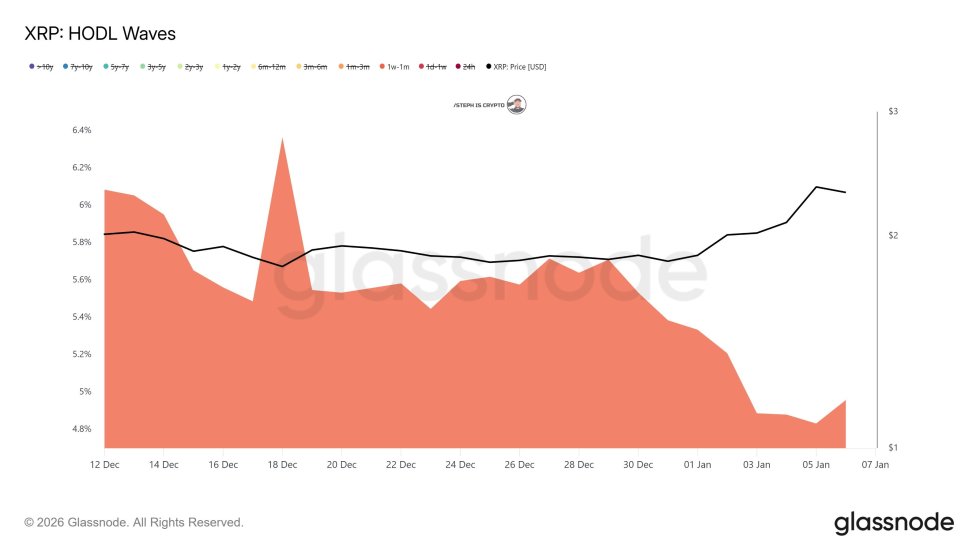
Source: Chart from Steph is Crypto on X

Steph is Crypto highlighted that the share of the total XRP supply held by these investors has fallen from 5.75 to 4.9% in just 7 days. While the pullback may seem small, the shift has the potential to reshape sentiment around the altcoin and its price dynamics in the upcoming weeks.

This is due to the fact that these investors are often one of the most reactive groups in the market. Once positions start to move into profit territory, the cohort tends to sell off their coins at a swift rate. With short-term holders going on a selling spree, the focus now is on whether institutional players and longer-term holdings will withstand the sell-side pressure.

However, while short-term players are exiting, large holders, also regarded as whales, are stepping back in at a significant rate. This implies that deep-pocket investors are exhibiting renewed conviction in the altcoin’s long-term prospects.

According to the report from Steph is Crypto, whales, particularly wallet addresses holding between 1,000,000 XRP and 100,000,000 XRP, recently acquired an additional 60 million XRP in a single day. After a period of relative quiet, the cohort seems to have moved back into accumulation mode.

Leading The Charge In Asia

Demand for XRP is growing in the Asian region, as a report from X Finance Bull shows that the altcoin dominated Bitcoin in South Korea. Data from Upbit reveals that the token was the most traded asset of 2025 across the most active retail market on Earth.

This is beyond price speculation. It is a testament to the altcoin’s increasing volume, liquidity, and usage. The XRP/KRW was ranked in the top spot most of the year, with Upbit executing over $1 trillion in trades. According to the expert, this is an important landmark because real markets reveal truth, and South Korea interacts with trades that work.

XRP trading at $2.1 on the 1D chart | Source: XRPUSDT on Tradingview.com

Preguntas relacionadas

QWhat on-chain data indicates a shift in sentiment among XRP short-term holders?

AThe XRP HODL Waves chart shows that the share of total XRP supply held by short-term holders (addresses that purchased in the past week and month) has fallen from 5.75% to 4.9% in just 7 days, indicating they are closing positions and reducing exposure.

QAccording to the expert Steph is Crypto, what is the potential impact of short-term holders reducing their XRP exposure?

AThe shift, while seemingly small, has the potential to reshape sentiment and price dynamics for XRP in the upcoming weeks, as this reactive group's selling can create sell-side pressure.

QHow are large holders, or 'whales', behaving differently from short-term holders regarding XRP?

AWhile short-term holders are exiting, whales (addresses holding 1M to 100M XRP) are stepping back in, acquiring an additional 60 million XRP in a single day, showing renewed conviction and moving into accumulation mode.

QWhat evidence from South Korea suggests growing demand for XRP beyond mere price action?

AData from the Upbit exchange shows that XRP/KRW was the most traded asset of 2025, with over $1 trillion in trades executed, demonstrating the altcoin's increasing volume, liquidity, and usage in a major retail market.

QWhat is the suggested primary reason for short-term holders closing their XRP positions?

AThe shift strongly resembles profit-taking and risk management from this cohort in response to the altcoin's recent choppy price action and weakening momentum, as they tend to sell swiftly once in profit.

Lecturas Relacionadas

Agents Take Over Traffic Distribution Power: What Are Tencent, ByteDance, and Alibaba Competing For?

In the race to dominate the AI era's entry point, China's tech giants—Tencent, ByteDance, and Alibaba—are aggressively deploying AI Agents to control the future of traffic distribution. Alibaba is pursuing a dual-track "closed loop + openness" strategy. Its Qianwen app is evolving into a super-Agent integrated across its ecosystem (Taobao, Alipay, etc.) to handle complex tasks like travel planning. Concurrently, it is opening its platform to external brands (Luckin Coffee, KFC) and has launched a B2B Agent platform, "Wukong," targeting enterprise automation. Its other flagship, Quark, aims to be an "AI super search box" for information and tasks. ByteDance is executing an omnipresent "sprawl strategy." Its Doubao app boasts over 300 million monthly active users and is evolving into a default AI entry point for daily life, with plans for paid versions and e-commerce integration. Its core weapon is the Kouzi platform, a visual "AI assembly factory" for developers to build custom Agents. ByteDance is also pushing hardware integration, collaborating on AI phones and developing smart glasses to embed Doubao everywhere. Tencent is playing its long-held "ultimate card" by quietly embedding an AI Agent directly into WeChat. This Agent, accessible via a swipe, can understand user commands and automatically execute tasks by calling upon WeChat's millions of mini-programs (e.g., finding and ordering coffee). This leverages WeChat's unparalleled 1.4-billion-user ecosystem to position the app as an AI-powered "service operating system," a move that could dramatically reshape the competitive landscape. The core battleground is shifting from competing for "user screen time" to competing to be the "default execution layer" for user intent. The business model is evolving from an "attention economy" to an "intent economy," where the Agent that can most efficiently fulfill a user's need gains control over service access and token flow. This represents a fundamental change in how users connect with digital services, making the fight for the Agent入口 (entry point) a pivotal moment for redefining industry leadership in the AI age.

marsbitHace 52 min(s)

Agents Take Over Traffic Distribution Power: What Are Tencent, ByteDance, and Alibaba Competing For?

marsbitHace 52 min(s)

From Banning Doubao to Embracing Honor: Why Did WeChat Suddenly 'Change Its Face'?

The article explores the sudden shift in WeChat's strategy towards AI assistants from mobile phone manufacturers, transitioning from strict opposition to active collaboration. For over a year, WeChat fiercely resisted attempts by phone AI assistants (like ByteDance's Doubao in late 2025) to control its features via GUI automation ("simulated clicking"), citing security and data control concerns. This stance created a significant barrier for system-level AI integration. Now, Tencent has initiated A2A (Agent-to-Agent) partnerships with major phone brands like Honor, Xiaomi, OPPO, and vivo. This model allows a phone's system AI (e.g., Honor's YOYO) to parse a user's voice command and send a structured request directly to WeChat's own internal AI agent via secure APIs. WeChat then executes the action (e.g., sending a message) and returns the result. The article attributes Tencent's "change of face" to strategic pressure. While leading in social app usage, Tencent trails rivals like ByteDance and Alibaba in standalone AI app popularity. WeChat, with its vast mini-program ecosystem, is Tencent's key asset for an AI comeback. The upcoming WeChat AI agent aims to handle tasks like booking and payments within the app. However, phone system assistants remain the primary AI entry point for most users. The A2A collaboration allows Tencent to extend WeChat's AI reach to this crucial system layer while maintaining control over its core functions and data. For phone manufacturers, embracing A2A is a pragmatic move. The GUI route proved unviable due to WeChat's blocks. A2A offers a compliant path to integrate a vital service, enhancing their AI assistants' usefulness. It allows them to focus on developing their own AI ecosystems for other services while cooperating on WeChat access. The collaboration is framed as a mutual, strategic necessity: Tencent gains a distribution channel, and manufacturers gain a key functionality. The partnership relies on a "dual authorization" mechanism for security, requiring both user and app consent for each action. While questions about long-term data privacy practices remain, experts note A2A is more secure and compliant than GUI automation. Ultimately, this cooperation is seen as a tentative, calculated truce. Tencent's long-term goal is to make WeChat an AI-powered "service OS." Phone manufacturers aim to make their system AI the central user interface. Their paths may converge or clash in the future, but for now, the A2A deal represents the opening chapter in the battle for the AI-era user入口, driven by necessity and strategic calculus on both sides.

marsbitHace 2 hora(s)

From Banning Doubao to Embracing Honor: Why Did WeChat Suddenly 'Change Its Face'?

marsbitHace 2 hora(s)

Trading

Spot
Futuros

Artículos destacados

Cómo comprar MOVE

¡Bienvenido a HTX.com! Hemos hecho que comprar Movement (MOVE) sea simple y conveniente. Sigue nuestra guía paso a paso para iniciar tu viaje de criptos.Paso 1: crea tu cuenta HTXUtiliza tu correo electrónico o número de teléfono para registrarte y obtener una cuenta gratuita en HTX. Experimenta un proceso de registro sin complicaciones y desbloquea todas las funciones.Obtener mi cuentaPaso 2: ve a Comprar cripto y elige tu método de pagoTarjeta de crédito/débito: usa tu Visa o Mastercard para comprar Movement (MOVE) al instante.Saldo: utiliza fondos del saldo de tu cuenta HTX para tradear sin problemas.Terceros: hemos agregado métodos de pago populares como Google Pay y Apple Pay para mejorar la comodidad.P2P: tradear directamente con otros usuarios en HTX.Over-the-Counter (OTC): ofrecemos servicios personalizados y tipos de cambio competitivos para los traders.Paso 3: guarda tu Movement (MOVE)Después de comprar tu Movement (MOVE), guárdalo en tu cuenta HTX. Alternativamente, puedes enviarlo a otro lugar mediante transferencia blockchain o utilizarlo para tradear otras criptomonedas.Paso 4: tradear Movement (MOVE)Tradear fácilmente con Movement (MOVE) en HTX's mercado spot. Simplemente accede a tu cuenta, selecciona tu par de trading, ejecuta tus trades y monitorea en tiempo real. Ofrecemos una experiencia fácil de usar tanto para principiantes como para traders experimentados.

265 Vistas totalesPublicado en 2024.12.13Actualizado en 2026.06.02

Cómo comprar MOVE

Discusiones

Bienvenido a la comunidad de HTX. Aquí puedes mantenerte informado sobre los últimos desarrollos de la plataforma y acceder a análisis profesionales del mercado. A continuación se presentan las opiniones de los usuarios sobre el precio de MOVE (MOVE).

活动图片