XRP Retests $1.29 Support: Is $2 Still in Play or Will LiquidChain Capture the Momentum?

bitcoinistPublicado a 2026-02-06Actualizado a 2026-02-06

Resumen

XRP is currently retesting a key support level at $1.29, a critical point that will determine whether it can resume its upward trajectory toward $2.00 or face a deeper decline. The recent pullback is seen as a healthy consolidation after a strong rally, driven by profit-taking and broader market volatility. Technical indicators suggest that holding above $1.25 could pave the way for a run to $1.96 and beyond, while a drop below $1.10 may lead to a fall toward $0.85. Regulatory developments, including potential SEC leadership changes and ETF approvals, remain central to XRP's bullish narrative. Meanwhile, LiquidChain ($LIQUID) is emerging as a high-risk, high-reward alternative, positioning itself as a cross-chain liquidity solution integrating Bitcoin, Ethereum, and Solana. Having raised over $529K in its presale, it aims to address fragmentation in DeFi through specialized Layer-3 infrastructure. While XRP's focus remains tied to regulatory clarity and institutional adoption, LiquidChain offers a speculative bet on the future of interoperable decentralized finance.

Trusted Editorial content, reviewed by leading industry experts and seasoned editors. Ad Disclosure

Quick Facts:

  • ➡️ XRP’s dip to $1.29 is a technical retest of support; holding here is key for a potential run toward $2.00.
  • ➡️ Regulatory clarity (post-SEC changes) remains the main driver, with ETFs as the next potential spark to unlock institutional flows.
  • ➡️ Losing the $1.10 level would invalidate the bullish view, likely opening the trapdoor to the $0.85 region.
  • ➡️ LiquidChain offers a high-risk, high-reward alternative, aiming to unify liquidity across Bitcoin, Ethereum, and Solana through specialized L3 infrastructure.

XRP hit a wall.

After a blistering rally that momentarily silenced years of regulatory suppression, the asset is retracing to the $1.29 level.

The-1 year chart looks abysmal, but this goes for pretty much the entire market as a whole.
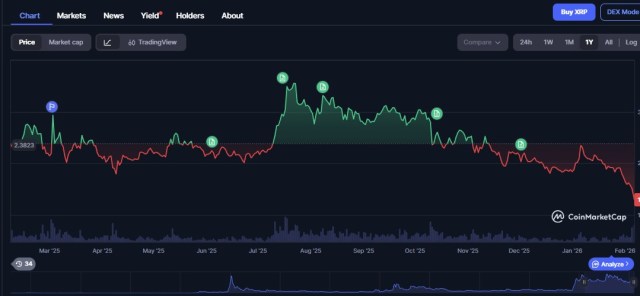
It’s a necessary cooldown. Traders are taking profit, and the market is digesting the broader implications of the impending SEC leadership change. While the dip has shaken out over-leveraged long positions, on-chain data suggests this isn’t a reversal, it’s likely just healthy consolidation.

What’s driving the volatility? A mix of macro rotation and simple technical exhaustion. The “regulatory relief” trade got crowded fast after the news of Gary Gensler’s potential exit broke.

Now, the market wants receipts, specifically, progress on the RLUSD stablecoin or confirmed ETF filings, to justify the next leg higher. This price action is a classic retest of previous resistance-turned-support. And frankly, that’s often exactly what an asset needs before attacking a psychological barrier like $2.00.

But crypto isn’t a zero-sum game between one asset and the dollar. As XRP churns, capital is starting to rotate into high-utility infrastructure plays solving different problems. Does XRP have the muscle to reclaim the $2 handle before year-end?

Or will liquidity siphon off into emerging Layer 3 protocols like LiquidChain ($LIQUID), which are positioning themselves (perhaps ambitiously) as the connective tissue of the next DeFi cycle?

$LIQUID is available here.

Technical Outlook: Why the $1.29 Retest Could Trigger a Run to $2

The drop to $1.29 puts XRP at a critical juncture.

This level lines up perfectly with the 0.382 Fibonacci retracement from the recent swing low, a high-probability zone for institutional accumulation. Even better, the Relative Strength Index (RSI) on the daily chart has reset. It dropped from ‘overbought’ (above 70) to a neutral 55, giving bulls room to maneuver without fighting immediate exhaustion signals.

Extended rallies need these cooling periods to build the structure for sustainable growth.

Fundamentally, the thesis for a $2 XRP remains intact, underpinned by the ‘SEC pivot’ narrative. With a pro-crypto administration likely taking the reins, the regulatory cloud that suppressed XRP price discovery for four years is finally lifting.

That changes the risk premium entirely. Plus, whispers of a Bitwise or Canary Capital ETF approval continue to circulate. If an XRP ETF application moves to the “acknowledged” phase, it could be the spark needed to shatter the $1.60 resistance wall.

Traders should monitor three distinct scenarios in the coming weeks:

  • The Bull Case: XRP holds support above $1.25, chops sideways for 5-7 days, then reclaims $1.50 on heavy volume. That validates $1.29 as a ‘higher low’ and opens the door to $1.96 and eventually $2.20.
  • The Base Case: We see a chop-fest. The asset trades in an accumulation range between $1.20 and $1.45, frustrating impatient retail traders while smart money absorbs supply.
  • The Bear Case (Invalidation): A daily close below $1.10 breaks the thesis. This invalidates the immediate bullish structure, risking a deeper flush down to the 200-day moving average near $0.85.

Keep an eye on volume. Declining volume on this pullback suggests the sellers are running out of steam, which favors the bulls.

LiquidChain Emerges as a High-Beta Alternative for Cross-Chain Liquidity

While XRP battles for dominance in cross-border payments, a different story is playing out in decentralized infrastructure. Investors hunting for high-beta opportunities, assets that tend to move faster than majors during a bull run, are looking at Layer 3 (L3) solutions.

That’s where LiquidChain ($LIQUID) comes in, pitching itself as a specialized fix for the fragmentation plaguing today’s multi-chain world.

Unlike XRP, which focuses on fiat-to-crypto bridging, LiquidChain operates as a ‘Cross-Chain Liquidity Layer.’ It fuses Bitcoin, Ethereum, and Solana liquidity into a single execution environment. The idea?

A ‘deploy-once’ architecture allowing developers to build apps that access users and capital across all three giants without the security risks of traditional wrapped assets. If interoperability becomes the theme of the next DeFi summer, this utility puts it in a prime position.

You can see the project’s early traction in the presale numbers. To date, LiquidChain has raised over $529K so far. The native token is currently priced at $0.01355, an entry level far below the established caps of legacy L1s. Join the presale here.
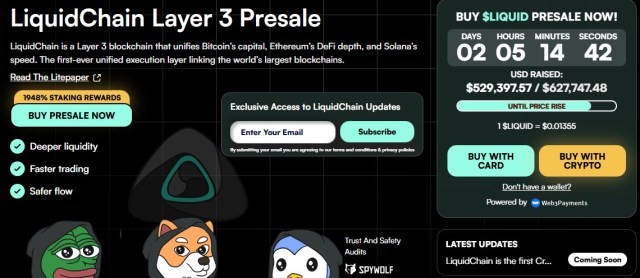
Moving from established majors like XRP to presale assets obviously carries risk. While LiquidChain offers a unified liquidity layer and verifiable settlement, it’s still early in its roadmap.

The potential for outsized returns comes with the usual dangers: regulatory uncertainty and the technical hurdles of executing a complex cross-chain VM. But for those with the stomach for it, the rotation into $LIQUID represents a bet on the plumbing that will power the next generation of dApps, distinct from Ripple’s payment-focused utility.

Buy $LIQUID here.

Disclaimer: This article is for informational purposes only and does not constitute financial advice. Cryptocurrency investments, particularly in presale projects and volatile assets like XRP, carry high risks. Readers should conduct their own independent research and consult with financial professionals before making investment decisions.

Editorial Process for bitcoinist is centered on delivering thoroughly researched, accurate, and unbiased content. We uphold strict sourcing standards, and each page undergoes diligent review by our team of top technology experts and seasoned editors. This process ensures the integrity, relevance, and value of our content for our readers.

patrubogdan

Follow

Full Profile

Related Posts

Bitcoin Teeters on Edge: Will $60K Hold or Is a V-Shape Recovery Imminent? $HYPER Keeps Pumping

Senator Lummis Urges Banks to Adopt Stablecoins Amidst CLARITY Act Delay, as Maxi Doge Turns Heads

$BTC Needs to Drop to $8K for Holdings Not to Cover Debt, Says Strategy, as $HYPER’s Presale Soars

Robinhood CEO Says Prediction Markets Will Soar as Bitcoin Hyper ($HYPER) Reaches $31.2M in Presale

Vitalik Buterin Cashes Out $6.6 Million In Ether After Early Signals

While Bitcoin And Ether Falter, XRP Optimism Stands Out: Analysts

Preguntas relacionadas

QWhat is the critical support level for XRP mentioned in the article, and why is it important?

AThe critical support level for XRP is $1.29. It is important because it represents a technical retest of previous resistance-turned-support and aligns with the 0.382 Fibonacci retracement level, making it a high-probability zone for institutional accumulation. Holding this level is key for a potential price run toward $2.00.

QAccording to the article, what is the main fundamental driver for XRP's price action?

AThe main fundamental driver for XRP's price action is regulatory clarity, specifically the potential changes at the SEC following Gary Gensler's anticipated exit. This 'regulatory relief' trade, along with the possibility of XRP ETF approvals, is seen as a major catalyst for unlocking institutional investment.

QWhat price level would invalidate the immediate bullish thesis for XRP?

AA daily close below the $1.10 level would invalidate the immediate bullish thesis for XRP. This break of support would likely trigger a deeper price decline toward the 200-day moving average, which is near $0.85.

QHow does LiquidChain ($LIQUID) differentiate itself from XRP in terms of utility?

ALiquidChain differentiates itself by focusing on cross-chain liquidity as a Layer 3 solution, whereas XRP focuses on cross-border payments. $LIQUID aims to unify liquidity across Bitcoin, Ethereum, and Solana through a 'deploy-once' architecture, allowing developers to build apps that access users and capital across all three chains.

QWhat was the amount raised in the LiquidChain presale and what is the current token price mentioned?

AThe LiquidChain presale had raised over $529,000 at the time of writing. The native $LIQUID token was being offered at a price of $0.01355 during its presale phase.

Lecturas Relacionadas

Annual Salary of Millions Competing for Electricians, Meta Rushes to Open Its Own Technical School

The AI boom is facing an unexpected bottleneck: a severe shortage of skilled construction workers and electricians. As tech giants like Meta, OpenAI, and Alphabet race to build massive data centers—such as OpenAI's $16 billion "Stargate" project—they are hitting a critical labor wall. The U.S. needs an estimated 130,000 more electricians, 240,000 construction workers, and 150,000 supervisors by 2030 for AI infrastructure alone, but tens of thousands of electrician jobs go unfilled each year. While AI companies offer high premiums, with electricians earning up to $280,000 annually, worker scarcity still causes massive losses—delays on a single project can cost $14.2 million per month. The complexity of building AI data centers, which require immense power (equivalent to powering hundreds of thousands of homes), sophisticated electrical systems, and advanced liquid cooling solutions, demands highly skilled technicians who are in short supply. To combat this, companies are investing heavily in training. Meta has committed $115 million to a free training school offering tuition, housing, and stipends, targeting 5,000 new workers. OpenAI is partnering with unions to secure skilled labor. These efforts are paying off, with a significant rise in Gen Z interest in trade schools over college. However, the power demands are staggering. AI data centers are driving a rapid surge in electricity consumption, projected to account for up to 12% of U.S. power use by 2028 and raising costs for consumers. Furthermore, the construction boom is project-based, leading to a potential future glut of trained workers once building peaks, which could depress wages industry-wide. The race for AI supremacy now depends as much on skilled hands as on advanced chips.

marsbitHace 1 hora(s)

Annual Salary of Millions Competing for Electricians, Meta Rushes to Open Its Own Technical School

marsbitHace 1 hora(s)

OpenAI No Longer Sells Its Most Expensive Model for Profit

OpenAI is shifting its business strategy away from promoting its most expensive, flagship models for every task. Recent price cuts—80% for GPT-5.6 Luna and 20% for Terra—signal a deeper change: the company now actively advises users that many tasks don't require the most powerful model. Instead, OpenAI recommends a tiered approach: use the high-end GPT-5.6 Sol for complex planning and analysis, then delegate execution to cheaper models like Luna. This mirrors moves by Anthropic, which recently launched Claude Opus 5 at half the price of its top model, Fable 5. Both companies are de-emphasizing flagship models as primary revenue drivers, using them instead for brand prestige and technological showcases. The industry is entering a "mass-market" phase, similar to automotive, where high-volume, cost-effective models handle daily operations and drive scale. OpenAI's price reductions are partly enabled by AI models themselves optimizing underlying code and infrastructure, creating a self-reinforcing cycle of efficiency gains and cost reduction. Competition is shifting from "who is smartest" to "who offers the best value." The goal is no longer selling individual models but fostering widespread API adoption and ecosystem lock-in. By making AI calls cheap and ubiquitous, companies like OpenAI aim to become the indispensable, utility-like infrastructure powering automated workflows—the "water and electricity" of software, quietly embedded everywhere.

marsbitHace 1 hora(s)

OpenAI No Longer Sells Its Most Expensive Model for Profit

marsbitHace 1 hora(s)

Trading

Spot
活动图片





