XRP Ledger Is A ‘Ghost Chain,’ Chainlink Community Liaison Claims

bitcoinistPublicado a 2026-03-17Actualizado a 2026-03-17

Resumen

Chainlink Community Liaison Zach Rynes sparked a debate by labeling the XRP Ledger a "ghost chain," arguing its core investment thesis has failed. He contends that XRP's proposed role as a global bridge currency has been overtaken by stablecoins and modern interoperability infrastructure, which institutions now prefer. Rynes criticized XRPL's low adoption in tokenized assets and stablecoins, stating USD stablecoins have become the dominant bridge asset. He also accused Ripple of socializing costs to XRP holders while privatizing gains for shareholders. XRP advocates, like lawyer Bill Morgan, countered that Ripple and XRPL are separate entities and defended Ripple's business structure. XRP price was $1.4757 at the time of reporting.

A fresh clash between XRP critics and defenders broke out on X after Chainlink Community Liaison Zach Rynes (@ChainLinkGod) argued that the XRP investment thesis has failed to keep pace with how crypto markets and financial infrastructure have evolved. His central claim was blunt: the XRP Ledger is now a “ghost chain,” while the use case once pitched for XRP as a bridge asset has largely been overtaken by stablecoins and broader interoperability infrastructure.

Rynes framed the dispute around what he called the long-running retail thesis behind XRP. “The bizarre retail thesis of XRP is that it will become the global reserve currency that everything trades against, the so-called ‘XRP standard,’” he wrote. “Rather than trading Dollars for Euros directly, you would trade USD for XRP, and then XRP for EUR, because this makes payments supposedly more efficient.”

He argued that XRP supporters prefer to describe this not as a bid for reserve-currency status, but as a narrower “bridge currency” role. In his view, that distinction does not materially change the argument. He said the larger problem is that the market structure envisioned by early XRP advocates was built in other ways over the past decade.

“The XRP vision was created over a decade ago before we had modern 200K TPS high-throughput chains, programmable smart contracts, DeFi protocols, fiat-backed stablecoins, tokenized deposits, atomic DvP/PvP swaps, and cross-chain infra,” Rynes wrote. “If you listen to what the world’s largest financial institutions and market infrastructures like Swift, DTCC, JP Morgan, BlackRock, and many others are saying, you’ll find zero of them talking about the need for a ‘bridge currency.’ Rather, they talk about the need for connectivity, interoperability, privacy, compliance, and orchestration.”

That critique extended to XRP Ledger’s position in tokenization and on-chain finance. Rynes said XRPL “will become the dominant chain for tokenized real world assets” remains a popular belief among XRP holders despite what he described as weak adoption metrics. He called XRPL “a ghost chain with less than 1% RWA market share and under 0.01% of stablecoins,” arguing that this makes the idea of XRPL emerging as the primary settlement layer difficult to defend.

He also pointed to stablecoins as the practical winner in the bridge-asset debate. According to Rynes, “USD-backed stablecoins have become the dominant crypto-native ‘bridge currency’ for payments, trading, and finance,” and the industry has already built “everything XRP was supposed to be, without XRP.” He cited Hyperliquid as an example of crypto-native finance where positions across multiple markets are effectively denominated against dollar-backed stablecoins rather than XRP.

The second half of his argument focused less on ledger design and more on Ripple’s business model. Rynes alleged that Ripple “socializes its costs to XRP holders and privatizes gains for its equity shareholders,” saying XRP sales fund products whose revenue accrues to Ripple rather than directly to token holders. He made the same point about RLUSD, writing that around 90% of its supply sits on Ethereum and other chains, which in his telling creates little to no direct demand for XRP itself.

XRP Community Fires Back

Not everyone in the thread accepted that framing. XRP advocate and lawyer Bill Morgan pushed back on Rynes’ comparison between token buybacks and equity buybacks, calling it “a false equivalence because a token is nothing like a share and has no rights attached it like a share.” He also rejected the idea that Ripple and XRPL should be treated as one and the same, writing that “Ripple does not own the XRPL which is a fully decentralised public permissionless Blockchain.”

Morgan argued that Ripple had opted for a different structure through Evernorth, which he described as an independent vehicle designed to acquire XRP and offer institutions regulated exposure. He said that model was preferable to Ripple itself running a reserve that could draw regulatory scrutiny, especially given how the SEC previously pointed to Ripple’s efforts to support XRP’s price in litigation.

At press time, XRP traded at $1.4757.
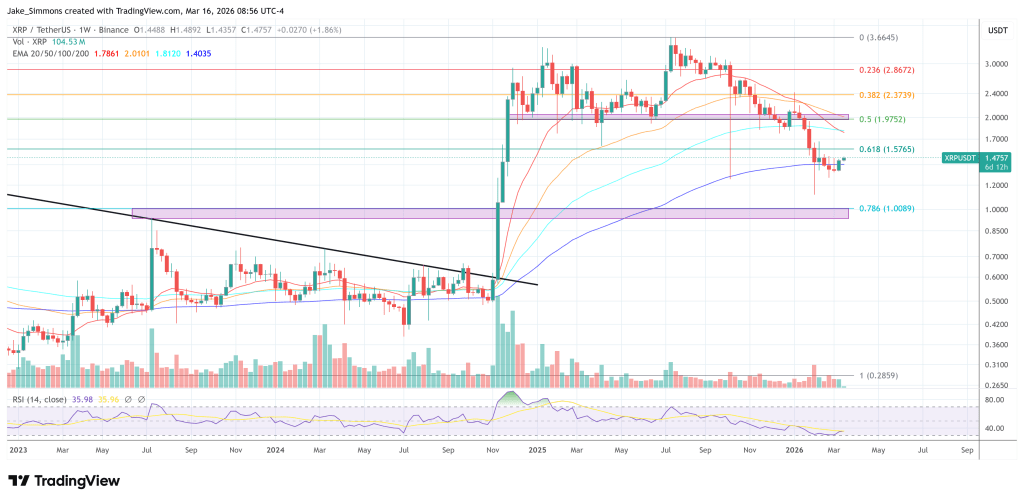
XRP rises back above the 200-week EMA, 1-week chart | Source: XRPUSDT on TradingView.com

Preguntas relacionadas

QWhat is the main criticism that Chainlink Community Liaison Zach Rynes makes about the XRP Ledger?

AZach Rynes criticizes the XRP Ledger as being a 'ghost chain' and argues that its original investment thesis as a bridge asset has been overtaken by stablecoins and modern interoperability infrastructure.

QAccording to Rynes, what has become the dominant 'bridge currency' in the crypto industry instead of XRP?

AAccording to Rynes, USD-backed stablecoins have become the dominant crypto-native 'bridge currency' for payments, trading, and finance.

QHow does Rynes describe the relationship between Ripple's business model and XRP holders?

ARynes alleges that Ripple 'socializes its costs to XRP holders and privatizes gains for its equity shareholders,' meaning XRP sales fund products whose revenue goes to Ripple rather than directly to token holders.

QWhat was Bill Morgan's key counterargument regarding the comparison between XRP tokens and company shares?

ABill Morgan argued that it is a 'false equivalence' to compare token buybacks to equity buybacks because a token is nothing like a share and has no rights attached to it like a share does.

QWhat reason did Bill Morgan give for Ripple using an independent vehicle like Evernorth instead of managing XRP directly?

AMorgan stated that using an independent vehicle like Evernorth was preferable to avoid regulatory scrutiny, especially since the SEC had previously pointed to Ripple's efforts to support XRP's price in litigation.

Lecturas Relacionadas

Trading

Spot
Futuros

Artículos destacados

Qué es XRP 2.0

XRP 2.0: Una Nueva Frontera en el Panorama de las Criptomonedas Introducción a XRP 2.0 En el siempre cambiante ámbito de las criptomonedas, nuevos proyectos surgen continuamente, compitiendo por atención y adopción. Una de estas iniciativas prometedoras es XRP 2.0, un nuevo proyecto de criptomoneda diseñado para aprovechar la tecnología blockchain avanzada y metodologías de encriptación robustas. Aunque el nombre establece paralelismos con el XRP de Ripple, es crucial señalar que XRP 2.0 opera de manera independiente, enfocándose en mejorar la seguridad de las transacciones, la privacidad y la escalabilidad. A medida que el panorama financiero digital abraza cada vez más soluciones descentralizadas, XRP 2.0 busca contribuir de manera significativa a web3 y a la expansión general de los proyectos de criptomonedas. ¿Qué es XRP 2.0? En esencia, XRP 2.0 es un proyecto de criptomoneda que busca crear un ecosistema de moneda digital seguro y descentralizado. Su tecnología fundamental integra principios avanzados de blockchain con técnicas de encriptación de vanguardia. El objetivo principal de XRP 2.0 es establecerse como una plataforma confiable y eficiente que permita la ejecución rápida de transacciones mientras prioriza la protección de la privacidad de sus usuarios. El proyecto se promociona como una solución a muchas limitaciones enfrentadas por las criptomonedas existentes, proponiendo un sistema que puede manejar un mayor volumen de transacciones con mejor velocidad y privacidad. Esta versatilidad posiciona a XRP 2.0 como un competidor significativo en un mercado plagado de diversas monedas digitales. ¿Quién es el Creador de XRP 2.0? La identidad del creador detrás de XRP 2.0 ha sido señalada como 'Wilbur.' Sin embargo, los detalles completos sobre Wilbur o su entidad asociada siguen siendo elusivos. La anonimidad de muchos creadores de criptomonedas no es un fenómeno poco común en la industria, a menudo diseñado para mantener un grado de privacidad y seguridad. ¿Quiénes son los Inversores de XRP 2.0? Hasta ahora, la información específica relacionada con las fundaciones o organizaciones de inversión que apoyan a XRP 2.0 no está disponible públicamente. En el sector de las criptomonedas, el respaldo de inversores respetables puede influir significativamente en la credibilidad y el éxito de un proyecto, sin embargo, la transparencia sobre los patrocinadores financieros de XRP 2.0 no se ha establecido. ¿Cómo Funciona XRP 2.0? XRP 2.0 se destaca al emplear una combinación de tecnología blockchain y algoritmos de encriptación avanzados que aseguran transacciones seguras y descentralizadas. Su estructura innovadora incluye características únicas diseñadas para fomentar el compromiso del usuario y ampliar las funcionalidades más allá de las transacciones convencionales de criptomonedas. Entre estas características, XRP 2.0 incorpora capacidades impulsadas por IA, como funcionalidades de texto a imagen y de texto a voz. Estas adiciones están diseñadas para mejorar la experiencia interactiva de los usuarios, promoviendo una mayor aplicabilidad en diversos sectores. Al unir avances tecnológicos con un diseño centrado en el usuario, XRP 2.0 busca captar la atención de una amplia gama de individuos y empresas que buscan integrar soluciones de criptomonedas en sus marcos operativos. Cronología de XRP 2.0 Entender XRP 2.0 requiere examinar los hitos que han definido su viaje hasta ahora: 23 de julio de 2023: Se presenta XRP 2.0 como un nuevo proyecto de criptomonedas, con el objetivo de revolucionar las capacidades de transacciones seguras y descentralizadas en el ámbito de blockchain. 8 de septiembre de 2023: Se lanza otro proyecto, XRP20, marcando la aparición de un token ERC-20 en la blockchain de Ethereum que no guarda relación con XRP 2.0. 13 de noviembre de 2023: El Libro Mayor de XRP experimenta una actualización significativa con el lanzamiento de la versión 2.0.0 del software del servidor rippled. Es esencial señalar que este desarrollo está desconectado del proyecto de criptomonedas XRP 2.0. Puntos Clave sobre XRP 2.0 Para destilar la esencia de XRP 2.0, surgen varios factores críticos: Características Únicas: La inclusión de características como texto a imagen y texto a voz impulsadas por IA diversifica aún más las aplicaciones potenciales de XRP 2.0. Tecnología Blockchain: El marco utiliza mecanismos avanzados de blockchain y protocolos de encriptación, asegurando un entorno seguro y descentralizado para las transacciones. Escalabilidad y Privacidad: XRP 2.0 prioriza la protección mejorada de la privacidad en los procesos de transacción y la escalabilidad necesaria para acomodar una base de usuarios creciente. No Afiliación con Ripple: Es importante destacar que, a pesar de su nombre, XRP 2.0 no tiene ninguna lealtad ni colaboración con el XRP de Ripple, diferenciando su marco operativo y objetivos dentro del ecosistema de criptomonedas. Conclusión XRP 2.0 representa una ambiciosa aventura en la esfera de las criptomonedas, buscando ofrecer una combinación de seguridad, privacidad y eficiencia en las transacciones digitales. Al integrar tecnologías sofisticadas y características amigables para el usuario, el proyecto se propone ampliar los horizontes de lo que la criptomoneda puede lograr en la economía digital de hoy. Si bien la anonimidad de su creador y la falta de inversores revelados pueden generar cuestionamientos para algunos, el enfoque de XRP 2.0 en funcionalidades avanzadas y descentralización realza su atractivo en un mercado de criptomonedas cada vez más abarrotado. A medida que el paisaje de las criptomonedas sigue evolucionando, XRP 2.0 podría emerger como un jugador crucial en la expansión de soluciones blockchain seguras y escalables.

174 Vistas totalesPublicado en 2024.04.05Actualizado en 2024.12.03

Qué es XRP 2.0

Cómo comprar XRP

¡Bienvenido a HTX.com! Hemos hecho que comprar XRP (XRP) sea simple y conveniente. Sigue nuestra guía paso a paso para iniciar tu viaje de criptos.Paso 1: crea tu cuenta HTXUtiliza tu correo electrónico o número de teléfono para registrarte y obtener una cuenta gratuita en HTX. Experimenta un proceso de registro sin complicaciones y desbloquea todas las funciones.Obtener mi cuentaPaso 2: ve a Comprar cripto y elige tu método de pagoTarjeta de crédito/débito: usa tu Visa o Mastercard para comprar XRP (XRP) al instante.Saldo: utiliza fondos del saldo de tu cuenta HTX para tradear sin problemas.Terceros: hemos agregado métodos de pago populares como Google Pay y Apple Pay para mejorar la comodidad.P2P: tradear directamente con otros usuarios en HTX.Over-the-Counter (OTC): ofrecemos servicios personalizados y tipos de cambio competitivos para los traders.Paso 3: guarda tu XRP (XRP)Después de comprar tu XRP (XRP), guárdalo en tu cuenta HTX. Alternativamente, puedes enviarlo a otro lugar mediante transferencia blockchain o utilizarlo para tradear otras criptomonedas.Paso 4: tradear XRP (XRP)Tradear fácilmente con XRP (XRP) en HTX's mercado spot. Simplemente accede a tu cuenta, selecciona tu par de trading, ejecuta tus trades y monitorea en tiempo real. Ofrecemos una experiencia fácil de usar tanto para principiantes como para traders experimentados.

1.3k Vistas totalesPublicado en 2024.12.10Actualizado en 2025.03.21

Cómo comprar XRP

Discusiones

Bienvenido a la comunidad de HTX. Aquí puedes mantenerte informado sobre los últimos desarrollos de la plataforma y acceder a análisis profesionales del mercado. A continuación se presentan las opiniones de los usuarios sobre el precio de XRP (XRP).

活动图片














